State Government

Alaska vowed to resolve murders of Indigenous people. Now it refuses to provide their names.

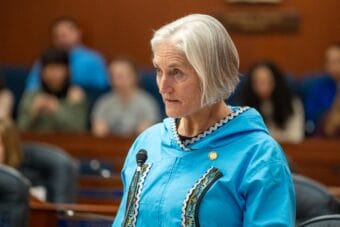
Charlene Aqpik Apok is the executive director of Data for Indigenous Justice, a nonprofit that requested a list of every Alaska Native murdered in the state over the past three years. The state said it doesn’t collect that information. (Marc Lester/ADN)

This article was produced for ProPublica’s Local Reporting Network in partnership with the Anchorage Daily News. Sign up for Dispatches to get our stories in your inbox every week.

Leaders in Alaska and elsewhere have repeatedly promised action in recent years to address the nation’s chronic failure to solve the murder or disappearance of Indigenous people.

Federal legislation backed by Alaska Sen. Lisa Murkowski called for improving data collection and information sharing among law enforcement and tribes. Gov. Mike Dunleavy said again and again and as recently as May 5 that the state government would work with Alaska Natives to address the crisis.

“My administration will continue to support law enforcement, victim advocacy groups, Alaska Native Tribes and other entities working together to solve these cases and bring closure to victims’ families,” Dunleavy said in a news release last year.

Yet when an Alaska Native group asked state law enforcement officials in June for one of the most fundamental pieces of data needed to understand the issue — a list of murders investigated by state police — the state said no.

Charlene Aqpik Apok launched Data for Indigenous Justice in 2020 after trying to collect the names of missing and murdered Indigenous people to read at a rally, only to discover no government agency had been keeping track. Over time, the nonprofit built its own homegrown database with the help of villagers, friends and family across the state.

In 2023, the state started publishing a list quarterly with names of Indigenous people reported missing. But the state still does not issue a list for the other key piece of the group’s efforts: Indigenous people who have been killed.

So on June 4, the nonprofit filed two public records requests with the Alaska Department of Public Safety concerning homicide cases the agency had investigated since 2022. The group asked first for victims of all races and then for those identified as Alaska Native.

Apok said she didn’t think the request was controversial or complicated.

But the state rejected the requests a week later. The agency said fulfilling the request would take “several hours” and cited a state regulation allowing a denial if providing information to a requester would require employees to “compile or summarize” existing public records.

“We do not keep lists of victims of any type of crime, including homicide victims, and to fulfil this request DPS would have to manually review incident reports from multiple years to create a record that matched what you are looking for,” Austin McDaniel, communications director for the department, wrote to the nonprofit.

McDaniel offered no direct response when the Anchorage Daily News and ProPublica asked why the agency could not retrieve homicide records with a simple database query or why, even if the work required manual review and wasn’t required under state law, the agency didn’t simply create a list of homicide victims.

(Alaska’s public records law says any records that take state employees fewer than five hours to produce shall be provided for free, and the state can choose to waive research fees if providing records would serve the public interest. Even if an agency needs to create a new record, as McDaniel asserted in his denial, it’s allowed to “if the public agency can do so without impairing its functioning.”)

Data for Indigenous Justice appealed the denial to the head of the department, Public Safety Commissioner James Cockrell, who decided in favor of the agency.

The nonprofit’s records request and the state’s denial revealed that Alaska, four years after creating a council on murdered and missing Indigenous people, cannot readily identify murder cases involving Indigenous victims. The state now employs four investigators who focus on such cases.

“How do they know which cases are Alaska Native or Indigenous people for their MMIP investigators if they cannot do a simple pull of the demographics that we are talking about?” Apok said.

Apok said tracking complete and accurate data on Indigenous people who have disappeared or been killed matters because otherwise, law enforcement can shrug off individual cases and deny the scale of the problem.

“That’s the power of data. That’s the power of collective information,” she said.

Grace Norton holds a photo of her niece, Ashley Johnson-Barr, who was murdered in Kotzebue, Alaska, in 2018. Kotzebue residents walked along Shore Avenue and scattered rose petals in remembrance of missing and murdered Indigenous people in 2023. (Marc Lester/ADN)

In lieu of answering detailed questions for this story, McDaniel provided a one-page response saying that the department receives thousands of records requests each year. He said the agency is a “leader in data transparency” for missing and murdered Indigenous people, adding that “to imply that we are not invested in this work due to the denial of one records request from an advocacy group is absurd.”

He cited as examples of transparency the department’s publication of information about missing Indigenous people and its provision of law enforcement data to tribal governments in support of their requests for federal grants.

Anchorage, which runs the state’s largest municipal police department, recently reversed a policy that withheld the identities of certain homicide victims. The police chief released the records after Daily News reporting revealed the policy had no basis in law and was opposed by some victims’ rights advocates.

State troopers, meanwhile, handle about 38% of all murders in Alaska, according to statistics that law enforcement reports each year. From 2019 to 2023, the most recent data available, troopers investigated an average of 22 murders each year. That means the agency would likely need to review just a few dozen reports to provide the requested names.

Watershed reports published in Canada in 2017 and by the Seattle-based Urban Indian Health Institute in 2018 revealed the scope of the crisis of missing and murdered people from Indigenous communities.

Those reports, Apok said, “named exactly what a lot of us were seeing and feeling, where we didn’t know our experiences were part of a larger collective.”

In 2021, Data for Indigenous Justice published the first report on the crisis in Alaska, highlighting the failure of media and local governments to gather data on cases of missing and murdered people to analyze patterns. A council appointed by Dunleavy even relied on Apok’s findings — including her conclusion that little data is available — when trying to describe the scope of the problem.

Dunleavy and Murkowski have been vocal on the issue in the years since.

A spokesperson for the governor did not respond to emailed and hand-delivered questions about the state’s failure to provide names of homicide victims to Apok’s group. Told of the decision not to release the names, Murkowski’s office said the senator was unavailable for an interview and offered no comment on the state’s actions.

Apok said her group will continue making public records requests to the state while building its own database through community connections.

“We’re going to keep doing what we do,” she said. “People will keep telling us names.”

Roses are piled at the conclusion of a ceremony to remember missing and murdered Indigenous people in Anchorage in 2023. The event coincided with Missing or Murdered Indigenous Persons Awareness Day, for which events were held nationwide. (Marc Lester / ADN)

Dunleavy says he won’t call Alaska lawmakers into another special session this year

Alaska Gov. Mike Dunleavy (center, red tie) stands with members of the Alaska Legislature on Thursday, Aug. 28, 2025, at the Alaska Oil and Gas Association’s annual convention in Anchorage. (Photo by James Brooks/Alaska Beacon)

In a Friday letter to the leaders of the Alaska House and Senate, Gov. Mike Dunleavy said he will not call lawmakers into a special legislative session when the current one expires at the end of Sunday.

“I write today to inform you that I will not be extending the current special session,” Dunleavy’s letter begins.

Officially, Dunleavy called the session in hopes that legislators would take up education policy legislation and his proposal to create an independent Alaska Department of Agriculture.

The agriculture issue remains unresolved amid a dispute over executive power and appears headed to the court system.

Lawmakers rejected the governor’s education ideas during this spring’s regular session and declined to take them up during the special session, something Dunleavy called “disappointing” in his letter.

Unofficially, lawmakers and political observers believe the governor called the session to force an early vote on his decision to veto millions of dollars of public school funding. Because not all lawmakers were expected to attend the session, it was expected that an early vote would increase the odds that Dunleavy’s veto would stand.

Instead, through extraordinary actions, 59 of 60 legislators were present on the first day of the special session and overrode Dunleavy’s veto. It was the first time since 1987 that Alaska legislators reversed a sitting governor’s budget veto.

After the override, legislators left Juneau and have not held a meeting in the Capitol since.

An education funding task force, created before the special session, has met once, but lawmakers have not taken up education policies the governor prefers, including legal changes that could lead to an increase in the number of charter schools statewide.

In his letter, Dunleavy said that if he does not see progress on his education policies next year, “I am prepared to call additional special sessions, in both duration and number, until we see substantive steps taken to improve Alaska’s education system.”

“That’s his right,” said Senate President Gary Stevens, R-Kodiak. “He can call us into as many special sessions as he wants. Of course, we’re not going to waste time and money. We’ll meet and see where we go.”

Next year is an election year, and the Alaska Constitution prohibits legislators from campaigning while the Legislature is in session.

Calling a special session could keep incumbent lawmakers from raising money or holding campaign events.

“That would be an impact,” Stevens said, “but you know, he has more of his followers running — or as many as people who are opposing his ideas on education. So, it could really hurt his friends more than his enemies.”

In a news conference with reporters after the veto override, Dunleavy said he was considering a special session in September or October to discuss long-term measures intended to bring state revenue and expenses in line.

That’s now off the table.

“The fiscal plan is moving forward. I would expect it to be ready for the 2026 session,” said Jeff Turner, the governor’s communications director.

Another aspect of the special session will linger and may not be resolved short of the court system.

At the start of the special session, Dunleavy issued an executive order setting up the Department of Agriculture.

Lawmakers refused to take up the order, saying they believe it is unconstitutional to issue an executive order during a special session, and they believe it is unconstitutional to reissue one that has already been rejected.

The governor has declined to withdraw the executive order and has said he plans to consider it effective unless lawmakers vote it down.

Legislators are unwilling to vote it down, because doing so would be an implicit recognition of the governor’s right to issue an order during a special session.

The dispute remains unresolved as the special session ends.

At oil conference, Dunleavy declines to endorse his lieutenant governor as his replacement

Alaska Gov. Mike Dunleavy, at right, speaks during the 2025 Alaska Oil and Gas Association conference in Anchorage, on Thursday, Aug. 29, 2025. (Photo by James Brooks/Alaska Beacon)

A year before Alaska’s 2026 primary election, 10 candidates have already announced their intent to run for governor, and more are expected to announce campaigns in the coming months.

Incumbent Gov. Mike Dunleavy is term-limited and unable to run himself, and with so many people in the race, there is no clear front-runner.

During a question-and-answer session at this week’s Alaska Oil and Gas Association conference in Anchorage, Dunleavy was asked who he supports.

Among the confirmed candidates are Dunleavy’s lieutenant governor, Republican Nancy Dahlstrom, and his former revenue commissioner, Adam Crum. His former attorney general, Treg Taylor, is also expected to enter the race.

But given the opportunity to endorse any or all of them, Dunleavy didn’t name any specific candidate as his preference and spoke only in generalities.

“Who do you want to replace you as governor?” asked the event moderator.

“Somebody taller than me,” Dunleavy said to laughter. “No, I’m kidding. … Somebody that believes in Alaska like you do and like I do. You’ve got to be on a mission, right?”

Dunleavy said he believes any governor faces distractions and nay-sayers, people who will oppose projects and a governor’s efforts.

“I would hope that whoever is the next governor has a mission to continue the good things that are happening for the state, continue to work with the Trump administration, because I’ll be gone,” Dunleavy said, alluding to President Donald Trump’s efforts to increase mining, logging and oil and gas drilling in Alaska.

“There’ll be two more years, at least, of President Trump, and hopefully someone after him in a similar vein, who wants to keep this going for the country. So whoever you talk to that’s running for governor, ask them what their mission is. If they balk, or they look up at the sky or they think about it, that’s a concern,” the governor said. “Getting things across the finish line, getting things across the finish line, is the most important thing.”

After the governor’s remarks, deputy press secretary Grant Robinson said by email that the governor’s statement about “at least” two more years was “nothing more than an approximation of the time remaining in the President’s term.”

The 22nd Amendment of the U.S. Constitution prohibits someone from being elected President more than twice.

Dunleavy’s own political future is also in question. On Thursday, Fox News, citing unnamed sources, said the governor is considering whether to run against Sen. Lisa Murkowski, R-Alaska, when her current term expires in 2028.

The Fox News report could not be immediately corroborated, but Murkowski herself has said she may leave the Senate. In interviews earlier this month, she declined to rule out a run for governor in 2026.

In addition to Crum and Dahlstrom, seven other Republicans have filed documents for a campaign: former state Sen. Click Bishop of Fairbanks; current state Sen. Shelley Hughes of Palmer; 2022 write-in governor candidate Bruce Walden of Palmer; Matanuska-Susitna Borough Mayor Edna DeVries; podiatrist Matt Heilala of Anchorage; former teacher James William Parkin IV of Angoon; and business owner Bernadette Wilson of Anchorage.

Former state Sen. Tom Begich of Anchorage is the only Democratic candidate to have filed paperwork for a candidacy, and no independents have entered the race so far.

Gov. Dunleavy names Stephen J. Cox as Alaska’s next attorney general

Stephen J. Cox has been named by Alaska Gov. Mike Dunleavy to serve as the state's next attorney general.
Stephen J. Cox has been named by Alaska Gov. Mike Dunleavy to serve as the state’s next attorney general. (Alaska Department of Law)

Gov. Mike Dunleavy has named Stephen J. Cox to be Alaska’s next attorney general.

Cox is a member of the Federalist Society, a conservative legal organization, and has experience in the public and private sector.

During his first term, President Donald Trump appointed Cox in 2020 to be the U.S. Attorney for the Eastern District of Texas, after having served as a deputy associate attorney general in Trump’s Justice Department for about three years.

Most recently, Cox was a senior vice president for Bristol Bay Industrial, a subsidiary of Bristol Bay Native Corporation.

“From his service in the U.S. Department of Justice to his leadership on complex work here in Alaska, Stephen has demonstrated a wide breadth of experience and steadfast dedication to the rule of law,” Dunleavy said in a written statement.

Cox replaces Treg Taylor, who announced his retirement earlier this month. Taylor, Dunleavy’s third attorney general, is widely expected to be a Republican candidate for governor.

Dunleavy’s first two attorneys general both left office in disgrace.

Kevin Clarkson resigned in August 2020 after allegations that he sent unwanted text messages to a younger female state worker.

Clarkson was replaced by Ed Sniffen, who resigned 11 days after his January 2021 appointment. Sniffen’s resignation came following inquiries from the Anchorage Daily News and ProPublica over allegations of sexual misconduct with an Anchorage high school student three decades earlier.

Cox said in a statement that he’s worked on Alaska issues since 2011 and feels blessed to live in the state full-time.

“The duties are broad, but the role of the Attorney General begins and ends in Alaska and with its people,” Cox said. “It is a privilege to step into this role, and I am committed to serving with fairness and justice.”

Cox is set to start in his position Friday, Taylor’s last day.

Cox’s appointment is subject to approval by the Alaska Legislature, which is set to gavel in to its next session in January.

As the end of the special session nears, the governor mulls calling another

Speaker of the House Bryce Edgmon, a Dillingham Independent, speaks to a nearly empty floor at the Alaska State Capitol on Tuesday, Aug. 19, 2025. (Photo by Clarise Larson/KTOO)

Gov. Mike Dunleavy’s 30-day special session ends this weekend and lawmakers don’t plan to meet at the Capitol again. But, the governor left open the possibility of calling another special session. 

“We’re having a discussion, I’ll let you know,” he said during a press briefing in Anchorage on Wednesday. 

Dunleavy’s statement comes after House leadership notified Representatives on Wednesday that a technical session scheduled for Sunday morning — the last day of the special session — was canceled. 

The governor originally called the session earlier this summer with a plan for lawmakers to consider his education reform policies and to create a new state Agriculture Department. 

Neither happened. Instead, lawmakers convened and overrode two of his vetoes, including restoring more than $50 million in state funding for public schools and strengthening the authority of the legislative auditor.

Instead of adjourning, lawmakers decided to keep the session open to prevent Dunleavy from calling lawmakers back into session. 

The Legislature briefly gaveled in and out for a technical session midway through August and a total of five lawmakers showed up. They took no action and adjourned in less than a minute.

In a statement on Wednesday, the governor’s communications director, Jeff Turner, called the Legislature’s actions disappointing. 

A group of state lawmakers kicked off a Task Force on Education Funding on Monday. The aim of the 18-month-long study is to examine Alaska’s public schools and find areas of improvement. 

As Alaska Legislature convenes education task force, lawmakers have different views of where to go

Students begin their first day of school at the Tlingit Culture, Language and Literacy program at Harborview Elementary School in Juneau on Aug. 15, 2025 (Photo by Corinne Smith/Alaska Beacon)

The Alaska Legislature opened an 18-month study of the state’s troubled public education system on Tuesday as lawmakers convened the first meeting of their Task Force on Education Funding, established by law this spring.

Alaska’s public schools rank among the worst in the country according to national standardized testing data, and members of the bipartisan, bicameral task force have been charged with identifying ways to improve performance by changing the way schools are funded and manage their students.

Legislative leaders have said the task force will also have the opportunity to examine funding for schools and ways to address rising costs of transportation, utilities, insurance and maintenance.

Members of the task force will hold a series of hearings and discussions before drafting recommendations for new laws that legislators might implement. Those recommendations must be delivered before lawmakers arrive at the Alaska Capitol in January 2027.

Gov. Mike Dunleavy called legislators into a special session to address education issues, but lawmakers have ignored that call and are not planning to hold formal meetings before the special session ends at the end of the month. Legislative leaders have said they prefer to work through the task force instead.

Dunleavy is term-limited and will be out of office by the time the task force’s recommendations are complete.

“The current state of Alaska’s education is not where we’d like it to be, but I know that we can get to a better place if we all work together, we find common ground, and we build upon what we agree upon,” said Sen. Löki Tobin, D-Anchorage and co-chair of the task force.

But on Monday, it appeared that finding that common ground could be difficult, as task force participants identified different areas they prefer to focus upon.

“John Muir said that when we try to pick out anything by itself, we find it hitched to everything else in the universe. The same is true in education,” said Rep. Rebecca Himschoot, I-Sitka. If we take steps to improve teacher quality, that has an impact on the classroom. If we take steps to make sure kids are fed, that has an impact. If we take steps to make sure that we have the right ratios of teachers with students. All of these things have impacts.”

Rep. Justin Ruffridge, R-Soldotna, said he would like the task force to consider how it measures results. What standardized tests, if any, should be used to consider performance?

“I think accountability broadly is a place that I hope to go, and I hope that the (Alaska Department of Education and Early Development) can have some input on that,” he said.

Sen. Jesse Kiehl, D-Juneau, suggested that the task force should be “looking at how we empower local government” to deal with education decisions, while Sen. Mike Cronk, R-Tok, said he wants to make sure the task force is “focusing on policies like the READS Act,” which was a bipartisan bill intended to improve reading performance among younger students.

“We are seeing success in that, and those are the kind of policies we need,” he said.

This year, lawmakers voted to increase the base student allocation, core of the state’s per-pupil funding formula, but Ruffridge suggested that lawmakers need to examine other aspects of the formula to see whether they are delivering the intended results.

Alaska, for example, multiplies the base student allocation for students with “intensive needs” and those in rural Alaska.

“It’s a scary proposition to open up the foundation formula, but I think it’s something that we are really tasked with doing in this group,” he said, adding that the state has failed to properly maintain school facilities, particularly in rural Alaska.

Cronk, in prior comments, said he also is concerned about school maintenance. In most of Alaska, proper maintenance depends on funding from the state government.

“If we want to continue to have (stable) education funding, us as a collective group need to create a fiscal plan for this state,” he said.

“I’m hoping that if we’re talking about funding, that should be our goal as part of this, to make sure that we can come up with something so we do have a level funding for all the government services,” Cronk said.

legislative task force in 2021 did draft a long-term state plan to bring expenses and revenue into balance, but lawmakers have not adopted any legislation suggested by that task force.

The next meeting of the education task force is scheduled for Oct. 30 in Juneau.

Site notifications
Update notification options
Subscribe to notifications