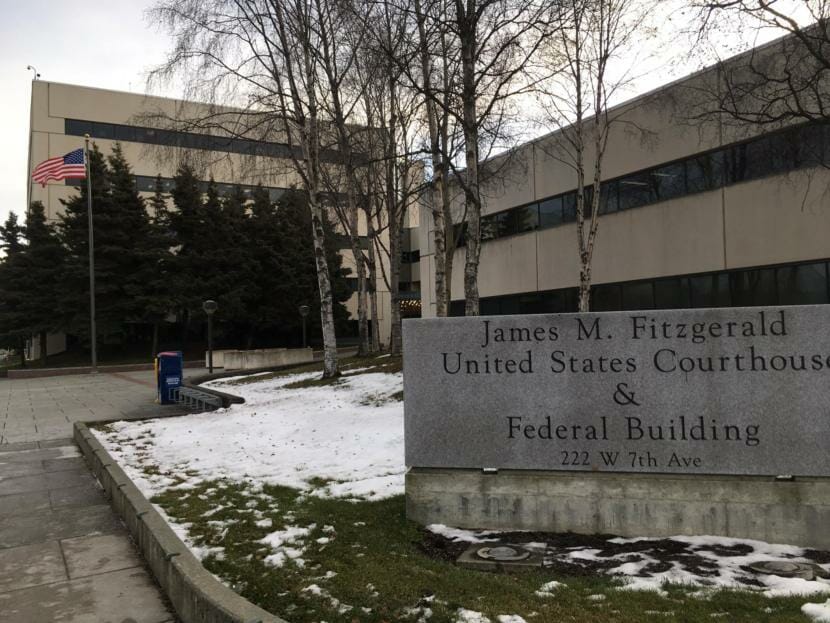
The United States Courthouse and Federal Building in downtown Anchorage. (Photo by KDLG)
A federal trial began Monday in Anchorage for a class-action lawsuit against the Alaska Office of Children’s Services on behalf of all kids in OCS custody.
Marcia Lowry, an attorney and director of a national nonprofit advocating for foster reforms, said the organization is helping with this lawsuit because Alaska’s foster system has some of the worst outcomes in the country.
“They have a very, very high maltreatment rate,” Lowry said. “They do not have the kids visited every month. That’s a federal requirement children have to be visited, because how else can you know whether a child is safe when you put a child in a foster home?”
The complaint alleges OCS caseworkers have too many cases to be able to adequately serve families and that the agency has failed to place Alaska Native foster children in culturally appropriate placements, violating the Indian Child Welfare Act.
Former foster youth testified Monday that under OCS care, they moved placements frequently, missed school because of instability and experienced abuse and assault when they were placed in foster homes and hotels.
OCS director Kim Guay also took the stand Monday. She said all OCS employees are working to make positive changes in the system and that the agency has taken steps to increase recruitment and improve training.
Margaret Paton-Walsh, assistant attorney general for the state, is defending OCS in the trial. She said running the foster care system in Alaska is challenging.
“It’s especially hard in Alaska because of the size and the remoteness of so many of the communities, and we are doing the best that we can to manage the challenges that we have,” Paton-Walsh said. “And there are definitely challenges. Nobody is denying that. And I think critically in this context, we have a very, very severe caseworker shortage.”
Guay also repeatedly pointed out on the stand that OCS is only one piece of the child welfare system.
Alaska coho salmon cooks on the Crush Bistro grill on August 22, 2025. (Marc Lester/ADN)
Amid the hubbub of President Donald Trump and Russian President Vladimir Putin’s Alaska summit last week, Gov. Mike Dunleavy, posting on social media, posed a provocative question.
“Alaska is a leader in fresh caught wild salmon. We could also be a leader in the farmed salmon industry. Why not do both instead of importing farmed salmon from Scotland?,” he wrote, sharing an article about the value of fish farming in Scotland, where Atlantic salmon are raised in net pens in the ocean. “This would be a great opportunity for Alaska.”
The answer from scientists, wild salmon advocates, restaurant people and regular salmon-eating Alaskans has come swiftly, full of alarm and often along the lines of one of the early commenters on his post, who wrote, “Are you insane?”
Love for wild salmon cuts through partisan politics. No food is more important to the state’s culture, diet, identity and economy. As such, Alaskans don’t look kindly on farmed fish. It’s tough to find it in stores and few, if any, restaurants serve it. Farming salmon and other finfish has been banned since 1990 over concerns about environmental threats to wild stocks and economic competition. But Dunleavy, who has become increasingly interested in Alaska’s food security since the pandemic, is curious about bringing in fish farms.
Canadian organic farm-raised king salmon filets at a store in Fairfax, Va. (AP Photo/Alex Brandon/File)
Last legislative session, his office introduced a bill that would authorize land-based farming of non-salmon species like trout or tilapia. That bill faced an avalanche of opposition in committee. But his recent post went further, signaling a shift feared by fisheries advocates, from a narrow focus on land-based farms to a broader look at farming salmon, the vast majority of which happens in net pens in the ocean.
A number of people sent the governor’s post on the social media platform X to state Rep. Louise Stutes, a Republican from Kodiak. Last session she chaired the House Fisheries Committee, which heard the fish farming bill.
Alaska’s politicians should be focusing all their energy on shoring up the state’s fishing industry, she said. In recent years the fishing sector has been upended by global politics, market fluctuations and weak runs.
“Introducing farmed salmon into coastal waters, to me, is just an unacceptable risk,” she said. “It’s outrageous to think that we could become a leader in farmed salmon.”
She said it was very unlikely the bill would find the support it needs.
Dunleavy, in an interview this week, said he is always looking for economic opportunities, including fish farms.
“The article came up, and I figured I’d post it just to see what the response is, not to irritate people, but just to see what the response is,” he said.
He anticipated it would stir criticism, he said.
“The problem is, and I’ll be quite frank, is it gets very emotional. It makes it difficult to have a conversation,” he said. “Quite frankly, it’s tough to have a conversation about a lot of topics today, it’s tough to have a conversation where facts can be the decider.”
Fish farming could be done in concert with wild salmon fishing, he said.
“Does that then mean that wild-caught is done? I don’t believe it does. I think, actually, wild-caught is an amazing brand,” he said.
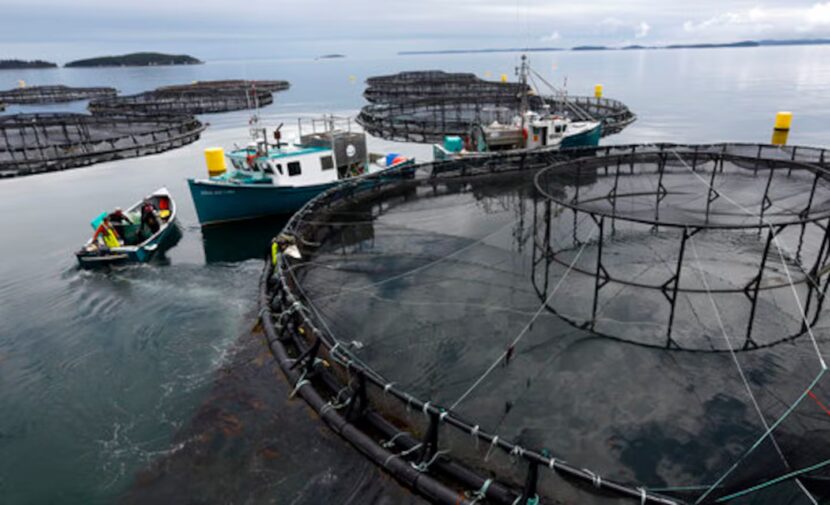
In this Thursday, July 13, 2017 photo, workers position their boats at a Cooke Aquaculture salmon farm near Blacks Harbour, New Brunswick, Canada. (AP Photo/Robert F. Bukaty)
Dunleavy didn’t have a specific plan for how salmon in Alaska might be farmed, he said. Land-based salmon farming, something some environmental groups support, is being tried in a few markets but can be cost-prohibitive. There are concerns over open-net pens that need to be addressed, he said, as well as concerns about what species of salmon might be raised.
Salmon is the second-most popular seafood in the country, just behind shrimp, and roughly 75% to 80% of the salmon Americans eat is farmed Atlantic salmon. Atlantic salmon in the wild have almost disappeared due to overfishing and they cannot be fished commercially. Alaska provides the lion’s share of the wild salmon in the country’s fish markets. But in the world, Dunleavy pointed out, Russia provides the largest share of salmon. Farming fish might be a way for Alaska, and the U.S., to occupy a larger position in that marketplace, he said.
“What I’ve said is, basically, is the discussion worthwhile that Alaska has today, in 2025, to visit the idea of Alaska being part of that game of a new sector?” he said.
At-sea fish farming has gotten cleaner in recent decades, thanks to advances in technology and feeding practices that minimize the impacts of effluent, said Caitlyn Czajkowski, executive director of the National Aquaculture Association, a Florida-based aquaculture trade association.
“There’s a lot of things about the ocean that we know now that we didn’t know 20 years ago,” she said.
Some non-salmon operations also now farm fish that are genetically sterile, so that if they escape, they can’t mix with local populations. That technology is still under development for salmon, however. There are a number of places that used to have commercial salmon fisheries in the Atlantic region, including Maine, Canada and a number of European countries that now farm Atlantic salmon. There isn’t another place, like Alaska, where salmon farming is happening in tandem with a robust wild salmon fishery, Czajkowski said.
At Crush Bistro, a high-end restaurant in downtown Anchorage bustling with tourists this week, Rob DeLucia, owner and general manager, said he was dumbfounded by the governor’s post. Guests come into the restaurant every night and say they came to Alaska for two reasons: to see Denali and to eat wild fish, he said.
“It is crystal clear when you get a piece of salmon at a restaurant in Alaska, that thing was swimming around in the last couple of days out in the wild blue ocean, and now we’re going to have guests be like, ‘Well, is this farmed or is this wild?’” he asked.
Atlantic farmed salmon, from a culinary standpoint, is inferior in taste and texture, he said. It made no sense to promote it.
“(Dunleavy) should have his Alaskan card revoked,” DeLucia said.
Crush Bistro executive chef Rob Lewis prepares a current special, grilled Alaska coho salmon with zucchini strings, cauliflower puree, spinach pesto, smashed fingerling potatoes, smoked tomato vinaigrette and dehydrated kalamata olives. (Marc Lester/ADN)
Melanie Brown is a Bristol Bay fisherwoman and outreach director at SalmonState, an organization that advocates for wild salmon. She penned a recent editorial against fish farming and was unsurprised by Dunleavy’s post about farming salmon.
Open net pens cause pollution from fish waste and medications, which hurts wild fish, she said. The farmed fish also eat a meal made from other fish — often anchovies caught in developing countries, where there are concerns about overfishing and the local food supply.
She bristled at the way fish farming undermines the preciousness of wild fish, which are particularly important in Alaska Native culture. She often tries to explain the importance of Alaska’s fisheries in Native communities by comparing fishing to a school, where people pick up essential skills, and a church, which brings fellowship with a community and a connection to something larger, and a museum, where people learn about history and culture and craft, she said.
“It’s so much more than money and it’s so much more than food,” she said.
Michelle Stratton, a fish biologist who heads the Alaska Marine Conservation Council, which represents fishermen and scientists, was outlining a blog response to the governor‘s post Wednesday while her commercial setnet soaked off Kodiak Island.
“Farmed salmon collapsed prices once already, spreads disease and pollution, and risks erasing the Wild Alaska brand that fishermen depend on,” she wrote in an email. “Other regions are shutting fish farms down; replacing our wild advantage with farmed salmon would be a grave mistake.”
Dunleavy noted that he’s got a little more than a year left in office and may not have success with his fish farm bill in that time. He hoped his successor would convene a conversation among fishermen, chefs and others involved with salmon about how to farm fish while protecting the wild-caught brand.
“I think you can,” he said. “I think there’s ways to do it.”
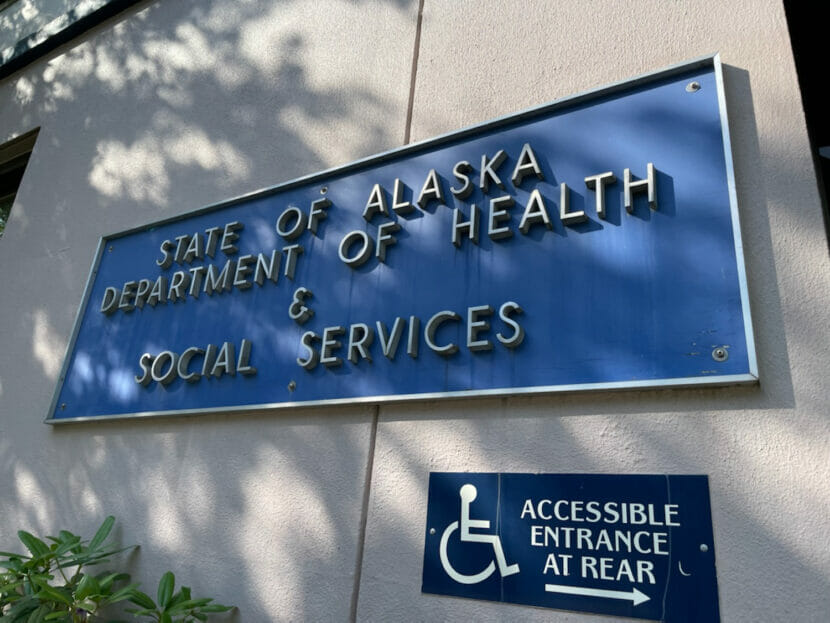
he offices of the Alaska Department of Health and Social Services are seen in Juneau on Friday, July 1, 2022. The department is being split into two separate agencies. (Photo by Lisa Phu/Alaska Beacon)
The politically appointed board that regulates health care in Alaska voted unanimously Friday to recommend that the state restrict medical care for transgender youth in the state and approved a letter asking Alaska lawmakers to end access to abortion in the late stages of pregnancy.
On transgender care, the board approved a draft regulation that — if made final — would declare that providing gender transition care for someone younger than 18 amounts to “unprofessional conduct” equivalent to drunkenly practicing medicine.
Someone violating that regulation could be subject to disciplinary action. In the most extreme cases, the board has revoked medical licenses after a discipline investigation.
The draft regulation is subject to a public comment period before becoming final or being amended.
In a separate action, the board approved a statement declaring that it does not believe that abortions late in pregnancy are “ethical medical practice” and advised Alaskans to lobby the Legislature to change state law.
Currently, access to abortion in Alaska is protected by a precedent set by the Alaska Supreme Court, which has declared that medical care is covered by the personal privacy clause of the Alaska Constitution.
Both actions come amid a push by Republicans nationally to restrict abortion and gender-affirming care for children. Twenty-seven states, almost all of which are controlled by Republican politicians, have enacted laws or policies restricting gender-affirming care for children.
Abortion restrictions are more common, with only Alaska, eight other states, and the District of Columbia, having no restrictions on abortion care.
Board member Dave Wilson, a commercial pilot who sits in a public seat on the board, said before the vote that the transgender care regulation came about because of public requests.
“This was brought to us as a concern by members of the public, and we acted on that. This is not politically driven. This is not politically motivated,” he said.
Next to Wilson’s image in the board’s Zoom meeting was Dr. Matt Heilala, a podiatrist who is a member of the board and a Republican candidate for governor.
All six of the board’s current members were appointed by Republican Gov. Mike Dunleavy. The board has eight seats, but two are vacant. All six sitting members are male; four are from the Matanuska-Susitna Borough and two are from Anchorage.
Under the draft regulation, medical providers would be acting unprofessionally if they provide “medical or surgical intervention to treat gender dysphoria or facilitate gender transition by altering sex characteristics inconsistent with the biological sex at birth, including but not limited to puberty blockers, cross-sex hormones, mastectomy, phalloplasty, or genital modification to a minor under the age of 18 years old.”
That contradicts recommendations from most medical associations in the United States, which have defined gender dysphoria as a disorder that can affect children. The American Academy of Pediatrics, for example, has continuously supported access to chemical and surgical procedures to treat dysphoria and allow someone to potentially seek gender-affirming surgery.
Other countries, including the United Kingdom, have taken a different approach and have restricted gender-affirming care for children.
Since the start of President Donald Trump’s second term in office, the U.S. Department of Health and Human Services has also changed its policy to be against gender-affirming care for youths.
“Earlier in the year, we’ve seen a lot more study that is alarming,” Heilala said during Friday’s board meeting. “Policy shifts across the world, and we have strong support of the governor on this. More than half of the states have either outright banned or curtailed this care. And I think it does need to be pointed out, a regulation is an opportunity and a tool to be used at the discretion of the board.”
He said that if the regulation is enacted, disciplinary sanction isn’t “an obligation … but it is an option.”
Public testimony on Friday was uniformly against the draft regulation.
Tom Pittman is executive director of Identity Inc., which offers gender-affirming care to minors in Alaska.
Speaking to the board, he said the proposed regulation “strips parents of their ability to work with trusted doctors to make the best decisions for their child. It shrinks the already fragile provider network and endangers children’s lives.”
Dr. Lindsey Banning, a licensed psychologist and the parent of a transgender child, said that the benefits of gender-affirming care are well-established.
“It’s quite simply the standard of care for trans folks that’s accepted by all major medical organizations in this country,” she said. “Blocking access to this care has devastating consequences on the health and well being of trans kids, dramatically raising (their) rates of depression, anxiety and suicide, and yet somehow we’re here watching this politically appointed medical board brazenly ask us to ignore the research and opt to politicize the healthcare choices of Alaskans.”
The draft regulation is expected to be vetted by the Alaska Department of Law, then would be published for a 30-day public comment period.
Alaska Attorney General Treg Taylor speaks at a news conference on Thursday, Dec. 15, 2022, at the Alaska State Capitol in Juneau. (James Brooks/Alaska Beacon)
Alaska Attorney General Treg Taylor will resign Aug. 29, he told employees at the Alaska Department of Law in an all-staff email Thursday afternoon.
Taylor, who became the state’s top attorney in 2021 after his two immediatepredecessors resigned in disgrace, is expected by political observers to join a competitive field of candidates running for governor in the state’s 2026 general election.
Incumbent Gov. Mike Dunleavy is term-limited and unable to run for reelection, leaving the office open to challengers.
This week, former Alaska Revenue Commissioner Adam Crum formally confirmed his plans to run for governor, and former state Sen. Tom Begich became the first Democrat to announce a run for the office. Bruce Walden of Palmer, who ran as a write-in candidate in 2022, filed for the office on Wednesday.
In addition to Crum and Walden, seven other Republicans have filed documents for a campaign: former state Sen. Click Bishop of Fairbanks; current state Sen. Shelley Hughes of Palmer, Lt. Gov. Nancy Dahlstrom of Eagle River; Matanuska-Susitna Borough Mayor Edna DeVries; podiatrist Matt Heilala of Anchorage; former teacher James William Parkin IV of Angoon; and business owner Bernadette Wilson of Anchorage.
No independents have filed for the office, and Begich is the only Democrat who has filed.
While Taylor has not formally stated that he will run for governor, he has participated in a significant number of non-state events that appear to foreshadow a campaign.
Next Thursday, he was scheduled to join other Republican attorneys general in Anchorage at an event hosted by the Anchorage Republican Women’s Club. It wasn’t immediately clear whether that event would still take place.
In a written statement, Dunleavy thanked Taylor for his service and noted that he will end his career as the third-longest-serving attorney general in state history. In the same statement, Taylor thanked the employees of the Department of Law.
During four and a half years as attorney general, Taylor has tended to favor Christian conservative and Republican causes, aligning the state legally with other Republican attorneys general.
In 2022, Taylor helped fundraising efforts for a Republican group that ran ads opposing more moderate members of the state House and Senate in that year’s elections. Taylor’s family has backed efforts that would allow state homeschool funding to be used for tuition at private and religious schools.
Earlier this year, Taylor’s travel itinerary drew scrutiny after it was revealed that a corporate-funded group had paid at least $20,000 for a trip to France for Taylor and his wife.
Taylor’s time in office has corresponded with a drop in violent and sexual crime within the state. Alaska ranks among the worst states in the nation for both categories of crimes.
Dunleavy is expected to appoint an acting attorney general on or before Aug. 29.
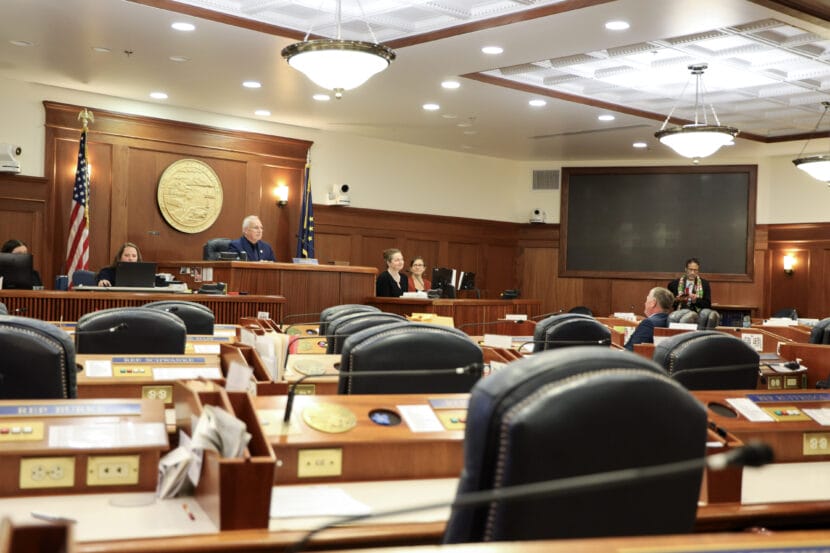
Speaker of the House Bryce Edgmon, a Dillingham Independent, speaks to a nearly empty floor at the Alaska State Capitol on Tuesday, Aug. 19, 2025. (Photo by Clarise Larson/KTOO)
The Alaska House and Senate met Tuesday in Juneau but adjourned in less than a minute.
A total of five lawmakers showed up for the floor sessions and took no action. They needed to meet to prevent Gov. Mike Dunleavy from calling lawmakers back for another special session.
Senate President Gary Stevens, R-Kodiak, said on Tuesday that lawmakers already achieved everything they sought during the special session. He said there’s no reason to bring more lawmakers down to Juneau than necessary.
“We didn’t accomplish anything today other than following the legal issues of calling ourselves back in doing a technical session,” he said.
Dunleavy called the special session earlier this summer for lawmakers to consider his education reform policies and to create a new state Agriculture Department.
But instead, within hours of convening, lawmakers overrode two of his vetoes. They restored more than $50 million in state funding for public schools that Dunleavy cut when he signed the budget. They also strengthened the authority of the legislative auditor.
The governor can call another special session once members gavel out on Aug. 31. But, Speaker of the House Bryce Edgmon, I-Dillingham, said he hopes to avoid that. He said doing so wouldn’t accomplish much.
“If he calls us back in, the results are going to likely be the same as where we’re at now,” he said
Both Stevens and Edgmon said they have had no communication with Dunleavy or his staff since lawmakers last convened.
The governor’s communications director, Jeff Turner, in a statement on Tuesday, said a public announcement will be made if the governor plans to call another special session. He said the Legislature’s actions were disappointing.
“The longer the Legislature waits to pass meaningful education reform, the more Alaskan children will pass through an education system in which too many Alaskan students are not learning the skills necessary for future success in school and life beyond the classroom,” he said.
A group of state lawmakers are expected to meet Aug. 25 to kick off a Task Force on Education Funding. The aim is to discuss ways to improve Alaska’s public schools and examine state funding as student performance continues to wane. The task force will also look at Dunleavy’s proposed policies.
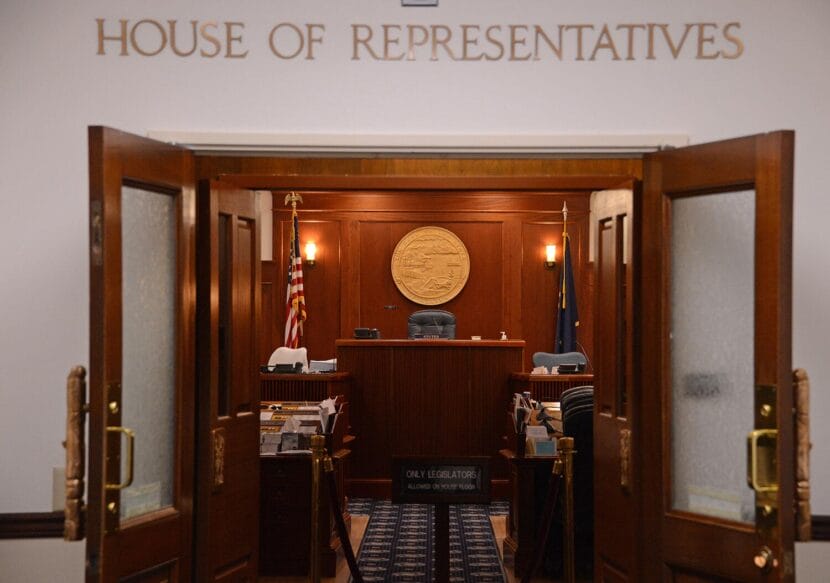
The House chambers are seen on Friday, May 13, 2022 at the Alaska State Capitol in Juneau, Alaska. (James Brooks/Alaska Beacon)
The Alaska State Legislature is planning a brief session without taking any action on Tuesday, and legislative leaders say they’ve already completed their intended work for the special session, which ends on Aug. 31.
Gov. Mike Dunleavy called the 30-day session, which began on Aug. 2, for legislators to address his education policy priorities and to create a new Alaska Department of Agriculture. The Legislature convened — one senator flying back from U.S. National Guard duty in Poland — and within hours voted to override two of the governor’s vetoes. Lawmakers then adjourned until Tuesday.
Legislators voted to leave the session open and not officially close out the special session to prevent Dunleavy from calling them into another one.
On Tuesday, just “a handful” of legislators are expected to be present for what’s known as a “technical session,” said House Speaker Rep. Bryce Edgmon, I-Dillingham, reached by phone Monday in his district.
Edgmon said he was planning to fly back to Juneau to facilitate proceedings in the House on Tuesday, but said it will be brief.
He said the Legislature’s votes to override two of the governor’s vetoes, including restoring $51 million for K-12 schools, was a success – and their only goal for the special session.
“But the specter of the governor calling us right back in seems to be very prominent,” Edgmon said. “And we had to do what we had to do in terms of allowing members to go back home, go back to their districts, not being Juneau, drawing per diem, costing the state money — with the stated intention, of course, of looking at the governor’s bills, continuing to consider the governor’s bills and the subject matter next session, as we started to do last session.”
The governor introduced three bills on Aug. 2, related to education policy, and Edgmon said they have been referred to related committees.
Edgmon said he’s had no communication from the governor’s office since the veto override votes.
“I wish we had a better relationship with the governor, to where we could plan things out, work jointly in terms of any outcomes for a special session. The governor is acting unilaterally, which, of course, is his prerogative, should he choose. But that does not bode well in terms of any kind of a positive result for special session,” he said.
Jeff Turner, the governor’s communications director, said by email Monday, “lawmakers should not need an incentive to improve public education policy,” and that it was the Legislature’s decision to not take up the governor’s bills during this special session.
Turner pointed to the governor’s comments on an Anchorage-based commercial radio show on Aug. 14, where Dunleavy criticized the Legislature’s veto override restoring school funding, and said additional funding is “not going to change the performance outcomes.”
The House and Senate are scheduled to gavel in at 10 a.m. on Tuesday.
A new joint legislative education funding task force is scheduled to hold its first meeting on Aug 25, where its six members are expected to examine how the state funds schools, as well as Dunleavy’s educational policy items.
Close
Update notification options
Subscribe to notifications
Subscribe
Get notifications about news related to the topics you care about. You can unsubscribe anytime.