State Government

Alaska Supreme Court places new limits on pretrial delays

""
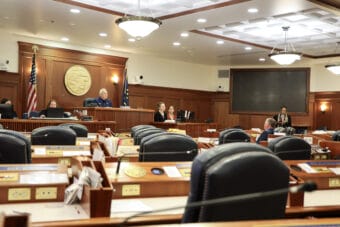
The Alaska Judicial Council holds a public hearing about applicants for two Anchorage Superior Court judge positions in the Boney Courthouse in Anchorage on Nov. 16, 2022. . (Photo by Matt Faubion/Alaska Public Media)

This story was originally published by ProPublica. ProPublica is a Pulitzer Prize-winning investigative newsroom. Sign up for The Big Story newsletter to receive stories like this one in your inbox.

Alaska’s Supreme Court has placed new limits on how long criminal cases can be postponed, part of an effort to reduce the time many criminal defendants wait to face trial in the state.

The court’s order, which takes effect May 12, directs state judges to allow no more than 270 days of new delays for criminal cases filed in 2022 or before. Court system data shows that about 800 active cases fall into that category, making each one more than 800 days old and counting.

The move to reduce delays follows an investigation by ProPublica and the Anchorage Daily News that found some cases have taken as long as a decade to reach juries, potentially violating the rights of victims and defendants alike.

The time to resolve Alaska’s most serious felony cases, such as murder and sexual assault, has nearly tripled over the past decade. Victims rights advocates had long complained that judges rubber-stamped delays, particularly in Anchorage, where about half of the cases impacted by the Supreme Court order are pending. Some cases dragged on so long that victims or witnesses had died in the meantime.

In addition to capping the duration of delays, the state Supreme Court’s order says judges must explain why they’ve allowed any request for delay.

“It’s a positive step by the court to be able to work with the lawyers to move cases along,” said state Sen. Matt Claman, D-Anchorage, chair of the Judiciary Committee, which held a hearing on pretrial delays in February.

Alaska Court System spokesperson Rebecca Koford said the new Supreme Court order, issued on March 12, tackles the “most pressing concern.”

The time needed to close out the oldest cases “is exceedingly long,” she said, “and we need to get them resolved.”

The Supreme Court order said judges in pre-2023 cases are to allow only 90 days of new delays at the request of the defense, 90 days for prosecutors and 90 days for “other periods of delay for good cause.”

Koford said that an example of why a case might be delayed for good cause would be when a witness is temporarily unavailable to testify. Additional efforts are in the works to reduce the time it takes cases to get to trial, she said.

“We do not view it as the solution; it is part of the solution,” Koford said.

Alaska criminal rules grant defendants the right to a trial within 120 days of being charged with a crime. Crime victims have the right to the “timely disposition” of their case under the state constitution.

The 120-day deadline is rarely met. One sexual assault case highlighted by the Daily News and ProPublica was filed in 2014 and has been delayed more than 70 times. That case has now been set for trial on April 1.

Several high-ranking state officials have spoken of the need to rein in delays since the news organizations highlighted the issue in January.

Chief Justice Susan M. Carney told state lawmakers on Feb. 12 that the court system was working to curb delays, noting recent news coverage of the issue. The Senate Judiciary Committee held a hearing focused on pretrial delays later that month, when court system General Counsel Nancy Meade told legislators that the cases recently highlighted in news stories were unacceptable but were outliers among criminal cases.

“The time it takes to resolve cases now is certainly longer than it was 20 years ago. Nobody is happy about that,” Meade testified.

The new order signed by Carney and other Alaska Supreme Court justices said that a 2023 judicial order had led to “some decrease” in what the court characterized as “persistent backlogs.” The current order, the court said, “is intended to facilitate the further reduction in the time to disposition of these older criminal cases without undue delay.”

The order also addresses delays caused when attorneys fail to provide evidence to the opposing party in a timely manner. It says that judges should consider sanctions, including dismissing the charges, when prosecutors fail to provide evidence or banning the missing evidence from being used at trial.

State LNG project gets non-binding support letter from Taiwan

Gov. Mike Dunleavy (second from left) and Alaska Gasline Development Corporation President Frank Richards (third from left) celebrate a letter of intent from Taiwanese CPC Corporation for the Alaska LNG Project. (Courtesy photo/Alaska Gasline Development Corporation)

The $44 billion Alaska LNG Project picked up a letter of intent last Thursday from Taiwan’s state-owned CPC Corporation. The letter is non-binding. But project officials say it’s a first step toward a binding agreement to buy gas from the project if it’s built.

In a joint press conference with Gov. Mike Dunleavy, Taiwanese President Lai Ching-te said Alaska gas is conveniently located and a source of high-quality natural gas. In a press release, CPC Corporation said Alaska would become Taiwan’s closest source of natural gas if the project is built.

“We are very interested in buying Alaska natural gas because it can meet our needs and ensure our energy security,” Ching-te said.

Gov. Mike Dunleavy called Alaska LNG the state’s flagship project. And he said it’s more than just an energy initiative.

“It is a bridge connecting the future prosperity of both Alaska and Taiwan,” he said.

If it’s built, the Alaska LNG Project would move natural gas from the North Slope to Southcentral for shipment overseas. The project includes a treatment plant on the Slope, an 800-mile pipeline and a liquefaction facility in Nikiski.

President Trump has been a vocal supporter of the project. As reported by the New York Times, some say recent foreign interest is a result of tariff threats from the White House.

Last month, Trump announced a joint venture with Japan for the project, although that did not include a letter of intent. And after Dunleavy visited the Philippines last month, the country’s ambassador to the U.S. said they plan to procure natural gas from Alaska.

To date, no company has signed firm agreements to buy gas from the project. And the state corporation that owns the project declined to provide details about existing letters of intent, including who has signed them and how many there are.

Dunleavy is still in Asia to promote the project and seek investors. His office was not able to provide the trip itinerary. But Reuters reports Dunleavy met with government officials and companies in South Korea on Tuesday. He’s traveling with officials from Glenfarne. That’s the company in talks to take over the project from the Alaska Gasline Development Corporation.

Alaska legislators look to savings account for deficit fix

Snow falls on the Alaska Capitol and the statue of William Henry Seward on Monday, April 1, 2024. (Photo by James Brooks/Alaska Beacon)

Members of the Alaska Legislature said this week that they’re likely to use the state’s Constitutional Budget Reserve to fix a roughly $173 million budget deficit for the 12 months that end June 30.

Lawmakers are confronting another, larger deficit as they craft the budget for the fiscal year that begins July 1, but it remains possible that some tax increases — on oilbusiness income and online sales — could offset the need to spend from savings for that year.

When it comes to the current fiscal year, things are more certain. Passing new taxes and implementing them would take time, and the state’s budget needs to be balanced by June 30.

While members of the Senate’s bipartisan coalition majority previously rejected the idea of spending from savings, they admitted this week that there is no other option.

“Times change, things change, and sometimes you have to eat crow up here,” said Senate President Gary Stevens, R-Kodiak, during a news conference with reporters.

Spending from the state’s $2.8 billion Constitutional Budget Reserve will require the approval of three-quarters of the state Senate, plus three-quarters of the state House.

Reaching those thresholds will require the support of the Republican minority caucuses in both the Senate and the House. It isn’t clear what political horse-trading — if any — will be required to get the needed Republican support.

About half of the deficit in this year’s budget is attributable to lower-than-expected oil revenue. The other half is due to budget changes proposed by Gov. Mike Dunleavy, whom the Republican minority caucuses generally support.

Among the budget additions: $10 million for the Alaska Seafood Marketing Institute, millions for wildfire firefighting, and $2.7 million to cover missed payments by the state to employees’ retirement accounts.

As of Wednesday afternoon, members of the House Finance Committee were debating the use of the budget reserve for the upcoming fiscal year as well as the current one, but those debates had yet to reach a resolution.

Alaska corrections officials testify on in-custody deaths, mitigation efforts

Dr Robert Lawrence, Alaska chief medical officer (left), Travis Welch, director of corrections health and rehabilitation services (center), and Dr Tim Ballard, DOC chief medical officer (right) present before the House State Affairs Committee on March 4, 2025. (Gavel Alaska)

The Alaska Department of Corrections has had at least 67 people die in-custody of state prisons and jails since 2020, with at least 17 deaths reported as suicides, according to the department.

There were at least 14 deaths last year. Two deaths were reported so far this year, with one investigated by the Alaska State Troopers and reported as a suicide.

On average, 4,500 people are incarcerated each year in Alaska’s 13 facilities, which includes individuals under arrest and awaiting trial or sentencing, known as pretrial, and those who are serving sentences. Of those in custody, an estimated 42% of men and 60% of women are pretrial, according to state data.

Alaska state medical and corrections officials pointed to “natural causes,” including acute and chronic disease and illnesses, as the leading cause of in-custody deaths – or 68% of reported deaths since 2015.

State officials gave a presentation to lawmakers with the House State Affairs Committee on March 4, describing causes of death from 2015 to 2024, as well as demographics and mitigation efforts.

“We do see a higher number of people who may have never seen a doctor,” said Travis Welch, director of the Division of Health and Rehabilitation Services for the Department of Corrections.

As a result of mental illness or substance use disorder, they may “lack the ability to make a doctor’s appointment and go in and see a doctor or a dentist. So the population that we’re serving is acute, and probably one of the more acute populations within the state of Alaska,” Welch said.

Causes of Alaska in-custody deaths, 2015 – 2024 (Screenshot of Alaska Department of Corrections presentation)

Officials presented data on the causes of in-custody deaths. Of the 68% of in-custody deaths reported as natural causes, 43% were reportedly from heart or lung diseases, 22% cancer, 13% infectious disease, 10% unknown, 6% liver disease, 4% kidney disease, and 2% substance related.

The health issues within state prisons mirror Alaska’s health trends, Welch said. “When we have high rates of heart disease, for example, in the state of Alaska, we’re going to see a concentrated amount of heart disease within our facilities and those we’re caring for,” he said.

Rep. Kevin McCabe, R-Big Lake, asked about expedited release processes for those who are sick or nearing end of life, like medical parole. Welch said that is ultimately up to the courts.

“We always try to house people in the least restrictive environment,” Welch said. “And when people are towards the end of their life, statute does allow for people to be released if they meet certain statutory requirements… we’re the information providers to the courts, and then the courts actually make the decision on people being released.”

There have been at least 114 deaths from 2015 to 2024, according to department data. According to the department, 78 were due natural causes, 30 were suicides, four due to accidental causes, two were homicides, and one cause of death from 2024 is still pending.

Of those, DOC reports 102 men, and 12 women died in custody, reflecting the larger statewide prison demographics. According to department data, 47% were white, 37% Alaska Native, 7% Black, 4% Native American, 2% Hispanic and 2% Asian.

“Every year, there are anywhere from four deaths up to 18 deaths,” said Dr. Robert Lawrence, Alaska’s state chief medical officer, who was the former chief medical officer for the Department of Corrections. “There’s somewhere between 11 and 12 individuals who will die during the period that they are in custody. That average has not changed. What has changed over time are the causes of death.”

Lawrence said that prior to 2015, about a quarter of deaths were due to overdose or related to symptoms of substance withdrawal. He said after the department deployed new screening and withdrawal treatment protocols, those deaths decreased substantially. “From 2017, for the next five years, there were zero deaths in that early withdrawal period,” Lawrence said. “Because of identifying the problem, coming up with a mitigation strategy, and then training staff to address that.”

He said fentanyl is still a problem in the prison system, “but even still, those numbers (of deaths) remain quite low.”

In 2022, a record 18 reported deaths sparked public outcry, an investigation by the ACLU of Alaska, and a wrongful death lawsuit against the department. Seven of the 18 deaths were reported as suicides.

Rep. Ashley Carrick, D-Fairbanks and state affairs committee chair, asked whether the department sees suicide rates also increasing.

Dr. Tim Ballard, current chief medical officer for DOC, said the suicide rate has been going down “slightly,” and that staff training and awareness for suicide prevention is ongoing.

Adam Rutherford, deputy director for health and rehabilitation services with the Department of Corrections testifies on mitigation efforts to prevent in custody deaths on March 4, 2025. (Gavel Alaska)

“One of the key things that we looked at was training, and what can we do to better prepare our staff to identify folks that may be at risk, and how to respond and do appropriate referrals,” said Adam Rutherford, deputy director for health and rehabilitation services. “We also increased scenario-based training within our facilities as well. We use tools to replicate suicide attempts and how to respond appropriately from both the security side of the house and medical side of the house as well.”

Rutherford listed mitigation efforts, including adding medical bags and more cameras across facilities; installing jump barriers; and implementing larger windows for “segregation” units or solitary confinement, for suicide watch.

“So we want to be able to see folks. We want visibility. We want folks to be able to see out. We don’t want them to feel like they’re enclosed,” he said.

Rutherford said aging prison facilities are also an issue. “Our facilities are old, and let’s face it, corrections (facilities) nationally weren’t built to be behavioral health treatment facilities, and that’s really what our systems have become,” he said.

In the presentation, officials reported that 65% of the prison population are living with a mental illness, and 80% have a substance use disorder.

Rutherford said the department reviews each in-custody incident, either suicide attempt or death, in order to make improvements. “And it really is a process of looking at that continuous quality improvement, what changes can we make, and encouraging our staff to have that input and that feedback. And that’s had a significant impact,” he said.

Carrick asked about the protocol for notifying loved ones of those who have died, citing complaints from bereaved family members. “A lot of times people feel like it was a void,” she said. “They didn’t know what was going on. They didn’t know there was a problem, and then all of a sudden, their loved one is gone.”

“Full transparency, we often struggle because we often don’t necessarily have a point of contact,” Rutherford said, and that the department has to adhere to the federal Health Insurance Portability and Accountability Act privacy laws.

“It’s very difficult to make sure that we can navigate through what we’re legally allowed to disclose and what we can’t,” Lawrence added.

Rep. Andi Story, D-Juneau, emphasized it would be good practice for the department to have contact information for family members and release of information agreements in place. “If that is not a standard practice, can that be a standard practice?” she asked.

Lawmakers had more questions around suicide watch, solitary confinement, detoxification protocols, and other issues as the hourlong hearing time ended, and planned to submit those questions to the department.

“It is a very sensitive subject, and very, very close to home for a lot of Alaskans,” said Carrick in a phone interview after the hearing. “And I was grateful we were able to talk about it respectfully, and to have the Department of Corrections in front of us.”

Carrick said she sees deferred maintenance and facilities upgrades as a priority for improving prison conditions, safety and mental health services.

“Inmates have access to certain mental health services, and they have rights for health care while they’re in custody,” Carrick said. “However, that pretrial population doesn’t necessarily have any established, ongoing, mitigating mental health care.

“It’s unclear to me how accessible to the sentenced population, even long-term ongoing mental health services are,” she said. “I think the department is trying to offer what services it can, but I do think that our budget’s not reflective of the number of staff we need” to provide needed services.

Carrick said she’s concerned about the high number of suicides, and support services available.

“I don’t think any person in state custody should ever be dying of suicide,” she said.

Carrick noted that Department of Corrections health care costs are expensive, and she wants to see better management of those services to meet prison population needs.

“I think the public should be aware of what the real costs are for incarceration,” she said. “And at the same time, I’m someone who firmly believes that taking care of every individual that is in state custody is the state’s responsibility, and we should not have lacking medical or mental health care for these individuals while they are incarcerated.”

The hearing took place one day after another in custody death was reported on March 3: 42-year-old Reginald Childers Jr. of Kodiak was found dead in his cell at the Anchorage Correctional Complex. The Alaska State Troopers announced the death was a suicide.

State officials did not address any individual death incidents, investigations or outstanding lawsuits against the department at the hearing.

Carrick said she plans to hold more hearings with corrections officials on in-custody deaths, and contributing issues across the state’s prison system, like prison wages, living conditions, “access to meaningful activities or employment while in corrections, access to other services, like class services, visitation services,” she said. “A lot of these are major challenges in an understaffed and overcrowded prison system.”

Carrick said there are clear improvements to be made across facilities, and the department.

“I want folks that are incarcerated to actually come out of that experience with the tools and the skills needed to productively reenter society,” she said. “We’re not really setting any trends for extraordinary success right now, and I’d really like to see us, even potentially in the future, be a leader in what successful rehabilitation and reentry can look like.”

Why a Fairbanks lawmaker wants to put the governor’s mansion on Airbnb

People walk by the Governor’s House, as it’s referred to in official documents, in downtown Juneau, Alaska on Friday, March 21, 2025. (Clarise Larson/KTOO)

A Fairbanks Republican lawmaker wants to put the governor’s mansion on Airbnb.

“Airbnb! Airbnb!” Rep. Will Stapp chanted, both fists raised, on a catwalk outside the House chamber last week.

Stapp filed a bill March 17 that would require the governor’s office to offer the Juneau residence up for rent on a short-term basis while the Legislature is not in session and the governor has not reserved it in advance.

“I always try to look for ways to make government more efficient, and when you see that you have facilities that are underutilized, you should try to maximize them so they at least cover their own operating expense,” Stapp said in an interview. He said he’d also be open to renting out some of the Legislature’s facilities, including an apartment building lawmakers acquired in 2021 and later renovated to house legislators and staff.

Dunleavy spent a total 13 nights in Juneau during the first two months of the year, according to his public calendars. In recent weeks, the governor has spent time in Asia drumming up support for a North Slope natural gas pipeline.

Even so, Stapp told the Juneau Empire he did not intend the bill as a swipe at the governor. The governor’s office did not respond to emails seeking comment.

The state pays a full-time staff of four to run the more than 14,000 square foot mansion, including a manager, a private chef and two housekeepers. The three-story home with 26 rooms, 10 bathrooms and eight fireplaces was built in 1912 with a stipend of $40,000 from the federal government, according to the Anchorage Daily News.

Salaries and upkeep on the mansion currently cost about $800,000 a year, according to budget documents.

Stapp said he’d like to defray that cost. He said it’s a great place for any number of events — parties, weddings, even overnight stays for Instagram influencers.

“I don’t think a normal person would pay an exorbitant amount of money to stay at a normal hotel room,” he said. “But they would, actually, if, you know, they could rent the governor’s mansion.”

Most bills introduced in the Legislature have little chance of passing, and this one is no different. Senate President Gary Stevens, R-Kodiak, isn’t taking the new bill seriously.

“That’s pretty silly,” he said last week. “I’m sorry to hear that. I mean, we have serious things to accomplish here.”

At the same time, Stevens said, “silly things happen.” Stevens compared it to a resolution he introduced in 2005 that aimed to change Fairbanks’ name to Barnette’s Cache.

“It never passed. It never even got a hearing,” he said, “Sometimes you do things just for, you know, humor.”

Alaska’s draft 20-year ferry plan depends on steady federal funds

The M/V Columbia travels the Inside Passage in October 2023. (Jack Darrell/KRBD)

A draft of the 20-year plan for Alaska’s state ferry system is open for public comment. Officials with the Alaska Department of Transportation are asking residents to weigh in on the plan that will guide the Alaska Marine Highway System through the year 2045.

The long-range plan seeks to increase service to over 30 ports. In recent years, port calls have decreased and coastal communities have repeatedly voiced their concern.

In an online public meeting March 19, AMHS Director Craig Tornga said the system is planning for more reliable service – not increasing it much but bringing it back to pre-pandemic levels.

“We’re really looking at trying to increase the port calls at our current communities and to make sure that we have some reliable service on a regular basis that can be planned,” said Tornga. “And then keeping it as efficient as we can from a cost perspective for the state, so it can be maintainable going forward.”

The state plans to build new hybrid ferries to replace the aging fleet, hire more workers to run them, and improve infrastructure at the ports.

That, plus regular maintenance, will cost about $3 billion. The plan to pay for it includes a combination of state and federal money along with increasing profits from ridership.

In creating the plan, the state hired engineering and research groups to crunch data and gather information from dozens of coastal communities. Economist Katie Berry said the ferry plan anticipates the state to appropriate roughly $120 million a year in operating costs. The 20-year plan also calculates that federal funding remains intact.

“The expectation is that the federal funding sources that have pre-dated the Federal Infrastructure Act will be stable over this time period,” Berry said.

The Infrastructure Law brought in about $700 million in federal funds to the ferry system in the last three years. Meanwhile, Gov. Mike Dunleavy has vetoed millions in state ferry funding that the Alaska Legislature approved.

Efforts for a long-range plan began in 2022 after the Legislature created the Alaska Marine Highway Operations Board to help guide the state’s DOT. The nine-member board is made up of state workers and coastal residents with ferry knowledge.

The public comment period on the long-range plan ends March 30. The operations board will consider the plan in April before it heads to the Legislature. According to state law, the plan will be updated every five years.

Site notifications
Update notification options
Subscribe to notifications