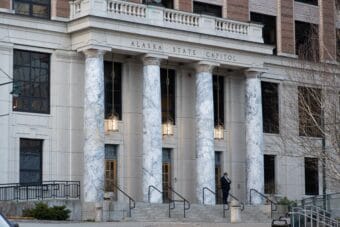
A school bus waits outside the Alaska State Capitol after offloading a group of preschoolers, their parents, caregivers and advocates on Feb. 13, 2023. (Katie Anastas/KTOO)
Alaska’s state education funding formula is really complicated. It’s based on data, collected during the school year, that takes months to process. That can leave districts building budgets based on projections that might be inaccurate. Juneau Democratic Rep. Andi Story wants to address that through a bill that would change what data is used for funding calculations.
Story, who served for years on Juneau’s school board, said there’s a level of uncertainty built into the way students are counted.
“When I was a school board member, when we were asking community members, parents to come and work on our budgets, we were always projecting cuts and not knowing what we were going to do,” she said.
Part of that uncertainty comes from not knowing exactly how many students are enrolled until later in the budgeting process. Right now, school districts count the number of students enrolled in October of their current school year. That count needs to be approved by the Department of Education and Early Development, and it determines how much state funding a school district will get for the following school year.
Districts typically don’t receive the approved numbers until months later – in January. That lag means districts begin planning their budgets based on projections instead of actual data.
Story’s bill – House Bill 261 – would make several different changes to which student counts would be used when determining state funding for education.
Story said one of the main things her bill would do is to base student counts either on the previous school year or an average of the previous three years – numbers that would have already been processed by DEED and wouldn’t change throughout the budgeting process.
“I’ve been living in this roller coaster, and seeing how it does not build confidence in our public schools,” Story said. “And so we need to get on a more stable plan, a smart plan.”
This isn’t a new idea. Story is on the Legislature’s Task Force on Education Funding. She said this part of the bill came from a recommendation made by an education consulting agency more than 10 years ago. The idea came up again last November, during a task force meeting.
The bill also seeks to address budgeting for students with disabilities, keeping schools open
There are a couple of other pieces in this bill as well. One addresses how the state counts students that qualify for intensive services. Students with disabilities that require those services receive 13 times the amount of funding that’s typically allocated for a student. If the state determines there are fewer of those students than what the district counted, that can create serious shortfalls in its budget.
The new bill would offer four different options for how to count students who qualify for intensive services, to ensure districts receive the funding needed to support them.
Districts could count students in October or February of the current school year, in October of the previous school year, or take an average of the last three years. They could then use the number that would provide the largest amount of funding.
Story said this method would account for students who might move to other districts.
“Sometimes students move after the count date, they might move to another community, and all of a sudden that community is going to have to hire another staff person, but they’ve already budgeted,” she said. “So where do they pull that money? Because by law, we need to meet that student’s needs.”
Story’s bill also addresses how enrollment counts determine how many schools a district can have. She said small districts can sometimes fall below the threshold that allows for opening another school or keeping an existing school open if enrollment drops by just a couple students in a given year. She said taking an average would help stabilize numbers in situations where the difference of one student could have big financial consequences.
“Those big funding cliffs that really make— that really have communities on edge of, ‘Am I going to get a couple more or a couple less?’” she said.
Lon Garrison is the executive director of the Alaska Association of School Boards, a nonprofit organization that advocates for Alaska students. He said the bill would provide far more stability as school districts build out their budgets. But he said the issue of adequate education funding remains.
“That’s the piece that we have to be focused on,” Garrison said. “What are we going to do to ensure that we’re getting the student outcomes, and what resources do we need?”
It’s unclear if this bill will make its way through the Legislature. Story expects the House Education Committee, which she co-chairs, to take it up in a couple of weeks.
Legislators watch during an vote seeking to override Gov. Mike Dunleavy’s veto of a bill that would have expanded Alaska’s corporate income taxes to capture more revenue from Outside businesses. (Eric Stone | Alaska Public Media)
Alaska lawmakers failed Thursday to override Gov. Mike Dunleavy’s veto of a bill that backers said would have modernized Alaska’s corporate income tax system.
The override failed 35-25. It would have required a 45-vote majority to become law.
Senate Bill 113 would have expanded the state’s corporate income tax to capture revenue from so-called “highly digitized businesses” that sell to Alaskans over the internet but may not have a physical presence in the state. Some of the money raised by the tax change would have gone toward reading programs in public schools.
After the vote, House Speaker Bryce Edgmon, a Dillingham independent, said the debate over the bill illustrated how difficult it would be for lawmakers to agree on ways to raise new revenue as the state deals with a fiscal crunch.
“I’d also say it’s a preview of the debate that we’re going to undergo on a fiscal plan,” he said.
Some Republicans who voted against the override said they were concerned that the bill could increase costs for Alaskans, including Big Lake Republican Rep. Kevin McCabe.
“It’s disingenuous to think that we are not going to pay for this tax one way or the other,” he said.
Supporters of the bill rejected McCabe’s characterization, saying that the bill would simply give Alaska a share of similar taxes companies already pay in other states.
Sen. Bill Wielechowski, an Anchorage Democrat who championed the bill last year, said the idea that the bill would raise consumer costs was “wildly inaccurate.”
“In fact, there’s been research on this,” he said. “The National Bureau of Economic Research did a working paper titled Corporate Taxes and Retail Prices, and found null — zero — effects on prices for firms subject to a single sales factor.”
Gov. Mike Dunleavy said Wednesday that he planned to introduce a temporary sales tax as part of a larger fiscal plan. Wielechowski said the corporate income tax change was a better option.
“How dare we go to Alaskans and say, ‘We want to tax you. We want to take your dividend,’ before we’re going to tax collect revenue from tech billionaires,” he said. “Really? Is that where we’re going with this?”
Some lawmakers who voted against overriding the bill said they supported the law in concept, including Fairbanks Republican Rep. Will Stapp, who voted for the bill when it passed in May.
But he said the complexity of the tax change— and the fact that the bill would take effect immediately if the veto was overridden — gave him pause.
“(If) you vote to override this bill, Mr. Speaker, you’re going to create a new type of corporate tax structure for people that there’s no regulatory guidance on how to pay,” Stapp said. “I would argue we probably shouldn’t do that.”
Wielechowski said he was confident the state would have been able to put out regulations before taxes would be due in 2027.
Even so, Stapp said he planned to introduce a new version of the bill this session addressing that and several more technical objections he raised on the floor.
“There are a lot of questions with the bill that we should probably know the answer to,” he said.
Gov. Mike Dunleavy is set to deliver the annual State of the State address to the Alaska Legislature in Juneau Thursday at 7 p.m.
Starting at 6:30 p.m., KTOO Managing Editor Lisa Phu will host a discussion with Alaska Legislative Digest Publisher Tim Bradner, KNBA News Producer Rhonda McBride, and Alaska Public Media State Government Reporter Eric Stone to provide some context for the speech.
Watch live Gavel Alaska coverage of the discussion and Dunleavy’s speech on KTOO 360TV or listen to your local public radio station.
Students end their school day in Aniak. Theirs is one of nine schools in the Kuspuk School District, which is a plaintiff in a lawsuit filed against the state Tuesday alleging years of inadequate education funding. (Photo by Emily Schwing)
Two Alaska school districts filed a lawsuit Tuesday in Anchorage Superior Court against the state, its governor and its education commissioner over what they say is a long-running failure to adequately fund public education.
In the complaint, the Kuspuk School District and the Fairbanks North Star Borough School District argue “the state is failing to meet its constitutional obligation” both to provide Alaska students “a sound basic education and meaningful opportunity for proficiency” in vital subjects, and “to fund schools and school districts at a level that is adequate to provide students with a sound basic education.”
The plaintiffs are seeking a declaratory judgment that the state is violating the Alaska Constitution by failing to sufficiently fund public education. They say the state is violating the plaintiffs’ and students’ rights to substantive due process. They’re also seeking an injunction directing the state to fulfill its constitutional obligations, and requesting a court-ordered adequacy study to determine what it costs to educate students.
“Alaska, we don’t believe, has ever done an adequacy study to really understand what it would take to allow Alaska students a fair opportunity to learn the skills they need to participate and contribute to society,” said Matt Singer, a trial attorney representing the plaintiffs. ”If you don’t know what something is going to cost, then you can’t have a conversation with the Legislature about how to fund it,” he said.
The lawsuit points to low proficiency assessment scores, reductions in teaching staff and the elimination of fine arts, career technical and vocational education programs as direct impacts due to years of chronic underfunding. It also cites dangerous conditions inside school buildings.
“The last eight years, we’ve experienced a governor that has put forward a zero dollar budget going into budgeting,” said Kuspuk School District Superintendent Madeline Aguillard. “That’s almost a decade of just starting at nothing and when you have to claw your way to even less than minimal funding, that takes a toll,” said Aguillard.
A spokesperson with the governor’s office deferred to the state Department of Law.
“The responsible path is legislation — not litigation,” Department of Law spokesperson Sam Curtis wrote in an email Tuesday night, noting that “we have not been served with this lawsuit and have not yet had an opportunity to review the claims.”
The education clause in Alaska’s constitution does not specify a dollar amount for education. Instead, wrote Curtis, the constitution “vests the power of the purse squarely in the Legislature and the Governor. The legislative session began today. That is where education policy and funding decisions are meant to be debated and resolved.”
Superintendent Madeline Aguillard oversees nine rural public schools in Western Alaska’s Kuspuk School District. (Photo by Emily Schwing)
It’s not a coincidence the suit was filed on the same day legislators convened in Juneau for this year’s legislative session, according to Fairbanks North Star Borough School District Superintendent Luke Meinert. “I think it sends the message that the work on education funding is not done,” said Meinert. “We’re calling on this year’s Legislature to continue to work on that issue. They have the power to do so. Nobody else does,” said Meinert.
Education Commissioner Deena Bishop did not respond to a request for comment as of Tuesday evening. When she was superintendent of the Anchorage School District, Bishop consistently advocated for increased state funding for public schools through a change to the state’s education funding formula. But Bishop changed her stance when she became education commissioner under Dunleavy, arguing that the state’s budget is strained and that she preferred a more targeted approach to increasing school funding, like providing more money for tutors.
In the past, Bishop has said her department is not responsible for allocating funds for education. “The levers that I can pull aren’t levers for funding,” Bishop said in a 2024 interview. “I don’t create the money. The Legislature creates that, but we can certainly support policy that would help support schools as their needs come up,” she said.
Caroline Storm, executive director of Alaska’s Coalition for Education Equity, a nonprofit organization that is helping finance the lawsuit, said that “legal action is not the only way, but it raises the public awareness.” Storm said years of advocacy from her organization and others simply “hasn’t moved the needle enough” in Alaska to pay for wide-ranging needs from curriculum to building maintenance.
Storm said the lack of financial support for public education should be central to this year’s election cycle. “In my mind I don’t frame that as using politics, but ensuring something that is in our constitution,” said Storm.
According to Article VII of Alaska’s constitution, “the legislature shall by general law establish and maintain a system of public schools open to all children of the State.” For years, the complaint alleges, the state has failed to do so.
“This does not come as a surprise to me,” state Sen. Löki Tobin, an Anchorage Democrat who chairs the Senate Education Committee, said Tuesday. “In this conversation around adequate school funding, our local school boards have been bleeding,” she said.
“They have come to Juneau, they have talked to our commissioner, they have elevated the desperate need that they are under to have adequate state funding. We know that the state support for schools has been slowly diminishing,” said Tobin, who is also a member of a task force formed at the end of last year’s legislative session to address education funding, among other issues.
Alaska’s public schools receive funding from two state budgets. Capital funds pay for building maintenance, upgrades and construction. Money for operations, often referred to as the Base Student Allocation, or BSA, buys things like textbooks and pays for teachers’ salaries. According to the complaint, Alaska allocated $5,800 per student in 2015. Over a decade, the number had risen only 2.2%, totaling $5,960 in 2025.
“The state is failing in all regards,” said Singer. “In order to provide a basic sound education, you need a lot of different things,” he said. “One of the things is a safe school building with a roof and heater. Another thing you need is a competent teacher standing in front of a classroom educating young people.”
After years of relatively flat state funding for schools amid rising operational costs, Alaska lawmakers during the 2025 legislative session passed a $700 increase to the BSA, then gained enough support to override Gov. Mike Dunleavy’s veto of the bipartisan education bill — and later overrode his veto of $50 million in education funding from the budget.
While advocates celebrated the funding increase, many education leaders have said it still falls short of what school districts need to effectively operate, and the plaintiffs in the lawsuit filed Tuesday said the increase in the BSA was “woefully insufficient to keep pace with inflation, which had eroded purchasing power by 37% in the preceding decade.” After last year’s protracted battle over school funding, and with state revenues projected to be lower than expected, it’s unclear whether there’s enough traction in the Legislature to pass another increase this year.
There are more than 50 school districts in Alaska, and most are located within cities or organized boroughs, which have access to local tax revenue to help fund education.
Nineteen districts are nearly entirely reliant on the state for funds, because they serve rural, unincorporated communities where money from local taxes is simply not available to help pay for schools. Dozens of those school buildings are owned by the state education department, including in the Kuspuk School District, which straddles the middle stretch of the Kuskokwim River and covers an area roughly the size of Maryland in Western Alaska.
State assessment data on student performance within the Kuspuk School District “are dire,” according to the complaint. The numbers show 90% of the district’s 330 students during the 2024-25 school year were not proficient in English language arts, math or science. Aguillard said chronic underfunding from the state is having an outsized impact on districts like hers, where the student population is predominantly Indigenous.
Bats sometimes fly through the hallway and classrooms in Sleetmute. The building’s roof had a leak for nearly two decades before state funds finally became available for repairs. (Photo by Emily Schwing)
Those students aren’t only struggling with classwork. For years, Aguillard said her district has had to pull funds from its operational budget to keep buildings open. Over the last two years, an investigation by KYUK Public Media, NPR and ProPublica uncovered a public health and safety crisis inside many of Alaska’s public schools and in particular, in rural schools that serve predominantly Indigenous student populations. In one school, bats occasionally fly through classrooms and the hallway. At a school above the Arctic Circle, maintenance staff struggled for years with a persistent toxic chemical leak from the heating system, and in several cases across the state, failing plumbing means kids have to leave school to go to the bathroom.
Dozens of studies cited by the U.S. Environmental Protection Agency highlight negative impacts on student performance as a result of poor maintenance and conditions inside schools. The investigation found black mold inside several Alaska schools. Exposure can increase the risk of asthma and is linked to higher rates of absenteeism. According to the agency, leaking roofs and problems with heating and ventilation can also impact academic performance.
The situation isn’t unique to rural school districts, however. In an interview, Meinert described at length the tangible impacts a $5 million budget deficit has had in the Fairbanks North Star Borough School District, one of the three largest in the state.
“The state does have a responsibility to provide safe and adequate facilities for our students not only in rural Alaska but also in urban Alaska,” said Meinert. In the last five years, seven schools in his district have been forced to close due to a budget shortfall. Meinert said the district opted to outsource its custodial jobs and eliminate more than 70 positions. Since 2019, Meinert said, his district has terminated more than 300 teaching positions districtwide, which means class sizes have swelled to more than double what the National Center for Education Statistics reported for the state five years ago.
Meinert contends that a lack of state financial support within his district is also disproportionately impacting the minority student population. State assessments show that more than 76% of Indigenous and economically disadvantaged students in the district are not proficient in English language arts.
Aguillard has also been scrambling with maintenance staff over the last two weeks. This winter, communities across the state experienced a prolonged and extreme cold snap in December and January. Eight of the Kuspuk district’s nine buildings could not open in time for students to return from the holiday break because there was no running water, heat or electricity. The majority of the buildings in the district are owned by Alaska’s education department.
”It’s unsettling,” Aguillard said. “Our buildings should not be shutting down so easily. It’s really just evidence of the decline of the capacity of those buildings,” she said.
Gov. Mike Dunleavy gestures while speaking to reporters during a meeting of his 15 department commissioners on Wednesday, Jan. 21, 2026. (Eric Stone | Alaska Public Media)
Gov. Mike Dunleavy says he’ll soon propose a statewide sales tax as part of his larger plan to stabilize the state’s finances.
“There will be a temporary, seasonal sales tax concept put forth for discussion with the Legislature,” Dunleavy said during a cabinet meeting livestreamed on his Facebook page Wednesday in which he and the state’s 15 department commissioners outlined their accomplishments over the past seven years.
Dunleavy said a fiscal plan — along with moves to advance a natural gas pipeline from the North Slope — are his top two priorities for the legislative session that began Tuesday.
Dunleavy has been tight-lipped about the specifics of his plan. The political news site the Alaska Landmine reported Tuesday it would include a seasonal sales tax, a limit on government spending, changes to oil taxes and a new formula for the Permanent Fund dividend. Dunleavy’s communications director, Jeff Turner, declined to confirm the Landmine report and said by email, “the bills are still being finished.”
During Wednesday’s meeting, Dunleavy said he would start rolling out his fiscal plan next week. A required ten-year plan released alongside his budget in December identified some $1.6 billion in unspecified new annual revenues starting in July 2027. Dunleavy said he expects the plan to raise revenues “pretty close to that mark.”
“The proposal and the fiscal plan has multiple components,” he said. “It’s a road map to inject stability, especially over the next five years, when revenue is not quite what will be in the years out.”
Dunleavy emphasized that most of the measures he’d propose would serve as a temporary, half-decade bridge. After five years, Dunleavy said he expects state revenues to rebound thanks to increased oil production, growth in the Permanent Fund and the possible natural gas pipeline.
Lawmakers have said they’ll consider Dunleavy’s proposals, but it’s unclear if a sales tax and other components of Dunleavy’s plan will have enough support to pass the state House and Senate.
Amanda Metivier, director of Facing Foster Care, at a presentation in the state capitol. (Courtesy of Amanda Metivier)
An Alaska foster youth advocacy organization is suing the state Office of Children’s Services for allegedly failing to provide food and necessities for older youth in their care.
The lawsuit by Facing Foster Care in Alaska claims foster youth placed in shelters or college dormitories don’t receive enough money for food or basic needs like they would if they were in a home placement with a family.
Facing Foster Care director Amanda Metivier said for years, she’s heard complaints from foster youth that they cannot afford to buy enough food or other necessities.
“For a young person in the dorm who needs transportation to a therapy appointment, the state has a duty to cover that cost,” she said. “When the [college] commons close during winter break and there’s no meal plan, we hear from those youth who say, ‘I don’t know how I’m gonna eat during winter break.'”
Alaska foster youth 16 years and older get a small stipend to help with transitioning to adulthood, for things like getting a driver’s license.
But Metivier said the stipend amounts to a small fraction of the more than $1,000 a month that foster families get to provide food and necessities for children in their care. Facing Foster Care has provided gift cards to cover transportation and food outside of meal plans and shelter meals, according to the lawsuit.
The Office of Children’s Services declined an interview for this story, but an official with OCS wrote in an email that they routinely offer food and clothing vouchers, bus passes and other transportation assistance, and that young adults have access to the same funding streams as younger children.
Metivier said her organization’s youth board works with OCS and has brought up the issue multiple times without resolution. She said some other states have better systems to provide stipends to youth living independently as they transition out of foster care.
“As a state, we’ve continued to see a decline in foster homes,” Metivier said. “We’ve continued to see challenges with workforce in the child welfare system, and those things are not going to improve overnight. And these youth have needs right now, and this would be a pretty simple way to solve that, right?”
Facing Foster Care in Alaska filed the lawsuit Jan. 6 in Alaska Superior Court.