Health

Juneau’s child advocacy center holds Superhero Walk amid funding instability

Rex Reid feeds a treat to a dog at the Airport Dike Trail in Juneau on April, 26, 2025. (Photo by Jamie Diep/KTOO)

Listen here:

Families, community members and dogs in superhero costumes gathered on the Airport Dike Trail in Juneau on a rare sunny Saturday morning. 

The Southeast Alaska Family Evaluation – or SAFE – Child Advocacy Center, Juneau Animal Rescue and AWARE, a nonprofit supporting survivors of domestic and sexual violence, set up tents by the trail, handing out dog treats, bubbles and capes for their first Superhero Walk.

Six-year-old Rex Reid was at the event dressed in a Spiderman and T. rex costume.

“I was supposed to be Spider Rex, but my T. rex mask is kind of lost,“ he said.

The superhero walk is part of the three nonprofits’ effort to raise awareness on different types of abuse. It’s a lighthearted event that celebrates how anyone can be a superhero when it comes to preventing child and animal abuse. Reid said he lost his dinosaur mask, but he was still having a great time hanging out with the animals.

“I’ve been able to pet the dog,” Reid said. “I also gave some treats.”

The effort comes as state funding for child advocacy centers, or CACs, is on the chopping block while the Alaska Legislature considers how to resolve a nearly $2 billion deficit in the budget.

Jenny Weisshaupt is the program manager for the SAFE Child Advocacy Center in Juneau. It’s one of 19 developing or established CACs in Alaska. She said state funding for CACs used to come from a federal source that’s not available next year. For the past decade, the state used federal Temporary Assistance for Needy Families money to fund CACs, but an audit last year put a temporary end to that. A federal grant to expand rural services ends this year too.

Now the Legislature has to decide whether to add their funding to the state budget.

“We were told that everything this year is going to be decided at the very end of session in a conference committee, and then up to the governor to decide what will be funded,” Weisshaupt said.

She said the changes mean Alaska’s CACs will be down $5.5 million if the state doesn’t fill the gap. So far this legislative session, lawmakers have added that money and taken it out of the proposed budget for the next fiscal year. It’s currently not in the latest draft budget. 

On top of that, the amount they receive in federal funding from the Victims of Crime Act is up in the air.

“It’s constantly, for years at the federal level, a question of whether that funding is stable for states,” Weisshaupt said.

She said the Juneau center has a small $75,000 grant meant to increase training and outreach across Southeast Alaska that can be put toward operations if state funding falls through. But it’s not enough to keep the center running as is.

She said that’s critical to the safety of one of the state’s more vulnerable populations. Data from the Annie E. Casey Foundation shows Alaska has one of the highest rates of reported child abuse and neglect in the country and consistently outpaces the national average. 

If child abuse happens, or is suspected, the centers do everything from medical exams and mental health counseling to advocating for children through the life of a case. Staff work on a multidisciplinary team with members from the Office of Children’s Services, law enforcement, medical professionals, lawyers and more.

A major role of CACs is to do forensic interviews to confirm if a child has been abused. But not just anyone can do forensic interviews. Weisshaupt said the skill requires years of training that others may not have the time to dedicate.

Matt Dubois is the investigations commander for the Juneau Police Department and sees their value. He said it would be “devastating” for police without the work CACs do.

“The absence of CAC means children might have to endure multiple interviews with different agencies, which is not only emotionally distressing, but can also undermine the integrity of the evidence in these investigations,” he said.

Assistant District Attorney Jennifer Chaudhary said the forensic interviews CACs provide are important when it comes to prosecuting people while avoiding traumatizing children.

“With the CACs, that’s a good way to get that evidence, to get that video testimony to be able to play in court, so that child victims don’t have to come in and re-go over every single thing that they’ve had to talk about already before and go through all of that trauma again,” Chaudhary said.

She said CACs are a neutral space where interviewers can talk to children in a safe space away from other influences, like family members or law enforcement officers. She said adults around children may intimidate them.

Despite the uncertainties, Weisshaupt said she is hopeful the state will fund CACs. 

“I know what the government’s thinking and considering right now, but this is a cost that I just don’t see them not funding,” she said. “So I have confidence that someone’s going to figure out how to fund child advocacy centers in some way.”

The legislative session ends May 21, when lawmakers must pass a balanced budget or face a state government shutdown.

Juneau families rally to support child care funding as Legislature teeters on fiscal cliff

Rally attendees carry signs and babies on the steps of the Alaska State Capitol in Juneau on April 29, 2025. (Photo by Jamie Diep/KTOO)

Listen here:

More than 100 parents, children, lawmakers and advocates carried signs and babies outside the Alaska State Capitol on Tuesday. They were asking the Legislature to prioritize child care funding.

The rally comes after the Alaska Senate cut more than $13.8 million in child care funding from the budget.

Hannah Weed is raising two children and runs Tumbleweeds, a licensed child care facility in Juneau. She said the only way she could afford taking care of her younger child was to start a business providing child care to others at the same time.

“I can’t actually afford to stay home with him, but I don’t have anywhere to send him,” Weed said. “So thankfully, I have experience working with children, and that route worked for me. But it doesn’t work for everybody.”

Child care is part of a long list of cuts as the Senate works on drafting their version of a budget that balances a nearly $2 billion deficit. Advocates also pushed for supporting several bills to bolster several early childhood education and development programs.

Blue Shibler is the executive director for the Southeast Alaska Association for the Education of Young Children. She’s advocated for child care support for years. She said it’s legislators’ job to look for ways to make money to fund child care, like through taxes.

“Parents are tired of having to, like, sing for their supper,” Shibler said. “We shouldn’t have to beg and plead for these things. They’re just basic things that every family needs to thrive in a state.”

At a Senate Majority press conference after the rally, Fairbanks Republican Sen. Cathy Giessel said she agrees with rally-goers on the importance of child care, but the state can’t afford to fund it.

“The problem is we don’t have any money. We’ve had to make serious cuts. And child care funding is one of them,” she said.

Giessel added that advocates shouldn’t give up as the Senate finds other ways to drum up revenue for the state.

“We’re not at a fiscal cliff anymore. We’re actually falling over the cliff,” she said. “And so what we’re trying to do is be creative, to find new ways and yet not place burdensome taxes on Alaskans that are struggling and businesses that are struggling.”

The Legislature is required to pass a balanced budget by the end of the session or face a state government shutdown. The last day of session this year is May 21.

Alaska becomes first state to require warnings about alcohol link to colon, breast cancers

Bottles of wine are displayed on June 29, 2022, at an Anchorage liquor store. Alaska is the first U.S. state to require that businesses post signs warning that alcohol consumption raises cancer risks. (Photo by Yereth Rosen/Alaska Beacon)

Alaska bars and liquor stores will be required to post signs warning of alcohol’s link to cancer, under a bill that became law on Friday.

The new sign mandate, to go into effect on Aug. 1, makes Alaska the first U.S. state to require such health warnings specifically related to colon and breast cancers.

The warnings about the alcohol-cancer relationship will be added to already mandated warnings about the dangers that pregnant women’s consumption can lead to birth defects.

The requirement is part of a measure, Senate Bill 15, that allows employees under 21 to serve alcohol at restaurants and breweries. Lawmakers last year passed a similar bill, with the same combined provisions, but House members gave their final approval just minutes after the midnight adjournment deadline. It was one of five bills that Dunleavy vetoed because of passage after that deadline.

Rep. Andrew Gray, D-Anchorage, was the leading proponent of the new signage. He sponsored a stand-alone measure, House Bill 37, that became combined with the alcohol-server measure; the same process was used last year, though passage of that bill was after the adjournment deadline.

This time, the combined bill on alcohol servers and cancer warnings was approved by lawmakers well before they adjourned. It won final passage with a unanimous vote in the Senate on April 4. Dunleavy allowed the measure to become law without his signature.

Alcohol consumption has been shown to increase risks of certain types of cancer, including breast and colon cancer.

Gray said the relationship has gained more attention in recent years, and he some gave credit to former U.S. Surgeon General Vivek Murthy. In January, Murthy issued an advisory report describing how alcohol consumption, even at moderate levels, increases risks of at least seven types of cancer. “Alcohol consumption is the third leading preventable cause of cancer in the United States, after tobacco and obesity,” said the report.

Murthy recommended that the label on packaging for alcoholic drinks be updated to include the cancer-risk link.

Currently, South Korea is the only nation that requires warning labels about alcohol consumption increasing cancer risks. A similar warning is set to go into effect in Ireland next year.

The newly passed bill includes a provision, originally part of a stand-alone bill sponsored by Rep. Andrew Gray, D-Anchorage, that requires warnings to be posted about alcohol use’s link to cancer. The currently requried sign is on the left; the new sign required starting on Aug. 1, 2025, is on the right. (Graphic provided by Alaska Legislature)

Anti-abortion advocates gather at Alaska State Capitol in wake of reproductive health funding cuts

Members of Alaskans For Life gather for an anti-abortion rally outside the Alaska State Capitol on Thursday, April 24, 2025. (Photo by Clarise Larson/KTOO)

There have been more than a dozen political protests at the Alaska State Capitol since President Donald Trump took office in January.

But members of an anti-abortion group called Alaskans for Life who gathered on Thursday said they didn’t have specific demands for legislators. Instead, they took to the steps of the Capitol to spread awareness for their cause.

A group of 30 people prayed while huddling under a tent in the driving wind and rain.

They were up against more than the weather. Throughout the rally, individuals walking and driving past yelled their dissent with boos and chants of “my body my choice.”

Attendees like Jane Villant said they want to lead the conversation around abortion with care.

“Well, it’s all about saving the babies,” she said. “You know that young women that find themselves – or older women that find themselves – pregnant, that there’s options out there.”

The rally came as access to abortion has been limited nationally and locally – though the Alaska Supreme Court has ruled repeatedly that the state constitution’s privacy clause protects abortion rights. Still, lawmakers have attempted annually to limit abortion access, most recently during the current legislative session.

Abortion rights dissolved nationally in 2022 when the Supreme Court overturned Roe v. Wade — a 1973 Supreme Court ruling that established abortion rights federally.

Juneau’s Planned Parenthood clinic closed last year, limiting access to abortion care locally, though patients can still receive abortion care remotely. The Trump administration continues to target federal funding for reproductive care.

In a speech at the rally, Priscilla Hurley said she was protesting against abortions because she felt pressure from partners and her parents to have the procedure when she was a young woman.

“So I go into the hospital pregnant. I come out not pregnant. And I went back to college,” she said. “I was just like, ‘Yes, I’ll comply.’ But there was nobody that talked about it.”

Hurley pointed to the right to choose, and said she didn’t get that choice. It’s a line of argument also used by abortion rights advocates.

Many protesters said that abortion clinics don’t give pregnant women the complete picture of their options, or the potential for trauma from abortions.

Rose O’Hara-Holley, the Alaska state director for Planned Parenthood Alliance Advocates, said in an email, “We trust Alaskans to make the best decisions for themselves and their families, based on facts, science, and compassion, not fear or misinformation.”

In a study of 1,000 women who sought abortions, more than 95% of those who chose to have abortions reported that it was the right decision for them when interviewed over the next five years.

For the most part, speakers and attendees avoided talking about politics. Tiffany Bean said she didn’t have any requests for legislators in the Capitol building they were gathered in front of.

“I don’t think I am familiar enough with any bills or anything like that that they have on the table right now,” Bean said. “I appreciate them. I would like them to know that I pray for them on a regular basis.”

Bean said she just wants people to approach this issue with more openness and less divisiveness.

Correction: An earlier version of this story misrepresented the timeline of a study of women who sought abortions.

Bartlett Regional Hospital to take over Family Practice Physicians in the Mendenhall Valley

Family Practice Physicians in the Mendenhall Valley on Tuesday, April 22, 2025. (Photo by Clarise Larson/KTOO)

Bartlett Regional Hospital is taking over an independently owned primary care clinic in the Mendenhall Valley.

Family Practice Physicians has been a primary care clinic in Juneau for more than four decades. On Tuesday night, the city-owned hospital’s board of directors voted unanimously to purchase the assets of the practice and bring the clinic under Bartlett’s umbrella of care.

At the meeting, board member Dr. John Raster, who leases office space in the Family Practice Physicians building, called the move a “win-win” for patients.

“This truly is good for the patient, because these are great physicians that have been in the community for 20-something years. Now they can keep practicing and the hospital benefits, because we have a place to put other physicians, other nurse practitioners — and it’s a footprint up the Valley,” he said. “I just don’t see the downsides, it’s mostly upsides.”

Bartlett already owns the physical building where the practice is based along Glacier Highway. The hospital bought it in the fall of 2022 for $2.4 million.

Under the plan approved by the board, the clinic will remain at the same location and its current employees will continue to oversee medical services. Clinic employees will become hospital employees and the clinic will be renamed Bartlett Family Medicine.

According to hospital leaders, discussions with the practice about its financial sustainability have been happening for nearly a year.

Juneau has continued to see multiple private medical practices consolidate with larger entities, namely the Alaska Native-run Southeast Alaska Regional Health Consortium. In the past two years, it’s acquired Southeast Medical Clinic, Juneau Youth Services and Juneau Physical Therapy – and many other clinics throughout the region.

Some Bartlett board members shared concerns about yet another private practice falling under a larger organization. At a previous meeting on the topic, Dr. Raster said the plan will ensure longtime providers can stay in Juneau.

“It’s hard to get doctors to move to small towns. These are well-respected positions that are already here. It’s such an easy transition, especially as a foil with the other single provider SEARHC — the big gorilla,” he said. “My suspicion is that this will be supported broadly.”

The transition is estimated to take around three months to complete and the board approved $600,000 to purchase the assets. It comes as Bartlett’s finances appear to be on the mend following a difficult year.

Last spring, the hospital faced a multimillion-dollar deficit that threatened bankruptcy. Its board controversially chose to reduce staffing and shut down multiple programs to keep that from happening.

The hospital presented a positive budget outlook for the next fiscal year at a Juneau Assembly finance meeting earlier this month.

Correction: A previous version of this story misidentified Dr. John Raster as a physician with Family Practice Physicians. He leases space for his independent practice in the same building.

Trial again delayed in sexual assault case against former Juneau chiropractor

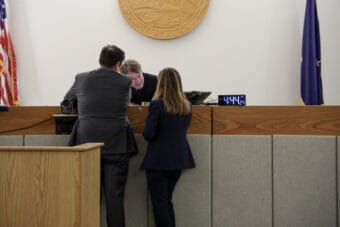
Courtroom A at the Dimond Courthouse in Juneau on Dec. 11, 2024. (Photo by Yvonne Krumrey/KTOO).

The trial for a former Juneau chiropractor accused of assaulting more than a dozen patients has once again been delayed. It was scheduled to start this week, but was pushed back at a pre-trial conference because a member of the defense team is having severe health issues. The court plans to hear the case later this year. 

Police arrested Jeffrey Fultz four years ago on three charges of sexual assault. More women have come forward since. A total of 14 women, a majority of whom are Alaska Native, have now accused Fultz of assault.

The charges are based on accusations that he assaulted patients who sought chiropractic care while he worked for Southeast Alaska Regional Health Consortium. 

Some of the charges date back more than a decade. 

The case has seen years of delays in the pre-trial process. Now the court is attempting to set a trial date for the third time. The delays have left the alleged victims in limbo, waiting for justice.

At a pre-trial conference last week, Fultz’s defense attorney, Anchorage-based James Christie, reported that his co-counsel, Wally Tetlow, is experiencing life-threatening health problems and has been advised not to travel for at least one month. Christie argued that Tetlow’s in-person participation is vital.

“So I think, I think we’re in a position where there’s, there’s really, unfortunately, we have to identify a new window for a trial date,” Christie said.

State Prosecutor Jessalyn Gillum told the judge that her team opposes the delay. 

“Given the age of the case, the number of victims, and the fact that the victims have been very clear on wanting their day in court, the state is in no other – has no other choice but to oppose this request,” she said.

Gillum acknowledged Tetlow’s health concerns, but pointed to the fact that Tetlow is not the attorney named in the case for Fultz’s defense — Christie is. She argued that his inability to participate in person shouldn’t derail the trial schedule. 

This is not the first time that the health of the defense has delayed the trial. Fultz’s previous attorney had health problems that caused delays for the majority of a year.

Several other factors have also contributed to the long wait for a trail. The investigating Juneau police officer died, then the first judge assigned to the case retired, and later Fultz’s first attorney was deemed “mentally unable” to continue with the case. 

Victims have repeatedly said in hearings that each time they have to call in to advocate for the case to go to trial, it’s traumatizing.

Fultz has been out on bail, living in Colorado with some pre-trial monitoring since 2021. He appeared in court in person once last year. 

Judge Larry Woolford, who is presiding over the case, said he was reluctant to reschedule, after the dozens of witnesses had set aside time for what is expected to be a long and complex trial. 

“I mean, certainly the parties are aware that it has been the court’s intention that this matter would be ready to go on April 21,” he said. “And we have been, I think it’s fair to say, marching steadily, if imperfectly, toward that for some time now.”

But he said Tetlow’s emergency health issues are within the bounds of what constitutes an appropriate reason for further delays. 

“This is obviously not something anybody could have predicted nor prevented,” Woolford said. 

Woolford cited recent orders from the Alaska Supreme Court to limit delays in older court cases, and said this situation abides by those new rules as well. Under that order, the defense and prosecution can request delays for up to 90 days each, and a court can consider delays for up to 90 days for “good cause.” 

Multiple witnesses who called into a hearing last week said this delay will impact the prosecution.

“I just want to remind the court that there are 14 victims that have cleared the next five weeks to make this happen,” one alleged victim said. Victims who called in did not identify themselves by name. 

Another cited the disruptions this is causing her own life. 

“I’m a therapist, and have to cancel my clients,” she said. “And it, you know, that’s a big deal too.”

Woolford said in the hearing the court is willing to extend the case into the summer, and no further. 

“The windows that I’ve outlined strike me as a reasonable compromise between the unfortunate situation in which your team finds itself, and the, I think, compelling need to get this matter to trial,” he said.

But both the prosecution and defense expressed that their teams and witnesses may not be available for much of the summer. 

A hearing to determine a future trial schedule is set for April 28. 

Site notifications
Update notification options
Subscribe to notifications