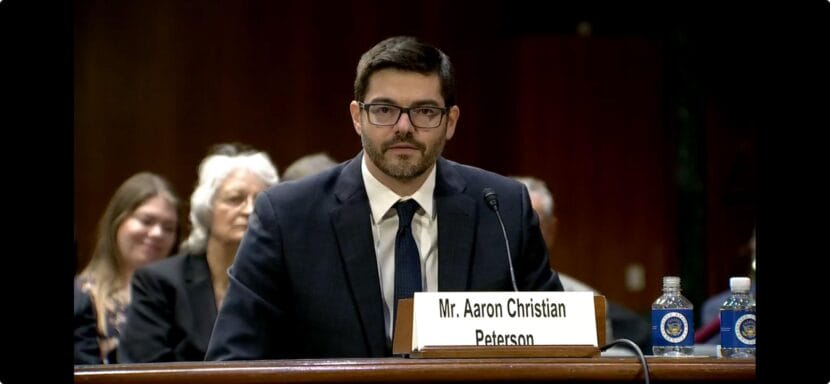
Aaron Peterson at his confirmation hearing in the U.S. Senate Judiciary Committee on Nov. 19, 2025. (Screenshot from U.S. Senate video)
WASHINGTON — The U.S. Senate on Wednesday confirmed Aaron C. Peterson of Anchorage to be a federal District Court judge in Alaska.
The vote was 58 to 39, with seven Democrats voting yes.
Peterson is in his mid-40s and was born in Anchorage. He’s an Air Force veteran and has worked at the state Department of Law since 2012. Earlier, he clerked in the Alaska Superior Court, for now-retired Superior Court Judge Michael Spaan.
“Judge Spaan approached his work diligently, with humility and always respecting every litigant that appeared before him,” Peterson said at his Senate confirmation hearing last year. “I took so much away from that clerkship, and I’ve carried those lessons with me every day since.”
Peterson, once he’s sworn in, will be the first judge to go through an advisory committee Sen. Dan Sullivan established to help select candidates for Alaska’s federal court.
He’ll be Alaska’s first new federal judge since U.S. District Court Judge Joshua Kindred resigned amid allegations of impropriety with law clerks and attorneys. Like Peterson, Kindred had the support of both U.S. senators and was nominated by President Trump.
Peterson’s swearing-in will bring the number of judges on Alaska’s U.S. District Court to two. The court still has one vacancy.
The state of Alaska’s case against a Haines man charged with animal cruelty is stuck in a holding pattern, seven months after officials first removed dozens of animals from his wildlife facility.
In September, the Office of Special Prosecutions filed three felony and two misdemeanor charges against Chilkat Valley resident Steve Kroschel, the longtime owner of the Kroschel Films Wildlife Center.
After a years-long back and forth over conditions at the center, the office alleged that Kroschel had failed to provide adequate care for his animals, in some cases causing prolonged pain, suffering and death.
The state issued a warrant for Kroschel’s arrest in late December. But there’s a catch — Kroschel says he has been in Russia since last summer, around the time when the state seized his animals. And during a recent phone interview, Kroschel said he’s staying put for now as he works to obtain Russian citizenship.
“I’m not going anywhere now for a year,” he told KHNS.
Kroschel has virtually attended a number of hearings in recent months. But there will be no trial as long as he remains overseas, Juneau Superior Court Judge Amy Mead said during last week’s hearing.
“Obviously, I would not hold a trial,” Mead said. “If you were to enter into an agreement that included a felony conviction, you would need to be here in person because that involves fingerprinting.”
Kroschel said he understood.
The hearing, which focused on how Kroschel’s defense would be handled rather than on the case itself, was scheduled in response to Kroschel’s request that he be allowed to represent himself due to his dissatisfaction with his public defender.
“I know enough about this case, right and wrong, and the protocols to do this on my own. My life is on the line here, my family, everything,” Kroschel said. “I know what I’m doing. I wish to proceed representing myself.”
Mead, the judge, walked Kroschel through the potential risks and warned him that most people who defend themselves are not successful. Then she asked if he still wished to proceed.
More than eight years after 19-year-old Kake resident Jade Williams was killed at a party, a man has been sentenced for causing her death.
On Wednesday, Superior Court Judge Marianna Carpeneti sentenced 33-year-old Isaac Friday to 20 years in prison for manslaughter. Friday has already spent several years in prison since his 2019 arrest. The judge suspended the remaining years of the sentence.
Instead of serving more time in prison, Friday will be on probation for seven years, and if he violates his probation, he will face the remaining prison time.
Williams was found dead on August 15, 2017 at a party in her family’s house in Kake, according to court documents. Investigators from Juneau didn’t reach the scene until the next afternoon. Williams and Friday, who was 24 years old at the time, had been in a relationship, and the case was tried as a domestic violence case.
Friday was first indicted in 2019 on four charges: two murder charges, a manslaughter charge, and a criminally negligent homicide charge. As part of a plea deal, Friday pleaded guilty to the manslaughter charge in February 2025. All other charges have since been dropped.
Jeremy Williams, Jade’s father, said at the sentencing hearing that his life hasn’t been the same since his daughter was killed.
“I had one job — I failed — that was to protect her,” he said. “It eats at me every day.”
Williams said he believes the sentence is just a slap on the wrist, and that his family’s experience throughout the investigation and criminal proceedings has been traumatizing.
“I really don’t know what to make of this,” he said. “It’s been a nightmare”
He said Jade had plans to go to cosmetology school in Washington, and that seeing other kids graduate and go to college makes him feel her loss, even eight years later.
But Williams said he hopes this sentencing means Jade’s family can begin to move forward.
“I hope myself, my family, my friends, his family — we could start to heal,” Williams said.
Friday’s defense attorney Eric Hedland said at the hearing he believes it’s possible that his client didn’t kill Williams. He pointed to another man at the party, who Hedland said admitted that he had been in a fight with Jade that night and had injuries consistent with an altercation. Hedland said DNA evidence that came out years after Friday’s indictment pointed to that other man. The state never filed charges against that person in connection with Williams’ death.
“I don’t know what happened. I don’t think anybody does. I don’t think the state does,” he said. “And that troubles me.”
Friday himself took the chance to speak during the sentencing Wednesday, and said he wants to be able to serve his community again.
“I’m ready to start giving back instead of taking,” he said. “I’m ready to help someone else rather than sitting in a room taking.”
Before delivering the sentence, Carpeneti said she also thinks the facts of the case remain muddled.
“None of us will ever know with a lot of clarity every event that transpired that evening and all of the harm that was done to different people,” she said.
Carpeneti said she knows the legal system can’t fix the pain Williams’ death has caused.
“There is not a sentence in the world that will restore Mr. Williams, his family, Jade’s friends and the community of Kake,” she said.
But, she said, the court’s responsibility in a plea agreement is to find an outcome that both parties — the state and the defense — will accept. Friday’s sentence, which both parties agreed to, achieves that.
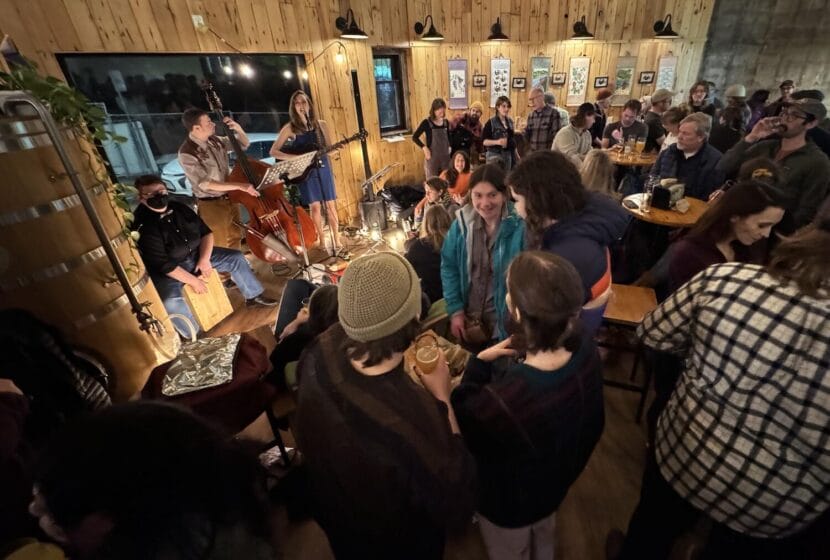
Musicians perform Sunday, Feb. 18, 2024, at Devil’s Club Brewing in Juneau. The event was among the first three allowed under a newly amended state law. (James Brooks/Alaska Beacon)
An Alaska Superior Court judge has ruled that a state law limiting live shows at breweries, distilleries and wineries in Alaska is an unconstitutional violation of the First Amendment and the Alaska Constitution’s protections for free speech.
“The speech restrictions fail the tests of strict and intermediate scrutiny, and such suppression of speech by the state cannot stand,” Zeman wrote at the conclusion of his 25-page order.
Until 2022, alcohol manufacturers were prohibited from having entertainment — including TVs, dancing, games and live music — on site. That year, as part of a sweeping modernization of the state’s alcohol laws, breweries, distilleries and wineries were allowed up to four live events per year if approved by the Alaska Alcohol and Marijuana Control Office, the state regulator.
Bars continued to be allowed an unlimited number of live events without permit; the difference in limits was billed as a political compromise necessary for the reform to pass the Legislature and become law.
Three companies — Zip Kombucha, Sweetgale Meadworks and Cider House, and Grace Ridge Brewing Company — filed suit to overturn the four-event limit, raising free-speech and equal-protection claims.
They were represented in court by a national group, the Pacific Legal Foundation. While the plaintiffs eventually dropped the equal-protection argument, the free-speech debate continued through written arguments.
Zeman ultimately concluded that the state failed to show how restricting live entertainment at breweries and distilleries, but not bars, would protect public health or safety.
“This court recognized that the challenged speech restrictions were once a critical piece of a grand compromise … however, political compromise is not recognized as a substantial government interest for the purposes of restricting speech under the First Amendment. Neither is the codification of preference for one industry actor over another,” he wrote.
While Zeman overturned a law limiting live entertainment, he upheld a law forbidding breweries, distilleries and wineries from having pool tables, dartboards and similar games, “because they are not speech.”
He also gave nodding approval to a law that restricts brewery, distillery and winery operating hours and serving sizes to less than what’s allowed for bars.
“The Legislature has, and can further address public health and safety risks associated with alcohol consumption in breweries and wineries by limiting the amount of product that can be served, the hours during which they can operate, or by reducing the cap for the number of brewery or winery licenses allowed in a given community,” he wrote.
Alaska Cabaret, Hotel, Restaurant & Retailers Association, or CHARR, a trade group representing all kinds of alcohol retailers — including bars and package stores — did not return a request for comment before the reporting deadline for this article.
An appeal to the Alaska Supreme Court is possible by either side. Representatives of the Alaska Alcohol and Marijuana Control Office and the Alaska Department of Law said those agencies were still analyzing the decision.
“AMCO does not have an opinion on the ruling and is discussing the matter with agency legal counsel,” said Jenae Erickson, acting public information officer for the Alaska Department of Commerce, Community and Economic Development, the parent agency of AMCO. “At this time, we can’t definitively state how the order will be implemented, or what Alaskans can expect. When AMCO has appropriate guidance, an advisory notice will be released.”
Donna Matias, an attorney with Pacific Legal Foundation who represented the plaintiffs, said she is “really pleased” with the decision and said Alaska limits on live events are “actually very unusual” on a national level.
“It was a political compromise, but the legislature really never had the breweries’ First Amendment rights to use as political bargaining chips,” she said, “and I think the court in this opinion recognizes that very explicitly.”
Lee Ellis, head of the government affairs committee for the Brewers Guild of Alaska, said by phone that the guild had been pushing for a legislative solution to the issue, “but we’re happy to see those entertainment live-music restrictions are finally lifted. I think it’s a win regardless, and we look forward to offering a lot of opportunities for small-time musicians to further present their craft.”
One of those musicians is Juneau singer-songwriter Marian Call, who also works as executive director of MusicAlaska, a group devoted to boosting Alaskan musicians.
Call hosted a Christmas concert in a Juneau distillery before the end of the year, one of four events allowed at that space last year.
She said her group applauds Zeman’s ruling.
“Musicians have a superpower — we can enter an empty room and fill it with people. We create economic activity out of nothing but sound waves. Many businesses benefit from our labor, but none more than restaurants, bars, and the alcohol industry at large,” she said. “Limiting music professionals’ opportunities to work as a part of the SB9 compromise was inappropriate and, as the Superior Court has now ruled, unconstitutional, since musical performance is a form of speech.”
Call said MusicAlaska would love to see Thursday’s ruling bring more music to all kinds of venues — bars, breweries and those that don’t serve alcohol at all.
“Alaskan musicians’ desire and ability to host music events is not a limited resource,” she said, “and the more we get to work, the more Alaskans get to play.”
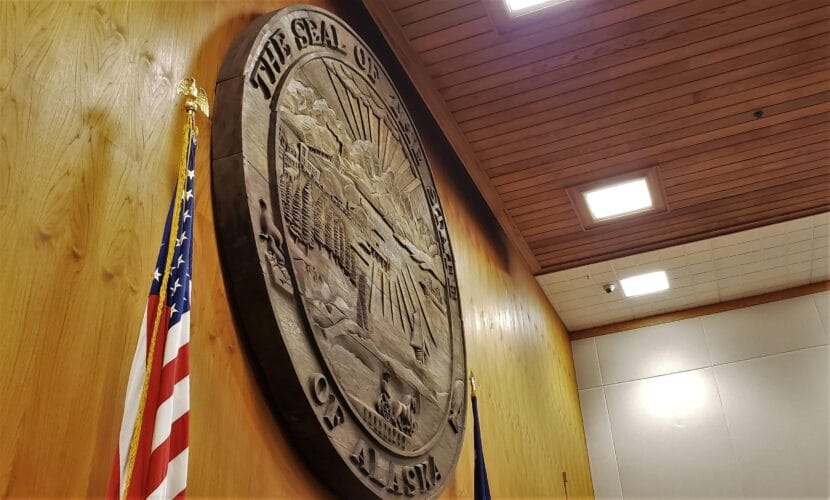
The seal of the state of Alaska hangs behind the dais at the Boney Courthouse, where a three-judge panel of the Alaska Court of Appeals heard oral arguments Thursday, Jan. 15 in the voter misconduct case of Tupe Smith. (file photo/Alaska Public Media)
The Alaska Court of Appeals took up the case of a Whittier woman Thursday who was indicted in 2023 on felony charges of voter misconduct.
Like others born in American Samoa, Tupe Smith is a U.S. national but not a U.S. citizen. Smith says she thought that meant she could vote in local elections but not presidential elections.
When filling out voter registration forms in the past, Smith and her lawyers say a Whittier city official told her to check a box that said she was a U.S. citizen, even though Smith knew she wasn’t, because the forms did not have a box for U.S. national.
That led to an investigation by Alaska State Troopers, who arrested Smith in late November 2023.
Voting rights advocates have linked Smith’s case – and a similar, separate case that includes some of her family members in Whittier – to national efforts by conservatives to end birthright citizenship in the United States. The advocates say the plight of people born in American Samoa highlights a group that is already being denied the right to vote.
After a grand jury indicted Smith in early 2024, her lawyers asked a Superior Court judge to toss the indictment, saying a trooper who testified to the grand jury had misled them on the issue of whether Smith intentionally checked the box saying she was a U.S. citizen.
The judge denied the request. But in a rare move, the Alaska Court of Appeals accepted Smith’s appeal before the Superior Court judge’s final decision and on Thursday heard oral arguments from one of her lawyers, as well as an attorney for the state.
Now, one of the main sticking points is whether the words “knowingly” and “intentionally” mean the same thing in regards to a person making a false statement on a voter registration form.
While some people might use the terms interchangeably, doing something “intentionally” requires a higher mental state – in legal terms, mens rea, or “guilty mind” in Latin – than doing something “knowingly.”
Smith’s attorney, Whitney Brown, told the three-judge Appeals Court panel Thursday that the words do not mean the same thing. In writing the law on voter misconduct, Brown said, the Legislature used both terms differently and therefore they should be understood differently.
“The record also reflects that if she had known she was not supposed to vote, she would not have done so,” Brown said. “So the state has just shown no evidence of an intent to mislead or deceive. So we believe that the court, in this instance, can take the extra step of just dismissing the indictment.”
The state wants the Appeals Court to send the case back to the Superior Court for a final decision. The state’s attorneys argue that the words “intentionally” and “knowingly” can mean the same thing.
“It’s not that she didn’t know what she was writing was false. It’s that she thought she was supposed to write something that she knew was false for these specific purposes, and that’s a little bit different,” Assistant Attorney General Kayla Doyle told the Appeals Court judges.
Doyle agreed with Brown that it was a difficult, but important, case. And there were multiple puns made in Thursday’s oral arguments – intended or not – about how intentional the Legislature had been in including the word “intentional” in the law on voter misconduct.
The Appeals Court will make a decision in the case at a later date, though it’s unclear when that will be.
The ferry terminal at Pier 1 in Kodiak is seen on July 14, 2021. (James Brooks/Alaska Beacon)
A years-old mistake by the Alaska Department of Motor Vehicles voter registration program has endangered the citizenship of two prominent Kodiak residents and could cause them to be deported, according to a newly filed lawsuit in Alaska’s federal court.
The suit, filed Thursday by Eva Benedelova and Pavel Benedela in the U.S. District Court for the District of Alaska, says U.S. Citizenship and Immigration Services canceled their citizenship oath ceremony because they were erroneously registered to vote in Alaska when they updated their driver’s licenses in 2022.
USCIS is overdue on a decision about their citizenship, the suit claims, and it asks a judge to order final action.
Attorney Margaret Stock, who is representing the couple, said there’s a bigger issue at stake: Many more Alaskans may unknowingly be facing the same problem.
According to a timeline provided by the Alaska Division of Elections, between 2022 and 2024, “less than 50” Alaskans, “mostly non citizens,” were “being registered to vote through DMV online transactions such as address updates, license renewals, etc.” despite stating that they were not U.S. citizens and did not want to register to vote.
The Division of Elections admitted the error involving the Kodiak couple, apologized, and wrote a letter saying that Benedelova and Benedela did nothing wrong. The couple never voted and immediately canceled their voter registration when they discovered the problem.
Alaska Senate President Gary Stevens, R-Kodiak, and Rep. Louise Stutes, R-Kodiak, submitted a letter of support for the couple. The office of U.S. Sen. Dan Sullivan, R-Alaska, has also been working on the case and advocating for the couple. The couple’s employer, North Pacific Seafoods, backs them too.
“The errors in 2022 and 2024 were committed by the Alaska DMV, not by these upstanding individuals,” wrote Dave Hambleton, President of North Pacific Seafoods.
Despite that support and extensive documentation about the error, USCIS sent a letter to Pavel Benedela on Dec. 5 stating that the federal agency is seeking further evidence and that “false claims to U.S. citizenship and voting violations … even renders an alien deportable.”
The couple have two children who have grown up in the United States, Stock said. If either one of them becomes a citizen, the children will, too. If they don’t, all could be deported.
“It’s an insane situation,” Stock said. “It shouldn’t be happening. It’s not right. It’s unjust. The state’s at fault, and they shouldn’t be punishing these folks because of errors made by State of Alaska employees.”
According to the complaint, the delay in the Kodiak couple’s citizenship application appears to be due in part to a federal policy implemented by USCIS in May 2025 that requires the agency’s headquarters to approve all matters where an applicant has been registered to vote in the United States.
“By the way, blanket policies like that are unlawful,” Stock said.
According to a timeline of events provided by the Alaska Division of Elections, the errors affecting the Kodiak couple and an unknown number of other Alaskans took place at the DMV between 2022 and 2024.
Alaska law allows people who update their driver’s licenses — or get new ones — to automatically register themselves to vote.
It’s supposed to be an opt-in process, but in 2022, an update to DMV’s system “cause(d) online transactions with DMV to automatically opt-in people who don’t select either yes or no,” an act that sent voter registrations to the Division of Elections, the division’s timeline states.
In the case of Benedelova and Benedela, someone along the process — likely a state employee — filled out the voter registration form in their name, copying their signatures without their knowledge or consent.
“I confirm that Mr. Benedela and Mrs. Benedelova did not specify on any DOE document that they are U.S. citizens,” wrote elections supervisor Ryan Wilson on Dec. 12. “Additionally, your signatures on the voter registration forms are a digital copy of which neither of you was aware of its use.”
Stock said that while Benedela and Benedelova are the only people who have come forward publicly about the issue, she is aware of others in the same position.
“I can tell you that I know other people the same things happen to, so it’s not just a one-off with these two people,” she said.
Stock said that in her career, she’s seen many examples of people mistakenly registered to vote because of a lack of understanding about what a citizen is, but this case is something different.
“The creepy thing is that the registration form says you’re not allowed to use an electronic signature on it, but the state’s been doing that anyway. … We have a copy of their voter registration form, and the state created that on their own, without the immigrants’ knowledge, and submitted it and checked off that they were US citizens. Some employee of the state is really doing bad things, basically,” Stock said.
A spokesperson for the Alaska Department of Administration, which oversees the DMV, did not answer questions by the deadline for this article on Friday.
The Division of Elections, which has been examining the issues for years, provided detailed documentation and explanations, as well as an apology it sent the couple.
According to its timeline of events, Benedelova was registered to vote through the DMV process in September 2022.
The division became aware of noncitizens being registered to vote by the DMV in 2023 or 2024 and worked with the DMV to reword their forms and change the process so people who opted out did not have their information sent to the division.
An additional question was also added to the process: “Are you a U.S. Citizen?”
Despite those changes, the effects of the erroneous process appear to be lingering. This summer, the U.S. Department of Justice asked Alaska and other states to provide copies of their voter rolls in order to identify noncitizens who may have illegally participated in state or local elections.
The data provided by the division and obtained by the Beacon via a public records request included an inactive voters list with 541 people whose records were tagged as “NC” for non-citizen.
Among those 541 people were Benedelova and Benedela, who had canceled their registrations in 2024 immediately after learning they had been erroneously registered.
At the time the record was released, the director of the Division of Elections said to treat it cautiously because some people might have been erroneously labeled.
“When we have gone in there and looked and contacted them, we have found that usually it was a mistake,” she said.
Close
Update notification options
Subscribe to notifications
Subscribe
Get notifications about news related to the topics you care about. You can unsubscribe anytime.