Public Safety

Finalists for new Juneau fire chief present their plans for the department

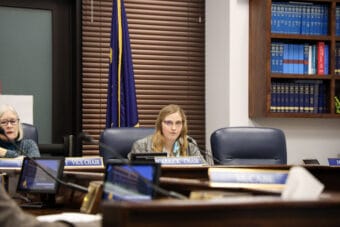
Capital City Fire/Rescue fire chief finalists Tom Hatley (left) and Sean Wisner (right) during presentations at City Hall in Juneau in December 2025. (Photos by Clarise Larson/KTOO)

Two finalists in the running for fire chief at Capital City Fire/Rescue got a chance to share their vision for the department during public presentations this week. Juneau’s city manager is expected to make a decision next week.

Finalist Sean Wisner, who presented on Monday, has been the fire chief for Alyeska Pipeline Fire & Rescue in Valdez since 2012. He’s spent more than 20 years serving in emergency services leadership roles. He founded a consulting firm that specializes in helping organizations be resilient and improve their performance.

“I’ve been in leadership positions in all sorts of complex, municipal, industrial, backcountry and critical infrastructure environments,” he said. “I think that gives me a unique perspective on a place like Juneau.”

Wisner said he’s had his eye on Juneau since he visited the capital city in 2022 to compete in the Ironman Alaska race.

The other finalist, Tom Hatley, presented on Tuesday. He served as the deputy chief for the Spokane Valley Fire Department in Washington until April of this year, when he left due to a family medical reason. He has more than 30 years of experience in fire service, holding positions like fire chief, assistant chief and fire marshal at multiple agencies in the Pacific Northwest. 

Hatley said he was drawn to the position because of the complexities of Juneau’s fire and emergency medical services. He pointed to the community’s lack of outside support, large service area and seasonal population surges. CCFR services 3,255 square miles.

“This unique operating environment is why CCFR must focus on prevention, system resilience, workforce sustainability and community-centered service delivery,” he said. 

Hatley said, as chief, he would focus on addressing staffing problems in the department, especially retaining the department’s current employees. The fire department has struggled with staffing shortages, which union officials say have led to burnout and driven people away from the department. 

The Juneau Career Firefighters Union is currently at an impasse in its negotiations over a new contract with the city.

Juneau’s Capital City Fire/Rescue Chief Rich Etheridge in downtown Juneau on Tuesday, Sept. 16, 2025. (Photo by Clarise Larson/KTOO)

“Retention must come before recruitment,” Hatley said. “Hiring new people is important, but keeping experienced, well-trained personnel is what maintains service quality and organizational stability.”

Wisner said his strategy for strengthening the department is focusing on staff mental health. He said he wants the department to be a place where employees feel empowered and supported when they need help. 

“Emotional intelligence and emotional literacy is one of the tools that we can use to get there, to create a better culture within the organization and to foster stronger mental health,” he said. 

Both finalists said they also want to increase transparency, leadership development and community engagement.

The new chief will replace outgoing Fire Chief Rich Etheridge, who announced his plans to retire in September. He has been at the helm of Capital City Fire/Rescue for more than 15 years.

The annual salary listed on the city’s website for the position is between $125,944 and $161,761.

Disaster aid deadlines extended into 2026 for those affected by Western Alaska storms

Alaska Organized Militia members, assigned to Task Force Bethel, survey Nightmute, Alaska, while conduct post-storm recovery efforts for Operation Halong Response at Oct. 27, 2025. (Courtesy photo by the Alaska National Guard)

The State of Alaska and the Federal Emergency Management Agency have extended their deadlines to apply for individual disaster assistance for those impacted by storms in Western Alaska, including Typhoon Halong.

How to apply for State of Alaska or FEMA individual assistance:

  • Online
  • Call the Alaska Call Center at 1-866-342-1699
  • Or visit an assistance hub set up in Bethel through Dec. 19.

State and federal officials are continuing to encourage residents to register for both state and federal assistance programs to maximize their potential benefits. The new deadline for applications is February 20, 2026.

“We know that there may be more people out there, and we want to give them this opportunity to register,” said Jeremy Zidek, a spokesperson for the Alaska Division of Homeland Security and Emergency Management.

Zidek urged residents to apply for both assistance programs if they have experienced any level of storm damage. He said registrations can be updated once they have been filed.

“We always say that if people are unsure about their damages or unsure if they want to apply, to just go ahead and apply,” he said. “They can always amend their application at a later date. But after those deadlines, it becomes very difficult for us to register people, so we really urge anyone that had damage, even if it was a little bit of damage, to apply and go through the process.”

The state has received 1,920 aid applications and FEMA has received 1,630 applications for assistance as of Dec. 10. The programs provide relief for damage to homes, damage to essential personal property and medical, dental or funeral needs directly related to the disaster. State disaster aid also includes assistance for damage to subsistence camps. The Small Business Administration is also providing low-interest loans, including up to $100,000 for repairs to subsistence camps.

The state and FEMA have distributed over $41 million in disaster assistance as of Nov. 25, and have visited 43 communities.

An estimated 1,160 residents evacuated from Western Alaska following Typhoon Halong, with dozens of communities sustaining damage across the region.

Since the evacuations, 678 residents have been staying in hotels in Anchorage. The first group of families began moving into longer term housing last week, according to a state update. The state’s emergency management division is working with local property owners and non-profit partners to locate apartments and housing units throughout Anchorage for long-term housing for storm displaced residents.

Officials also set a Dec. 15 deadline for owners to claim pets. Over 200 dogs were evacuated from Western Alaska after the storms, and 21 dogs remain unclaimed. Pet owners who have not yet claimed their dogs  can search for them at a website created by volunteers.

Federal disaster areas include:

    • The Northwest Arctic Borough
    • Lower Yukon Regional Education Attendance Area
  • Lower Kuskokwim Regional Education Attendance Area

State of Alaska disaster areas include:

  • North Slope Borough Northwest Arctic Borough
  • Yupiit Regional Education Attendance Area
  • Lower Kuskokwim Regional Education Attendance Area
  • Bering Straits Regional Education Attendance Area
  • Lower Yukon Regional Education Attendance Area
  • Kashunamiut Regional Education Attendance Area
  • Pribilof Islands Regional Education Attendance Area
Pollution response teams from U.S. Coast Guard Sector Western Alaska and U.S. Arctic conduct post-storm assessments in Kipnuk, Alaska, Oct. 22, 2025, after the community was impacted by severe flooding from Typhoon Halong. Personnel deployed to affected areas to identify pollution concerns and work with state, federal, and industry partners to conduct clean-up operations. (U.S. Coast Guard photo by Petty Officer 1st Class Shannon Kearney)

After a Juneau sexual assault case ended in mistrial, new defense team asks for more time to prepare next trial

Public Defender Nico Ambrose in the Dimond Courthouse on Dec. 12, 2025. (Photo by Yvonne Krumrey/KTOO)

Three months after a trial against a former Juneau chiropractor accused of sexual assault ended in mistrial, the new public defense team is asking for more time to review the case before a second trial.

Fourteen former patients accused Jeffrey Fultz of sexual assault under the guise of medical care. They say the incidents took place during medical appointments between 2014 and 2020 while he was employed at Southeast Alaska Regional Health Consortium in Juneau.

In September, his trial ended in a hung jury on 14 counts of felony sexual assault, and two not guilty counts. One of the 14 counts has since also been dismissed. The state is attempting to retry the remaining charges that are eligible to be considered again.

The court assigned Fultz a public defender in October, Juneau’s Nico Ambrose. Private attorney James Christie represented Fultz for the last two years, and through the trial this summer. Ambrose appeared in court Wednesday for the first time since taking over Fultz’s representation.

Ambrose requested the next hearing date to be in April, which will mark five years since Fultz’s initial arrest. 

“There are just so many things in this case that need to be dealt with before we’re ready for trial,” he said. 

Ambrose said he has to review trial proceedings, which lasted six weeks this summer, and hasn’t yet received transcripts from the trial. Ambrose is Fultz’s third defense attorney since his 2021 arrest. 

Earlier this year, the Alaska Supreme Court issued a ruling that would limit delays in old cases, and while this case falls into that window, Ambrose said he doesn’t think it was written with a case like this in mind. 

“This case has not sat around for 5 years waiting to go to trial,” he said. “It has gone to trial.”

State Prosecutor Krystyn Tendy disagrees with scheduling the next hearing so far out and said the case has taken years, regardless of the recent trial. Some of the alleged crimes happened more than a decade ago. 

“We have seen how this case has dragged out and can drag out,” she said. 

Tendy said the court needs to set a new trial date, and should schedule a hearing in February. 

Ambrose said having hearings sooner than April — six months after he was assigned to the case — would be a waste of the court’s time.

Judge Larry Woolford scheduled the next hearing for this case on Feb. 11 at 11:30 a.m.

CCFR aims to reduce response times for Juneau residents experiencing cardiac arrest

Capital City Fire/Rescue’s Andrew Pantiskas on Dec. 9, 2025. (Photo by Yvonne Krumrey/KTOO)

When someone experiences sudden cardiac arrest in Juneau, the average response time for Capital City Fire/Rescue is 9 minutes. 

CCFR’s EMS Program Manager Andrew Pantiskas is leading an initiative – involving the help of Juneau community members and an app called PulsePoint – to make the response time faster.

KTOO’s Mike Lane spoke with Pantiskis about this life-saving effort.

Listen:

This interview has been edited for length and clarity.

Mike Lane: There’s an effort that you’ve been helping to lead to collect the contact information from people trained in cardiopulmonary resuscitation, or CPR, and to provide training opportunities. Tell me about that. 

Andrew Pantiskas: Yeah, so we’re trying to get our cardiac arrest response to more of a community response. And what I mean by that is our average response time to a cardiac arrest when someone’s heart stops is 9 minutes across the board, and has been for the past over five to 10 years since we’ve been tracking our data. And what we’ve realized, and what most major cities down south have realized, is we need to get the community to the point that they can respond faster, start early compressions. Law enforcement agencies, military organizations, schools – the sooner we can have other trained responders start CPR, the better outcome we’re going to have for that person. Every 1 minute without good quality chest compressions is a 10% decrease in survival. And so you can kind of assume, if no one does chest compressions for about nine to 10 minutes, we’re not going to have a great outcome for that person. Now, that’s not a hard and fast definitive that it will be 100% mortality rate. It just means that the sooner we get compressions on board, the better chances we’re going to have of returning someone home to the community neurologically intact. 

Mike Lane: There’s a particular tool out there called Pulse Point, and that’s an app for your phone. Correct?

Andrew Pantiskas:  It is, yep. 

Mike Lane: So can you tell me about this and why it would be helpful for folks who live here in Juneau?

Andrew Pantiskas:  When we identify that someone might be in cardiac arrest, and our dispatchers start telling someone on the phone to start compressions, it basically pings everyone within a certain distance, whatever we set it to, and says, ‘Hey, this person here is in cardiac arrest. We need trained responders to respond. And here is your closest AED so that you can grab it on the way.’

Mike Lane: And that’s going to reduce the response time overall.

Andrew Pantiskas: Exactly.

Mike Lane:  Now, PulsePoint is not an active app in Juneau yet, but is going to be in the near future. 

Andrew Pantiskas: Yep, I don’t have an exact date. Our hope is that mid- to late-2026, we can do it. So there’s some things administratively we need to do. It’s got to be integrated into our dispatch system. What I can tell you is that CCFR is already adding in AEDs into our registry. If you do have an AED in a public location, your workplace, your religious gathering, your school, wherever it may be, and you don’t know if it’s entered, I would love it if you would send me an email. My email is andrew.pantiskas@juneau.gov. I would love to come out, photograph it and add it to our registry. That way, the day that PulsePoint is ready to go, we’ve already got them all in, and it will speed up the implementation of it. 

Mike Lane: Excellent. And now what is the reaction from Juneau residents been towards CCFR’s efforts for this? 

Andrew Pantiskas: So far, what I’ve heard is an overwhelming amount of support. This is going to drastically change how we manage our cardiac arrest. And I think that people realize that this is for their family, it’s for our community, it’s for the people who suffer out-of-hospital cardiac arrest, it’s for our friends and family.  

Mike Lane: Now, do you have a goal for how many contacts you need or want in order for the app to be effective? 

Andrew Pantiskas: To me, as long as we have one person who’s willing that could be their sooner, I see that as a win. 

Mike Lane: Tell me about any of the training opportunities in Juneau for CPR.

Andrew Pantiskas:  Absolutely. So there’s several agencies, and I apologize, I’m probably not going to list them all, but Tlingit and Haida does CPR classes. Bartlett Regional Hospital does CPR classes. We do CPR classes. While ours are mostly right now, tailored for individuals within or around CCFR, we do them. Southeast Extinguisher does them. And I know that there’s a couple others and I apologize I can’t name them off the top of my head that do them. The first thing I would do is, if anybody has any questions, email me. I can absolutely send you a list. 

Mike Lane: Who can be a user of Pulse Point? 

Andrew Pantiskas: Yeah, anybody can be a user. There’s differences in the types of responders, and we’ve not internally worked out who’s going to be a verified or unverified responder, and so on and so forth. But anyone can download the application. And so if anybody has questions on that, I would just go download it and start looking into what it does and how it does it. If you are like me or my family and travel down to Seattle or travel down somewhere else, and if you’re walking through Seattle–Tacoma International Airport airport, you might get a ping and say, ‘Oh, there’s someone in C gates who’s in cardiac arrest,’ and you could be the first person there. So if you have questions, just download it and start looking at it. 

Release date set for Alaska State Troopers TV show

A photographer films an Alaska State Trooper deplaning in Unalakleet for an upcoming reality TV series. (Ben Townsend/KNOM)

The Alaska State Troopers are returning to television with a new show set to air in January. The self-titled documentary series follows troopers responding to calls across the state, including cities in the interior and villages in rural Alaska.

Spokesperson for the troopers, Austin McDaniel, said the State of Alaska won’t be compensated for participating in the show, and instead views it as a recruiting tool. He said bringing the show back was also in response to requests to station more troopers in underserved communities.

“Many communities, especially in rural Alaska, are asking us to hire more state troopers,” McDaniel said. “To hire more state troopers we have to show people what state troopers do.”

McDaniel said the old series that began airing in 2009 drummed up thousands of job applications for the state-run police force each year. He said that number has dwindled since the show ended in 2015.

“Today, we receive hundreds [of applications]. Around 1% are successful in making it to become a state trooper,” McDaniel said. “We’re hoping to increase the number of qualified applicants that are interested in becoming state troopers.”

KNOM reported in September that at least one trooper was spotted filming during a flight between Unalakleet and Nome.

McDaniel said troopers were given a choice to participate in the show. He also said the production company behind the show, Anusia Films, followed an “in-depth process” to get consent from Alaskans featured in the series.

According to a press release from the network airing the show, A&E, the series will include “multi-agency criminal takedowns” and “life-saving search and rescue missions.” McDaniel said the hope is to give Alaskans a better understanding of how troopers spend their days.

“We hope Alaskans will see that and it will be a point of pride for the work that their law enforcement officers do to keep them safe every day,” McDaniel said.

The new season of “Alaska State Troopers” begins airing on A&E on January 7, 2026. Older seasons of the show will also be available on-demand through the A&E app.

Skagway’s lone paramedic is suing the city, alleging retaliation by fire department officials

Downtown Skagway, with snow dusting its streets, is seen in this undated photo. (Photo by C. Anderson/National Park Service)

This article was reported and published in collaboration between the Chilkat Valley News and the Alaska Beacon.

Skagway’s former paramedic is alleging wrongdoing by the Southeast Alaska town, saying in a newly filed lawsuit that she was illegally fired after submitting a grievance against the city’s fire chief and deputy fire chief.

In a lawsuit filed Nov. 20 at Juneau Superior Court, Samantha Philemon — the town’s lone licensed paramedic for much of her employment since 2023 — alleges she was fired due to disputes over recordkeeping and the department’s decision to purchase an all-terrain vehicle known as an Argo.

According to Philemon’s complaint, at the time of her firing, Skagway officials said she was being let go due to violations of HIPAA, the federal medical-privacy law. Philemon’s attorney says in the complaint that the accusation “was a sham.”

Philemon filed a formal complaint against the chief and deputy and was fired by Skagway’s deputy borough administrator the day after the complaint was resolved.

“We’re excited to have our day in court, so to speak, and we think that a jury who hears Sam’s story is going to do the right thing and understand what happened here, and we’re just looking for this to never happen again,” said her attorney, Miye D’Oench of the Anchorage-based Northern Justice Project.

Philemon said her firing has left Skagway, a town of roughly 1,100 year-round residents, without a trained paramedic.

“There are firefighters with EMT 1 and EMT 2 and some (EMT) 3 training, but there are no paramedics, and that harms the community because paramedics are trained and licensed to do things that EMTs are not,” she said.

Neither Fire Chief Emily Rauscher nor Borough Manager Emily Deach responded to requests for an interview that would allow them to respond to Philemon’s complaint.

The borough denied a public records request by the Chilkat Valley News. Robert Blasco, the city’s hired attorney, did not return messages left at his office on Friday and Monday.

Philemon moved from Mississippi to Skagway in 2023, she said, and enjoyed working with the department at first.

“I wanted to be between the mountains and the ocean,” she said.

According to the complaint, she encouraged a friend to work for the department this past summer, but when he arrived, he was told his position had funding for only one week. Philemon believed that was because the department had recently purchased an Argo.

When she raised the issue, according to the complaint, “Rauscher and Mead then turned on Ms. Philemon,” and “began silencing and excluding her from department business.” There were additional disputes about medical procedures performed by the fire department and accounting at the department..

Philemon submitted a formal grievance to the borough manager in July. The manager, Emily Deach, said in an August memo that Skagway “will take action to address the behavior and prevent reoccurrence” as well as take steps toward formalizing fire department training.

“The actions of the department supervisors do not require termination of those supervisors, as

you requested verbally,” Deach wrote to Philemon.

Philemon, who had been placed on administrative leave while the grievance was investigated, was ordered to return to work under a separate plan. She objected, concerned that she would be returning to work under the same supervisors and conditions as before, and appealed to a committee that included the Skagway Mayor.

The committee upheld Deach’s work on Sept. 10. Philemon planned to return to work, but the deputy borough manager fired her the following day.

Philemon said she’s been looking for work since then but hasn’t found success.

“I’m looking for a new job after being fired from a job that I never wanted to leave. I’m devastated because I love my job, and I love Skagway,” Philemon said.

Online court records show the case has been referred to Judge Amy Welch. No additional proceedings have yet been scheduled.

Site notifications
Update notification options
Subscribe to notifications