Public Safety

Alaska lawmakers float sending inmates out of state as prison costs mount

prison
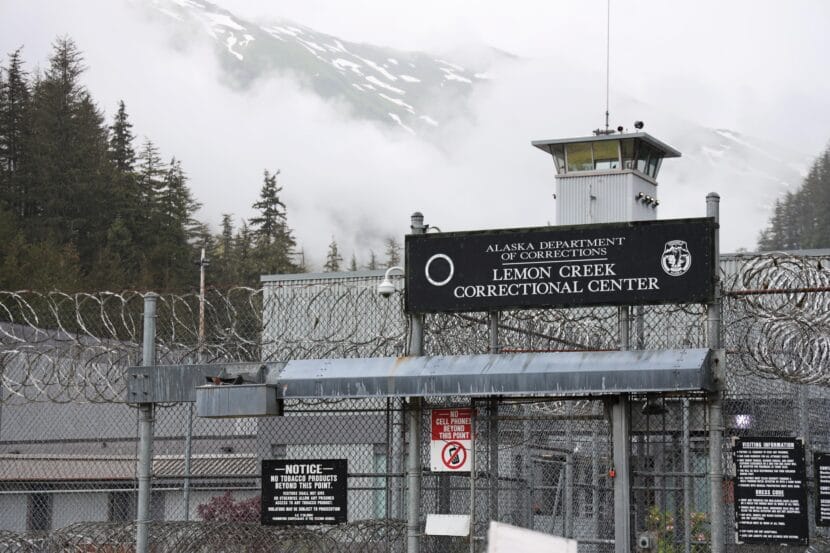
Lemon Creek Correctional Center in Juneau, Alaska in June 2023. (Clarise Larson/KTOO)

As Alaska lawmakers reckon with a tight state budget and rising costs in the Department of Corrections, some are floating an uncomfortable idea: once again sending Alaska inmates out of state.

Over the last ten years, lawmakers have boosted the Department of Corrections’ budget by 70%, and even that hasn’t been enough.

Each of the past five years, the department has had to ask lawmakers for millions more — or tens of millions more — to make ends meet. This year, the department is requesting $24 million to cover unexpected costs in the current budget.

The department’s commissioner, Jen Winkelman, told the Senate Finance Committee earlier this month that she looked every day for ways to rearrange operations to avoid budget shortfalls or overruns. Health care for inmates and overtime to make up for short staffing are the two largest cost drivers, Winkelman said.

“It is consistently … a perfect storm,” Winkelman said.

Lawmakers went as far as to close one housing unit at the Spring Creek Correctional Center in Seward last year in an effort to save money. But sometimes, Winkelman said, big expenses come up unexpectedly.

“Approximately two weeks ago, we had a large fight on the yard — 48 inmates involved in a fight,” Winkelman told a House committee on Tuesday. “Quick napkin math, we believe it to be just under $200,000 that that cost us.”

Five people were injured in the fight, and all are recovering, a department spokesperson said. But Winkelman said the cost-cutting move to close part of the prison may have played a role and ultimately resulted in a large unexpected cost.

“Those are just those anecdotal examples of the population and the complexity when we start overpopulating one area, what happens as a result due to the population we serve,” she said.

The spiraling costs have some lawmakers floating a return to a practice Alaska abandoned more than a decade ago: sending prisoners out of state to save money.

“We can’t keep going the direction we’ve been going the last few years,” said Sitka Republican Sen. Bert Stedman, a co-chair of the Finance Committee. “The operating budget is extremely strained with those items, and that’s what’s driving this discussion.”

Wasilla state Sen. Rob Yundt, a Republican in the minority, filed Senate Bill 126 last year, which if passed would direct the Department of Corrections to explore the idea to see if it saves money.

“Oftentimes we get to run legislation that we’re excited about,” Yundt said at a hearing on Tuesday. “There is none of that here.”

In the 1990s and 2000s, the state contracted with private prisons in Colorado and Arizona. By 2005, about a third of Alaska’s prisoners were held out of state in private facilities, according to news reports at the time.

One of those prisoners was Adam Barger, who spent more than a decade in out-of-state prisons after his conviction in Alaska in the 1990s. He returned in 2013 after the state opened the $240 million Goose Creek Correctional Center in the Mat-Su borough in an effort to bring Alaska’s prisoners home.

When he was transferred back, guards told him how much more difficult it was to manage prisoners who had been sent to Outside facilities than those who had not, Barger told lawmakers during public testimony on the bill.

“We were more violent, had gang affiliations, drug addictions, behavioral problems, and were more resistant to authority than those who had never been sent out of state,” Barger said. “Then, we were released back into the community.”

Some, like Barger, managed to leave the justice system behind them, he said. Barger said he earned a master’s degree and now lives in Arizona.

“For many, though, they were apt to get out and return to incarceration, often in conjunction with another charge,” Barger said. “They went back to their communities and created more victims because the behavioral issues they developed out of state had not been addressed or resolved prior to their release.”

Barger asked lawmakers to oppose Yundt’s bill.

Yundt’s bill would mandate that Alaska prisoners be kept separate from those from other states. It would also limit the prisoners that could be sent out of state to those with at least seven years left in their prison term, and Yundt said he’d like to see inmates brought back to Alaska as their release date approaches.

Sen. Löki Tobin, an Anchorage Democrat in the majority, said she sees other ways to reduce costs in the state’s prison system — like granting parole for people who are elderly, disabled or unlikely to reoffend.

Tobin said Alaska grants parole far less often than other states, and she blames the state’s parole board for keeping too many people behind bars.

“They’re engaging in double jeopardy,” Tobin said. “Folks who are up for discretionary parole, who are excellent candidates to re enter into their community safely with support, are being recommitted to incarceration.”

The parole board chair said last year that state law places strict limits on the board’s ability to grant parole.

The policy director of the Alaska chapter of the American Civil Liberties Union, Mike Garvey, said that sending prisoners out of state would cut them off from family and friends in Alaska and make them more likely to reoffend.

“Moving prisoners out of state jeopardizes the constitutional rights of prisoners in Alaska, as well as presents public safety concerns,” Garvey said. “Alaska’s Constitution guarantees prisoners the right to rehabilitation, to due process, the right to counsel and the right to adequate medical care.”

Yundt said he was sympathetic to Barger and Garver’s concerns.

“I was once a young child that would travel to see family members as well on a Sunday, and so that’s not a great situation for anyone to be in,” he said. “I wish we weren’t in the situation, but here we are.”

Democratic Juneau Sen. Jesse Kiehl, a member of the powerful Finance Committee, said he understands the cost concerns, but he’s skeptical.

“I will just express a little concern about the notion of shipping Alaskans to warehouses outside,” Kiehl said. “We’ve done that in the past. The cleanup has been both expensive and ugly, and I don’t know that that’s a long term cost we want to bear.”

To realize any savings, Winkelman said, the department would likely need to close a facility. And that brings with it a whole host of thorny questions about jobs, local economies and public safety.

But with few options to control rising costs, and a governor resistant to standalone efforts to raise revenue, it may be a choice they’re forced to make, said Sen. Lyman Hoffman, a Bethel Democrat who co-chairs the Finance Committee.

“We have a limited budget. If we are not able to pass revenue measures, we have to look at doing something,” he said. “So this is an idea that is on the plate.”

Q&A with Juneau’s Alaska Fellows Program VOAD coordinator on improving local disaster response

Akanksha Basil smiles for a photo in downtown Juneau on Wednesday, Feb. 4, 2026. (Photo by Clarise Larson/KTOO)

The Alaska Fellows Program cultivates Alaska’s next generation of leaders. It places young professionals in communities across the state, where they work alongside nonprofit and public sector organizations while receiving mentorship, housing and a modest living stipend.

In Juneau, Akanksha Basil is tasked with improving the community’s disaster response.

KTOO’s Mike Lane sat down with Basil to learn about her efforts to strengthen and streamline disaster response coordination in Juneau.

Listen:

The following transcript has been lightly edited for clarity.

Mike Lane: You’re here in Juneau, working with United Way to establish a VOAD. So what is a VOAD? And why does it matter in Alaska?

Akanksha Basil: Yeah, so VOAD, “Volunteer Organizations Assisting or Active in Disaster,” is a group of community organizations from around a particular place that mobilizes in cases or events of disaster to coordinate resources where they need to be going, depending on the type of disaster and the people affected. So you know, who’s going to come in for feeding, and who’s going to come in for shelter. Who’s taking care of, you know, debris removal and construction, and who’s also looking at kind of a long term recovery part of this. 

Mike Lane: How would a coordinated VOAD change the way Juneau responds to disasters compared to how things have been working up until this point?

Akanksha Basil: Sure, so a coordinated VOAD would streamline the process a little bit more. So currently, what’s really great about Juneau an Southeast is that we already have an established network of people that communicate and coordinate when disasters strike, but it’s more on an informal basis. But we’d like to make this process a little bit more structured and coordinated, so that we know exactly who to call in case of emergency, no matter what the prior existing connection would be, especially because organizations are changing and there’s turnover and disasters involve different different responses and different needs. So I think that having a coordinated VOAD in Juneau would make the process a lot more streamlined, stress free and fungible and adaptable, in case that was needed.

Mike Lane: And so far, what kind of organizations are currently involved or being recruited?

Akanksha Basil: So we have organizations from all kind of sectors and who take care of all different things, anyone from Juneau Animal Rescue to the food bank and Salvation Army and the Red Cross, various churches around town that already have really wonderful established feeding programs and and mutual aid networks. And I think that this is, this is a process that we’re really trying to make as public as possible. So we are really encouraging public participation, public leadership. We want to get the word out so that people know where to find us, and they know how to get involved. So any organization, anyone’s welcome, because this is a public — it’s a public process.

Mike Lane: So are there resources or support that are still needed to fully launch this particular VOAD?

Akanksha Basil: Yes, for sure. So, right now, we are a small but mighty network. We still have quite a few organizations that we need to get in touch with, reach out to, and we’re trying to get collaboration from a broader, a broader set of the population. So that’s been a major next step to look at. 

Mike Lane: From the ground up, how long does it take to build a functioning VOAD?

Akanksha Basil: Oh, that’s a good question. I would say, quite some time, right? It’s definitely a process that we’re learning about every day. It’s changing every day. We’re still really in the initial processes of figuring out how to do this. A lot of my first couple months was researching the community, getting to know people here, making connections, figuring out what past disaster responses have looked like, and we’re just just about, kind of starting to structure structured committees, create internal policy. And you know, actually wanted to mention that we’ve also held a couple meetings so far that have been really productive have spurred some really great conversations. So we’re really happy about that, too. 

Mike Lane: And how can people get involved? 

Akanksha Basil: Yes, please. I would love for people to reach out to United Way. I’ve got an email address: voad@unitedwayseak.org … I welcome anyone, anyone to reach out and share your thoughts, share your opinions, inquire more about the process. Because we’d love people, more people to be involved in this process.

Mike Lane: Akanksha Basil, thank you for joining us.

Akanksha Basil: Thank you so much. Appreciate you.

3 more families sue Bering Air a year after a deadly crash near Nome

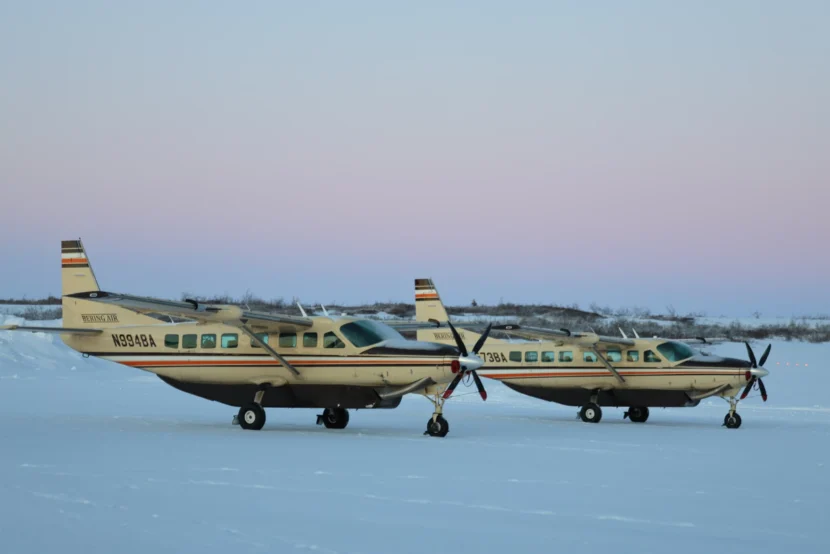
The Cessna Caravan is a mainstay in Bering Air’s fleets. Caravans were parked at the Nome Airport on Friday, Feb. 7, 2025, as a massive search was ongoing for the plane that went missing the day before on its way from Unalakleet. (Ben Townsend/KNOM)

The families of three more victims of last year’s fatal Bering Air plane crash have sued the regional airline.

The pilot and all nine passengers died when Bering Air Flight 445 crashed on sea ice on its way from Unalakleet to Nome.

A preliminary report from the National Transportation Safety Board found that the Cessna Caravan was overweight when it flew into icing conditions. The agency hasn’t yet determined the cause of the crash.

The family of one of the passengers, JaDee Moncur, filed the first wrongful death lawsuit in Nome Superior Court last week.

Two more lawsuits followed in Nome Superior Court in the days after – one filed by the family of passenger Talaluk Katchatag and another one by the families of Donnell Erickson and Kameron Hartvigson.

All of the complaints are based on the NTSB preliminary report and assert claims for wrongful death.

In a statement, Bering Air President Russell Rowe said it would be inappropriate for the company to comment on the lawsuit now “out of respect for the legal process and the families involved.”

“Bering Air continues to cooperate fully with the NTSB, the FAA, and all other appropriate authorities as their investigations continue,” Rowe wrote.

The NTSB expects to release a full report into the crash in early summer.

One phone call at a time, Kipnuk residents vote on whether to rebuild or relocate

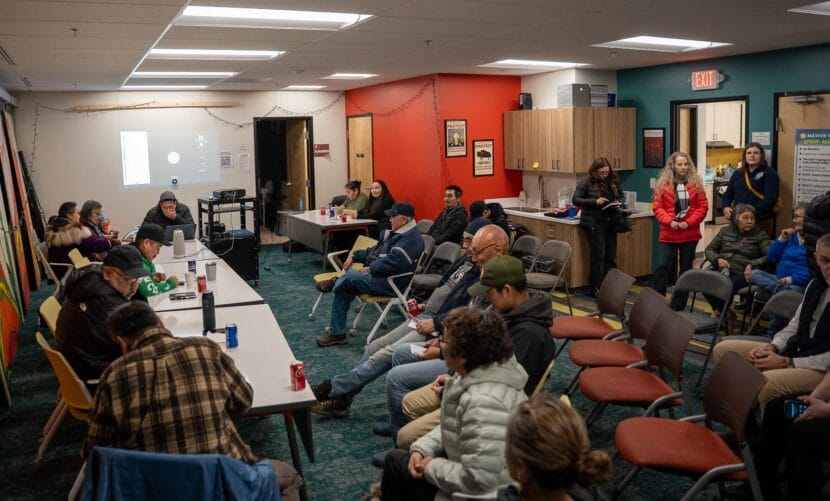
A few dozen people gathered in Anchorage on Jan. 31, 2026, while several dozen more joined virtually, to discuss whether to rebuild or relocate Kipnuk.
A few dozen people gathered in Anchorage on Jan. 31, 2026, while several dozen more joined virtually, to discuss whether to rebuild or relocate Kipnuk. (James Oh/Alaska Public Media)

Rayna Paul sat in an Anchorage office on Monday, scrolling through a spreadsheet filled with hundreds of names and phone numbers of Kipnuk tribal members.

“We are just on As,” she said with a chuckle.

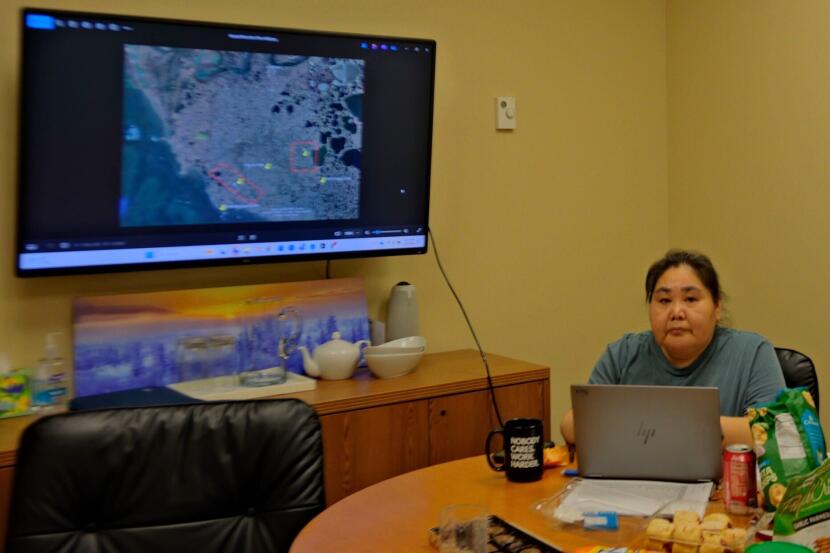
Paul is Kipnuk’s environmental director who is in charge of the village’s voting process. Over the next several days, she and her team plan to call every single adult tribal member – that’s about 900 people – and ask them a pressing question: Do they want to rebuild the village in its current location or move to higher ground?

“It’s very important for us to find out what the tribal members from Kipnuk want to do, so we can continue trying to move forward in applying for funding,” she said. “We’re always on a timeline.”

Rayna Paul and her team started reaching out to Kipnuk residents on Feb. 9, 2026, to collect their votes on whether they want to relocate or rebuild. (Alena Naiden/KNBA)

Kipnuk sits about 4 miles inland from the Bering Sea, in the Yukon-Kuskokwim Delta. Last fall’s disastrous winds and flooding destroyed homes and infrastructure there and contaminated land and water. Today, most residents remain evacuated in Bethel or Anchorage, including Paul. She said she wants the future Kipnuk to be safe.

“We love our community. We miss our community,” Paul said. “We’re doing it for our future generations to come, because they might not know what to do when this happens again. I think we’re just going to be hit with many, many storm events.”

The first community meeting about whether to relocate happened about a week ago. The decision to start voting followed swiftly.

Sheryl Musgrove, who directs the climate justice program under the Alaska Institute for Justice, is assisting the village in the process. She said residents need to act quickly to make the most of both the short construction season and the available funding for disaster recovery.

“It seems fast, but we’re four months out from the disaster,” Musgrove said. “The tribe just needs to know which direction they’re going, so that they can put their efforts into following the path forward that they determine is the best path for them.”

The relocation process can be costly, but Musgrove pointed out that so is repairing and rebuilding homes and infrastructure.

The fall storm also destroyed much of Kwigillingok and residents have already voted to relocate. Musgrove said that while the relocation of another village in the region, Newtok, took decades, she hopes that Kipnuk and Kwigillingok can be examples of how to move through this process faster.

“They don’t have decades. They need to do it immediately,” Musgrove said. “My hope is, they can show other communities that are going to be faced with this in the future, that you can rebuild someplace else – if that’s what they decide – on a short timeline as the disaster recovery process.”

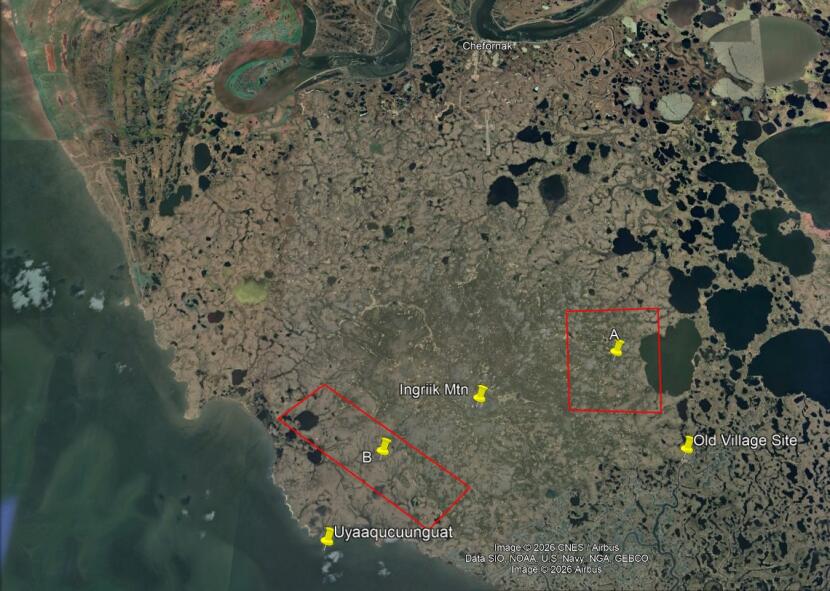
Kipnuk leadership is looking at two sites for relocation, both between the village and Chefornak. (Photo from the Native Village of Kipnuk)

Right now, Kipnuk leadership is looking at two sites for relocation. They are both between the village and Chefornak, in the area of a historical settlement called Cheeching. Both spots are located on higher ground, one close to the ocean and the second one further inland. The village would have to work with either the Chefarnrmute Corporation or U.S. Fish and Wildlife Service to obtain ownership of the sites.

During the voting process, Paul said she and her team of four will also ask residents if they want to suggest any other sites for relocation.

They still have a lot of phone calls to make. While Kipnuk was home to about 700 people, Paul said the Native Village of Kipnuk has closer to 1,240 tribal members, and about 900 of them are ages 18 or older. She said they hope to reach all the adults within a week.

“It’s hard, but it’s doable,” Paul said.

Paul said she’s unsure how long the process will actually take and when the results will be announced. She said that if Kipnuk residents don’t receive a call by Friday, they should reach out to her and provide their phone number.

A year after fatal plane crash, family sues Bering Air

The Cessna Caravan is a mainstay in Bering Air’s fleets. Caravans were parked at the Nome Airport on Friday, Feb. 7, 2025, as a massive search was ongoing for the plane that went missing the day before on its way from Unalakleet. (Ben Townsend/KNOM)

The family of one of the victims who died in a Bering Air plane crash last year is suing the regional airline. The news came a day before the anniversary of the crash, which killed all 10 people on board and shook communities in Northwest Alaska.

Bering Air Flight 445 was on its regularly scheduled route from Unalakleet to Nome when it crashed about 30 miles southeast of Nome.

The family of JaDee Moncur, one of the passengers, filed a wrongful death lawsuit in Nome Superior Court on Thursday.

“It’s a hard week one year the same week after the accident,” said Casey DuBose, an attorney with Aviation Law Group, which is based in Seattle and represents the family. “But as we’ve done our investigation, we have enough evidence, and we decided it’s time to get moving forward with this litigation so that their family can get answers and some justice out of this terrible incident.”

Bering Air did not respond to a request for comment as of Thursday.

The federal National Transportation Safety Board has not released its full investigation into the crash. However, a preliminary report found that the Cessna Caravan was almost a thousand pounds overweight when it flew into icing conditions.

The plaintiffs argue that led to the crash.

“This aircraft flew into an area of known ice, and we think that that’s ultimately the cause of what had the aircraft lose control,” DuBose said. “As you fly into icing conditions, that ice, as it accumulates on the airframe, adds an incredible amount of weight, very rapidly.”

The court complaint also alleges that the plane flew without adequate safeguards for the conditions, though that has not been confirmed by federal investigators. DuBose said the allegations are based on the NTSB’s preliminary report and an independent investigation by the law group.

JaDee Moncur. (Moncur family photo)

The crash victims included a mentor to new teachers, a school counselor and two employees with the Alaska Native Tribal Health Consortium who were traveling to service a local water plant. Moncur, 52, was one of six victims from Southcentral Alaska.

Moncur was born in Wyoming and moved to Alaska in 2008, his family had said in an obituary. An avid outdoorsman and church volunteer, Moncur worked as a project engineer and lived in Eagle River. He is survived by his wife and three adult children.

The family said in a written statement that they appreciate the outpouring of support they have received throughout the year.

“In the wake of this tragedy, we have taken legal action to seek answers and accountability regarding the circumstances of the crash,” the family said. “We hope that through this process, we can contribute to greater aviation safety so that others do not have to endure what we have.”

NTSB officials said they anticipate the final investigation into the crash to be released in early summer.

Juneau man accused of killing Anchorage cellmate found competent to stand trial on murder charges

Lawrence Fenumiai appears in court in Anchorage on February 19, 2025. Fenumiai is charged with murder after a fellow inmate died following an assault at the Anchorage jail in December 2024. (Marc Lester/ADN)

Lawrence Fenumiai, the 34-year-old Juneau man charged with killing his Anchorage jail cellmate in a December 2024 assault, will return to the criminal justice system after being found mentally competent to stand trial.

Both Fenumiai and his cellmate, 36-year-old William Farmer, were diagnosed with schizophrenia in their 20s. Their family members say the state should never have housed them together.

Less than 24 hours after Farmer entered custody, prosecutors say, the brief but violent assault occurred, leaving Farmer with a traumatic brain injury. He never regained consciousness and died at Providence Alaska Medical Center in January 2025.

Now the Alaska Department of Corrections needs to house Fenumiai again in a way that safeguards his mental state and protects others in custody with him.

Farmer’s twin sister, Robin Farmer, told the Daily News this week that her family does not want Fenumiai put through the trial process.

“What good would a guilty verdict do?” Farmer wrote in a message. “It would only put him back in the same environment and circumstances it happened in.”

Fenumiai was found incompetent to stand trial in this case three times: in February, May and August of last year, according to filings in the case.

He was found competent last month.

Judge Josie Garton presides over a competency hearing in Anchorage on February 5, 2025. (Marc Lester/ADN)

Fenumiai spent a total of 335 days in restoration programs at the Alaska Psychiatric Institute starting in February 2025, according to court filings.

The programs help prepare criminal defendants with mental illness to stand trial. In Alaska, a defendant must understand court processes enough to meaningfully assist in their defense. Otherwise, the charges against them are dismissed.

On Monday, Anchorage Superior Court Judge Josie Garton officially arraigned Fenumiai on the charges against him: first- and second-degree murder.

Fenumiai, wearing a hooded puffy coat over light blue hospital pants, attended the hearing, sitting quietly and without expression next to his attorney. A Court Services officer sat nearby.

Attorneys representing both the state and Fenumiai stressed the need for the Department of Corrections to provide safeguards as Fenumiai transitions back to jail.

Their concern is that Fenumiai could “decompensate” — become unstable or experience a sudden worsening of his symptoms — when he’s moved out of the familiar environment of API into the potentially overstimulating atmosphere at the jail.

“The state wants to be notified as soon as possible if there’s decompensation,” prosecutor Ashley McGraw said at a hearing last week, adding that prosecutors want the case to move along as quickly as possible to avoid future competency issues.

Fenumiai was supposed to be released from jail the week the fatal assault occurred in 2024. A judge had dismissed an assault case involving his father after finding Fenumiai incompetent to stand trial.

Instead, the former high school football standout was still in a general population intake unit with another man when Farmer came into their cell. Farmer was given a bed on the floor of the crowded unit in a cell intended for two people.

The incident raised questions as to how the Department of Corrections handles the challenge of housing people with diagnosed mental health disorders, who make up nearly a quarter of the state’s in-custody population.

Those questions are resurfacing now.

State corrections officials have “consistently failed” to keep people safe in custody, Robin Farmer said this week.

“They failed to keep William safe from harm, and failed to keep Mr. Fenumiai safe from causing harm. Why would anyone think they’ll do it now?” she wrote. “My family and I understand the complexities of a loved one living with mental illness, and although deeply saddened by the loss of William, believe the real criminal is the Department of Corrections and hold no personal hatred towards Mr. Fenumiai or his family.”

Fenumiai’s family declined to comment for this story.

The corrections department completed an internal review of the 2024 assault, according to spokesperson Betsy Holley.

“We are aware of comments made by Mr. Farmer’s family and understand their concerns regarding this situation,” Holley said in an email. “The Department of Corrections will not address allegations or ongoing matters in the media.”

A pedestrian walks on 40th Avenue near the Alaska Psychiatric Institute. (Marc Lester/ADN file)

While at API, Fenumiai is voluntarily taking medications prescribed to him, attorneys said during last week’s hearing. He can stay at API through the end of this week.

Medical staff at the Anchorage Correctional Complex will reach out to API staff to coordinate a “warm handoff” when Fenumiai is transferred back to the jail, assistant attorney general Kevin Dilg said during last week’s hearing. That would mean API staff familiar to Fenumiai would be directly involved as jail staff take custody of him.

Fenumiai may be housed in one of the jail’s two designated mental health units, said Dilg, who is representing the corrections department in the case. But that will depend on Fenumiai’s evaluation by staff at the jail, he said.

“I can’t really say a whole lot” until Fenumiai arrives at the jail for intake and assessment, Dilg said.

Fenumiai’s legal team may pursue an insanity defense. Under Alaska law, an arraignment starts a 10-day window for attorneys to file an insanity defense notice.

David Biegel, one of Fenumiai’s attorneys, on Monday asked Garton for a 60-day extension, a request opposed by the state. Biegel said he needs time to not only talk with his client but make sure he understands what they’re discussing.

“Mr. Fenumiai has been charged with first-degree murder. That’s the most serious crime we have in this state,” Biegel said during Monday’s hearing. “I think we all share a concern of decompensation but I don’t think that is any basis to steamroll a decision.”

It’s also possible the case will resolve via plea agreement. McGraw, the prosecutor, said the state has an approved offer.

Garton extended the insanity plea filing deadline to Feb. 17, noting that “there is an interest in this particular case in ensuring that it moves expeditiously toward trial, if it’s not going to resolve in another way, just because of the risk of decompensation.”

This story was published by the Anchorage Daily News and is republished here with permission.

Site notifications
Update notification options
Subscribe to notifications