Search & Rescue

Coast Guard Jayhawks flying in three SAR cases

Three groups of boaters throughout Southcentral and Southeastern Alaska are keeping Coast Guard aviators busy.

The 107-foot fishing vessel “Midnight Maid” began taking on water about 30 miles south of Resurrection Bay on Thursday night. Lt. Crystal Hudak, search and rescue controller for the Coast Guard in Juneau, says the wooden vessel was getting hammered by 13-foot seas. Winds were 30-knots in the area. The four crewmen of the Seward-based vessel were prepared. Hudak says they donned survival suits, grabbed a radio and an EPIRB as they climbed into a life raft. A Kodiak based H-60 helicopter hoisted them aboard and took them back to Seward about midnight last night.
Hudak says there were no reported injuries.

An H-60 helicopter will be dispatched out of Sitka on Friday morning when the fog lifts. They will search for at least four people in a skiff who were headed to Klag Bay to count salmon. They did not return to Sitka as planned on Thursday night.

The Coast Guard has rescued four men whose 19-foot aluminum boat swamped in heavy seas as they were returning from a hunting trip northwest of Cordova. The men sent a distress call on Thursday before abandoning their boat and taking their dinghy to shore. A Coast Guard helicopter located the men on a shoreline off Orca Inlet and hoisted them off the beach. They were taken to the Cordova Community Hospital for evaluation.

UPDATE: One dead, one missing after fishing vessel sinks near Kodiak

5:00 p.m. update:

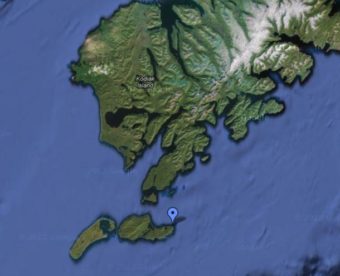
One man is dead and another missing after the Kodiak-based fishing vessel Advantage sank early this morning 14 miles southeast of Kodiak Island.

Three crew members were rescued from their liferaft by a Coast Guard helicopter around 1 a.m.

Coast Guard spokeswoman Sara Francis says none were wearing survival suits.

Leif Bolan, the skipper of the 58-foot Advantage, died after he and two crewmen were transported to Kodiak, suffering from hypothermia. The other two are reported to be recovering. Their names have not been released.

The missing crewman’s name is Jaime Gallega. The search for him was ongoing as of news time.

A signal from an emergency locator beacon was received by the Coast Guard just after midnight, and after the ship could not be raised via radio, a Jayhawk helicopter from Air Station Kodiak was sent to the scene.

There were clear skies, two- to three-foot seas and a water temperature of about 52 degrees Fahrenheit reported by the helicopter crew. The Coast Guard is investigating the sinking.

Original post:

The Coast Guard has been searching all night for one crew member still missing after a fishing boat sank south of Kodiak. An automated distress signal from the 58-foot Advantage was picked up just after midnight 50 miles southeast of Kodiak city. Three crewmen were rescued and are being treated for hypothermia.

Coast Guard civilian search and rescue controller Adam DeRocher in Juneau says when the helicopter launched from Air Station Kodiak around 1 a.m., the EPIRB satellite signal was not precise:

“While they were en route we got an ambiguity resolution, which is a positive position for the EPIRB, passed that to them. When they got on scene they located a debris field and shortly after that they located a life raft with three persons on board. So they successfully and safely hoisted the three men into the helo and transported them to awaiting EMS in kodiak, and then went back out to look for the remaining one individual that is un-located,” DeRocher said.

No names have been released yet. DeRocher says none of the rescued crewmen were wearing survival suits. He said the cause of the sinking is as yet unknown.

New England fisheries battle deadly fishing conditions

In a formation called "the worm," crewmen link up to be able to paddle against strong waves and winds to a lifeboat. (Photo by Jesse Costa/WBUR)
In a formation called “the worm,” crewmen link up to be able to paddle against strong waves and winds to a lifeboat. (Photo by Jesse Costa/WBUR)

On the fishing-boat piers of New England, nearly everyone knows a fisherman who was lost at sea.

Boat captain Joe Neves remembers when a crew member got knocked overboard. “We heard him screaming ‘Help me!’ ” Neves says, grimacing. “But you know, on the water at night, your head is like a little coconut.” They didn’t find him.

Mike Gallagher discovered a friend who was entangled in still-running hydraulics. “I knew right away he was dead,” he says.

And Fred Mattera was fishing 125 miles off the coast of Cape Cod when the 21-year-old son of a close friend succumbed to poisonous fumes in a nearby boat. “That was a brutal week in this port,” he says.

The Deadliest Catch

The Bureau of Labor Statistics ranks commercial fishing as the deadliest job in the United States. And despite the popular notion from reality TV’s Deadliest Catch, which features Alaskan crab fishermen, the most dangerous American fishery is in the Northeast.

From 2000 to 2009, workers in the Northeast’s multi-species groundfish fishery (which includes fish such as cod and haddock) were 37 times more likely to die on the job as a police officer.

A National Institute for Occupational Safety and Health report shows that 70 percent of those deaths and those in the second-deadliest fishery, Atlantic scallops, followed disasters such as a vessel catching fire, capsizing or sinking. Most of the rest came from onboard injuries or falling overboard — often caused by heavy overhead equipment.

Not one of those who fell overboard and drowned was wearing a life jacket.

An investigation by the Center for Public Integrity, NPR News and WBUR in Boston found that despite earning the odious ranking as America’s deadliest job, commercial fishing in the Northeast operates in a cultural tradition and regulatory environment that thwarts promising safety measures.

Out To Sea, Out Of Mind

Despite the strikingly high fatality rate in the fishing industry, pushes for reform have taken decades to come to fruition. In 1988, Congress required fishing boats to carry life boats, personal flotation devices and other safety equipment.

Yet while the Coast Guard mandates seaworthiness inspections of passenger ferries and other commercial vessels, fishing boats are not inspected.

“We’ve … requested authority to do inspections on vessels,” says Jack Kemerer, chief of the fishing vessels division of the Coast Guard. Congress did not include that power in the U.S. Coast Guard Authorization Act of 2010.

“So I can’t answer why or why not,” Kemerer says. “But, you know, it’s not that we haven’t asked for it in the past.”

The Last Of The Ocean Cowboys

Most fishermen don’t want to be supervised. Some are fatalistic about their life on the seas. New England fishermen used to buy steel-toed boots, believing that if they fell into the frigid Atlantic, it was better to drown faster. Others espouse a rugged individualism and see themselves as the last cowboys on the ocean.

At Chatham Harbor on Cape Cod, Bill Amaru runs one of the last cod-fishing boats from a harbor that used to be so prolific, fish markets labeled cod Chathams. Now, strict federal rules limit how much he can catch. Many other cod fishermen have gone out of business. Amaru doesn’t like the idea of the feds inspecting his boat.

“If there’s a resentment to these kinds of rules,” Amaru says as he moors his boat in the harbor, “it’s based on the overall huge number of regulations that have come down on our industry in the last decade — so much federal ‘nanny state,’ kind of telling us how to operate — when I think I have a pretty good understanding of what I need to do to keep safe.”

Still, the 2010 law requires boat owners like Amaru to prove that their safety equipment is up to date. Coast Guard checks have forced many fishermen to throw out old and disintegrating life rafts, and replace the expired batteries from their emergency signal beacons.

But just because a boat has updated safety gear doesn’t mean the crew knows how to use it.

‘We Will Make This A Safer Industry’

When Fred Mattera raced his boat to help fishermen overcome by poisonous fumes in a nearby boat in 2001, he didn’t know exactly what to do to help them. The radio was no help, either.

“What I heard there was this hodgepodge [of] try this, try that,” Mattera remembers. “And nobody knew for certain.”

When 21-year-old Steven Follett, the son of a close friend, died, Mattera was frustrated. Some people in port called him a hero for trying. “Being a hero is … someone survives,” he says, shaking his head.

Mattera told his friend he would make good come from the loss of life. “I just said, I promise you, we need to change the culture. We will make this a safer industry.”

The incident turned Mattera into a safety evangelist. Earlier this month, he helped the crews of two boats organize a disaster training and man-overboard exercise.

‘Get Your Panic Out Now!’

In one exercise, crew members clumsily put on bright orange-red survival suits. Insulated, watertight and buoyant, the suits cover each fisherman from head to toe; only their faces are exposed. They step off the boat into the calm dockside water. But even in these conditions, wearing what some guys call a “Gumby suit” feels claustrophobic to some, and they thrash around until they get their bearings.

“Get your panic out now!” Fred Matter shouts from the deck. The crew members are practicing abandoning ship in the case of a fire or capsizing. The immersion suits are designed to keep them alive and afloat in the icy Atlantic until someone can rescue them.

Mattera coaches them to link up with each other back-to-back and paddle together over to a life raft and climb in.

When it’s all over, the crew looks winded.

“There’s a ‘Holy crap!’ issue to it,” boat captain Norbert Stamps says of the training. “You jump in, you kind of realize that this isn’t fun and games. This is real serious stuff. And you gotta practice, and you gotta know what to expect.”

Crew member Mike Gallagher says fishermen-organized trainings are becoming more common. “To be honest with you,” he says, “the safety thing hasn’t really been paid much attention to until the past several years. Really, it’s been overlooked.”

Learning From Alaska

Alaskan waters had been viewed as the most hazardous place for commercial fishing — that is, until a closer focus on safety reduced the number of fatalities in those fisheries.

“I believe that fishermen want to be safe,” says National Institute for Occupational Safety and Health epidemiologist Jennifer Lincoln, who’s based in Alaska. “They just want things to be practical. They want the solutions to really address the hazards that exist.”

In Alaska, fishermen, state regulators and the Coast Guard have worked together to make fishing less deadly:

  • Bering Sea crabbing boats now transport fewer crab pots when they head out to sea. In turn, that weight limit prevented capsizing. Fatalities fell by 60 percent.
  • Because capsizing often occurred in deaths of Alaska’s salmon fishermen, skiff operators are now allowed the option of leaving immersion suits off their small boats, as long as they wear a life preserver at all times.
  • Pilot projects with life preservers designed for their working conditions encouraged scallop boats to require crew members to wear them.

That kind of safety progress is what Fred Mattera and others want to replicate in the Northeast, the home of today’s deadliest catch. Since that deadly accident in 2001, Mattera has trained hundreds of fishermen at Point Judith in Narragansett, R.I. But he’s not done.

“I’m just a fisherman,” Mattera says. “That’s what I loved, and that’s what I did for a long time. I promised a family we’d make a difference. [As long as] I’m still breathing, that’s what we’re going to strive to do.”

Mattera hopes that someday, the deadliest job in America will only be as dangerous as it has to be, and not one bit more.

Our stories about dangers in the commercial fishing industry were jointly reported by the Center for Public Integrity, WBUR in Boston and NPR News. The stories are part of CPI’s Hard Labor series on workplace safety.

81-year-old woman medevac’d from Diamond Princess

A U.S. Coast Guard helicopter crew from Air Station Sitka medevac’d a cruise ship passenger from the Diamond Princess early this morning (Tuesday).

The 81-year-old woman was showing signs of a blocked artery in her right leg.

The MH-60 Jayhawk hoisted her from the ship in Frederick Sound, north of Admiralty Island about 4:30 this morning. She was transported to Guardian Flight in Juneau and flown to Seattle for advanced care.

Sightseeing cruise strikes rock, takes on water

About 70 people were rescued on Sunday from a sightseeing boat that struck a rock near Glacier Bay waters.

The 79-foot Allen Marine vessel “Baranof Winds” reported it was taking on water Sunday morning. The Coast Guard, National Park Service, and a Holland America Cruise ship responded, said Petty Officer David Mosley with Coast Guard public affairs.

“The cruise ship was already there on scene and when they heard about the need for assistance they immediately diverted. They were there before our helicopter could get there from Sitka,” Mosley said.

Most of the passengers transferred to the cruise ship Volendam. It took them to Bartlett Cove where another vessel was planning to bring them back to Juneau.

Two passengers were transported by the National Park Service. Mosely said four crew members remained on the boat to ensure it would stay afloat until it can be towed to Sitka.

“They’re going to stay on board until they can get the vessel taken care of, meaning a response will be planned by the owner of the vessel to come out and to salvage it, to tow it back into port, where they can make repairs,” Mosley said.

The MH-60 Jayhawk helicopter from Air Station Sitka delivered a dewatering pump to the Baranof Winds. The cutter Anacapa also diverted to assist the crew.

Mosley said Coast Guard Sector Juneau is sending response personnel to investigate the cause of the grounding and look for potential fuel leaks. No pollution had been discovered as of Sunday afternoon.

Allen Marine offers tours near Juneau, Sitka and Ketchikan.

Floatplane occupants safe, brought back to Juneau

A Coast Guard Station Juneau rescue crew aboard a 45-foot Response Boat retrieves the pilot and one passenger from a disabled floatplane which performed a crash landing when one of the landing floats reportedly gave away Aug. 16, 2012. No one on the plane was injured during the event, and both were delivered to safely to Juneau. Photo courtesy of the U.S. Coast Guard and Carnival Spirit.

A floatplane ran into trouble in Tracy Arm on Thursday after a malfunction or a break in a strut for one of the floats.

The plane, identified only as a red and yellow Glasair with two people on board, activated an emergencey beacon and issued a distress call before 4:30 Thursday afternoon that was picked up by an Alaska Airlines jet.

According to the Coast Guard Command Center in Juneau, the strut came loose when the plane hit a wake while taking off.

A rescue boat from the cruise ship Carnival Spirit was dispatched to the scene in Williams Cove. The two aircraft passengers declined treatment. They were apparently not injured and waited on one of the floats of the partially submerged aircraft.

A Coast Guard 45-foot response boat picked up both of the aircraft’s occupants and brought them back to Juneau.

A mechanic will be dispatched to repair the aircraft on Friday.

Another view as a Coast Guard Station Juneau rescue crew aboard a 45-foot Response Boat arrives alongside a disabled floatplane. Photo courtesy of the U.S. Coast Guard and Carnival Spirit.
Site notifications
Update notification options
Subscribe to notifications