Search & Rescue

Leone: ‘A rapid, liquid stop’

Helo crash
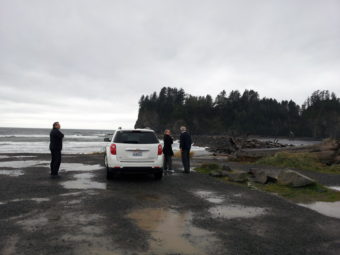
A Coast Guard crew from Station Quillayute River, Wash., along with local emergency response personnel, search the water near James Island, Wash., for crew members and wreckage from a Coast Guard Jayhawk helicopter, which crashed July 7, 2010. (Coast Guard photo by Petty Officer Nathan Litteljohn.)

Lt. Lance Leone was the only survivor of a fatal helicopter crash in 2010, in which three people from Coast Guard Air Station Sitka died. Leone was the co-pilot aboard Coast Guard Helicopter 6017 as it flew back to Sitka from Astoria, Oregon.

Leone recently talked about the mission and the events leading up to the flight, as well as his experience in the cockpit with Lieutenant Sean Krueger, the pilot in command and a longtime friend. On their way north, they saw a small Coast Guard boat leaving a station in Washington. Krueger decided to fly low over the boat.

“And he started a righthand turn down in a decreasing altitude along the coastline. At this point in the flight recorder it gets very interesting. I say “Well, that’s Quillayute.” And I say it wrong. … But I said it, and on the third time of saying it, moments later, we hit something we never saw.”

Electrical wires, stretching nearly 2,000 feet between the mainland and nearby James Island. The impact caught the chopper’s right main landing gear. Its four main rotor blades broke off, and the fuselage was torn into five pieces, coming to rest in shallow water about 150 yards northeast of the island.

Leone talked more about the crash with KCAW’s Ed Ronco in an interview that was recorded last week.

LEONE: I was in the left seat. My shoulders and my knees and my head were all banging around in the cabin for I don’t know how long. It felt very slow motion, but then there was a rapid stop, and that rapid stop quickly became a rapid liquid stop. And I was underwater, upside-down, in a helicopter.

RONCO: It happened that fast.

LEONE: It was that fast. We were flying, everything was fine, and then it blew apart. When I was underwater I didn’t know anything. It felt like the world was shaking apart.

RONCO: What did it sound like?

LEONE: Screeching? Screeching and cracking. I had double hearing protection, but it was kind of like a pounding and a screeching. I got to listen to it on the voice recorder and it is literally screeching and crashing. I don’t know how to link it to … what anyone else would hear. I guess, like a car accident?

RONCO: Was that difficult, listening to those recordings?

LEONE: I had the opportunity to read the recordings months in advance. Actually this time last year was the first time I had the ability to read through the recording and to go through and see what I had done right. I’d read the investigation and seen everything I’d done wrong, and that the crew had done wrong, because that’s what they’d focused on. But to see what I’d done right and everything I did to the best of my ability, but then to listen to it and hear the sounds, it was … I would say “troubling,” but I was ready for it, based upon my desire. I didn’t have to. My lawyers could’ve just listened to it with me outside the room, but I wanted to make sure the nonverbal made it into there.

CG 6017 left Astoria, Ore., at 8:48 a.m. PDT on July 7, 2010. At 9:41 a.m., it crashed near La Push, Wash. (KCAW map)

Leone is referring to nonverbal communications going on in the cockpit. He wanted to make sure they were part of the investigation record, which would later be summed up in what’s called a FAM, or Final Action Memo.

RONCO: The FAM says there were six minutes between impact and the time you fired off a flare. What was going on in those six minutes?

LEONE: So, after the abusive vibrations and then it stopping underwater, I did what every aviator would do out there. We train on it all the time. Yearly, we’re flipped over in a chair and go through the procedures. I did the procedures the Coast Guard taught me. I retracted my collective, found my exit, pushed the exit out of the way. Undid my cords, released my harness and pulled through the hole to get out. This is where it changed a little from what I’d done before. I was kicking to get out and I wasn’t getting to the surface. I hadn’t put my regulator in to breath underwater yet. I just assumed I’d be able to get out quicker than be able to have to put that in. Normally when we do it, it’s a slow flip in a chair. This was an unbelievably fast hitting the water. I can’t quote on how many Gs but I know there was a lot of impact having been flying through the air at 125 knots, and hitting the wires at approximately 115 feet. At that point, we were a projectile.

Leone used an emergency air supply helicopter crews carry. It’s called a HEEDS bottle, which stands for Helicopter Emergency Egress Device. It carries about 1.5 cubic feet of compressed air. How long that lasts depends on how you breathe. In training, Leone could usually get between 7 and 13 good breaths out of it. But after the crash, as he tried to find his way out of the underwater wreckage, he only managed six.

LEONE: Coming to the surface, my eyes were burning because when the 6017 crashed, we were pretty much max-fueled with JP8 jet fuel, which is very similar to kerosene. So when I came up on the surface, I was covered in kerosene. I still had my helmet on, and I started looking for anything to float on, because I couldn’t kick hard enough to keep my head and my body out of the water enough to be comfortable.

Leone broke his collarbone in the accident, and as he tried to inflate his life vest, he discovered his arms weren’t working.

LEONE: It was the first time I’d ever asked my body to do something and my body said “No.” But my wrist worked, and so I cranked my wrist against the base of the regulator, which was sitting right to my left, and for some reason, it worked, with just that little bit of wrist motion.

The vest inflated, but there were still problems. Leone’s dry suit was torn and filling with water, and although he says he wasn’t in pain, he certainly was injured.

LEONE: I had a piece of helicopter that had lodged itself in my left forearm. My right hand was fairly mutilated because of pounding against something in the helicopter. My right shin was open to the bone. The bone looked like a corncob that had been eaten – like the white, remaining husk of corn. My ankle was badly swollen. But the only real injury was a broken collarbone and a dislocated shoulder, which are both seatbelt injuries from the seatbelt that saved my life.

Now floating in the water between James Island and La Push, Washington, Leone began to look for his crewmates.

LEONE: I’d assumed based on every survival class I’d taken that everybody else would be there. I’d not taken classes where you’re the only one left to survive. You’re always part of a team. And I couldn’t find Sean, Brett and Adam. I didn’t know where they were. It was very disheartening, but I knew I had to stay afloat if I could ever figure out where they were.

Leone looked for his emergency beacon, but with his arms disabled, he couldn’t get to it. Next, he reached for a signaling mirror to try and reflect sunlight and catch someone’s attention. As he opened that pocket, out popped a pencil-sized flare. He managed to assemble it using only his fingertips. By the time he fired it into the air, a skiff from the La Push harbormaster’s office was already heading in his direction.

LEONE: As they approached me, they said “We’re going to grab you, we’ve got other people looking for the other three.” I, at that moment, had the wherewithal to tell them “I don’t want you to pull on my arms,” because I didn’t feel like they were attached. In my head, I kind of envisioned them being disconnected from my body, although my fingers worked. Because I couldn’t use the rest of them, I just pictured they were either just flopping around with nerves just connected, but with bones not… so they, with all the training that they’ve had, pulling fishing nets aboard that boat, they scooped me out of the water by dropping the gunnels of the vessel below my back and sliding me into the back of that johnboat – I call it a johnboat, but it’s just an aluminum craft. But those were the heroes of the day for me.”

Leone was taken to a nearby hospital and then medevacked to Seattle for further recovery. His parents from Maine and Florida, and his family in Sitka met him there within 12 hours.

LEONE: Ellen, my unbelievably great wife, loaded up the children, got an Alaska Airlines flight the Coast Guard booked for her, and she landed in Seattle. The pilots came on the intercom and had everyone sit down so she and the children could get off. The Coast Guard brought her directly to the hospital to see me.

Less than a week after the crash, hundreds of Sitkans, as well as high ranking Coast Guard officers and elected officials gathered at Air Station Sitka for a memorial service in honor of Krueger, Banks and Hoke. Leone was there, too.

LEONE: I had wanted to attend a memorial service in La Push, but my doctors wouldn’t let me go, because they were afraid of blood clotting.

RONCO: Were you medically ready to leave the hospital when the memorial service happened, or was that a little faster than – it just seems fast to me, I guess.

LEONE: I didn’t like being in a hospital. I don’t like being a patient. I like helping people, I don’t like being helped. I don’t know what it is about my personality. The day after the accident I asked when I could stand up and they said “Just wait one more day.” So on Day 3, I stood up, walked around, did the stairs, and on that day I started the long process of physical therapy. It was quick. Similar injuries to a car accident. Obviously physical wounds were very quick to heal. Now, the mental stuff took a lot longer.

CG 6017 ‘hit something we never saw’

Lt. Lance Leone with wire ball
U.S. Coast Guard Lt. Lance Leone holds one of the warning balls on the power lines his helicopter hit on July 7, 2010. According to a Coast Guard memo after the crash, these warning balls are half as big as the ones normally used, were faded and required replacement, and according to earlier photos, were positioned over land, leaving a large portion of the lines unmarked. The memo also states FAA regulations don’t require power lines as low as the ones in the accident to be marked. (Photo courtesy of Lt. Lance Leone)

In 2010, a Coast Guard helicopter crash in Washington state claimed the lives of three airmen from Sitka.

Today, for the first time, we’ll hear from the sole survivor of the incident, Lieutenant Lance Leone.

The MH-60 Jayhawk, known by its tail number, 6017, had been upgraded in Elizabeth City, North Carolina. An aircrew of four left Air Station Sitka to pick up the new chopper in Astoria, Oregon and fly it back to Alaska.

On July 7, 2010, during the first leg of that return flight, the helicopter struck wires near La Push, Washington, and crashed into the sea.

Lieutenant Sean Krueger, who was the pilot in command, along with Petty Officer First Class Adam Hoke and Petty Officer Second Class Brett Banks – were killed.

Leone, the co-pilot, faced criminal charges in the aftermath of the crash. Those charges were dismissed, but an official reprimand was placed on his record, and he was transferred to a desk job in San Antonio, Texas.

He spoke to KCAW’s Ed Ronco last week. It is the first time he’s talked on the record to a news organization, and we’re going to bring you the interview in three parts. Today, we begin just before the crash, which happened shortly after Leone transferred to Air Station Sitka.

LEONE: I literally had just gotten there. I was still living in a bed and breakfast in the community because my household goods had not arrived yet. So, all of our couches and stuff had not arrived yet from Elizabeth City, because it was taking a barge around the whole world. I don’t know where it went exactly.

RONCO: It felt like the whole world.

LEONE: It felt like that.

RONCO: If we can begin with when you first get to Astoria: Was it the morning of? Or the night before?

LEONE: We were assigned to fly down to Astoria in the Juliet model. 6017 was flying from Elizabeth City, which was an aircraft I’d flown before quite a bit. It was flying across the country and we were flying down from Sitka. We were going to rendezvous in Astoria, exchange paperwork on the two different aircraft, and then the pilots were going to shake hands, swap aircraft, and we were going to fly back to Sitka, and the other aircraft was going to fly back to Elizabeth City. It’s an often done thing in the Coast Guard. Our large depot maintenance is all done in Elizabeth City, so we have to switch our aircraft out.

RONCO: What does it feel like to pick up a new chopper? Is it like driving a car off a lot, or…

LEONE: So, it’s interesting — 6017, I had actually flown it the whole time I was in Elizabeth City. I’d done most of the test flights on it when it came out of the depot maintenance. I’d flown it. When we say it’s brand new, it was refurbished. We’d bought these 60s in 1991 through 1993 – that timeframe – and they’re the same aircraft. They look absolutely gorgeous always, because we have some of the best maintainers in the world. They’re not brand new, but they are totally, beautifully refurbished. The 6017 had sat in Elizabeth City and I’d flown it on cases in Elizabeth City. It was great to go from the J model to the T model. It was like a new aircraft even though they’ve just been polished and re-done from the inside, like they do with most aircraft that you fly on in the commercial world. They just replace all the parts.

Leone says he was selected for the mission two days beforehand. He and Lt. Sean Krueger, the chopper’s pilot, had met at the Academy. And although Leone had known Krueger for most of adult life, this would be one of their first times flying together. As co-pilot, Leone’s responsibility was inside the cockpit – to monitor equipment and navigate the helicopter along a safe course.

LEONE: The morning of the mishap, we all woke up, we had breakfast at a hotel in Astoria. Everyone was very happy to have had the opportunity to go to Astoria. It was one of the warmest couple days on record there. Leaving Sitka, heading down to Astoria where it was beautiful, taking the opportunity to do lots of shopping at Costco. We were all very motivated to get back home.

LEONE: We’d spent three days talking about, on the way down, what we were going to do on the way back up. How the weather, what the winds were going to be affecting. We did a lot of talking around the dinner table and the breakfast table that morning about some of the different things we were going to have to experience. The morning was fairly hurried, because we knew we had a long way to go. 900 miles with a possible 20-knot headwind depending what altitude we were at was going to make it a very long day, so we knew we had to get on the road. We got all the checklists completed, a lot of business on the ground. We took off, climbed to 800 feet, and upon reaching 800 feet, we realized we’d had a headwind that was predicted. We came right back down again to a lower altitude. It was more of an off-shore or on-shore breeze, because there are cliffs all along that shoreway there. It was an absolutely gorgeous day.

The Jayhawk had been upgraded with a new avionics system – those are the electronics that control the helicopter. It included a new autopilot system. Leone refers to it as a “coupler.”

LEONE: When you cross through into Canadian airspace, you have to tell them exactly what time and what location you’ll be crossing into that airspace. So I set that track, I told them how far away it was, and I engaged our auto pilot, which couples up the flight controls with the path I’d set. The path was an offshore path that hit a point on the Canadian airspace, which we would then tell them we were going to fly through there.

RONCO: So Canadian authorities know exactly where you’re going to be, and that that’s you.

LEONE: Correct. We were making jokes about it. I don’t think Canadians ever shot down an American plane headed north. It’s way more important going into American airspace, but you give them the same courtesy that they give us.

Krueger was an experienced pilot whose career included a three-year exchange program with the British Royal Navy. But Leone was more experienced on the revamped helicopter’s systems, especially the autopilot.

LEONE: I was very excited to show him how you can engage it. It will fly itself. As long as you keep it away from obstacles and have the right altitude it will fly you safely to wherever you tell it to fly you.

By this time, Coast Guard 6017 was nearing La Push, Washington. The small town on the Olympic Peninsula is home to the Quileute Tribe, as well as a small Coast Guard boat station.

LEONE: We both saw something up ahead. It was a Coast Guard cutter leaving port – actually, a CG small boat, a 47-footer, leaving (Station) Quillayute (River).

The helicopter was flying at 220 feet when Krueger began flying it toward the boat. Leone says it’s a maneuver pilots often perform at sea when checking on fishing boats or spotting a Coast Guard vessel. The Coast Guard’s report on the accident acknowledges that performing the maneuver is not isolated to this incident, but says vessels should not be – quote – “zoomed” except in an emergency or during rescue operations. Leone describes the next 42 seconds, when Helicopter 6017 slowed to 115 knots, descended to 114 feet, and passed over the boat.

LEONE: At this time, he (Krueger) said “coupler disengaged” and he started a righthand turn down in a decreasing altitude along the coastline. At this point in the flight recorder it gets very interesting. I say “Well, that’s Quillayute.” And I say it wrong. I can’t read it. It’s a very difficult word. It’s like many Tlingit terms that are hard for us to read in our language. But I said it, and on the third time of saying it, moments later, we hit something we never saw. And … I was … at that moment, everything changed.

That’s Coast Guard Lt. Lance Leone, recorded last week (Nov 12) at the studios of Texas Public Radio in San Antonio. His attorney, John Smith, listened in on the conversation from his office near Washington, D.C., but did not prevent his client from answering any of our questions.

Tomorrow, Leone describes the accident, and how it changed his life and his career forever.

“We were flying, everything was fine, and then it blew apart. When I was underwater I didn’t know anything. It felt like the world was shaking apart.”

Coast Guard reports rescue of tug crew

Five people were reported rescued Wednesday morning after their tug and barge went aground on the Aleutian Chain.

The 78-foot tug ‘Polar Wind’ and the barge ran hard aground in Pavlov Bay Tuesday night in eight-foot seas and 30-knot winds.

A Coast Guard H-60 helicopter from Kodiak hoisted two crewman aboard and an H-65 helicopter from the cutter Sherman hoisted the other three crew. They were all taken to nearby Cold Bay on Wednesday morning.

No injuries reported and no pollution reported so far. The Coast Guard says overflights of the grounding site are likely. The owner of the tug is also expected to the salvage the vessel.

Firefighters fight downtown blaze

Firefighters battle the blaze.

Capital City Fire and Rescue spent Monday night fighting a blaze at the Gastineau Apartments in downtown Juneau.

Division Chief Brian Long said the initial report of a fire came in about 5 p.m. He estimated between 50 and 60 firefighters responded and were still on the scene at 10 p.m.

“The fire started on the fourth floor, spread rapidly, smoke pressed through all floors of the structure,” said Long. “We did not get all clears on any searches yet, we don’t know the status of all the victims inside, and we’ve had one civilian and one firefighter transported to the hospital for injuries.”

Long said many of the firefighters would remain on-scene through this morning to continue dousing hot spots.

He said the two confirmed injuries were non-life threatening. But he was unable to say if there were more serious injuries or people stuck inside while the building burned. He said that would have to wait until the flames were completely doused and firefighters were able to safely enter the structure.

“We’ve got to wait until the fire is completely out. Then we have to drain all the water from the building,” Long said. “There’s three feet of standing water on every floor up there. So we’ve got to drain all the water out of the structure, make sure it’s safe to enter, and then we’ll have to search every room and make sure that there’s no victims.”

James Barrett owns the Gastineau Apartments. He said as far as he knows all tenants were able to make it to safety.

[quote]”My understanding is everybody is accounted for and taken care of,” Barrett said.[/quote]

He was one of hundreds of people who gathered on South Franklin and Front Streets to watch as huge orange flames and black smoke billowed out of the building. He called the fire “devastating.”

[quote]”I’ve spent years working on this building and trying to renovate it and make it a nice place for people to live,” Barrett said. “So yeah, it’s absolutely devastating.”[/quote] Barrett, who also owns the Bergman Hotel, said he was offering free rooms there for residents displaced by the fire.

City and Borough of Juneau Emergency Programs Manager Tom Mattice said the Red Cross also established an emergency shelter at Centennial Hall.

[quote]”There’s drinks there and cots there and blankets there and people there to take care of them,” Mattice said. “We’re just making sure everybody downtown’s got a place to be for the night.”[/quote]

Mattice said the fire didn’t appear to spread to any other structures, but some nearby buildings including the Baranof Hotel were evacuated due to heavy smoke.

Alaska Electric Light and Power also shut off electricity throughout much of downtown Juneau while firefighters battled the blaze.

The Juneau Assembly canceled its regularly scheduled meeting last night.

Mattice said he’d have to wait until today to figure out how many people were displaced.

[quote]”The Centennial Hall numbers are really low compared to the numbers we assume are displaced,” said Mattice at about 9:30 last night. “But people find friends and they’re still watching the fire.”[/quote]

Gastineau Apartments resident Noel Koppisch left the building with his dog Abby right after the fire started. He talked with Red Cross volunteers at Centennial Hall before deciding to take a room at the Bergman.

[quote]”They told us to get out, we were on the second floor, so we left,” Koppisch said. “She’s a Great Dane. If she’s not with daddy, she freaks out. She’s definitely a daddy’s girl. I go where she goes. Obviously I lost everything but I have her, and that’s all that matters. I talked to one of the firefighters and yeah, it’s gone.”[/quote]

Caleb Smith lived on the third floor of the apartment building. He said police officers alerted residents to the fire at about 5 p.m.

[quote]”I was actually asleep, my dad came and opened my door and said ‘wake up, we got to go,'” Smith said. “And then, as soon as I came out of my room I seen the cops, running back and forth in the hallway, pretty much ran out of the house right then, didn’t really have time to grab anything right then and there.”[/quote]

Barrett, the owner of the Gastineau Apartments, reported that an unattended candle was the cause of the fire. However, that hasn’t been confirmed by fire officials.

Barrett said the property is insured.

Brian Long with Capital City Fire and Rescue did not know the extent of the damage, but said it would be significant. He said an investigation was already underway last night, but fire officials would have to tour the building before determining the exact cause.

Original post, 6 p.m. 11/5/12

Firefighters are still trying to extinguish a fire at a downtown Juneau building.

KTOO’s Casey Kelly reports that the fire seems contained to the top floor of the Gastineau Apartments only, but there is still a lot of smoke coming from the building.

Capital City Fire and Rescue was called out to the Gastineau Apartments (next to the Elks) on South Franklin Street between 5:00 and 5:30 Monday evening. At about 5:30, there was an all-call for all career and volunteer firefighters.

A ladder from a ladder truck had been extended to the building, but then retracted.

Flames were reported in the interior of the structure about 6 o’clock.

Electricity was cut to the area at approximately 6:10 p.m and restored sometime before 9:45.

Firefighters reported difficulty keeping the street and area clear of spectators.

Some residents of the building were reportedly trapped inside.

Kelly reports that he saw at least one ambulance leave the Gastineau Apts. earlier and firefighters carry another man out of the building.

Two confirmed non-life threatening injuries reported so far.  A firefighter and a building resident both sustained injuries. No fatalities reported yet.

City manager Kim Kiefer said earlier that the Baranof Hotel was being evacuated. An emergency shelter is currently set up at Centennial Hall.

Five members of the Alaska National Guard assisted with perimeter security.

According to building owner James Barrett of the Gastineau Apartments, all residents have been accounted for and are safe. Barrett also reports that an unattended candle was the source of the fire, however that has not been confirmed with fire officials.

(This is a developing story that will be updated throughout the night. Check back later for details.)


[youtube https://www.youtube.com/watch?v=CgU9jCKW-8k]


Coast Guard takes diver to Kodiak

A Coast Guard helicopter crew from Air Station Kodiak medevac’d a diver from a 48-foot fishing vessel in Alitak Bay late Monday night. The unidentified 24-year-old was suffering from shortness of breath and was in and out of consciousness when he was lifted from the fishing vessel Patricia Kay at about 10:30 p.m.

The crewman reportedly had been diving for sea cucumbers when he apparently ran out of air and was forced to surface quickly. The crew of the vessel performed CPR while the master of the Patricia Kay called for assistance.

The Coast Guard was notified at about 8:30 of the emergency. The man was flown to Kodiak and transferred to local EMTs in stable condition.

There were 17 mph winds at the time of the medevac, with calm seas and an air temperature of 34 degrees Fahrenheit. The Patricia Kay is homeported in Kodiak.

Update: Coast Guard suspends search for missing Haines fisherman

Update, 9:00 p.m.

The Coast Guard suspended its search for a 62-year-old Haines fisherman who went overboard Tuesday afternoon near Skagway. The news came in press release issued shortly before 8:00 p.m. Tuesday.

At about 12:40 p.m., Coast Guard Sector Juneau received a call from a Skagway police officer reporting the man had gone overboard from the fishing vessel Darlin’ Michelle.

The search covered 20 square miles and included a Coast Guard MH-60 Jayhawk helicopter from Air Station Sitka, a HC-130 airplane based at Air Station Sacramento, Skagway emergency response personnel, Alaska State Troopers, three good Samaritan vessels, and a Temsco helicopter.

“It is always a very hard decision to make when you have to suspend a search for a man overboard,” Sector Juneau watchstander Nick Meyers said in the Coast Guard press release.

Winds in the search area were reportedly 35 miles per hour, with 2 foot seas.

This is a developing story. Check back for updates.

Original post, 5:15 p.m.

The Coast Guard was notified about 12:40 p.m. Tuesday that a 62-year-old man was missing from the fishing vessel Darlin’ Michelle in the fjord between Haines and Skagway.

A deckhand was on board at the time and made the call to the Coast Guard, according to Lt. Ryan Erickson.

A Jayhawk helicopter and C-130 from Air Station Sitka were dispatched to the scene. A Wings of Alaska plane on a scheduled flight from Haines to Skagway and a tour company helicopter from Skagway assisted with the air search. An Alaska State Troopers’ boat and fishing vessels from Haines were helping with the search on water.

Darlin’ Michelle is captained by Haines fisherman Ted Lynch. Several independent reports from searchers identified Lynch as the missing fisherman, who was commercial shrimping in the Tayia Inlet between Haines and Skagway.

Skies were clear and sunny in the area Tuesday afternoon. But the National Weather Service has a gale warning in effect through Tuesday evening for the Upper Lynn Canal with a north wind of 35 knots and gusts up to 50 knots forecasted. Seas were expected to reach 7 feet.


View Missing Haines fisherman in a larger map

Site notifications
Update notification options
Subscribe to notifications