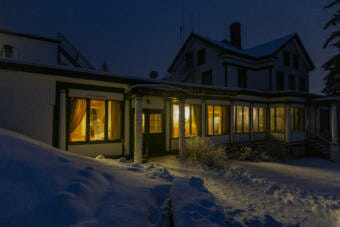
A landslide in Haines swept houses, trees and debris across Beach Road and into the bay in front of town on Wednesday (Photo courtesy Greg Bigsby)
Searchers will continue to look Thursday for two people still missing after a large landslide rumbled through a residential area on Beach Road in Haines Wednesday afternoon, destroying at least four houses, according to the Alaska State Troopers.
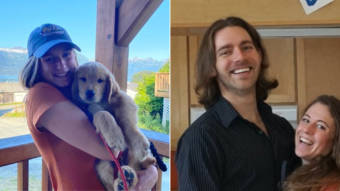
On Thursday morning, Haines Mayor Douglas Olerud identified the two missing residents. They are Jenae Larson and David Simmons.
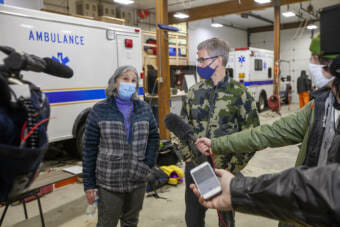
“The side of the mountain has completely pushed them down to the waterline and into the water. The water was full of debris from pieces of the houses,” said Haines Fire Chief Al Giddings. “While we were on site, the ground began to rumble again like a locomotive.”
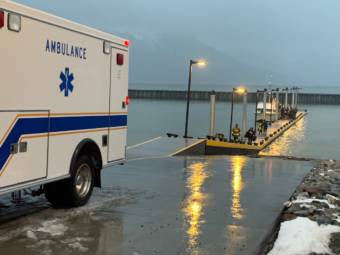
Witnesses have estimated the slide spans hundreds of feet across. It’s a muddy smear down the side of the mountain south of Haines. Rubble from homes drifted in Lynn Canal below as the light faded Wednesday.
Searchers suspended operations late Wednesday as the slide continued to move. Six people were originally feared missing, but four were found safe by Thursday morning. Troopers said there were nine feet of mud and trees covering the area. Surrounding homes were evacuated, and a helicopter planned to deploy at sunrise to continue surveying by air.
A UH-60 Black Hawk helicopter from the Alaska Army National Guard in Juneau, prepares to take search and rescue crew to Haines on Thursday, Dec. 3, 2020. (Alaska Army National Guard courtesy photo by 1st Lt. David Marshall)
Record downpours brought at least eight inches of rain in a span of 48 hours from Tuesday to Wednesday, and the rain continued overnight. The heavy rain melted snowpack in the uplands and saturated the soil, which contributed to the instability of the hillside.
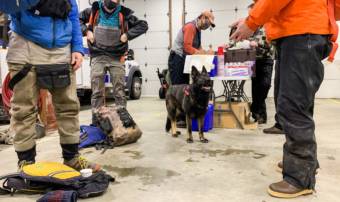
Gov. Mike Dunleavy sent thoughts and prayers along with “assets from the Alaska State Troopers and the Alaska National Guard,” according to a Wednesday evening statement. Giddings said a mountain rescue team and up to eight members of Juneau’s Capital City Fire/Rescue were activated, as were personnel from Sitka, Skagway and other communities. The Coast Guard will also assist, along with local volunteers.
On Wednesday night Giddings erected a command center at the public safety building in downtown Haines. He’s acting as incident commander to coordinate the effort as help arrives from across the region.
“We have, unconfirmed, possible six people that are unaccounted for. But two confirmed that are unaccounted for. So that’s all we have right now. …We’re not losing hope,” he said.
Salvation Army Captain Kevin Woods spent Wednesday helping evacuees find shelter. That’s after his road washed out and a neighbor picked him and his wife up along the highway.
“We worked on getting people in motels, and getting some food and some dry clothes and and just making them as comfortable as possible,” he said.
Woods estimates there are as many as 20 hotel rooms occupied by displaced residents.
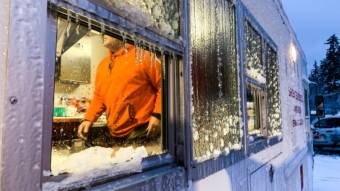
A mobile canteen — a specialized disaster vehicle — is on its way from Juneau to help feed those affected by the natural disaster.
State transportation road crews are actively working to repair the highway and keep supplies flowing. Dozens of roads were damaged or obstructed by flooding and fallen trees.
The National Weather Service is forecasting a mix of rain and snow for the rest of the week.
Editor Julia O’Malley contributed to this report from Anchorage.
A screengrab from Coast Guard video shows rescue swimmer Grant Roberts (left) and survivor Kurt Brodersen (right), holding on to all that remains of Brodersen’s boat “Irony” — the hatch cover. (Courtesy U.S. Coast Guard)
When a retired Southeast Alaska fisherman found himself adrift after his boat suddenly sank in a storm, he didn’t expect to be rescued. But a gadget on board alerted the Coast Guard, saving the 70-year-old man’s life.
For more than two hours, four members of the U.S. Coast Guard traveled in an MH-60 Jayhawk helicopter, battling blistering, 50-mph headwinds.
In a Coast Guard video, crew members can be heard after spotting a lone figure clinging to a piece of debris: “We just need to get him out of there quick, the quicker the better.”
Union Bay, Alaska (via Google Maps)
Seas were rough in the expanse of water between Ketchikan and Wrangell. Waves as tall as houses made it difficult to keep eyes on the figure, protected by a survival suit.
“As we made our approach to the flashing light, we lost sight of the survivor in the water with our cameras,” said Coast Guard pilot Lieutenant Justin Neal, who was in charge of the mission.
“We were in high winds, seas were 10 to 12 feet, trying to maintain a stable hover, and trying to relocate the survivor in the water,” Neal said. “We knew he was very close to us. But there was a moment there — maybe five minutes — where we were frantically searching with our cameras to try to find him again.”
Once the crew spotted the man again, Petty Officer Grant Roberts was lowered into the water, where he spent about 20 minutes in the pitch-dark trying to reach the man, who was clinging to something in the rolling waves.
In a video released by the Coast Guard, Roberts reaches the floating debris. Roberts helps the man into the water, and lays behind him in a sort of ‘Jack and Rose at the bow of the Titanic’ pose.
https://www.youtube.com/watch?v=iDQwCw-Xl7o
The man was 70-year-old retired fisherman Kurt Brodersen.
“It never occurred to me anybody was gonna come and get me,” Brodersen said in an interview a couple of weeks after the sinking. He says when he saw his 42-foot boat — named “Irony” — taking on water, he donned his survival suit, planning to abandon ship in the skiff. By the time he got his suit on, the skiff had sunk too.
“The hatch cover was floating off, and I got on the hatch cover,” Brodersen narrated. “My plan was to just stay there until it took me wherever the weather was going to take me. But when I got about halfway across Union Bay, I saw this red light in the sky. And I remember thinking, I wonder what those guys are doing out in these miserable conditions. After a while, I realized they were looking for me.”
Although Brodersen says he hadn’t checked the batteries in the rescue beacon in a few years, his EPIRB — Emergency Position Indicating Radio Beacon — was still working. The device automatically transmits a radio signal that rescuers hone in on.
As it went down with the ship on November 1, the EPIRB started transmitting at precisely 4:46 p.m. The Sitka-based Coast Guard helicopter crew was in the air and on the hunt within half an hour.
The November 1 rescue team, from left to right: LTJG Jon Orthman, AST3 Grant Roberts, AET2 Jimmy Schwader, LT Justin Neal (Courtesy U.S. Coast Guard)
Jimmy Schwader was on the mission that night. Schwader was the flight mechanic, tasked with running the winch that would raise and lower a rescue swimmer, and a survivor, if they found one.
“It was probably the worst seas that I’ve ever hoisted in,” Schwader said.
After more than three hours in the frigid bay, Brodersen was lifted out of the water. As he and rescue swimmer Grant Roberts dangled from the hovering helicopter, Schwader spooled the two up.
Lt. Neal, the aircraft commander, has been an armed forces pilot for 14 years. He says the high winds, 10-to-12-foot waves and pitch black made for one of the toughest rescues he’s ever done.
“This is probably the most challenging conditions that I’ve flown in and is absolutely the most challenging rescue that I’ve been able to prosecute,” Neal said.
The weather conditions that night made transporting Brodersen to Ketchikan for medical treatment a mission of its own. The Coast Guard crew ended up having to spend the night in Ketchikan because of dangerous wind gusts and power outages around the city.
Brodersen, the survivor, was fortunate to get to Ketchikan’s PeaceHealth Medical Center when he did. He’d had a heart attack, and was suffering from hypothermia and cold-induced rhabdomyolysis — a kind of muscle death.
He’s since been released from the hospital, but he remains in town. Doctors want to keep him nearby for observation, especially since Brodersen has epilepsy. Brodersen says epilepsy has had a profound impact on his life. He’s even captained his boat during an episode, without remembering how.
But it was no accident that Brodersen had taken his boat into open water during a storm.
After retiring from commercial fishing, Brodersen lived full-time on the Irony. The property where he would usually anchor the boat is exposed; he calls the area “The Blowhole.”
“It [gets] really bad williwaws, which are dangerous winds. If I know it’s gonna blow, I get out of there. I go up into the head of Union Bay and anchor, which I thought was supposed to be safe. Before last week, it has been [safe],” Brodersen explained.
The veteran mariner isn’t sure what went wrong on board. The anchored, steel-hulled vessel would usually be fine in rough seas.
“It’ll lay over, but then right itself because of the buoyancy of the boat. And this time, it didn’t right itself. I don’t know what happened. After a few seconds, I thought, ‘I don’t know what to do, I’m gonna start the engine and put it in gear and get bow into the weather,’ and the engine wouldn’t start. It’s the first time it’s ever failed to start. Apparently, there was already water going up the engine.”
Brodersen says he lost everything in the shipwreck: “Everything. All my records, my tax stuff, and all my clothes, everything that I had. Which is, in a way, sort of liberating because I’m starting fresh. Just the clothes that I’m wearing. The problem that I’m having is, I don’t know, I don’t exactly have a goal for the rest of my life. But you know, maybe something will occur to me.”
The Coast Guard says there’s no trace of the Irony. The only sign of the boat was the hatch cover Brodersen had clung to, and the EPIRB signal. Just the signal — the Coast Guard never found the device.
A friend offered to pay to help Brodersen search for the fishing boat that had been his home for decades. But he’s not interested in salvaging it.
“I was afraid I’d find it, and then I’d have this unholy mess to try to clean up,” Brodersen explained.
The offer of help was appreciated, though. Brodersen was stunned by how many other offers there have been since the calamity.
“In some ways,” he said, “it was one of the best events in my life. For one thing, I don’t have to do all the maintenance on the boat anymore. And for another thing, so many people tried so hard to help me, offering me places to stay, and everything really. I mean, it’s been kind of a unique event in my life.”
Brodersen says he hasn’t decided what he’ll do next. He’s still getting medical treatment in Ketchikan, and working out his epilepsy treatment. Normally, this time of year, he’d be anchored in the Zimovia Strait, looking at Wrangell Island.
“Guess I won’t be doing that anymore,” he said, laughing.
Brodersen and the Coast Guard say the somewhat miraculous rescue is really thanks to the EPIRB.
“They’re not the cheapest thing to buy, but they save lives. They work,” said Jimmy Schwader, the flight mechanic.
If you’re going out on the water, they say, make sure your EPIRB is working. Fresh batteries might just save your life.
NOTE: Mr. Brodersen has asked to not be contacted by other media.
The F/V Scandies Rose sank west of Kodiak on Dec. 31, 2019. (Photo courtesy of Bret Newbaker)
A $9 million settlement will be paid to survivors and families of those lost at sea last New Year’s Eve after a Dutch Harbor fishing vessel sank off the Alaska Peninsula.
The company that owned the fishing vessel Scandies Rose will pay out from its insurance policy to the families of four deceased fishermen and two survivors that worked on the 130-foot crab boat.
Earlier this year, attorneys for the survivors and families of deceased crewmates filed claims on their behalf, alleging that the Scandies Rose went down because it wasn’t seaworthy for the freezing conditions at sea when it left Kodiak and that they were entitled to damages.
“They carried a full load of pots and proceeded into some known icing conditions, which we feel was a major cause of the accident,” said Jerry Markham, a Kodiak attorney who represents the families of three of the deceased.
But neither side is seeking to formally cast blame in court now that a cash settlement has been reached.
“This takes care of everyone’s claims against the vessel,” said Mike Barcott, a Seattle-based attorney representing the vessel owners, Scandies Rose Fishing Company and Mattsen Management.
How the settlement will be divided between the survivors and families of the deceased will likely be done in private, either through mediation or arbitration, he added.
Captain Gary Cobban Jr. of Kodiak owned a stake in the Scandies Rose. He and his son perished when the vessel sank during a storm while on its way to the Bering Sea for Pacific cod and crab.
Barcott said the skipper’s next of kin is not part of this arrangement; his family will be receiving a separate settlement through insurance.
The settlement ends litigation that was headed to trial next spring in Washington state. That means assigning blame for the tragedy will not be decided in a courtroom.
“The trial would have decided if the vessel and her owners had been negligent in some way,” Barcott said. “It would not have divided up the verdict among the parties. This was just a ‘who’s responsible’ trial. And now that’s not necessary.”
But some of the questions raised in the lawsuit may be addressed during a formal inquiry by the Coast Guard Marine Board of Investigation. It’s slated to begin hearings into the incident on Feb. 22 in Seattle.
Barcott said the majority of maritime claims that involve lost ships end in a cash settlement. Trials, he said, rarely bring closure.
“Trials in an incident like this are wrought with emotions, and 99 percent of these cases involving vessel sinkings settle,” Barcott said. “The question is always how much is the settlement. The owners thought this was a terrific vessel, they thought Gary Cobban was a terrific skipper, and to vindicate themselves, they would have liked to have gone to trial. But they also understand there are some estates that are grieving, and it’s frankly better for everyone not to go through the process of the trial. It’s really hard to go through a trial like this. It’s hard on everybody.”
Jerry Markham, the Kodiak attorney who says he’s handled more than a dozen similar cases, echoed that sentiment.
“I think the families are relieved that they don’t have to go to court and cast stones on all the reasons why the accident happened,” Markham said. “It’s part of fishing; vessels sink. It’s [the responsibility] of vessel owners to keep them safe, and not put them in the position of having that happen.”
One of the crew members’ next of kin is a minor. The court will need to approve that portion of the settlement by determining it’s in the best interests of the child, Barcott said.
“Under maritime law, when a seaman dies, one of the claims that can be made is on behalf of their child who has lost the support of that parent. And that’s the situation here,” he said.
The four deceased crew members who will receive a portion of the settlement awarded this week are the captain’s son, David Lee Cobban, of Kodiak; Brock Rainey, Art Ganacias and Seth Rousseau-Gano. The two survivors sharing in the settlement are Dean Gribble and Jon Lawler.
The $9 million settlement will be paid by insurance, Barcott said.
The search has paused, indefinitely, for the seven overdue boaters who never arrived in Quinhagak two weeks ago. The boaters have been missing since Oct. 20.
Quinhagak Tribal Police Chief John Peter has been coordinating the search effort with local search and rescue groups. On Oct. 31, he put the search on hold.
“Due to the cold, dropping temperatures, we have to stop the search until the weather cooperates with us,” Peter said.
Snow covers the ground and ice has begun forming. The National Weather Service forecast a blizzard for Nov. 3.
“I’m not even sure we’d be able to send out boats because of the ice that’s on the mouth of our river,” Peter said.
Peter said that if temperatures rise and the ice breaks, the search could resume. If not, they will wait until spring to look for the seven missing people.
“I wish we could search some more,” Peter said. “But with this weather, I don’t want to risk anybody else’s life to search.”
Government search efforts have also stopped. Alaska State Troopers and the U.S. Coast Guard ended their search for the missing boaters on Oct. 27 after searching Nunivak Island and the Yukon-Kuskokwim Delta coast for four days.
The Alaska House Representative for District 38, Democrat Tiffany Zulkosky, wrote a letter to the Alaska State Troopers asking them to deploy the Civil Air Patrol to search for the missing boaters.
In a response letter, Trooper Col. Bryan Barlow noted the somberness of the situation and detailed the search efforts that had been taken. He wrote that the Civil Air Patrol believed that the Coast Guard was the most appropriate agency to search, and that the effort could resume if new debris or evidence was found. For now, the Civil Air Patrol will not engage in the search.
The seven missing boaters are Chad Chadwick Sr., Neal Gutleben, Alexie Nose Jr., Michael Sharp, Elizabeth Wassillie, Willie Wassillie and Bernice Waska.
Boats in Quinhagak, Alaska (Kristi Shallenberger/KYUK)
Searchers from multiple communities continue looking for the seven overdue boaters who never arrived in Quinhagak last week.
About a dozen searchers are participating, coming from Quinhagak, Eek, Kongiganak and Platinum. Bethel Search and Rescue is also providing support.
Usually the number of searchers greatly outweighs the number of people missing, but the COVID-19 pandemic is severely limiting how many people can search. Many are in quarantine, communities are locked down and most of the seven overdue boaters have family in Quinhagak. Traditionally, families of the missing do not search.
Also, temperatures are dropping.
“Each and every day we’re searching, it’s starting to be colder and colder outside. Tops of the little puddles starting to be frozen,” Quinhagak Tribal Police Chief John Peter said.
Where it feels coldest is on the water, where the searchers are going out.
The Coast Guard stopped searching for the overdue boaters on Oct. 27 after searching Nunivak Island and the western coast of the Yukon-Kuskokwim Delta Region for four days. Alaska State Troopers coordinated the search with the Coast Guard.
“The active search has been called off,” Trooper Spokesperson Megan Peters wrote in an email. “Should debris or new evidence be discovered, we can reevaluate and possibly resume search efforts.”
Chief Peter listed the debris found by searchers over the past week: “There was a 15 gallon tank, 6 gallon tank, 5 gallon white bucket, a personal flotation device, a glove. That’s all the debris that was found so far,” he said.
The items have been shown to the families to identify, but it’s unknown at this time if any of the items belong to the missing boaters.
Whether the search has turned into a recovery effort, Peter wouldn’t say.
“We still have hope,” Peter said. “If we put ourselves in the families’ shoes, we’d want others to help. That’s what is keeping me personally going.”
Many people and organizations have donated to the search effort. Peter says that food, gas and two-way radios for the searchers are needed
University of Alaska Fairbanks and state officials pose during a media event in front of the bus at the UA Museum of the North. (Dan Bross/KUAC)
The 1940s-era Fairbanks public transit bus made famous by the book and movie “Into the Wild” is back in Fairbanks.
Under an arrangement announced in June when the state had the bus airlifted from the Stampede Trail north of Denali National Park, the University of Alaska Museum of the North will develop an exhibit about the bus.
UA Museum director Pat Druckenmiller explained the future exhibit idea.
“The UA Museum of the North will be the long-term stewards of the bus so that we can allow people to see it, to see it for free, in an outdoor exhibition,” Druckenmiller said. “And tell the whole story of the bus, not — you know, there’s the famous part of the story with Chris McCandless — but there’s also a lot of other interesting aspects that we want to share with the public.”
UA Museum curator Angela Linn says a historic automobile conservator will be brought in to assess any safety issues with the bus — along with how the museum can improve its interpretive value for visitors.
Linn says the next step will be developing an actual exhibit.
“That’s really gonna be a challenging part,” she said. “Obviously there’s lots of divergent opinions about the stories that are associated with the bus, most dramatically with the Chris McCandless story, and so we want to be sure that we represent all those voices.”
Over the last 20-plus years, the bus regularly attracted visitors, including two who died trying to cross the Teklanika River. There have also been injuries and numerous search-and-rescue operations.
State Department of Natural Resources land manager Diana Lineberger says removing the bus from the wilderness has two benefits.
“Hopefully save lives and reduce the number of rescues that are required,” Lineberger said. “But I really think the other part of this is the museum having it and telling that story and making it available for some many more people to see.”
Originally towed out the Stampede Trail as a work crew camp, the bus later became a temporary shelter for hunters and other backcountry travelers. In the summer of 1992, Christopher McCandless used the bus as shelter when he tried to live off the land alone.
Developing the bus exhibit is expected to take 2 years of work, including significant fundraising. The plan calls for an outdoor exhibit site in the woods north of the museum parking lot. In the meantime, the bus will be stored at an undisclosed university facility.
Christopher McCandless’s sister, Carine McCandless, is working with the museum on the exhibit.
“You can look at the bus as, well, as just a bus,” she said. “But it’s also a symbol, for a lot of people, of kind of breaking free of societal norms.”
McCandless says the bus can be a powerful educational tool, including about the mistakes her brother made that led to his starvation in the wilderness.
“He wasn’t prepared,” she said. “And I don’t want people to gloss over that fact.”
Close
Update notification options
Subscribe to notifications
Subscribe
Get notifications about news related to the topics you care about. You can unsubscribe anytime.