Search & Rescue

Helicopter removes ‘Into the Wild’ bus that lured Alaska travelers to their deaths

Chinook helicopter removing the 'Into the Wild' bus
An Army National Guard Chinook helicopter carries a dilapidated Fairbanks bus away from its former resting place near the Teklanika River, close to Denali National Park. (Alaska National Guard)

An Army National Guard heavy-lift helicopter has removed the old Fairbanks city bus from the spot near Denali National Park where it once housed Christopher McCandless, the subject of the popular nonfiction book “Into the Wild.”

Photos posted to Facebook on Thursday show a twin-bladed Chinook helicopter carrying the bus away from the remote site it occupied near the Teklanika River, where it attracted numerous tourists who had to be rescued after the book’s publication.

The old Fairbanks city bus made famous by “Into the Wild” has become a tourist attraction. (Photo courtesy of Friends of the Stampede)

The Alaska departments of transportation, natural resources and military and veterans’ affairs were all involved in the operation, which came at the request of the Denali Borough, said Mayor Clay Walker. The bus had been abandoned since the 1960s, he said.

“I know it’s the right thing for public safety in the area, removing the perilous attraction,” he said. “At the same time, it’s always a little bittersweet when a piece of your history gets pulled out.”

Twelve National Guard employees helped remove the bus; they cut holes in its ceiling and floor to attach chains, the agency said in a prepared statement. The crew also “ensured the safekeeping and safe transportation of a suitcase that holds sentimental value to the McCandless family,” the statement said.

The effort was called “Operation Yutan,” in a reference to Yutan Construction, said National Guard spokeswoman Candis Olmstead. That’s the company that left the bus behind in the 1960s, after it housed workers building a mining road.

Walker said the bus is temporarily being moved to “safe storage,” but wouldn’t reveal its exact location. He said he doesn’t know where it will ultimately end up, but the state’s statement said it’s exploring putting the bus on display.

“We encourage people to enjoy Alaska’s wild areas safely, and we understand the hold this bus has had on the popular imagination,” Department of Natural Resources Commissioner Corri Feige said in a prepared statement. “However, this is an abandoned and deteriorating vehicle that was requiring dangerous and costly rescue efforts, but more importantly, was costing some visitors their lives. I’m glad we found a safe, respectful and economical solution to this situation.”

There were 15 bus-related search and rescue operations by the state between 2009 and 2017, according to Feige’s department.

In April, a Brazilian tourist was evacuated from the bus by helicopter. And last year, a newlywed woman from Belarus died after being swept away while trying to cross the Teklanika River on her way to the bus.

Another hiker drowned in 2010.

KUAC’s Dan Bross contributed reporting.

Body of missing Ketchikan five-year-old found

Five-year-old Jaxson Brown was found dead Saturday after a three-day search for him in Ketchikan. (Courtesy Alaska State Troopers)

Updated at 5:10 p.m.

The body of a five-year-old Ketchikan boy missing since Wednesday has been found. That’s according to state troopers.

“At approximately 1445 hours, ground searchers located Jaxson [Brown] deceased and recovered his remains. Next of kin has been notified,” the statement said.

Some 20 volunteers assisted in the search for Brown alongside law enforcement and the Coast Guard. Ketchikan Volunteer Rescue Squad head Jerry Kiffer thanked the Ketchikan community for their help in the effort.

“We can’t express enough gratitude for the way the public has supported our operations both in and the offering of personnel, food, warm drinks … delivered both to the operations center and to the scene,” Kiffer said in a Saturday afternoon phone interview as the search drew to a close.

He expects his volunteers to be out of the wilderness by Saturday evening, he said.


Original story

A search is underway for a five-year-old boy near Ketchikan who’s been missing since Wednesday.

“Jaxson [Brown] is a white male, approximately 4’ 2” and 70 pounds. He has blond hair and blue eyes. He was last seen wearing a black jacket and camo pants,” said a Friday afternoon dispatch from Alaska State Troopers.

Search and rescue volunteers are searching the Lunch Creek Trail area near Settlers’ Cove. Ketchikan Volunteer Rescue Squad head Jerry Kiffer said that a hiker found the boy’s mother on the trail with serious injuries on Friday.

The mother didn’t have the boy with her when she was found about three miles up the trail, Kiffer said.

She reportedly indicated that the pair had started their hike about three hours before dark on Wednesday.

“She indicated that they had gotten up into deep snow about knee-deep snow, turned around, came back,” Kiffer said.

State troopers say the pair were disoriented and lost the trail. They spent Wednesday night together before the mother sought help Thursday morning, according to a Saturday morning dispatch.

The mother reportedly placed the boy in a dry spot underneath a tree before leaving, Kiffer said.

“Her intention was to go down and get help. He was too big for her to carry,” he said.

On her way down the trail, the mother broke her ankle, he said. Troopers say she was found the following day, Friday.

Search and rescue personnel brought the mother back to the trailhead, where she was rushed to the hospital for emergency surgery, according to Kiffer.

Crews began searching the trail and the nearby area Friday afternoon, according to Kiffer. They suspended the ground search effort late that night as darkness fell.

That allowed a Coast Guard helicopter with a thermal imaging camera to search for the boy after dark on Friday. The helicopter departed in the early morning hours Saturday, Kiffer said.

The ground search effort resumed Saturday morning, Kiffer said. Approximately 20 trained search-and-rescue volunteers are looking for the boy.

As of 10 a.m. Saturday, authorities aren’t yet asking for the public’s help in the search in this early phase of the effort.

“The more people that we have out there, the more signs that they are going to leave in the woods that we can’t account for,” rescue squad chief Kiffer said. “So tracking becomes more difficult. Sometimes more help is not is not better.”

Anyone with information about the boy’s whereabouts is asked to call the local state trooper post at 225-5118.

This story has been updated

Rescuers called yet again to the site of the ‘Into the Wild’ bus

The old Fairbanks city bus made famous by “Into the Wild” has become a tourist attraction.
(Photo courtesy of Friends of the Stampede)

It’s happened, again.

Officials say they rescued five Italian tourists from “the Bus” — that’s the old Fairbanks city bus abandoned near Denali National Park that was made infamous by adventurer Christopher McCandless and “Into the Wild,” the book that John Krakauer wrote about McCandless after his death.

A local fire chief told the Anchorage Daily News that rescuers were called to a spot on the Stampede Trail about two miles from the bus around 8 a.m. Saturday, Feb. 22. After snowmachining there, they treated one of the Italian hikers for non-life-threatening cold exposure, the newspaper reported.

The bus, where McCandless lived and starved to death in 1992, has developed a seemingly magnetic appeal for tourists and adventurers since the 1997 publication of “Into the Wild” and a film adaptation a decade later.

There were 15 search-and-rescue operations related to the bus between 2009 and 2017, according to state troopers. And last summer, a woman from Belarus died as she tried to cross the Teklanika River with her husband on their way back from spending two nights at the bus.

How did the Nunam Iqua boys get lost on the snowy tundra? They were chasing a fox.

Irene Camille with her son, Ethan Camille, inside his hospital room at Alaska Native Medical Center in Anchorage. Ethan and his brothers left their home by snowmachine during a winter storm and ended up lost, 18 miles south of town. They weathered the storm for over 24 hours outside, until searchers found them huddled together in the snow. (Photo by Greg Kim/KYUK)

Lying on his hospital bed, 7-year-old Ethan Camille looks down at his hands. Nine of his fingers are wrapped in bandages.

“I only remember a little bit,” he said. “The weather makes me forget some things.”

Last week, Ethan and three other boys in his family from Nunam Iqua left their home by snowmachine during a winter storm and ended up lost 18 miles south of town. They weathered over 24 hours outside in freezing temperature before searchers found them huddled together in the snow. Searchers said they were lucky to be found alive.

His mother, Irene Camille, sits beside him. She’s also the grandmother of the three other boys who were lost. Her memory of that day is clear — the day her son and grandsons left home and didn’t return.

“That day was supposed to be a good day,” she said. “It was my birthday.”

Both Irene and Ethan said the weather looked ugly that day.

“How come you let us go outside?” Ethan asked his mom.

Irene sighs. She’s been asked that question a lot since that day. Part of the reason, she says, is the boys had been staring at their phones all morning.

“We don’t like them to be on their phones too much,” she said. “We like them to exercise and play in the snow and have fun outside.”

And so, she took away their phones and sent them out. She checked outside her window every now and then to make sure she could see them.

“Then we just…they just disappeared.” she said.

Ethan says he and the boys had been riding their snowmachine around town for four or five hours. Just as they were about to head back inside, something appeared, that lured them away from home.

“We found a real fox and we tried catch it, but it run away super far,” he said.

Ethan and the boys chased the fox until they eventually caught up, and hit it with their snowmachine.

Thinking it was dead, Ethan jumped off to pick it up. But the fox wasn’t dead. It bit Ethan twice. When it ran away, the boys continued to give it chase, driving miles and miles farther away from town.

“So, that’s how we got lost. Cause we were trying to catch a fox to show my mom and my dad,” he said.

The fox disappeared into the storm’s empty whiteness, which had worsened since they left home. That’s when Ethan says the snowmachine got stuck. 14-year-old Chris Johnson worked so hard to free the machine and pull the younger boys out of the deep snow that he suffered a hernia.

Soon, they ran out of gas, and had no phone or compass. Still, the boys were determined to get home. They abandoned their vehicle and started trudging towards what they believed was Nunam Iqua.

But they didn’t know which way to walk.

At one point, Ethan stopped to go to the bathroom. As he took off his gloves, the wind snatched them out of his hand.

The boys never found Ethan’s gloves. They were starting to lose their vision in the whiteness of the blizzard.

“We almost got blinded,” he said. “We almost got white eyes. White eyes.”

After four miles of walking, and no town in sight, Chris, the oldest, decided they should hunker down.

“We tried to dig a hole, but it was too hard,” Ethan said.

Ethan says he was originally on top of 2-year-old Trey Camille, below the older boys. But afraid Trey would suffocate, Ethan joined the outer ring of the huddle — gloveless — so that the baby could breathe.

“And I got tired so I went to sleep I waked up here,” he said. “That’s all I can remember.”

Irene said 8-year-old Frank Johnson was the only one who remained conscious through the night. She said Frank kept prodding the other boys, knowing that if they closed their eyes, they may not open them again.

“At the last couple of hours, I think I almost lost hope,” she said.

Ethan Camille, 7, succeeds in opening his soda bottle with his bandaged fingers. He and his brothers left their home by snowmachine during a winter storm and ended up lost, 18 miles south of town. They weathered the storm for over 24 hours outside, until searchers found them huddled together in the snow. (Photo by Greg Kim / KYUK)

Miraculously, Herschel Sundown and searchers from Scammon Bay found the boys the next day around 4:25 PM. In a few hours, the boys would have faced their second night outside.

Back in the hospital room, despite having nine of his fingers bandaged, Ethan insists on trying to open a coke bottle by himself.

Irene says Ethan and the other boys will make a full recovery. And when they do… she says they can go right back out, into the storm.

“I’ll never ever feel regret that they were outside in the storm,” she said. “I’ll always let them play out in the storm. That’s where they were born, that’s where they come from, that’s where they’re gonna be. There’s always gonna be a storm.”

Irene says, if you don’t understand… that’s because Nunam Iqua is not your home.

Missing Nunam Iqua children reunited with family

Two of the boys found in the snow 18 miles south of Nunam Iqua will return home with their mother after being released from the Yukon-Kuskokwim Health Corporation, according to the mother's sister, Fannie Camille. Credit Matt Scott
Two of the boys found in the snow 18 miles south of Nunam Iqua will return home with their mother after being released from the Yukon-Kuskokwim Health Corporation, according to the mother’s sister, Fannie Camille. (Photo by Matt Scott)

All four boys who were found huddled in the snow near Nunam Iqua have reunited with their family. The condition of the most severely injured of the brothers has improved.

After the boys were initially found, 7 year-old Ethan Camille was immediately transported to Anchorage, where he is receiving treatment at the Alaska Native Medical Center. His grandmother, Irene Camille, is with him. On Friday, Feb. 7, she said that that he is doing well, and that he has bandages over his hands, but is moving around.

The oldest of the boys, 14-year-old Christopher Johnson, was also flown into Anchorage on Feb. 5, according to his grandmother. She said that he suffered a hernia fighting to get the snowmachine and his younger siblings out of the snow, but that he is also doing well and is being taken care of by his dad, Frank Johnson Jr.

The other two boys, 8-year-old Frank Johnson III and 2-year-old Trey Camille, were released from the Yukon-Kuskokwim Health Corporation earlier this week and returned to Nunam Iqua with their mother, Karen Camille, according to Karen’s sister, Fannie Camille.

The boys’ mother and their grandmother flew from Nunam Iqua to visit the boys on Thursday, Feb. 6, according to Fannie. She said that they were unable to fly to Bethel any earlier because poor weather prevented planes from flying to Nunam Iqua earlier in the week.

The boys’ mother has started a GoFundMe fundraiser for travel, clothing, and meals to “be with my babies.”

When the Scandies Rose sunk, he survived. Now he’s grappling with losing his crewmates.

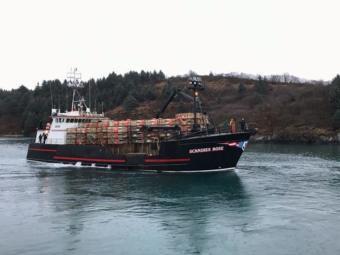
The F/V Scandies Rose, a 130-foot crab fishing vessel based in Dutch Harbor, sank on Jan. 31, 2019, with seven crew members aboard. (Photo by Gerry Cobban Knagin)

It’s been just over a month since the F/V Scandies Rose sunk west of Kodiak.

Two fishermen were rescued from a life raft. They were wearing “gumby” survival suits. The other five crew members — as well as their 130-foot crab boat — were never found.

Dean Gribble grew up in Washington. He began salmon tendering when he was 11 years old, and he’s spent the past 21 years crab fishing.

“I was born a commercial fisherman,” said Gribble. “It’s in my blood. My dad and my family have all been in it. Other kids grew up having football or baseball players as their heroes, and I had crabbers as mine.”

On New Year’s Eve 2019, Gribble hadn’t planned to be on the Scandies Rose, which is based in Dutch Harbor, but a crew member quit in late December, and his friend, John Lawler, asked him to fill in.

“John called me the 28th,” said Gribble. “I flew up the 29th. We left the 30th, which is my birthday. We sank the 31st. I was home on the 1st.”

Gribble describes it as a “whirlwind” — everything that happened between 10 p.m. on Dec. 31, when the crew hit the mayday button, and 2 a.m. on New Year’s Day, when he and Lawler were rescued by a U.S. Coast Guard swimmer.

Gribble was woken up by Lawler yelling that the boat was going down. He said the vessel was taking on ice and listing to the side amid 30-foot seas, well-below-freezing temperatures and 40 mph winds.

“I started passing out the suits to everybody,” said Gribble. “We’re listing really hard at this point. I tried to get my suit on on the ground, and I couldn’t because I kept sliding down towards the starboard side. I jumped up in the bench and used the armrests as a foothold, and I was able to get my suit on about halfway. The armrest I was using broke, so I started sliding down.”

He finally got outside on the deck on his fourth try, and then the generator shut off and the lights cut out.

“Now it’s just loud,” said Gribble. “All you hear is the creaking of the steel — the waves slamming into the boat. And it’s sinking. It’s going fast.”

Gribble helped Lawler get his survival suit on, and they tied themselves together with a rope.

“I’m screaming at these other guys,” he said. “I’m screaming at them to get out of the boat, and they were trying. I was trying to find something to throw back in so they could use it to climb out. I couldn’t find anything, because everything was so icy. I just couldn’t get anything, and the boat was going down.”

Gribble said he’s been involved in searches for lost crews before, and he didn’t have any hope that he and his crew mates would survive.

“I knew I was going to die,” said Gribble. “My main concern was just trying to get out so maybe they could get my body or something for my family to get closure.”

At that point, Gribble and Lawler jumped off the deck and into the water as the rest of the crew remained on the boat.

“Now I’m alone in the dark, floating in 20, 30-foot seas,” said Gribble. “Just any fishermen’s nightmare. I see the boat penciled — straight up and down in the air. The bow was straight up in the air, and then it sinks. My heart drops. I tried to do everything I could to get those guys out. I tried everything. I was screaming at them, ‘You’ve got to get out of the boat!'”

Gribble saw a fluorescent life raft about 500 feet away, and he and Lawler swam to it.

Once inside, they bailed water and waited in the dark for about four hours. Then, a crew from Coast Guard Air Station Kodiak found them and transported them to a hospital in Kodiak, where they were treated for hypothermia.

The rescuers said Gribble and Lawler wouldn’t have survived if it wasn’t for their suits and the life raft.

The search for the Scandies Rose and her remaining crew was suspended less than 24 hours later. It spanned more than 1,400 square miles and included four MH-60 Jayhawk helicopter crews, two HC-130 Hercules airplane crews and the Coast Guard Cutter Mellon.

The five missing fishermen are Gary Cobban, Jr., David Lee Cobban, Arthur Ganacias, Brock Rainey and Seth Rousseau-Gano.

Gribble is currently home with his family. He said it’s going to be awhile until he gets back out on a boat.

Meanwhile, Coast Guard officials said they don’t know yet how long it’ll take to complete their investigation into the cause of the sinking.

The loss of the F/V Scandies Rose marks the Bering Sea crab fleet’s deadliest accident since the 2017 capsizing of the F/V Destination, in which all six crew members died.

Site notifications
Update notification options
Subscribe to notifications