Krysti Shallenberger, Alaska's Energy Desk - Bethel
In secret recordings, Pebble Mine execs say Donlin mine is too expensive to build

On Sept. 21, an environmental group leaked footage of top mining executives discussing the proposed Donlin Gold mine. ( Environmental Investigation Agency)

On Sept. 21, an environmental group released secretly recorded video clips of Pebble Mine executives who thought they were talking to potential investors but instead were speaking to people pretending to be interested in investing in the controversial mine.

Among the things the Pebble executives said: Donlin Gold can’t afford to build its gold mine in the Yukon-Kuskokwim Delta.

The executives said there might be a way for Donlin to reduce its costs if the companies work together to connect the two Southwest Alaska mining projects by building a road through the tundra.

The United States-based nonprofit Environmental Investigation Agency released several video clips Thursday that show executives from the two companies that are developing the Pebble mine discussing plans about the mine’s development.

In one video, Tom Collier, CEO of Pebble Limited Partnership, and Ronald Thiessen, CEO of Northern Dynasty Minerals, talked about the future of the proposed Donlin Gold mine. On the recording, Collier said that the Donlin mine was too expensive to build even with the gold prices set at $1,934 per ounce on Sept. 21.

“The cost of the royalties and the cost of the capital that has to be invested in the project makes it difficult for the project to go forward at the time,” Collier said.

The royalties Collier is talking about refer to the money Donlin Gold has to pay the two Native corporations that own the land and mineral rights. Donlin also needs to build a lot of infrastructure just to operate the mine: an airstrip, a road, a port, a 315-mile gas pipeline and a power plant. All of that could cost Donlin nearly $7 billion.

Collier’s comments echo a report from a short-selling financial research firm that claims the Donlin Gold mine is overvalued and will never be developed because of its hefty price tag. The firm makes money when a company’s stock price declines.

Collier said one way for Donlin to cut costs would be to build a nearly 180-mile road from the Donlin mine site to the Pebble mine site in order to ship Donlin’s ore to a port in in the Bristol Bay region. Collier said that the state could finance the road and port, which Collier said would be a big win for both companies.

“Because when you flip the Pebble switch on, that means you could flip the Donlin switch,” Collier said.

In the secret recordings, Northern Dynasty Minerals’s Thiessen said they haven’t formally approached Donlin Gold with the idea.

“We’ve had a couple of discussions, but really we need to get to the point where we have our ROD in place,” Thiessen said.

ROD refers to the final record of decision from the Army Corps of Engineers, which is expected soon.

Donlin Gold declined an interview and sent a written statement instead.

“Donlin Gold continues to advance on a stand-alone basis and is not engaged with any other projects. We remain completely confident in our proposal and its economics, which has advanced through the federal and state permitting process, and are not proposing any modifications at this time,” it said.

‘A Swiss cheese moment’: how a communication breakdown stopped flights to Aniak

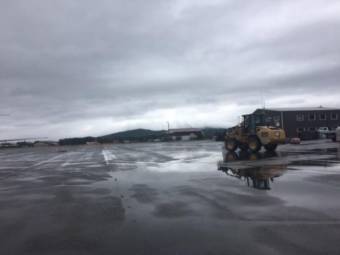
The Aniak runway is being moved 261 feet. (Krysti Shallenberger/KYUK)

Earlier in August, pilots trying to land at the Aniak airport got a last-minute notice that they were not allowed to land, disrupting cargo and passenger service into the small Yukon-Kuskokwim Delta hub. The Alaska Department of Transportation said the cause of the incident was a failure to communicate about a runway project.

According to Troy LaRue of the DOT, the Aniak runway was under construction for about three years after federal and state officials said it was too close to some homes and decided to move it 200 feet.

“So we worked for a very long time to put together a project to shift the runway in order to come into safety standards and federal compliance and shifting the runway. Eventually, you have to open one, and you have to close the other one, right?” LaRue said.

That’s what happened in August. To continue construction, DOT and the Federal Aviation Administration closed down the runway that housed the vital landing equipment. When the DOT and the FAA make a decision like that, they normally notify pilots and airlines over the radio, called a notice to airmen, or NOTAM. But this time, the radio notice was issued the day they closed the old runway instead of a few days before. And the new runway doesn’t have all the equipment pilots need to land safely.

Northern Air Cargo station manager Gideon Garcia said that it boiled down to a failure to communicate between the state and federal agencies involved in the project.

“Sort of a Swiss cheese moment when all the holes lined up in the swiss cheese and fell through the cracks, literally, and the right information wasn’t published in a timely manner to alert people that there was going to be an update from the old runway to a new runway,” Garcia said.

Garcia said that NAC couldn’t deliver bypass mail and freight for about a week. The DOT and FAA have since changed the approach to the runway so planes can land safely again.

“And gosh, I don’t think it took more than two days. And we had figured out that, ‘wait a minute, we can still use, it’s called an RNAV approach. And basically, it’s a circling approach that is designed for the old runway. We were able to modify the NOTAM to be able to put some approach procedures in place,” LaRue said.

LaRue said the RNAV approach, while not ideal, will work until they install new landing equipment, and that the department is currently investigating where they went wrong.

“If we would have started those conversations earlier, they would have been resolved earlier on, I’m pretty sure,” LaRue said.

LaRue said that they hope to have the new runway and all the landing equipment up and running by Sept. 20.

Amidst concerns about profitability, companies tout Donlin Gold test results

Donlin says it will get most of its major permits out of the way this year. But it still needs 100 before it can begin mining. (Photo By KYUK)

Donlin Gold is touting the results from its most ambitious drilling program yet. This news follows a recent financial report saying the mining prospect in the Yukon-Kuskokwim Delta was too expensive to build and likely not going to happen.

NovaGold and Barrick, the Canadian companies developing the Donlin mine, praised the drilling results in recent earnings calls. Melanie Hennessy, NovaGold’s vice president of corporate communications, said it shows both companies are serious about the mine’s potential.

“There is alignment between both companies on the direction and continuing focus on advancement of Donlin Gold,” said Hennessy.

Back in March, Barrick Gold CEO Mark Bristow said in an earnings call that the mine did not meet its criteria to build in its 10-year plan. Then in May, a short-selling financial research firm cited Barrick’s hesitation in a report that shed doubt on the future of the mine.

But now Barrick and Novagold appear pleased with the results from the drilling program so far, according to a transcript from Barrick Gold’s latest earnings call.

Barrick Gold CEO Mark Bristow told investors, “It’s a key project for Barrick, and very valuable today.”

Still, a financial analyst pointed out in the earnings call that comments from Barrick suggested that the company is more likely to sell the prospect before it’s actually built.

Greg Barnes, from TD Securities, told Bristow: “From your comments earlier on about Donlin and some of the other big projects, it sounds like you’re more of a seller of those projects than a builder in this kind of environment.”

Barrick CEO Bristow responded to Barnes: “You know that famous saying, everything’s got a price? We will sell anything as long as we feel that we’re getting more than what it’s worth or more. As I said earlier, our view is that whereas our activities in Donlin are still adding value, it’s a very substantial gold resource.”

Bristow said the biggest challenge is still how expensive it would be to build the mine. The proposed site is in a remote part of the Yukon-Kuskokwim Delta that is only accessible by plane. Developing the mine would require building a power plant, a 315-mile gas pipeline and a road, at a total cost of nearly $7 billion.

But Hennessy said the drilling results and Barrick Gold’s comments in the earrings call prove that they are serious about developing the mine.

“All that drilling that’s been done to date has been, has been quite positive,” Hennessy said.

Meanwhile, the coronavirus pandemic has slowed down Donlin’s permitting. Hennessy said the company has delayed work on the dam safety certifications. But back at the camp, none of the workers have tested positive for the virus so far.

Donlin’s COVID-19 protocols include requiring all employees have a negative test before coming into or leaving the camp. Village residents who work at the camp must test negative twice before entering the camp and before heading back to their village. Out-of-state employees also have to test twice before coming into the camp and leaving it.

“We’re using charter [planes] to deliver, to safely deliver employees to and from camp to minimize in-region travel. And we’re also doing frequent sanitization practices. We’re increasing communication onsite around hygiene and sanitization, and also looking to identify any symptoms,” Hennessy said.

Meanwhile, Donlin opponents have challenged the Alaska Department of Natural Resources’ decision to lease Donlin a right of way for its pipeline, and that challenge is still working its way through the procedural process at the agency.

Donlin Gold pushed back on textbook content. The Lower Kuskokwim School District removed it.

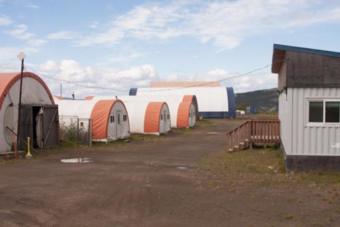
Donlin camp (Photo by Dean Swope/KYUK)

It all began over a photo.

“A couple of our staff reached out to Donlin to use a picture from their website,” said Dan Walker, then-superintendent of the Lower Kuskokwim School District, in February. He retired at the end of July.

For nearly a decade, LKSD, the biggest school district in the Yukon-Kuskokwim Delta, has been developing a place-based curriculum for its students. Typically, textbooks used in other parts of the country are not applicable to students in rural Alaska.

“In textbooks you see things like sidewalks and paved streets and stoplights,” Walker said. “And most of our kids don’t have any experience with sidewalks.”

LKSD wanted to create its own curriculum that would use the region’s resources and its history to teach kids about social sciences, health and ecology. Then that textbook would be translated into Yugtun, the Yup’ik language.

This is where it gets back to the proposed Donlin Gold mine.

The mining prospect has been around for decades, since the regional Native corporation, Calista, leased the mineral rights in 1980s. In the Yukon-Kuskokwim Delta, nearly everyone has heard of Donlin Gold.

A team of teachers began drafting a curriculum for fifth graders that focused on human impact to the environment. That included the impact of the proposed Donlin Gold mine. A draft of the curriculum obtained by Alaska’s Energy Desk showed that it featured Alaskans from the community voicing their opinions about the mine. For example, Bethel resident and tribal member of the Orutsararmiut Native Council, Bev Hoffman, speaks out against the mine in the curriculum. Thom Leonard, spokesperson for the Calista Corporation, speaks out in support.

The curriculum was almost ready in early January of this year — all that was missing was a few photos. So an LKSD employee, Mike Gehman, emailed Donlin Gold to request a photo. He included part of the curriculum, according to records obtained by Alaska’s Energy Desk.

Donlin Gold’s Kristina Woolston emailed back:

“I would like to work with you on the information you include in your class curriculum. This piece contains a number of things that are factually incorrect. We would like the opportunity to correct them, at the very least perhaps we can give a presentation to the class. It’s important to everyone that the information be correct. Thank you.”

Gehman agreed, and worked to set up a time to meet. Another Donlin employee, Vernon Chimegalrea, looped in Calista Corporation, which owns the mineral rights, and suggested that LKSD use Yugtun linguists recommended by Calista and Donlin’s Bethel-based community engagement team.

Gehman replied that the school district already had Yugtun linguists working on the curriculum, but was willing to go over any factual errors. Gehman again expressed the district’s interest in using photos of the mine site.

“I hope that will be discussed,” he wrote.

Woolston emailed back: “Apologies for not clarifying, but you have our approval to use the photos once the content is revised.”

In late January, Calista Vice President of Land and Natural Resources Tisha Kuhns, who used to work for Donlin and grew up in Bethel, sent a letter to the LKSD school board outlining Calista and Donlin’s concerns about the curriculum. But it did not list any specific errors.

A few days later, Kuhns emailed Gehman with their suggested edits.

In an interview with KYUK, Woolston said that Donlin’s main issue with the curriculum was the tone.

“The tone created fear,” Woolston said.

She said the curriculum didn’t focus on the nuances of the mining operations, and it implied that mining pollution from its waste was inevitable.

“We did not feel like it was objective to say that this would happen, so that was part of our concern as we wanted to have a more neutral tone about that,” Woolston said.

LKSD did not want to be caught up in the controversy over the mining project.

A few days after Calista sent the letter to the board, LKSD made its final decision: The district erased all mention of the proposed Donlin Gold mine.
“We’re moving forward,” Walker said. “I think there are ways for us as educators to capture the issue of humans and our impact on the environment without specifically relating it to Donlin Gold.”

Donlin wouldn’t say whether it supported Walker’s decision to remove the mine from the curriculum.

Woolston said that Donlin Gold is forging ahead with its investment into the region. The company has about $1 million each year that it puts into various projects and organizations.

Wrong fuel caused Alaska Forestry plane to crash in Aniak in May

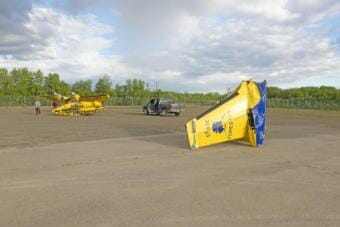
airplane wreckage a Division of Forestry plane that crashed during takeoff in Aniak
The remains of a Forestry plane that crashed during takeoff in Aniak on Thursday, May 28. (Courtesy of Dave Cannon)

The wrong fuel caused an Alaska Division of Forestry plane to plummet into freezing water in May, according to a preliminary report from the National Transportation Safety Board.

Three firefighters and one pilot took off from the Aniak runway on May 28. They were first heading to McGrath, and then to Soldotna to start fighting fires, but they didn’t make it.

Instead, they crash-landed in a pond right off the runway. All four survived. Three had injuries that required surgery, including the pilot, Mark Jordan.

The NTSB report says that a vendor tasked with filling up the plane was unclear which kind of fuel to use for the type of airplane and filled it up with the wrong kind. The Forestry airplane is an Aero Commander 500 Shrike, which only uses a certain type of fuel.

The fuel vendor asked the pilot if he wanted “prist with your jet.” Prist is a type of chemical that prevents fuel from gelling in planes that fly higher altitudes. And “jet” refers to Jet A fuel. The pilot said no. The fuel vendor filled it up with Jet A fuel, and wrote that down on a receipt that he then handed the pilot, who signed it.

Jordan said that as he took off, he felt “mechanical turbulence” and the aircraft struggled to climb. Unable to maintain altitude, he aimed for the shallow pond. That was the last thing he remembered. Five Aniak teenagers happened by and saw two of the firefighters struggle out of the plane. They helped rescue Jordan and the three passengers. The plane itself is totaled.

“Like with any accident or incident, we conducted an after-action review of the incident to try to pull any lessons learned out of it that we could, to see if there needs to be any policy changes or anything that we can do to make for a safer aviation program,” said Tim Mowry, spokesperson for the Alaska Division of Forestry.

Mowry said that those changes will not be made until NTSB issues its final report, which will be roughly six months from now.

Meanwhile, Jordan is out for this fire season. The three other firefighters are also recovering. Mowry said that only one of them, who is from Aniak, has recovered enough go back to fighting fires.

Bethel man and 5-year-old grandchild die in boating accident

David Berlin with his family. The 51-year-old died in a boating collision. (GoFundMe photo)

A Bethel man and child have both died after a boat crash Sunday on the Johnson River, a tributary of the Kuskokwim River, according to Alaska State Troopers.

David Berlin, 51 of Bethel, was navigating a blind turn in his Alweld 18-foot flat-bottom skiff when another skiff, piloted by Dennis Demientieff of Kasigluk, appeared from the opposite direction, troopers said.

Both boats tried to avoid each other, but turned the same way. Demientieff’s heavier skiff went over Berlin’s skiff, crushing the occupants and killing Berlin. His 5-year-old granddaughter, Danielle Berlin-Walker, was severely injured. She died on Monday.

Two other adults were in Berlin’s 18-foot skiff and sustained minor injuries. Berlin’s family has set up a GoFundMe account to raise money for David and Danielle’s funerals.

The nine occupants in Demientieff’s heavier skiff were not injured. Another traveler came across the accident and notified the troopers.

Site notifications
Update notification options
Subscribe to notifications