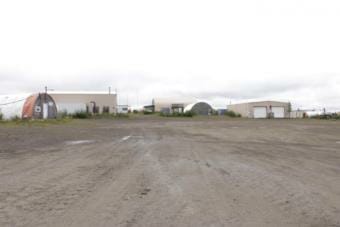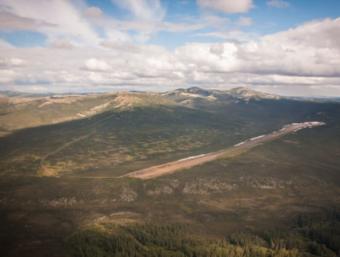
The proposed Donlin Gold mine would be one of the biggest gold mines in the world if completed. (Photo by Dean Swope/KYUK)
NovaGold, one of the companies developing the proposed Donlin Gold mine, has filed a lawsuit against a short-selling research firm. That firm released a report in May opining that the proposed Donlin Gold mine would not be built, and that NovaGold was overvalued.
The short-selling research firm, J Capital Research, and its clients make money from stock prices dropping. The firm released a report making the case that the proposed Donlin Gold mine is not going to be built because it’s too expensive to do so.
The day J Capital Research released its report, NovaGold stock prices fell from around $10 per share to $8 per share. By the end of June, the stock had recovered much of those losses. In an interview in June, NovaGold CEO Greg Lang called the report misleading.
“More than anything else, I think we’ve all experienced it, but it’s indicative of the power of misinformation when it spreads on the internet,” Lang said at the time.
NovaGold released a line-by-line rebuttal. Its partner, Barrick Gold, which is one of the biggest gold mining companies in the world, has not responded to a request for comment. Now NovaGold is suing J Capital Research for damages. Alaska’s Energy Desk reached out to NovaGold and J Capital Research for comment, but did not receive one from either entity by publication.
NovaGold’s stock rose slightly after it announced the lawsuit, and it’s now trading at nearly the same price as before J Capital Research firm came out with its report.
The work camp for the proposed Donlin Gold mine in the Yukon-Kuskokwim Delta. (Krysti Shallenberger / KYUK)
A recent report from a financial research firm says that the proposed Donlin Gold mine in the Yukon-Kuskokwim Delta will never be built. The mine could be one of the biggest gold producers in the world if completed, but the research firm says that it costs too much to actually build. But that firm can make a lot of money off of its report, and one of the mining companies strongly disagrees with its conclusion.
J Capital Research analyst Tim Murray lives in Australia, and what he does is research companies to see if their stock is worth buying or selling. More specifically, they focus on short research.
“That is, we help companies to make money from stocks going down. So we try and identify companies that are overvalued and present them to the market,” Murray said.
The firm acknowledges that they are biased both in bold letters on the report, and on its website. J Capital Research and its clients stand to make a lot of money if Donlin’s stock price declines. And after the firm released its report on Donlin on May 28, NovaGold, one of the companies that’s developing the mine, has seen its stock steadily drop from $10.10 a share to $8.64 on June 10. NovaGold stock closed out at $8.01 on June 16.
The report claims that NovaGold is overvalued because the Donlin Gold mine is actually too expensive to build. Murray claims that NovaGold executives are touting the mine to make themselves richer. NovaGold’s board of directors determines how much stock executives can receive as part of their financial compensation.
“They can make money whilst the market believes in it while [they] issue themselves shares and options. And then they can sell them at inflated prices because they keep pushing the mine. They become personally wealthy,” Murray said.
In response, NovaGold released its own report on June 8. CEO Greg Lang says that the J Capital Research report is misleading.
“It’s indicative of the power of misinformation when it spreads on the internet,” Lang said. His company points out inaccuracies in a line by line analysis. For instance, one argument in J Capital’s report is that employees selling shares indicates that the company is overvalued.
“They made a lot of statements about employees selling shares, my ownership, and so on, which are just simply erroneous. My ownership in NovaGold has steadily increased since I joined the company, and it will continue to do so,” Lang said.
How the stock sales work is complicated. NovaGold Vice President of Corporate Communications Melanie Hennessy said in a email that stock options granted to executives have a five-year limit. That means the executive must sell off those shares in five years in what’s called a stock option exercise, or forfeit them.
“Option exercises usually involve the sale of some shares, but the exercise does not result in a decrease of the number of shares held by a person before they exercised the option. In some cases, an exercise results in an increase in a person’s shareholdings,” Hennessy wrote.
J Capital Research and NovaGold both say that there’s no legal limit to how much stock a company executive can own. Murray said that NovaGold executives selling these shares now instead of waiting for the stock to rise even more when the mine is built shows that the executives themselves don’t believe that will happen.
J Capital Research didn’t stop at the financial inside-baseball. It also focused on the massive infrastructure that Donlin Gold has to build before it can start mining. The mining operations will require a lot of energy, so Donlin Gold has proposed building a 157 megawatt power plantfed by natural gas that will be transported through a 315-mile pipeline. That pipeline crosses mountains and will be built on permafrost. J Capital analysts argued that kind of terrain makes it unlikely that Donlin can build the pipeline, but Lang disagreed.
“We believe it. The pipeline is completely feasible as we’ve presented it. Just because some unknown expert says it can’t be done, I think I would rather put my faith with the Alaska contractors who know and understand Alaska. They’ve walked the pipeline. It’s been well studied. You know, it’s completely feasible,” Lang said.
Donlin Gold hired Alaska engineering firm CH2M Hill to draft pipeline construction plans and eventually build it. Texas-based Jacobs Engineering Group bought CH2M Hill in 2017, but the company is still involved with the Donlin Gold pipeline project.
The J Capital Research report cited growing costs in pipeline construction as another major hurdle facing Donlin’s pipeline project. NovaGold and its partner Barrick Gold, the largest gold mining company in the world, need $6.7 billion up front to build the mine, according to its 2011 feasibility study. The 2011 feasibility study has only been updated once, in 2012. Lang says that it costs tens of millions of dollars to update a feasibility study, and that for a long time, the market price for gold didn’t justify updating it.
“NovaGold has always been very careful with our money. We have a strong treasury, and when us and Barrick think the time is right, we will move forward,” Lang said.
Lang said the companies will start updating the study by the end of 2020, but he didn’t specify what market conditions and gold prices are ideal for building the Donlin mine project. Right now, gold prices are around $1,700 per ounce. That’s considered a good price for gold.
Alaska’s Energy Desk reached out to three financial and research firms to weigh in on the J Capital Research firm report: Morgan Stanley, Wood Mackenzie, and S&P Global. Wood Mackenzie and S&P Global declined to comment; Morgan Stanley didn’t respond.
Two years ago, Alaska’s Energy Desk asked financial firm S&P Global about the Donlin gold mine. Gold prices were hovering at $1,400 an ounce. The firm said then that the gold market was pretty good, but the cost to build the Donlin Gold mine was the biggest hurdle. That’s a common challenge facing Alaska infrastructure projects, because most of them cannot be reached by roads. Donlin Gold wants to build the mine in a remote part of Alaska, and the only way to get there is by a small plane.
NovaGold floated some ideas of reducing the cost in earnings calls, but nothing has been settled on yet. Barrick Gold released its 10-year plan to its investors earlier this year, but Donlin Gold did not appear in it.
In an earnings call in February, a financial analyst asked Barrick Gold CEO Mark Bristow about the Donlin Gold mine’s absence from the plan. Bristow said that the mine would not be feasible at $1,200 per ounce, which is the benchmark they used for planning.
“We’re not going to put Donlin in because we managed at $1,200. We’re not changing the rules in this; we’re showing you that we’ve got visibility on the runway for a 10-year program and there might well be opportunities that we will highlight, but they would need to be opportunities that make it at $1,200 gold price. So that’s, the optionality is what it is and we’ll leave it there,” Bristow said according to the transcript.
J Capital Research’s Murray points to co-owner Barrick Gold for clues that the mine may never be built.
“They say it’s not their plan to build it now. It’s possible they could build it in the future, but my question is more when? I mean, they put out a 10-year plan and Donlin’s not part of that.,” Murray said. “And they’ve said quite clearly that the current plan for the mine doesn’t reach their criteria for development. So what has to change? And they haven’t really said that.”
But Lang says that Novagold and Barrick still plan on building the mine.
“Barrick, NovaGold are completely aligned on where we see this project,” Lang said.
Alaska’s Energy Desk reached out to Barrick Gold for comment, but the company did not respond.
Meanwhile, NovaGold’s stock fell even more the day they released their defense of the mining project.
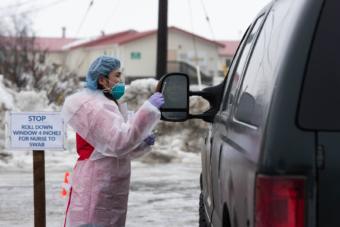
Registered Nurse Avelina Chung runs through protocol with a YKHC employee at the COVID-19 drive-thru test site on March 25, 2020 in Bethel, Alaska. Credit Katie Basile / KYUK
Days after Gov. Mike Dunleavy lifted many restrictions to slow the spread of the virus, the Yukon-Kuskokwim Health Corporation has confirmed a third case of coronavirus in an unnamed village resident.
YKHC says the person was in Bethel when the hospital tested them positive for coronavirus. YKHC spokesperson Mitchell Forbes couldn’t say whether the person was traveling outside the Yukon-Kuskokwim Delta before they came into town.
YKHC tested the person twice, with rapid testing and then with a swab that will be sent to the state lab. These results can take a few days, and the person is now self-isolating. Forbes says YKHC notified the village of the test results.
Forbes says contract tracers have started piecing together the person’s recent contact history and a response team has been sent to the village to test and screen residents.
This is the third confirmed coronavirus case in the YK Delta, and the second case that had contact with a village. YKHC confirmed the region’s first case in April — and the second one a month later at the Bethel airport.
That person then headed to Nunapitchuk before the positive test results came back. The village immediately locked down after YKHC notified village leaders of the test results. The health corporation sent out a team to test residents with rapid testing, and then sent those swabs to the state lab in Anchorage to double check the results.
On May 22, YKHC announced all test results came back negative from the state lab.
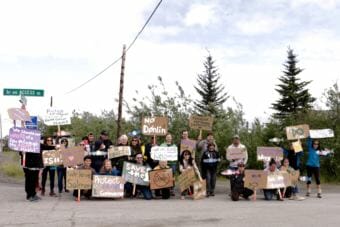
The Orutsararmiut Native Council led a public demonstration against the proposed Donlin Gold mine in Bethel on Friday, June 22. (Photo by Christine Trudeau/KYUK)
Ten tribes have sent a letter protesting the proposed Donlin Gold mine to the two companies trying to build it in the Yukon-Kuskokwim Delta.
The letter came as one of the companies, Novagold, was set to deliver its annual report to its shareholders last weekend.
The company has touted support from the region in its quarterly earnings reports and annual presentations, but this time tribes want to make sure that investors know that not all tribes support the Donlin Gold mine.
“The proposed project poses too much risk to our lands and our food sources which we have an obligation to protect and develop responsibly for future generations,” the letter said.
The letter asked both companies to withdraw their investment in the project. The mineral rights and land belong to two Native corporations formed under the Alaska Native Claims Settlement Act, and those companies have leased their rights to Canadian mining companies Novagold and Barrick Gold. The letter cited concerns about the impact extra barge traffic could have on smelt habitat, the company’s plans to store its mining waste, and the fact that the companies must treat the mine’s wastewater forever.
In a statement, Mark Springer, the executive director of Orutsararmiut Native Council in Bethel, said that the mine would threaten the tribes’ subsistence lifestyle.
“Our gold swims in the Kuskokwim River. It hangs on our fish racks in the summer and sustains us throughout the long winter months until the salmon again return,” Springer said.
Last year, 35 tribes passed a resolution opposing the Donlin Gold mine at the annual Association of Village Council Presidents’ convention. That marked a major turning point in regional support for the gold prospect. The tribes signing the letter were: Orutsararmiut Native Council in Bethel, Tununak, Eek, Chuloonawick, Kasigluk, Chevak, Kotlik, Napakiak, Kongiganak and Ohagamiut Native Council.
Donlin Gold has repeatedly said it plans to build the mine as safely as possible.
The Kuskokwim River ice cleared in front of Aniak on May 1. (Photo courtesy Dave Cannon)
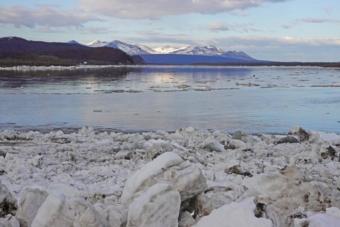
An ice jam just below Upper Kalskag is sending rapidly-rising water toward the village’s power plant.
The National Weather Service is flying aerial surveys of the Kuskokwim River during the day and hosting nightly river condition teleconferences. During the May 2 conference call, Dwayne Hoffman, Native Village of Upper Kalskag transportation manager, said that the water had crept close to the gate to the power plant.
Hoffman estimated that the water would have to rise another 2 or 3 feet before the power plant shut down.
“We’re monitoring as much as we can throughout the night,” Hoffman said.
The water is also rising closer to the Upper Kalskag runway. Hoffman said that residents living at one end are already seeing water near their houses and are monitoring levels.
Meanwhile, the ice jam just below Napaimute remains solid. Further downstream, the ice has moved out of Aniak. Residents are reporting that the water levels have dropped a few feet, but are still higher than during previous breakups.
Celine Van Breukelen, a hydrologist with the weather service, flew over the Kuskokwim River on May 2. She noticed water flooding the tundra around Aniak.
“I am very concerned about the flood threat for Aniak,” Van Breukelen said.
Should the ice jam below Napaimute release quickly, it could send more high water down to Aniak and spark flooding.
The ice in front of McGrath has cleared and is heading down the Kuskokwim River. Sleetmute reported high water levels on May 2 after the level dropped at least 3 feet over the evening of May 1.
The weather service plans to head out on May 3 to check river breakup conditions along the Kuskokwim River.
Nearly 20 communities in the Yukon-Kuskokwim Delta have no regular air service. (Photo by Katie Basile/KYUK)
Ravn Air Group’s bankruptcy left state officials and health providers scrambling to figure out how to transport rural patients who test positive for the coronavirus. Two weeks later, more than a dozen villages still don’t have regular air service.
While the state plans to use the National Guard to help transport COVID-19 patients from rural communities, the lack of reliable air service is putting a financial burden on rural healthcare providers who pay more for charter flights to get patients to hospitals.
Christina McDonogh is a law student in New York right now, but she’s been keeping up with news from her home state of Alaska. She’s Sugpiaq from the village of Perryville, and she worries that the state isn’t prepared for a coronavirus outbreak in rural Alaska. McDonogh remembers breaking her arm in Perryville as a kid.
“And I had to wait for a plane to take me to the hub in Dillingham, and you know, a broken arm is nothing compared to pneumonia,” she said.
McDonogh co-wrote an opinion article with Shanelle Afcan, who grew up in Nunam Iqua and Alakanuk, that laid out steps for the state to take to make sure rural communities are not left behind when preparing for a coronavirus outbreak. That includes more training for health aides, and small medical teams that could assist communities who have an outbreak. But reliable medical transport is her biggest concern.
Ravn’s bankruptcy earlier this month left a lot of questions for rural healthcare providers who depend on those airlines to fly patients in for medical care. Heidi Hedberg directs the Division of Public Health at the Alaska Department of Health and Social Services.
“We are hoping and waiting to see the private industry step into the vacuum and serve the needs of the villages who have had reduced flight services into their communities,” said Hedberg.
Eighteen villages in the Yukon-Kuskokwim Delta do not currently have regular air service; Ravn was the only passenger airline that served them. That means the Yukon-Kuskokwim Health Corporation must charter flights from those villages with other airline carriers to bring patients into Bethel for medical care. But not everyone who tests positive for coronavirus will be medevaced into a hub or to Anchorage. If cases are mild, the patient will likely stay in the village.
Hedberg said that the state emergency center has worked with private airlines to properly transport a patient who has tested positive for coronavirus in a village, but the National Guard will step in should private airlines refuse service or be unable to get the patient out.
With no regular air service to so many communities, YKHC has had to turn to charter flights to get non-coronavirus patients to medical care in Bethel, as well as deliver medical supplies. But YKHC is still waiting on the state for answers. YKHC spokesperson Mitchell Forbes said that chartering a flight can cost as much as $1,000.
“Right now, we’ve told the state that if a solution is not found there, it is not financially feasible for us to carry that cost,” Forbes said.
Forbes said that so far, the extra costs to charter a flight have not impacted YKHC’s ability to move patients out of the communities they serve or get medical supplies to those villages.
“We’re not going to leave someone in a village and say, ‘We cannot bring you to necessary care because it’s too expensive,’” Forbes said.
Currently in Southwest Alaska, only one person has tested positive for the coronavirus.
Correction: This story has been updated with the correct spelling of Christina McDonogh’s name.