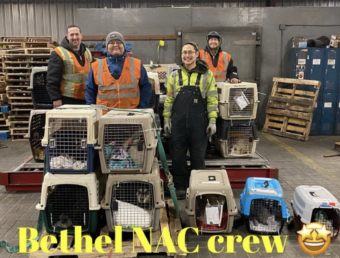
Northern Air Cargo employees stand near kennels of dogs that they helped Bethel Friends of Canines transport from Tuntutuliak. (Photo courtesy of Bethel Friends of Canines)
In January, one village in the Yukon-Kuskokwim Delta removed all its stray dogs with the help of two nonprofits, including Bethel Friends of Canines. It took a lot of planning to ensure that the ambitious effort was a success.
Alice Fitka teaches Yugtun at the Tuntutuliak school, but she took a break to talk about how the village decided that all its stray dogs needed to go.
Fitka is a traditional council member; she helped come up with the idea after the principal of the school expressed concerns.
“The people, the community out there complain about dogs, loose dogs,” Fitka said.
Fitka said that the principal was worried how the stray dogs would react to her dog if she was out walking it. And stray dogs can be a public health hazard, as they can carry rabies and bite people.
Andrew Frank is a tribal police officer in the village. He said that the tribal police officers didn’t want to shoot the dogs.
“A lot of people kept calling us and asking us to shoot dogs, and I kept telling a lot of people that we only shoot sick dogs or injured dogs that can’t be helped anymore,” Frank said.
Historically, shooting dogs has been one way villages controlled the population of strays. But that practice has become controversial, and communities are looking for other ways to manage the dog population.
The traditional council in Tuntutuliak passed a resolution that would give the council permission to ask Bethel Friends of Canines for help. The nonprofit helps put stray dogs in Bethel and nearby communities up for adoption, and holds spay-neuter clinics.
But Tuntutuliak wanted something that the nonprofit had never done before: Remove all the stray dogs.
Lillie Reder is a board member at Bethel Friends of Canines. She was one of five volunteers who went to Tuntutuliak to help the community remove the animals. As soon as her feet hit the ground, she was helping to administer vaccinations.
“When we got there, it was just go, go, go,” Reder said.
But to get there, the nonprofit needed a lot of help. Another nonprofit, Alaskan Animal Rescue Friends, helped raise money and offered support. Northern Air Cargo, Grant Aviation, and Ravn Alaska made space in their planes for kennels and transported the dogs out of Tuntutuliak. They shipped 28 dogs to Anchorage or Bethel for adoption.
But that’s not all.
“Then we did a lot of door-to-door vaccines, so we were able to vaccinate a lot of dogs that were owned by people in (Tuntutuliak), which was awesome because we got to meet a lot of people and make sure their dogs were safe for the upcoming year,” Reder said.
With help from Tuntutuliak’s tribal police officers, the volunteers vaccinated about 50 dogs. The effort lasted four days.
So far, Fitka and Frank have nothing but good things to say.
“It was a lot better than it was before,” Frank said. “Less loose dogs.”
Bethel Friends of Canines says that they wait for communities to invite them in. Reder said that helps with resources, like finding a place to stay, and it ensures that they only remove stray dogs rather than accidentally grabbing someone’s pet. It also helps with community goodwill and shows respect.
Other communities who want to remove stray dogs can reach out to the nonprofit through Facebook or their website: www.bethelfriendsofcanines.com.
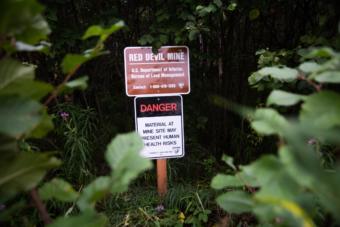
Signs at the entrance to the now defunct Red Devil Mine in Alaska warn people to stay out because of potential health risks, Aug. 17, 2019. (Photo by Katie Basile/KYUK)
The final feasibility study detailing cleanup options for the contaminated Red Devil mercury mine site is out. The Bureau of Land Management plans to hold public meetings in the villages near the mine site to collect feedback about the remediation plans.
According to BLM spokesperson James Hart, BLM will open public comments on the plan for 60 days, beginning March 1 and ending April 30.
The Red Devil mercury mine permanently closed in 1971 after the price of ore fell and the owners walked away, leaving it up to the state and federal governments to clean up the site. It’s taken 40 years of testing and some remediation before BLM, which heads the cleanup efforts, rolled out this final plan.
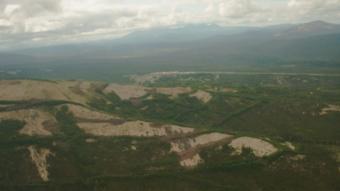
The mine used to be the biggest mercury mine operating in Alaska, and built the community of Red Devil in the Middle Kuskokwim River area. At the mine’s peak, 200 people lived in the village, but people left once the mine closed and jobs disappeared. Only about 20 residents remain year-round.
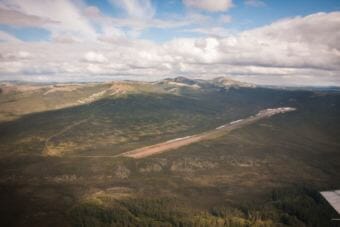
Aerial view of the site for the proposed Donlin Gold mine. (Photo by Dean Swope/KYUK)
The state of Alaska approved a right-of-way lease for Donlin Gold’s proposed 315-mile gas pipeline on Jan. 17. The lease is an important step forward in the company’s quest to build the Donlin Gold mine, which could be one of the largest in the world if completed.
The Alaska Department of Natural Resources will lease the right of way for 30 years, the maximum allowed under law. Donlin Gold has said that its mine is expected to operate for nearly 28 years, possibly longer.
According to the decision, the pipeline would begin near Cook Inlet and snake over more than 300 miles of federal, state and private land through the Alaska Range. It would end approximately 10 miles north of Crooked Creek, the village closest to the mine site.
Donlin Gold proposed the pipeline after residents raised concerns that barging diesel up the Kuskokwim River would increase the risk of a spill, endangering the region’s main food source. Fourteen inches in diameter, the pipeline would carry natural gas for a 220-megawatt plant that would power operations at the mine.
The decision says that the pipeline would keep more than 70 million gallons of diesel fuel off the river annually. Increased barge traffic is another concern from Y-K Delta residents, who worry that it will disturb smelt habitat. Donlin Gold has said that it will monitor smelt habitat throughout its operations.
This lease comes nearly two years after the Army Corps of Engineers issued a right-of-way permit for the proposed pipeline. Earlier this month, Donlin Gold received a handful of state permits that would allow it to build an airstrip and a port, and install fiber optic cable. Donlin Gold needs more than 100 permits before it can start constructing its mine, and it needs to complete a dam safety certification.
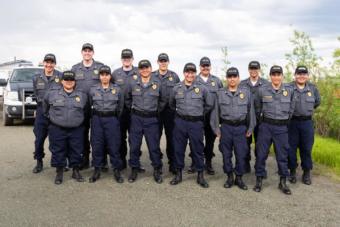
Thirteen officers graduated from Rural Law Enforcement Training at Yuut Elitnaurviat in Bethel on June 14, 2019. (Photo by Katie Basile/KYUK)
In 2019, U.S. Attorney General William Barr declared a public law enforcement emergency for rural Alaska after his visit to the state. Alaska lawmakers then formed a working group to fix the Village Public Safety Officer program, a key state service which has battled budget cuts, high turnover and an evolving job description.
Now the working group has come up with a list of recommendations that lawmakers hope will solve some of the issues with the program.
First on the list is to revise the state statute that details what the Village Public Safety Officer program is supposed to do.
Rep. Chuck Kopp, an Anchorage Republican who co-chairs the working group, said the program was supposed to help with wildlife management and search-and-rescue efforts.
Rep. Chuck Kopp, R-Anchorage, speaks during a House floor session, March 11, 2019. (Photo by Skip Gray/360 North)
“It had much less emphasis on law enforcement — you know, keeping the law, apprehending violators and keeping people safe. But then the program kind of just dramatically evolved,” Kopp said.
According to Kopp, the program’s evolution is not reflected in the state statute. He said that the feedback that the working group received suggests that revising it will make it easier to fix other problems in the VPSO program, like funding and the lack of flexibility for VPSOs to cover other communities in addition to the ones they are assigned.
Kopp said it could also help with high turnover rates.
“The way the program is structured, there is no real flexibility for the people who are the boots on the ground,” Kopp said.
VPSOs are usually the only law enforcement in a remote community, and are first to act during an emergency. It can take hours and sometimes days for an Alaska State Trooper to get to a community, usually because of weather.
But there are roughly 40 VPSOs covering the entire state of Alaska, leaving many communities without any kind of law enforcement. Only four VPSOs are currently based in four communities the Yukon-Kuskokwim Delta, according to Azara Mohammadi, the director of communications for the Association of Village Council Presidents. AVCP compacts with 56 tribes for services, like the VPSO program.
But AVCP is working to hire more. Mohammadi said they have one application currently in the hiring process and eight more applications waiting to be reviewed.
Since August, the working group has held eight meetings — usually listening sessions around the state to gather feedback, including the one in Anchorage this week.
Among the feedback is the need to create more flexibility with funding for the nine nonprofits and one borough that oversee VPSO programs throughout the state.
Sen. Donny Olson, D-Golovin, speaks during a Senate floor session in Juneau on March 13, 2019. (Photo by Skip Gray/360 North)
The working group also wants to establish a formal government-to-government consultation process at the state level that would consult tribes before any changes are made to training or regulation. The Alaska Department of Public Safety will continue to advise and train VPSOs.
Sen. Donny Olson, D-Golovin, also co-chairs the working group. He hopes that this time, with this list of recommendations, the solutions will be permanent.
“In the next five to 10 years, I don’t want to hear these same issues coming back at me,” Olson said. “And I plan to be here.”
The working group plans to finalize the recommendations by the end of the month. Kopp said they will focus on revising the statute during the 2020 legislative session, which starts on Jan. 21 in Juneau.
The proposed Donlin Gold mine would be one of the biggest gold mines in the world if completed. (Photo by Dean Swope/KYUK)
Donlin Gold received a handful of state permits on Jan. 2 that move the company closer to operating its gold mine in the Yukon-Kuskokwim Delta, according to Alaska Department of Natural Resources spokesperson Dan Saddler.
The permits will allow Donlin to build an airstrip and a port, and install fiber optic cables and build access roads for its mine, which could be one of the biggest in the world if completed.
The company needs more than a hundred permits before it can build and operate its mine. It already received two major federal permits and state permits in the last two years.
Separately, DNR Commissioner Corri Feige denied an appeal from Donlin opponents over the agency’s approval of Donlin’s reclamation plans. Those seeking to appeal that denial must go through the court system within the next 30 days.
But Donlin still faces hurdles. The state is reviewing its application for a right-of-way to build a 315-mile gas pipeline for its operations, and Donlin is currently working on its dam safety certification; that can take as long as two years.
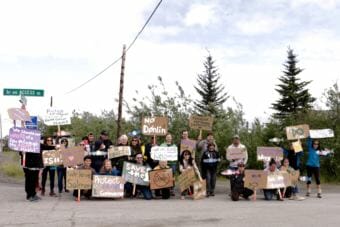
The Orutsararmiut Native Council in Bethel organized the first public march against the Donlin Gold mine in June 2018. (Photo by Christine Trudeau/KYUK)
For the last two decades, mining companies have been working to develop the massive Donlin Gold prospect in the Yukon-Kuskokwim Delta. And most of that time, the development has claimed support from neighboring communities. But that’s changing. Tribes, organizations, and communities have begun opposing the mine development and organizing.
In June 2018, the Orutsararmiut Native Council (ONC) organized the first public march against the mine. The final Environmental Impact Statement for the proposed Donlin mine had been published a couple months before.
Peter Evon is ONC’s executive director. He grew up in Akiachak, one of the villages along the Kuskokwim River more than 100 miles south of the mine site.
“You know, I was in junior high when I first heard about it. They were bringing in bikes, bringing in recycling programs and handing out trash bags with Donlin Gold on them,” Evon recalled.
The Donlin prospect has been around for decades, ever since the Calista Corporation and the Kuskokwim Corporation (TKC) selected the site for development under the Alaska Native Claims Settlement Act of 1971. Calista owns the mineral rights.
A company called Placer Dome struck a deal with Calista and TKC to develop the mine in the mid 1990s. After a series of business acquisitions, that venture became known as Donlin Gold.
Donlin has put a focus on what’s sometimes called “corporate citizenship” — investing in communities near the proposed development. In any village in the Yukon-Kuskokwim Delta, and in Bethel, you see Donlin Gold’s logo in the schools: on sweatshirts and coats and hats. Donlin Gold has paid to remove waste from villages. It has rebuilt churches, and purchased scoreboards for village schools.
Evon says that the company knew those steps would be welcomed in one of the poorest regions in the United States that has some of the highest costs of living.
“So anything free is usually associated with something positive, and so they took that approach and that’s all I knew growing up,” Evon said.
“It’s important that, you know, that your neighbors show a vested interest, and this is something we are, you know, showing every day, year after year: that we’re investing now, and we’re investing in the future of these communities,” said Woolston.
When the company signed the leases with the Native corporations that own the land and mineral rights, Donlin promised to prioritize jobs for their shareholders. There could be 800 mining jobs in the region once the mine is operational. Most of the time that the mine has been in development, it hasn’t generated many headlines. People have spoken against it at meetings and hearings, but there weren’t many organized, public protests.
In 2006, the Association of Village Council Presidents (AVCP) , a tribal consortium that represents 56 tribes in the region, passed a resolution supporting the proposed Donlin Gold mine as long as it was built in an environmentally-sound manner. Six years later, in 2012, Donlin Gold submitted an application for the environmental process. In 2018, the environmental review was finalized and published. Donlin also received a handful of major state and federal permits. That’s when tribes began to object, and to organize.
“Well, we came together very recently as part of the Y-K River Alliance just last month,” said ONC tribal member Danielle Craven in a 2018 interview.
Craven said that she knew and had concerns about the mine for years, but it wasn’t until the final EIS was published that she realized how real it could become. Like many people in the region, Craven is concerned that a mine accident could destroy the fish in the Kuskokwim River, and that the extra barge traffic would damage the habitat of smaller fish, like smelt. Donlin Gold had to start from scratch to study the smelt, and opponents say that there is not enough data to show that barge traffic will not impact them.
“We became concerned that this was going to harm our way of life and living in the Delta, and so we decided to come together,” Craven said.
Craven helped lead a grassroots effort along the Kuskokwim River during the summer of 2018, urging tribes to pass resolutions protesting the Donlin mine. Twelve did. Then the protesters turned their attention to Calista, the regional Native corporation that owns the mineral rights. Shareholders staged a sit-in at Calista’s annual shareholder meeting in Bethel in July 2018.
Then ONC turned its attention to rescinding the 2006 AVCP resolution supporting the Donlin mine. They teamed up with the Native Village of Kwinhagak at this year’s convention.
“The tribes felt it was not worth it just for 30 years out of thousands of years that’s always been there,” said Darren Cleveland, president of the Native Village of Kwinhagak.
Tribal delegates rescinded the 2006 resolution and passed an anti-Donlin resolution by huge margins. It marked a significant shift in the region: the Donlin Gold mine no longer enjoyed support from many villages. Now, at least 35 out of 56 tribes in the region are on record against the mine. KYUK sent multiple emails and followup emails to give Calista the opportunity to participate in the story, but Calista was not able to make anyone available. Donlin Gold says it will continue to build the mine as safely as possible, according to Woolston.
“Calista and The Kuskokwim Corporation selected the mine site with their lands specifically for the broad and significant benefits mining is able to provide to the region’s residents. These benefits complement subsistence traditions and the very limited economic opportunities available now and in the foreseeable future. Donlin Gold is engineered with modern, sophisticated environmental safeguards, and the rigorous and comprehensive permitting process, which is largely complete, includes engineering, environmental and safety requirements to protect Alaskans.”
In response to the anti-Donlin vote, Donlin Gold and Calista released a two-page statement detailing the hundreds of meetings that both companies have held with shareholders over the past two decades.
Tisha Kuhns is the vice president for public lands and resource development at Calista. In a statement to KYUK in September, she emphasized that mines can be developed safely.
“Calista’s board will continue to review and manage any regional resource development on ANSCA lands with full awareness and active participation,” Kuhns said.
Since then, Calista has intensified their marketing efforts, releasing opinion pieces statewide and a new promotional video. But as Calista promotes the mine, many of its shareholders want a vote on it. Some of them are against the mine. Others think the vote would ensure all shareholders get a say in whether or not the mine is developed. Calista has said that it is considering it.
Close
Update notification options
Subscribe to notifications
Subscribe
Get notifications about news related to the topics you care about. You can unsubscribe anytime.