Krysti Shallenberger, Alaska's Energy Desk - Bethel
Santa Claus is coming to town — in a Black Hawk helicopter

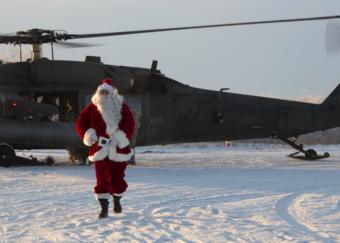
A man dressed as Santa Claus walks out of a Black Hawk helicopter.
Alaska Army National Guard Sgt. 1st Class Nicholas Mikos, an UH-60 helicopter repairer assigned to the Bethel Army Aviation Facility, dresses as Santa for Operation Santa Claus in Napakiak on Dec. 3. (Public domain photo by U.S. Air Force Airman 1st Class Emily Farnsworth)

Santa Claus delivered presents to Napakiak a little early this year — on Dec. 3, instead of the night before Christmas.

And instead of arriving behind flying reindeer, he arrived in a Black Hawk helicopter.

U.S. Army Sgt. 1st Class Nicholas Mikos is waiting for the Black Hawk helicopter to land outside the National Guard hangar in Bethel. The sun is just peeking over the horizon at 10 a.m., but everyone has been up much earlier.

“I feel great!” Mikos said.

The sergeant has played Santa Claus before, in the Alaska National Guard’s “Operation Santa.” It’s a tradition that dates back to 1956. Each year, the National Guard flies to small, remote Alaskan communities off the road system, bringing presents, ice cream and Santa.

Napakiak was the second village this year; Santa visited Tuntutuliak a week prior.

Mikos and roughly 20 other volunteers are setting up the gym at the Napakiak school. Bags featuring characters from the Disney movie “Frozen” are for babies and toddlers. Older students receive backpacks filled with snacks, toothbrushes and school supplies.

The adults are not left out: They get cheerfully-colored hats knitted by women in Florida.

Alaska Air National Guard Senior Master Sgt. Saroya Porche, 176th Force Support Flight superintendent of manpower and personnel, hands out backpacks during Operation Santa Claus in Napakiak on Dec. 3. (Public domain photo by U.S. Air Force Airman 1st Class Emily Farnsworth)

When everything is ready, the children file in to sit in the middle of the gym floor and start singing Christmas carols.

Then the big moment: Santa walks in.

While some kids and their parents line up for Santa, others line up for ice cream. They can choose caramel or chocolate toppings, as well as sprinkles and cherries.

Not everyone knew Operation Santa was coming to Napakiak. Trisha White saw the Black Hawk helicopter circling the village earlier in the morning.

“We didn’t know what was going on,” White said.

So she and her partner, Jonathan Nelson, called around and realized that Santa was on his way.

“A couple hours later, we found out everyone was here,” White said. So they brought their daughter to share in the fun.

Meanwhile, 16-year-old Natalia Ayagalria is admiring her new backpack.

“I got a free backpack that says ‘Peace Frogs,’ and it’s purple,” Ayagalria said.

Ayagalria hopes Santa will come back again.

“I hope it happens because it’s, like, a community activity that’s pretty cool, and not this many people always go to activities,” Ayagalria said.

Alaska Army National Guard Sgt. Randall Andrew, an infantryman assigned to the Bethel Army Aviation Facility, gives a child a gift during Operation Santa Claus in Napakiak on Dec. 3. (Public domain photo U.S. Air Force by Airman 1st Class Emily Farnsworth)

For many kids, this was their first time at Operation Santa. For Maj. Gen. Torrence Saxe — the adjutant general for the Alaska National Guard, and the commissioner of the Alaska Department of Military and Veterans Affairs — it was his first time too.

“I haven’t seen kids that excited over Santa for a long time,” Saxe said.

He doled out the cherries for the ice cream line. He has a pretty good idea of the favorite toppings.

“I’m gonna say chocolate with sprinkles and one cherry. I only had two people in the entire room that did not want a cherry,” Saxe said.

Two hours later, it’s over, and everyone packs up. Santa gets into the Black Hawk and takes off.

Broken lights on Quinhagak’s airport runway leave the village with limited air service

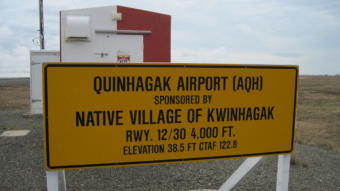
Sign at the Quinhagak airport in the Native Village of Kwinhagak. (Creative Commons photo by IceCreamForEveryone)

No night flights or medevacs have been able to land on the Native Village of Kwinhagak’s runway for the past two months, and it doesn’t look like they will be able to anytime soon.

That’s because the runway lights are out, and the village is trying to figure out what to do.

“There are some (lights) that are pulled out or have popped out, and there is one that looked like it was pulled out and the wires are showing,” said Tribal Administrator Patrick Cleveland.

Cleveland isn’t sure how long the lights have been out. He and others noticed the lights were out around September. As the nights got longer, it was obvious they were not working. Kids have vandalized lights at rural airstrips before, but Cleveland doesn’t know if that’s what happened in Quinhagak.

Cleveland said that the man who maintains the runway denies damaging the lights.

“There was another source of damage that caused that,” he said.

It’s put the tribe in a tough position. The Native Village of Kwinhagak took over the airport from the state in the 1990s, which means that they have to pay for lights and repairs.

For now, Quinhagak has shut down the airport to all night flights until the end of the month, and possibly longer. The tribe is also advertising for a contractor to repair the lights. Cleveland said that one contractor has expressed interest so far.

Shannon McCarthy, spokesperson for the Alaska Department of Transportation and Public Facilities, said the tribe can collaborate with DOT, but they need to apply for funding from the Federal Aviation Administration.

In a Facebook post on Monday, Tribal Council President Darren Cleveland said that the state DOT promised emergency lights so that medevacs can land.

A new report sheds more light on how climate change is impacting Alaska Native villages

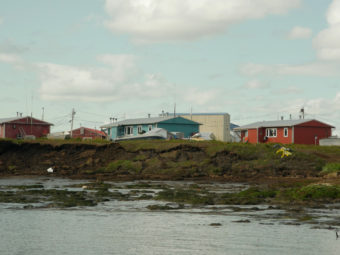
The Western Alaska village of Newtok in August 2016. Because of encroaching erosion, the village is in the process of relocating. (Photo by Eric Keto/Alaska’s Energy Desk)

Ten years ago, the Army Corps of Engineers released a report that detailed the impacts of erosion in Alaska Native communities.

Don Antrobus is the program manager for the Denali Commission’s Village Infrastructure Protection Program. He helped guide an updated report that documents three environmental threats facing the communities: erosion, thawing permafrost, and flooding.

Antrobus said those environmental threats are made worse by climate change.

“In order for communities to develop good solutions, they need to fully understand the site-specific threat,” Antrobus said.

The Army Corps and researchers at the University of Alaska Fairbanks conducted the research and wrote up the report at the behest of the Denali Commission. It took three years and $700,000.

Antrobus said that more specific information is needed to fully understand the threats.

“One of the approaches that we’re taking, to try to kind of paint a bull’s-eye around what those additional data collection needs are, is to not only say that you need additional information, but to identify these are the specific types of communities, specific vulnerability analyses that are necessary,” Antrobus said.

This report examines 187 communities, most of them in Western Alaska near or right on the coast or near a river. It ranks them according to how bad the threat is endangering their infrastructure.

The rankings are complex. The report separates the three threats and ranks each community under each threat. Then the report combines all three for each community and ranks the communities that are in the biggest trouble.

“There is a little bit of uncertainty based on that availability of data, so it shouldn’t be taken as hard and fast,” Antrobus said.

The top two most threatened communities are Shaktoolik and Shishmaref, both close to the Bering and Chukchi seas.

“We were looking at flooding, erosion, and permafrost degradation threats to community infrastructure. And so I think it’s natural that a lot of … the greatest flooding threats that we’re gonna see are gonna be along the coast,” Antrobus said.

These villages have endured catastrophic erosion and storms, and the dwindling sea ice means that there is less protection for the shoreline. The ocean is nibbling closer to communities, forcing some, like Shishmaref, to consider relocation.

Other communities sit right next to a riverbank, like Napakiak and Newtok in the Yukon-Kuskokwim Delta. Newtok is relocating entirely, while Napakiak wants to move its school.

Antrobus said that the report could help communities figure out their biggest threat. For some, erosion is the biggest. For others, it’s flooding. He said this report is just a one-time effort, but he hopes government agencies and villages can fill in the gaps in data, and apply for funding to do so.

Yup’ik Elders help revive the nearly-extinct tradition of crafting baby parkas

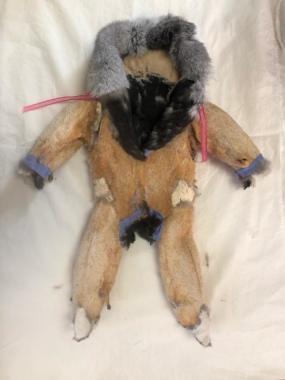
An atasuaq, a traditional Yup’ik baby parka. (Photo by Krysti Shallenberger/KYUK)

Sewing atasuaq, traditional baby parkas, was almost a lost skill.

That is, until a Yup’ik Elder helped revive it. And the result? An atasuaq, sewed with bird skin, from the coastal village of Toksook Bay.

The parka is roughly 2 feet long, just big enough to fit a 9-pound baby. The bird skin facing the outside feels like toughened leather, with the feathers tucked inside and peeking around the collar and hood.

“It’s made out of qengaallek, king eider skins, and four allgiar skins, which are long-tailed ducks,” said Ann Fienup-Riordan, an anthropologist who has documented Yup’ik life in Western Alaska for decades.

This used to be common in Yup’ik communities, where every child started life surrounded by bird skin and cuddled in feathers. There are Elders alive today who were snuggled in bird-skin parkas as infants.

But over generations, the tradition disappeared as cloth diapers and commercial baby clothes became more easily available at local stores.

Making this parka and reviving the almost-extinct tradition took the efforts of many people. It began with the memories of Albertina Dull, an Elder from Nightmute who began her life in a bird-skin parka made by her mother and later used it for her own children.

To make a new one, a hunter in the nearby coastal village of Chefornak sent over some of the skins. The rest came from Toksook Bay.

Fienup-Riordan said that the idea of making the traditional bird-skin parka arose during an education collaboration between Calista Corp. and Yup’ik Elders.

That’s when Dull remembered the baby parkas from her childhood. Dull said that the parka was easy to make. She only speaks Yugtun, but KYUK translated her replies.

“It’s easy to make an atkuuk because we are Yup’ik. Because we are Yup’ik, we never throw away anything that has skin, like birds. Keep them all, then wash them. After washing, when they are all good, we make atkuuks out of them,” Dull said.

There was one problem. At 101 years old, with poor eyesight, Dull couldn‘t sew the baby parka that she saw so clearly in her memories.

“My eyesight is no longer good anymore, but I can instruct,” Dull said.

That’s how Fienup-Riordan and the others started making this parka.

“Since she could describe it, and we’d never seen one, we decided to go ahead and make one. And so last spring, we started to work the skins,” Fienup-Riordan said.

They scraped the fat off the skins and washed them with Dawn soap before hanging the skins to dry. Then, to soften the skins, they rubbed them in a circular motion. Dull told them to do all of this by memory, Fienup-Riorden said.

“For instance, when you are scraping the skins, the way she described it was, ‘You hold the skin and you scrape toward the head, and then move gradually down the body, always toward the head.’ Now, if you picked up a greasy skin you wouldn’t know that, but she knew that,” Fienup-Riordan said.

The next step was sewing. A couple of women in Toksook Bay went to work, following Dull’s instructions. The result is a tiny parka worn by a baby until they start crawling. The tanned skin faces the outside, and the feathers line the inside to keep the infant warm. Blue cloth is stitched around the armholes and the opening in the crotch area. Pink ribbons tie the hood together.

Fienup-Riordan thinks that it may be the first such parka made in Western Alaska in nearly 80 years, but the women in Toksook Bay plan to make more.

“Our joke is that we should have a BYOB party: Bring your own bird!” Fienup-Riordan said.

Dull said that the more the parkas are made, the better they’ll look.

“When we first make something, when we didn’t know how and our moms first taught us how, they’re very ugly at first. Our first tries are very ugly, but they improve. As we learn more, our work improves,” Dull said.

It’s unclear where this, the first bird-skin baby parka in almost a century, will find a home. Fienup-Riordan hopes that home will be in Bethel.

Novagold talks expansion, mine development in latest earnings call

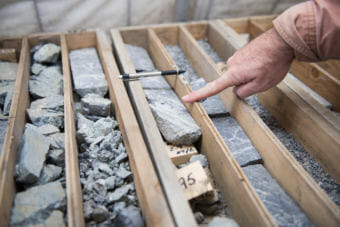
The proposed Donlin Mine could extract roughly 33 million ounces of gold during its initial 27-year production period. (Photo by Katie Basile/KYUK).

Novagold, one of two companies developing the proposed Donlin Gold mine in the Yukon-Kuskokwim Delta, is looking at building the mine in stages to reduce construction costs. That’s according to its latest quarterly earnings call.

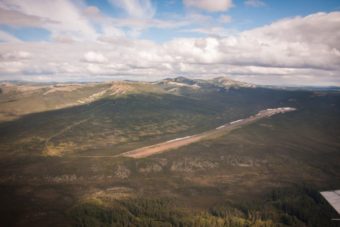
Donlin plans to build a mine consisting of two pits that will eventually merge into one. At its peak, the mine would be two miles long and more than a mile wide. That will require a lot of infrastructure, including a road, an airstrip, and a 315-mile gas pipeline. All of that comes with a $6.7 billion price tag, and Donlin’s developers need to trim costs.

Novagold is one of the two companies that has formed Donlin Gold to build and operate the mine. The company is exploring how to build the mine in stages. Novagold Vice President of Communications Melanie Hennessey says that the plan is not finalized.
“We’re just looking at the better ways to reduce the capital expenditure from the front end, but it’s one of many options that we’ve studied that we’re looking at,” Hennessy said.

Donlin says that it could take 3,000 people to build the mine, and 800 to operate it annually. Hennessey says that the company can’t say how building the mine in stages might change the number of jobs that the construction would generate.

“So we don’t have that level of detail, and in addition to that, given the population in the region, I think there are ample opportunities for those who are qualified and willing to work,” Hennessey said.

As part of its lease agreements with the two Native corporations that own the land and mineral rights, Donlin has promised to prioritize hiring local shareholders. Hennessy says that the mine, as currently designed, holds almost 40 million ounces of gold to be mined over 27 years. But there’s a big chance that can be extended.

Novagold’s board chair, Thomas Kaplan, said in the earnings call that “another part of the asset that people rarely think about is the unbelievable white swan that exists that the next Donlin could be at Donlin. My geologist from Electrum believes that there is great potential to be able to find another Donlin at Donlin.”

Hennessey said that she doesn’t know when they will wrap up the feasibility study, which would update how Donlin plans to build the mine. She said that the next earnings call should provide more details.

Mountain Village corporation wants vote on Donlin mine

Donlin runway and camp site in summer 2014.
The proposed Donlin Gold mine would be one of the biggest gold mines in the world if completed. (Photo by Dean Swope/KYUK)

A village corporation in the Yukon-Kuskokwim Delta wants Calista Corporation shareholders to vote on whether Calista should support the proposed Donlin Gold mine.

Calista owns the mineral rights to the mine, which would be built in the upper Kuskokwim River area. Azachorok is a village corporation in Mountain Village, on the Yukon River. Azachorok’s president, Loren Peterson, says its resolution isn’t a stance on the mine, but it would give shareholders a chance to decide if they want it.

Peterson describes the resolution as pragmatic.

“When it’s a controversial issue like this and you have a corporation that’s designed to develop and make money, we think there should be a pause in this situation and take a look at the mission and values of the corporation,” he said

The resolution is inspired partly by what happened at the Association of Village Council Presidents’ annual convention in September. There, delegates voted overwhelmingly to rescind a 2006 resolution supporting the mine.

Under the Alaska Native Claims Settlement Act, Native corporations are tasked with two goals: maintaining the traditional way of life and promoting economic development. Peterson says that sometimes those goals can conflict, like in the case of the proposed Donlin mine.

“It can bring a lot of capital to the corporation and we could see some economic development and jobs, but at the same time, the Donlin Creek development could impact subsistence resources and our subsistence,” he said.

The Azachorok resolution doesn’t take a stance on the Donlin mine. Peterson says that the corporation sees both sides. In fact, under the Alaska Native Claims Settlement Act, Azachorok would receive some of the mine’s profits. Peterson says that the resolution advocates for the shareholders who live closest to the mine to have a voice on whether it’s built.

“If it’s a bad development in the aftermath, the fault isn’t necessarily on the corporation, and they now have a more democratic approach to where the shareholders that own the shares of the corporation and live on the land and participate in hunting and fishing, they should have a say,” Peterson said.

More than 300 female Calista shareholders made a similar argument in a letter that they sent the corporation earlier this year. They expressed concerns over the mine’s possible impact to the Kuskokwim River, the region’s main food source.

KYUK reached out to Calista for comment on the resolution last week and has not received a response.

Site notifications
Update notification options
Subscribe to notifications