Krysti Shallenberger, Alaska's Energy Desk - Bethel

Quinhagak opposes Donlin Gold mine

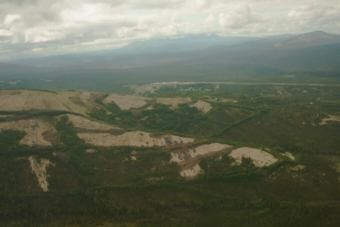
The Donlin Gold mine would be one of the biggest in the world, if developed. (Photo by Dean Swope/KYUK

There haven’t been any public protests against the proposed Donlin Gold mine in the Yukon-Kuskokwim Delta since last summer. But one tribe broke the silence with a resolution opposing the mine this month.

Quinhagak’s Native Tribal Council members all agree that the Donlin Gold mine should not exist. The council’s president, Darren Cleveland, worries that the mine will compel more people to leave Quinhagak.

“We feel that if it becomes real, that instead of slow trickle of people moving out, we might have all of a sudden a group of people just moving and it would be like a culture shock for families,” Cleveland said .

Cleveland said that the younger men might leave, and it would be on the women and elders to hunt and fish for their families. He also said that entire families might leave.

Quinhagak is hundreds of miles away from the mine site, which sits near a tributary of the Kuskokwim River. The village is closer to the mouth of the river near Kuskokwim Bay. Another concern is that a mining accident could contaminate the village’s main food source, even though it would be almost 200 miles away. Quinhagak doesn’t want that. Village residents depend on the river’s rich array of salmon species for food.

“That could be devastating for our way of life that has always been, and we don’t want to add on risks,” Cleveland said.

Cleveland says that the heat wave that killed salmon in the Kuskokwim is an example of risks that they are already facing. There is also the fact that Quinhagak doesn’t want any mining near its village. The resolution is supposed to show support for tribes closer to the mine that have passed resolutions against it.

“If we have mining here in our area, we’d want the support of other tribes to help us out that we are against it,” Cleveland said.

Quinhagak joins 12 other tribes that have passed resolutions opposing Donlin Gold in the past year: Tuluksak, Napakiak, Kongiginak, Kwigillingok, Nunapitchuk, Tununak, Chuloonawick, Emmonak, Eek, Chevak, Kasigluk and Chefornak.

Donlin Gold did not respond to a request for comment by broadcast time, but the company has said repeatedly that it plans to build the mine as safely as possible.

U.S. Department of Justice awards $5M to Alaska Native tribes for law enforcement

U.S. Attorney General William Barr heard concerns from Alaska Native leaders about the lack of law enforcement and high rates of sexual assault and domestic violence in rural Alaska. (Photo by Joey Mendolia/Alaska Public Media)
Earlier this year, U.S. Attorney General William Barr visited Alaska and heard concerns from Alaska Native leaders about the lack of law enforcement and high rates of sexual assault and domestic violence in rural Alaska. (Photo by Joey Mendolia/Alaska Public Media)

Eight communities in the Yukon-Kuskokwim Delta got good news last week: more money for more law enforcement positions, thanks to a U.S. Department of Justice program.

For Akiachak Tribal Police Chief Mark Mata, the grant means an extra set of hands and training. Akiachak is one of several Alaska Native tribes that received a portion of $5 million from the Office of Community Oriented Policing Services, or COPS, to hire village and tribal police officers.

A recent media report said that one in three rural Alaska villages lacked any kind of law enforcement. Earlier this year, U.S. Attorney General William Barr visited the Y-K Delta to see the public safety crisis firsthand.
The Department of Justice released $10 million in emergency funds in June, and promised to expand existing programs for Alaska Native tribes. The program that funds additional public safety officers in villages started in 2010. Tribes apply for funding, and the money lasts three years.

Mata says that Akiachak’s share this year is bigger than the last time it applied.

“Because couple years back, there are only two officers covered in the grant,” Mata said.

This time, the village can pay for three full-time positions. Currently the tribe pays the salaries of four tribal police officers: two full-time and two part-time.

With this latest funding Akiachak will also have enough to pay for Mata, along with a deputy chief and an additional tribal police officer. The money will also pay for more training. Tribal police officers are not required to get any training, and few actually do. A man died in Akiachak’s jail earlier this year; Mata says that more training could have prevented it.

“That’s why this grant is really helpful for us, because I can send them to training and get them certified,” Mata said.

The other Y-K Delta villages getting a piece of the $5 million in federal funds are: Napaskiak, Kipnuk, Quinhagak, Mekoryuk, Scammon Bay and Tununak.

For some Alaska villages, climate change means they may have to move

The Kanektok River is eroding large chunks of bank and land from Quinhagak. (Photo by Krysti Shallenberger/KYUK)

In Western Alaska, accelerating erosion is forcing several villages to consider moving. In Quinhagak, a village on the Bering Sea, erosion is threatening the sewer lagoon and the building that houses its washeteria and health clinic.

Jackie Cleveland grew up in Quinhagak and is the natural resource director for the tribe. She’s seen the changes from erosion her whole life: The house where she grew up is partially underwater now.

“Growing up here, the land used to extend so far out here, and we had this beautiful bed of different flowers, wildflowers that grew up everywhere. I miss that little wild garden we used to have,” she said.

Quinhagak is especially vulnerable to erosion. It’s surrounded by water, with the Kuskokwim Bay in front and the Arolik and Kanektok rivers on either side.

Quinhagak has moved parts of the village before, including fish camps and some houses, but the erosion is getting worse and happening faster now because of climate change. Quinhagak’s sewer lagoon and the building that holds the washeteria and health clinic are experiencing the worst impacts.

That makes it a public health problem, according to Ferdinand Cleveland, the tribal administrator for Quinhagak.

“This is supposed to be sitting on gravel,” he said, pointing out the multipurpose building where the washeteria and health clinic are located. “See the concrete? There’s a gap underneath.”

A cloudy day in Quinhagak. (Photo by Adrian Wagner/KYUK)

A 2012 report from the state listed the lagoon and the multipurpose building as top priorities for replacement or repair because of erosion and thawing permafrost. Nothing has changed eight years later. Thermosiphons, designed to keep the ground from thawing, were installed below the concrete foundation, but Ferdinand Cleveland said that they aren’t working because the ground is warming too fast.

He pointed out the cracks that lace the building’s walls.

“You can see, it’s evident that the cracks (are) all over. You see the outside part of the building. The concrete is sinking, and the drywall is cracking. It’s affecting our phone lines. We’ve already had some phone lines disconnected,” he said.

Quinhagak has to construct a new building to hold the health clinic and move the washeteria, according to Ferdinand Cleveland.

The sewer lagoon sits close to the ocean. A fence around the lagoon is roughly 200 feet from the edge of the beach. Ferdinand Cleveland said that he doesn’t know how they would close up the lagoon if the erosion causes the waste to leak into the ocean. The Kuskokwim Bay is an important food source.

Erosion threatens other infrastructure, like the airstrip, the water treatment plant and the water and sewer system for the entire village. The village got running water roughly eight years ago.

Jackie Cleveland and Ferdinand Cleveland believe it’s clear that Quinhagak has to move. Warren Jones, the president of the village corporation Qanirtuuq Inc., agrees.

Warren Jones, the CEO of Qanirtuuq Inc., surveys Quinhagak’s defunct processing plant. (Photo by Teresa Cotsirilos/KYUK)
Warren Jones of Qanirtuuq Inc. (Photo by Teresa Cotsirilos/KYUK)

“I think it’s time to start preparing. It’s coming. There’s no (other) way about it,” Jones said. “We have to relocate to better ground, get these engineers out here with their certificates and say, ‘This is good land,’ even though our Elders already know what land to pick.”

But it’s expensive to move an entire village. Newtok is another coastal community north of Quinhagak. It will cost them more than $100 million to move.

Ferdinand Cleveland has applied for a grant from the Bureau of Indian Affairs to plan how to move and rebuild the lagoon. He estimates that that alone could cost $6 million. A new health clinic could cost about $2.5 million.

KYUK asked Jackie Cleveland if the village is planning to build the new health clinic and move the lagoon first, or if they’ll wait until the entire town is ready to move. She said that they are still figuring out the answer.

“That’s a question of a lot of things here,” she said.

Ferdinand Cleveland said that it’s more likely they will rebuild the lagoon and build a new building to house the health clinic, then start planning to relocate Quinhagak.

For now, the town is starting to plan its next steps: Jackie Cleveland met with the tribal council and Quinhagak residents to get feedback earlier in June.

AG Barr says ‘everything is on the table’ to solve Alaska’s public safety crisis

U.S. Attorney General William Barr heard concerns from Alaska Native leaders about the lack of law enforcement and high rates of sexual assault and domestic violence in rural Alaska. (Photo by Joey Mendolia/Alaska Public Media)

Late last month, U.S. Attorney General William Barr spent three days touring Alaska with the congressional delegation to hear about and see for himself the lack of public safety in rural Alaska. He spent a day in Bethel and the nearby village of Napaskiak.

Barr’s security detail outnumbered the number of village public safety officers in the Yukon-Kuskokwim Delta, a region roughly the geographic size of Oregon.

Western Alaska has a public safety crisis, one that’s been there for decades.

A recent Anchorage Daily News article highlighted just how bad it is: At one point this year, at least 1 in 3 rural Alaska villages had no law enforcement. Western Alaska also has some of the highest rates of domestic violence and sexual assault in the nation, and ranks high in the number of murdered and missing Indigenous women.

With U.S. Sen. Lisa Murkowski, R-Alaska, by his side, the attorney general made his first visit to the Yukon-Kuskokwim Delta.

“You have to see it to understand it,” Barr said.

Barr said that it’s hard for him to imagine a “more vulnerable population.” And he said that even the bare minimum of basic safety standards is lacking in the Y-K Delta.

Barr and Murkowski first visited Bethel’s Tundra Women’s Coalition, one of two women’s shelters in the region. Staff there told them that they were over capacity and struggling to make room for families coming in. Ina Marie Chaney, a shelter manager, said that a case has to be pretty serious before the shelter can even consider it.

“Right now we’re screening on lethality cases,” Chaney told Murkowski and Barr.

And then Barr heard from the Association of Village Council Presidents about the public safety crisis and their ideas about fixing it. Reporters were not allowed in that meeting.

AVCP CEO Vivian Korthuis told KYUK later that they presented Barr with a plan to build seven public safety centers in the region, and she hopes that they will get the resources they need to build them.

Then it was time to visit Napaskiak. People lined the banks as the boats carrying Barr and Murkowski pulled up to shore.

Their first stop was the jail. Inside the large red building are cells made of wood, with wooden doors.

Napaskiak has two tribal police officers and two village police officers. All of them are working part-time; they work one week on and one week off. Napaskiak used to have two state-trained village public safety officers, but they left.

Barr also visited the school. There, Native Village of Napaskiak President Stephen Maxie Jr. begged him to declare an emergency because of how many alcohol-related deaths happened in the village over the past two years.

“The poor suffer the most, and they don’t got the most. They’re hurt the most because we’re always overlooked and always put aside,” Maxie said.

Barr said that he sees that the criminal justice system isn’t working for Alaska Native tribes. And as for the types of solutions, he said “everything is on the table.”

Meanwhile, another tribal police officer is set to leave after only a couple of months on the job: Harry Williams said that he plans to go to building maintenance. The reason? Better pay and benefits.

Barr has said he plans to return to the Y-K Delta. At an Anchorage meeting, he told leaders that he would schedule a followup meeting. So far, no date has been set.

Negotiations sour on tribal child welfare agreement

The Alaska Capitol Building in Juneau on June 6, 2017. (Photo by Jeremy Hsieh/KTOO)

Negotiations broke down last week over a compact between Alaska Native tribes, tribal organizations, and the Alaska Department of Health and Social Services. The agreement, called the Alaska Tribal Child Welfare Compact, was signed in 2017 by then-Gov. Bill Walker.

Alaska Native children make up more than half of the children placed in foster care, even though they are only 20% of the children in Alaska. The problem is that the state does not have staffing in many rural communities to intervene in cases where children are at risk.

But tribes that are already in those communities can step in to protect the children. The compact gives tribes more control over their children’s welfare.

Rep. Tiffany Zulkosky, a Bethel Democrat, chairs the Alaska House of Representatives’ special committee on tribal affairs.

“The biggest takeaway around the concern about whether the child welfare compact continues is that this is a historic government-to-government agreement, the first of its kind in the country between the state and tribes in Alaska, that is providing support to help with overwhelming caseloads that the state is doing, that is providing support in areas around the state that are seeing turnover rates from 50-80%,” said Zulkosky.

Rep. Tiffany Zulkosky, D-Bethel responds to questions during a press availability in the Alaska State Capitol on March 9, 2018. The House speaker had sworn her in earlier.
Rep. Tiffany Zulkosky, D-Bethel, responds to questions during a press availability in the Alaska State Capitol on March 9, 2018. (Photo by Skip Gray/360 North)

The compact itself is complex. It gives tribes more resources and freedom to step in and do what the state has not had resources to do, and that is to take care of Alaska Native children that could be placed in foster care. For instance, the compact says that tribes can conduct their own investigations into child welfare cases and participate in picking families to care for the children. It also allows tribes to negotiate for state funding to provide those services.

But that funding is imperiled by Gov. Mike Dunleavy’s administration.

The Association of Village Council Presidents is a nonprofit that serves 56 federally-recognized tribes. In a statement, it says that the negotiations got off to a rough start when the state changed some of its negotiating team at the last minute. The state also “refused to transfer funding for services that were already negotiated and agreed to in January 2019,” according to the AVCP press release.

In a statement, a Dunleavy spokesperson says that the negotiation broke down because of two issues: The administration expected that funding for next year would go toward “direct services and deliverables,” and it expected tribes to come up with sufficient insurance to cover liabilities and risks on any work the state does.

The Alaska Federation of Natives also called on Dunleavy to step in, but Dunleavy said that “I have full faith and confidence that my policy advisor, John Moller, can adequately represent me on these matters.”

Donlin Gold looks to schools, workforce development for future employees

Welding students at Yuut Elitnaurviat designed and fabricated a road grader that can be transported to villages in a shipping container. It could be used to grade remote roads for mining operations. (Photo by Krysti Shallenberger/KYUK)

Donlin Gold promised to hire local workers for its proposed gold mine. To fulfill that promise, the company knows that it has to start now — and it has to start young. Donlin is already investing in schools and programs in the Yukon-Kuskokwim Delta in anticipation.

Desiree Teeluk’s bag is filled with tools from her locker at Yuut Elitnaurviat, a workforce development organization located in Bethel. She came from Kotlik, a village south of Norton Sound. Desiree has dreamed of being a carpenter since she was small.

“It’s just, like, in the blood. My dad was a carpenter, and my biological dad is one too,” Teeluk said.

She’s one of hundreds of students who have gone through Yuut Elitnaurviat or similar programs that train rural Alaskans for jobs at home.

Jeremy Osborne is the director of programs at Yuut Elitnaurviat. He also works as a part-time copy editor for KYUK. He’s confident that his students will be ready for a job at the Donlin mine.

“So if the Donlin project goes, which is something we’ve talked about with Donlin Gold for a number of years, we actually have the capacity to house 160 people, which is pretty darn good,” Osborne said.

Donlin promised to prioritize shareholders from the two Native corporations that own the mineral rights and land for the mine. To do that, Donlin has to have a pipeline of shareholders already trained for the jobs at a mine that might not begin operating until years down the road.

Donlin is already hiring for its drilling and exploration efforts, and it spends $1 million each year on community programs throughout the Yukon-Kuskokwim Delta like Yuut Elitnaurviat and EXCEL Alaska.

“Basically, what we do is we take a look at what jobs that are available in the region,” said Carol Wilson, executive director of EXCEL Alaska, another workforce training program that starts with students as young as seventh grade.

EXCEL tailors sessions to fit the skills that a student needs to get a job in their village. Teachers and community members refer a student to the program, and EXCEL gives them training for skills on local jobs until they graduate high school.

Donlin has already hired employees who have gone through EXCEL Alaska.

“They have already hired and have called back probably between eight and 10 of our students that they hired last year, or that they’d have put into work internships that are now being looked at to bring back on for their summer drilling program,” Wilson said.

Donlin is preparing to hire more than 100 people for the final drilling program for its dam safety certification. Those jobs will only last a year, but Donlin also is playing the long game. They help fund scholarships from Calista Corporation and The Kuskokwim Corporation, which own the surface and mineral rights. Donlin also gives money to the Alaska Native Science and Engineering Program, or ANSEP.

Back at Yuut Elitnaurviat, Teeluk is helping build portable teacher housing that will be shipped to villages in the Lower Kuskokwim School District. When asked if she wants to work for Donlin, she shrugged and smiled.

“I guess so,” Teeluk said.

Right now she has this semester, and one more class, before she can fulfill her dream of being a carpenter.

Site notifications
Update notification options
Subscribe to notifications