Krysti Shallenberger, Alaska's Energy Desk - Bethel
Two tribes, Dunleavy at odds over tribal sovereignty

Two tribes say that Gov. Mike Dunleavy and his administration aren’t doing enough to consult with their leaders on big issues facing the state. The previous administration made it state policy to consult with tribal entities on a government-to-government basis, which is standard practice at the federal level. But while Dunleavy acknowledges the policy, he’s unclear about how it would apply.

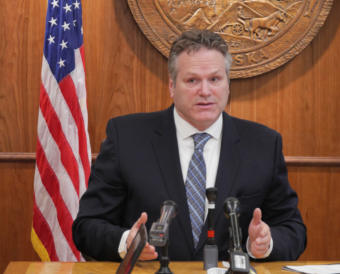
Gov. Mike Dunleavy discusses his proposed budget- and Alaska Permanent Fund dividend-related constitutional amendments with reporters at a press conference in the Capitol in Juneau on Jan. 30, 2018.
Gov. Mike Dunleavy speaks with reporters in January, 2018. (Photo by Skip Gray/360 North)

The Orutsararmiut Native Council in Bethel sent letters to three state agencies: the Alaska Department of Natural Resources, Alaska Department of Environmental Conservation and Alaska Department of Fish and Game, asking for government-to-government consultation on the permitting process for the proposed Donlin gold mine. The agency commissioners, all appointed by Dunleavy, said no.

“I was shocked. I couldn’t believe they were denying our request and it was like another shutdown to our voices,” said Mary Matthias, ONC’s natural resources director.

In a letter to ONC, the commissioners said that they want to treat all Alaskans fairly. In this case, they say that government-to-government consultation is a federal process, and is not applicable to state permitting. The Dunleavy administration also refused to consult with the Chilkat Indian Village over the proposed Palmer Project, a mineral exploration effort. In a press conference earlier this week, Dunleavy said that he is willing to use the government-to-government process only if it leads to an “absolute” outcome.

“My wife and my children are tribal members. I have a lot of friends who are tribal members. We’re going to be sitting down with various stakeholder groups associated with rural Alaska. We want to have genuine conversations, though, that move us from point A to point B. We just don’t want to have conversations for the sake of conversations,” Dunleavy said.

Alaska Native tribes are a form of government that’s recognized at the federal level as having sovereignty over certain matters. But Alaska, like many states, is sometimes reluctant to accept tribal authority.

In 2018, then-Governor Bill Walker issued an administrative order saying that the state must deal with tribes on a government-to-government basis when tackling issues that impact them. That order has not been rescinded by the Dunleavy administration. Walker’s administrative order is one step in a decades-long debate over tribal sovereignty in Alaska.

“Alaska as a state government and its approach to tribal sovereignty is really, unfortunately, it breaks down to political choices by past governors and past legislators, [or rather] Legislatures,” said Matthew Newman, a staff attorney for the Native American Rights Fund.

In the 1990s, the U.S. Department of the Interior formally recognized 229 Alaska Native tribes. Newman says that several court decisions have recognized tribal jurisdiction in Alaska.

“The universal answer every time is Alaska Tribes are indeed tribal sovereigns in the same sense that the Navajo Nation, the Cherokee Nation, or any other tribal nation in the Lower 48 is a tribe,” Newman said.

But tribal sovereignty is not enshrined in state law or the Alaska constitution. That leaves a lot of uncertainty over how the state will interact with tribes, and the political whiplash makes it harder for tribes to address problems and move forward with solutions. Kendra Kloster is the executive director with the nonprofit group Native Peoples Action, and a member of the Tlingit and Haida tribe. She says that every time a new governor steps into office, tribes must play defense.

“We’re constantly defending and trying to make people understand that Alaska Natives have been here; we’ve been stewards of this land. Every four years we might have to be doing that education part of it,” Kloster said.

Kloster says that government-to-government consultation should be standard in Alaska, especially when dealing with major projects like the proposed Donlin gold mine.

Dunleavy has repeatedly said that he understands rural Alaskan issues, including tribal sovereignty. Kloster says that just because Dunleavy’s wife and daughters are Alaska Native tribal members, that doesn’t give him a buy-in with the community or an automatic understanding of how tribal government works.

“I feel like he’s been using his wife, saying that ‘I understand, I understand,’ but clearly he does not or he’s not listening. He’s not responding to people, he’s refusing to work with tribes; this is very concerning,” Kloster said.

Back in Bethel, ONC says that their letter shows that they and Dunleavy want the same thing: an absolute outcome. But in this case, the desirable outcomes differ: ONC doesn’t want the proposed gold mine, and Dunleavy supports it.

Donlin Gold to begin drilling program

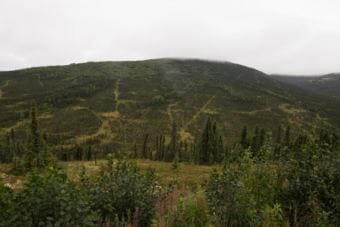
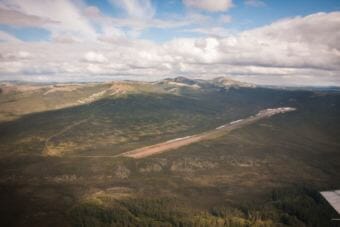
Donlin runway and camp site in summer 2014.
The proposed Donlin Gold mine would be one of the biggest gold mines in the world if completed. (Photo by Dean Swope/KYUK)

It’s going to be a busy year for Donlin Gold.

The company is gearing up for another round of geotechnical drilling, its first in two years. They are also advertising jobs for local hires, which is a vital selling point for their proposed gold mine in the Yukon-Kuskokwim Delta.

“Bear guard” is one of the jobs available.

“Well, there’s been recent events in Alaska where bears have been attacking people working on similar types of projects,” said Clyde Gillespie, Donlin’s senior project engineer.

There are other, slightly less risky jobs needed as well, like drillers, mechanics, cooks and housekeepers. Donlin expects to hire 120 people for a yearlong drilling program, the first in two years.

The drilling program will help the company prepare for its dam safety certification. That means it needs to evaluate the mine site in order to build seven dams for its gold mine. It’s one of the biggest hurdles that must be overcome before the company can build the mine.

Donlin promised to prioritize local hires, specifically shareholders from the two Native corporations that own the mineral and surface rights, but most of these jobs are contracted out. So how will Donlin hold up its end of the deal?

“We write that right into the contract,” Gillespie said.

Enforcing that part of the contract falls, in part, to Calista Corporation and The Kuskokwim Corporation. They work with Donlin and the contractors to fill the positions with their shareholders. Donlin spokesperson Kristina Woolston says that 90% of employees in the last drilling program were shareholders. She said that the majority came from the Yukon-Kuskokwim Delta.

The dam safety certification process could take two years and does not have a formal public comment process. Donlin and state agencies have said that they have open-door policies for the public.

Murkowski calls for many ‘silver bullets’ to tackle climate change

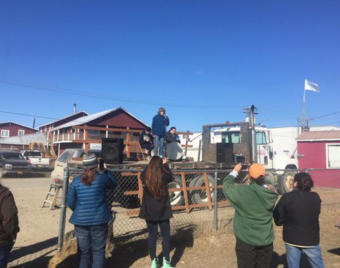
Sen. Lisa Murkowski speaks to a crowd of people at Bethel’s annual river breakup bash.
Sen. Lisa Murkowski speaks to a crowd of people at Bethel’s annual river breakup bash. (Photo by Krysti Shallenberger/KYUK)

Sen. Lisa Murkowski made an unexpected visit to Bethel Saturday on her way to Eek. Murkowski had hoped to check out Eek’s new running water and a tiny home project, but she got weathered out.

Instead, she joined Bethel residents in celebrating the annual Kuskokwim River breakup, which was the earliest on record.

Though people shared hot dogs and experienced live music and Yuraq dance, the river’s early breakup was another example of climate change taking a toll on the region.

“It is a reality that we are seeing,” Murkowski said.

Democrats and Republicans are divided on how the country should tackle climate change in Congress. Many Democrats back the Green New Deal, which is not yet a bill but a proposal to reconfigure the U.S. economy to tackle inequality and climate change.

Republicans like Murkowski think that’s too idealistic.

“What I’m trying to focus on is leading on an analysis and assessment of what is some of the pragmatic solutions that we’re putting in place now,” Murkowski said.

Comparatively, those solutions are modest: Invest more in technologies like nuclear energy, and don’t single out solar energy and wind energy as the only renewable technologies that would cut down on emissions.

“I want to make sure I don’t leave people with the idea that there’s one silver bullet. I don’t. I think there are many,” Murkowski said.

Each one, she said, should be affordable and tailored to a specific place.

Murkowksi is also not a fan of subsidies for renewable energy from the federal government, but she does support natural resource development — including oil, the biggest extraction industry in Alaska.

Before her visit to Bethel, Murkowski wrapped up a hearing in Washington, D.C., with the Senate Committee on Energy and Natural Resources on climate change. She said that she hopes that hearing will push the conversation forward.

Melting ice is disrupting daily life in the Y-K Delta in the worst possible way

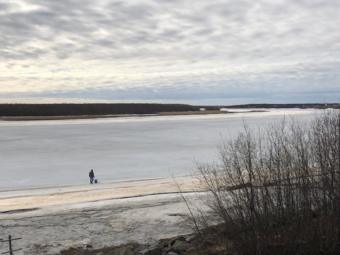
Four people have lost their lives in the past two months driving into open water or falling through the ice in the Yukon-Kuskokwim Delta. (Photo by Katie Basile/KYUK)

This spring has seen record-breaking warm temperatures across Alaska. In the Yukon-Kuskokwim Delta, the Kuskokwim River is melting early, with devastating consequences.

Bethel residents woke up to a warning earlier this month to stop driving on the frozen Kuskokwim River.

“Last night, our worst fears were realized,” said Bethel Search and Rescue volunteer Mark Leary, talking on KYUK’s morning radio show. He, along with a handful of other volunteers, had just rescued three men who had been traveling on all-terrain vehicles and fell through the thin ice.

The rescuers crept very slowly over the weak ice, surrounded by open water and tethered to a safety line. One of them fell through, but pulled himself out. In the end, they were not able to save two other men.

Charles Guest is another volunteer who took part in the rescue.

“As the ice rots more and more, I don’t think we’ll be able to pull that off again,” Guest said.

Historically, ice doesn’t get this weak in Bethel until May, but that has changed. This year, it started happening in March.

“This is something we haven’t experienced before, so early and getting bad so fast,” Leary said.

As the climate warms, Alaska is heating up twice as fast as the global average. Bethel experienced its warmest February and March on record this year. Now the melting ice is disrupting daily life, like subsistence hunting.

John Fitka lives in Tuntutuliak. Usually he’s outside on the frozen river, hunting seal this time of year.

“The trail conditions are just too dangerous to risk it. I did get two small seal, but I guess we just have to make do with what we have,” Fitka said.

Bethel and the surrounding communities are off the road system. In the winter, people traveling to other nearby villages drive on the ice road. In the summer, they travel by boat. Both are much cheaper than the only other option, which is flying.

Christopher Ondola was at the Bethel airport on his way back to Tuntutuliak. He usually drives the ice road this time of year, but this time he flew, even though it’s just 44 miles away.

“I’ve been too scared to go anywhere on my snowmachine because of the ice,” Ondola said.

The high price of a ticket limits the number of times he can come to Bethel to pick up groceries, fresh produce, and wood for his steam house. Last month, Ondola lost a friend who drove a snowmachine into open water.

“It’s just too freaky-scary,” Ondola said.

Last week, friends and family attended funeral services for Nelson Jackson and Ernest Demantle, who fell through the ice on four wheelers. Normally they would have driven on the ice road; this time they flew.

Rashah McChesney contributed reporting.

Donlin promises economic development if mine goes through

The proposed Donlin mine could be one of the biggest in the world — if completed.
The proposed Donlin mine could be one of the biggest in the world — if completed. (Photo by Katie Basile/KYUK)

Donlin Gold says that it will bring money and jobs to the Yukon-Kuskokwim Delta with its proposed mine.

The company wants to build one of the biggest gold mines in the world, and it promises to employ hundreds of local people to build and operate it.
The mine will bring 3,000 jobs to the region during construction, and 800 jobs annually to operate it. The total payroll is $375 million for the construction phase of the mine which, according to Donlin spokeswoman Kristina Woolston, would last roughly four years.

The Kuskokwim Corporation, a village corporation, and Calista Corporation own the land and mineral rights, and leased them to Donlin Gold two decades ago. In return, Donlin promised that their shareholders will get preference for jobs.

“We’ve had drilling programs at the site in the past, and we actually have a drilling program at the site this summer that will give us the opportunity to further train and hire local employees and folks at the project site that can be transferred to future operations,” Woolston said.

Communities in the Y-K Delta are some of the most remote in Alaska, and among the poorest. Jobs are hard to find in the villages and usually come from government, school districts or health care. Food costs are exorbitant, and fresh fruit and vegetables are hard to find in village stores. People in the region often rely on subsistence gathering of food like berries, fish and game meat, but practicing subsistence requires money too.

Andrea Gusty is the chief of staff for The Kuskokwim Corporation.

“We’re hearing from some of our shareholders in the smaller communities like Red Devil, where they don’t have any economic opportunities at all right now, and they’re finding it hard to continue that subsistence way of life,” Gusty said.

TKC oversees 10 villages in the Upper Kuskokwim area closest to the Donlin mine site. They own the surface rights to the proposed mine.

Gusty said that jobs are not the only form of economic growth for the region to come from the proposed mine. Donlin has promised a contracting preference with Calista and TKC subsidiaries to build the mine’s infrastructure. That’s a legal agreement that says that Calista and TKC subsidiaries get preference if they meet bidding requirements.

“We have a number of contracts that were negotiated in the surface mine agreement. One of the largest ever for TKC is that we will own and operate the upriver port site. And so there will, of course, be a shareholder hiring preference for that,” Gusty said.

Calista says that the Red Dog mine further north is an example of one that benefited Native corporations and nearby communities.

Rosie Barr is the vice president for lands and natural resources at Calista. Before that, she held a similar position at NANA Regional Corporation, which owns the mineral rights for the Red Dog mine. She grew up in Kivalina and Kotzebue, surrounded by the promise of jobs that Red Dog would bring these communities.

“I didn’t go to work at Red Dog, but my older brother David did. They had a fantastic apprenticeship program, and he worked his way up through the electrical program,” Barr said.

A 2015 report written by Robert Loeffler, a professor at the University of Alaska Anchorage’s Institute of Social and Economic Research, says that 57% of the mine’s employees were NANA shareholders. But less than half of those shareholders lived in the nearby villages; the rest commuted from Anchorage or elsewhere.

Then there’s the revenue Donlin could bring into the region. Donlin has two separate revenue sharing agreements with Calista and TKC, which are confidential. Those agreements are in addition to the revenue-sharing requirements under the Alaska Native Claims Settlement Act, or ANCSA. The ANCSA agreement requires Calista to share 70% of the revenue from resource development from their land with the other regional corporations that own land. Calista gets some of that money back, then it shares some of that with village corporations in the area.

Orutsararmiut Native Council is the first tribe to publicly demonstrate against the proposed Donlin gold mine on July 22.
Orutsararmiut Native Council is the first tribe to publicly demonstrate against the proposed Donlin Gold mine on July 22, 2018. (Photo by Christine Trudeau/KYUK)

Donlin’s opponents say that the mine is not the best economic choice for the Y-K Delta.

Peter Evon is the executive director of the Orutsararmiut Native Council in Bethel. ONC led the first march against Donlin Gold last summer. Evon said that he knows the region needs jobs, but he thinks that there are other ways to create them.

“There are a lot of opportunities that haven’t been tapped into, but I think Donlin was the wake-up call for some people to start looking into different avenues. There’s a lot of different areas. We’re not robust. We’re not the North Slope,” Evon said.

Initial funding for these projects can be hard to find, but Evon said that Y-K Delta communities shouldn’t give up. Some communities, like Kwigillingok, have invested in renewable energy projects that create jobs, but the question is whether more communities will prefer to try out these more localized projects over the promise of hundreds of jobs from a mine.

Winter storms flood houses in Y-K Delta

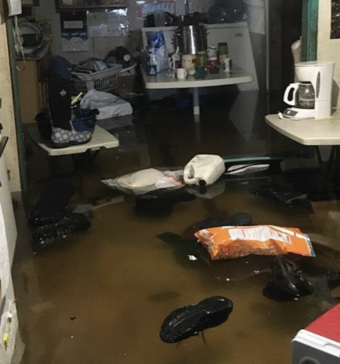
The house pictured had already begun sinking into the ground a while ago, making it more susceptible to flooding. According to a climate scientist, flooding in this area isn’t normal in February.
The house pictured had already begun sinking into the ground a while ago, making it more susceptible to flooding. According to a climate scientist, flooding in this area isn’t normal in February. (Photo courtesy Native Village of Nunapitchuk)

Storms battered the southern Bering Sea and the Yukon-Kuskokwim Delta last month. February storms aren’t unusual, but the amount of rain and flooding is. The combination caused some damage for two communities in the region.

“It’s like getting April weather out there. Not enough thickness, not enough snow, and already lots of water,” said Morris J. Alexie, the tribal administrator for Nunapitchuk. The rain flooded an older house that had already begun sinking into the ground.

Thomas Parks is a Nunapitchuk tribal council member who works with Alexie. Parks heard about the flooding and immediately started calling around to see how he could help. He said that the house is uninhabitable.

“Everything was all covered up, all the beds were soaked up, the couch was soaked. The Toyostove that was sitting a foot and a half up from the floor. It was also halfway covered up,” Parks said.

The flood damage in Nunapitchuk appears to have impacted only one house so far, but the community is bracing for more down the road. Winter storms also hit Kotlik a few weeks ago, flooding six houses.

The flooding is just another example of climate change in the area, according to Rick Thoman, a climate scientist in Alaska. Thoman said that this February was the warmest on record for Bethel, the hub of the Yukon-Kuskokwim Delta. He also said that the recent flooding was caused by warmer oceans and less sea ice.

“Because the Y-K Delta, especially the Y-K Delta and Kuskokwim Delta, precipitation is often occurring with temperatures not very far from freezing. Even a slight shift, a little bit of warming, can push you across that threshold,” Thoman said.

Storms that blow across the region will bring more rain to communities that are already experiencing less ice and snow. Nunapitchuk is in the heart of the Kuskokwim Delta, surrounded by several lakes. The longer warm periods mean that the tundra and lakes don’t remain frozen for very long and result in thinner lake ice.

Kotlik sits on the Yukon River near the Bering Sea on the southern end of Norton Sound. What happened there is a little crazier.

“There’s basically no ice, no ice in southern Norton Sound. And then the storm came along and had very strong southwest winds: 50, 65 miles an hour across Norton Sound. And that just piled up water into eastern Norton Sound, so you had big waves crashing at Unalakleet. And that water backs up into the Yukon River, which got a little ice in it, and so it just overtops that ice,” Thoman said.

Kotlik is looking for assistance from the state to help out residents who own the damaged houses, and the threat of more floods continues, according to Kotlik tribal administrator Victor Tonuchuk.

Tonuchuk said that the community is beginning to consider moving. This is becoming a familiar theme in the Y-K Delta as villages grapple with warmer winters, accelerating erosion and now flooding.

Site notifications
Update notification options
Subscribe to notifications