Krysti Shallenberger, Alaska's Energy Desk - Bethel
This old Alaska mining town is almost a ghost town. It has everything to gain from Donlin mine.

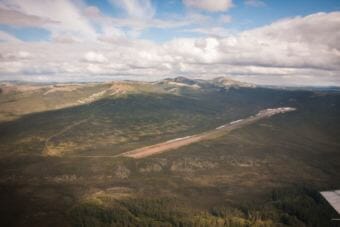
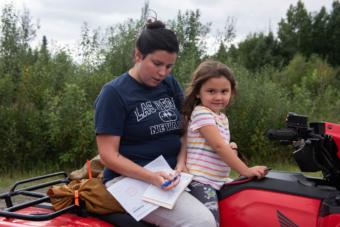
Rebecca Wilmarth and her daughter wait for a plane to arrive on the Red Devil runway on Aug. 17, 2019. Maintaining the runway and working as an agent for local airlines are two of the only jobs in Red Devil and Wilmarth’s family manages both of those contracts. (Photo by Katie Basile/KYUK)

This is a three-part series reported from a village of 20 people on the Upper Kuskokwim River that stands to gain the most from the proposed Donlin mine. Red Devil was built by mining almost 100 years ago, and now carries a toxic legacy of mine pollution. But to its residents, the Donlin Gold mine represents hope. Like so many communities in Alaska, resource extraction is at once a lifeline and a risk.

Red Devil, Alaska, Part I

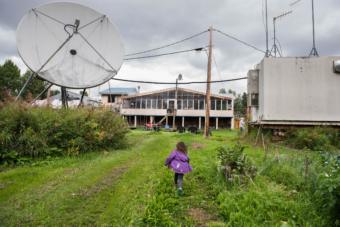
Outside Rebecca Wilmarth’s kitchen window, there’s a big green well-manicured lawn. It’s an unusual sight in one of the most remote places in Alaska. Wilmarth says there’s a history of big gardens and meticulously-kept lawns in Red Devil. The gardens grow some of the only fresh produce residents will eat and then save the rest for the winter.

“You know that sounds kind of cliche but we really do, you know, think about that,” Wilmarth said.

While talking, Rebecca’s phone pings occasionally with emails. She has to string together multiple part-time jobs to make a living here. She’s the agent for Ravn, maintains the airstrip, sells fuel and occasionally puts up travelers in a small, one-room cabin next to her house.

Rebecca also sends her seven-year-old daughter to Palmer for school because Red Devil doesn’t have one.

Red Devil used to be home to Alaska’s biggest mercury mine. Before the mine started in 1933, there was no permanent village. At its height, after the mine came, the village had a bar called the Mercury Inn, a school, a clinic and a store. Miners came from nearby communities. But it shut down in 1971 and people slowly left to find other jobs. Now, there isn’t much here. The population? Roughly 20.

So we’re just kind of in this stagnant position and the people who are here just don’t want to turn their back on this lifestyle and make a lot of sacrifices to stay here. Because they think it feel like it still beats city life,” Wilmarth said. “I love everything about it. Just the isolation, I guess, from the rest of the busyness of the rest of society,”

But, Wilmarth and other residents think the proposed Donlin Gold mine could help revive Red Devil. The mine would be built just 50 miles down the Kuskokwim River. It would employ 800 people.

Rebecca Wilmarth’s father is Dick Wilmarth, the very first Iditarod champion. He also loved Red Devil and passed that on to his daughter. “Gold miner’s daughter” is tattooed on Rebecca Wilmarth’s right arm.

Rebecca Wilmarth’s tattoo reads ‘Goldminer’s Daughter’ and honors her late father Richard Wilmarth, a gold miner and the champion of the first Iditarod Trail Sled Dog Race. Wilmarth supports opening the proposed Donlin Gold mine which could create local jobs and revitalize the community of Red Devil. Aug. 17, 2019. (Photo by Katie Basile/KYUK)

The proposed mine requires a lot of infrastructure: a port, an airstrip, a power plant, a proposed 315-mile pipeline to bring gas for the power plant from Cook Inlet, a road and fiber optic cable. Donlin says it expects to mine 1.3 million ounces of gold over a 27-year period. And that period could be even longer. As part of its lease agreement with the two Native corporations, which own the land and surface rights, Donlin promised to prioritize hiring local shareholders, like people who live in Red Devil.

The Donlin mine could be one of the biggest gold mines in the world. And the project is well on its way. Last year, it secured two vital federal permits and a handful of state permits. This year, it expects to receive several more. It’s also completing its safety certification for the seven dams it plans to build. That can take up to two years. It’s unclear when they will actually start mining.

“I think that’s what this area needs right now is the development of some kind,” Wilmarth said.

Joe Morgan in Red Devil, where he grew up and his dad worked in the nearby cinnabar mine, Aug. 17, 2019. The population and infrastructure of Red Devil fell after the mine closed in 1971, and now Morgan and fellow community members are working to revitalize the community. (Photo by Katie Basile/KYUK)

Glen Morgan and his brother Joe were raised in Red Devil but left with his family once the mine closed. Glen lived in Anchorage since 1997 but returned in 2015 with his wife, Theresa, after they  retired. Glen’s parents are buried there. Glen wants to bring back basic services, like a health clinic for the people that still live there.

(Image courtesy Hannah Lies/Alaska Public Media)

They would love the community to grow to a population of 200 — the same size it was when the Red Devil mine was in full swing just three miles away.

The old mine is now covered in trees and brush with a trail leading back toward where the buildings once stood. At the beginning of the trail leading to the mine site is a sign overgrown with fireweed. On a recent day, Joe Morgan hacked those out of the way.

The sign read: “Red Devil Mine, U.S. Department of Interior Bureau of Land Management. DANGER. Material at mine site may present human health risks.”

The Red Devil Mine left behind more than just the memory of good jobs. Developed before there were environmental safeguards, it also left behind pollution. The federal government has been working on a clean-up there for years.

In part two of our series, we’ll look at how Red Devil residents weigh the risks of that mercury pollution, and possible pollution from the mine, against he promise of jobs.

For people who live in remote Red Devil, an old mine’s toxic legacy is not enough to doubt Donlin’s promise

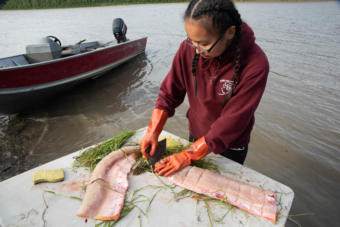
Leann Morgan cuts a northern pike in Red Devil, Alaska, on Aug. 16, 2019. Residents of Red Devil are warned to limit how much they eat of large, predatory fish like northern pike because of high mercury levels, but Leann and her father Joe Morgan depend on subsistence-caught foods and plan to eat the pike they caught. (Photo by Katie Basile/KYUK)

This is a three-part series reported from a village of 20 people on the Upper Kuskokwim River that stands to gain the most from the proposed Donlin mine. Red Devil was built by mining almost 100 years ago, and now carries a toxic legacy of mine pollution. But to its residents, the Donlin Gold mine represents hope. Like so many communities in Alaska, resource extraction is at once a lifeline and a risk.

Red Devil, Alaska, Part II

Leann Morgan stands at a makeshift table on bank of the Kuskokwim River, cutting a huge northern pike.

Leann and her father, Joe Morgan, make pike a regular part of their subsistence diet. They eat salmon, lush and sheefish. In the fall, they hunt moose.

But the pike they eat contain high levels of mercury. So high, in fact, that the federal government issued a warning to elders, children and pregnant women to limit how much they eat from the area. But Leanne and Joe Morgan aren’t worried.

Never get sick or anything … so we’re fine,” Leanne Morgan said.

Joe Morgan, Theresa Morgan, Glen Morgan, Desirae Morgan and Tamara Stern-Morgan in Red Devil, Alaska. (Photo by Katie Basile/KYUK)

This part of the Kuskokwim winds through a mercury belt. That type of mercury is called cinnebar, and naturally infiltrates the northern pike and other fish as part of the environment.

It also makes the area ripe for mining. In 1933, when there were few mining regulations, Alaska’s biggest mercury mine started operating and created its own town. It’s called Red Devil. At the mine’s peak during 1940s through the 1960s, around 200 people lived in the town. But the mine shut down in 1971, when the price of mercury ore dropped too low to turn a profit.

After the owners left, it was discovered that the mine tailings were leaching into Red Devil Creek, a tributary of the Kuskokwim, as well as the surrounding groundwater. No one knows when they started leaking. Those tailings contain methylmercury ⁠— a particularly poisonous form that was a byproduct of the mining operations. It can cause neurological damage, especially to unborn babies. Arsenic and antimony were also found in the tailings; both can cause cancer.

Buried contaminants from the old mine site in Red Devil, Alaska. (Photo by Katie Basile/KYUK)

Mike McCrum is the project manager for the Red Devil Mine for the U.S. Department of the Interior’s Bureau of Land Management. He says the owners did remove the groundwater from the mine site, but then literally just walked away, abandoning it.

The materials left behind were toxic enough to attract federal attention. Throughout the 1980s, the Environmental Protection Agency tested the site and found that the tailings required extensive remediation.

Typically the EPA oversees these efforts under a law called the Comprehensive Environmental Response, Compensation, and Liability Act or CERCLA. If the owner walks away from the site, like what happened in Red Devil, the EPA can use a fund called the Superfund to pay for remediation.

But what’s happening in Red Devil is different. In 1987, federal and state agencies began examining remediation. The site is not technically a Superfund site, with access to those funds. Instead, BLM has control over coordinating state agencies and local organizations, as well as paying for the cleanup.

(Image courtesy Hannah Lies/Alaska Public Media)

So far, BLM has torn down the old buildings, buried the tailings in a liner and planted a gate warning people of its health risks. It set up a weir to stop the leaching in 2014. BLM is set to come up with a final remediation proposal within the next year. But McCrum says communicating the risks from the mine to the community has been a challenge. People rely on fish food and don’t experience any immediate problems.

“Communicating risk to people is a challenge because it’s a pretty abstract concept that you’re talking to people whose food security is at risk,” McCrum said.

BLM tested the water from Red Devil Creek. It tested the fish that swam in that creek. It tested people’s hair. It tracked the northern pike and lush that swam in the Kuskokwim River and its tributaries. The state Department of Environmental Conservation and BLM tested groundwater flow around the mine and the wells of people living in the town. The results are complicated.

Signs at the entrance to the now-defunct Red Devil Mine in Alaska warn people to stay out because of potential health risks. Aug. 17, 2019. (Photo by Katie Basile/KYUK)

The northern pike that live farther up the river from the contaminated mine site showed higher mercury levels than those nearer to the old Red Devil Mine site. In fact, the BLM wrote this in a 2012 update to the Middle Kuskokwim communities:

“This report also highlighted the complexity of mercury chemistry within the aquatic food ecosystem, which includes fish species that seasonally migrate within the Kuskokwim and its tributaries.”

BLM’s McCrum says the northern pike prefer slower moving waters. Red Devil Creek, which flows into the Kuskokwim River, is very shallow and small, perfect for smaller fish but not pike. And the way the Kuskokwim River flows at the mouth of the creek is too fast for northern pike to live. McCrum says the creek dilutes the contamination before it reaches the river, and based on that, McCrum says there’s no correlation to the tailings leaking out into the river and the health of the pike.

Northern pike, a subsistence food on the upper Kuskokwim that’s vulnerable to mine pollution. (Photo by Katie Basile/KYUK)

The Kuskokwim Corp., a Native village corporation, owns the surface rights to the mine.

Vice President Andrea Gusty, says the lengthy remediation process for Red Devil is too slow, putting more residents more at risk.

“It’s been frustrating because we know the level of contamination that is in this historical mine site,” Gusty said.

Gusty is also not satisfied with the level of testing, and believes more information is needed to truly understand the risks of the mine’s contamination.

BLM says it takes a long time to gather feedback and do enough testing in order to clean up a toxic site like the Red Devil Mine.

For now, Red Devil residents aren’t too worried about mercury contamination. Joe Morgan, who caught the pike in the Holitna River, will still eat it.

Joe Morgan holds up a piece of cinnabar found on the beach outside of the now-defunct Red Devil Mine on Aug. 17, 2019. Cinnabar was mined and process on site to make mercury. (Photo by Katie Basile/KYUK)

Despite the Red Devil clean up, the residents are not as worried about possible contamination from the proposed Donlin Gold mine that’s about fifty miles down the river from the village. It’s a massive mine plan, but residents point out that Donlin Gold has to build it under much stricter scrutiny.

Not everyone in the region agrees. The Association of Village Council Presidents originally supported the mine, but recently withdrew its support over environmental concerns and worries it would impact subsistence animals.

In Red Devil, residents emphasize jobs. The proposed mine requires a lot of infrastructure: a port, an airstrip, a power plant, a proposed 315-mile pipeline to bring gas for the power plant from Cook Inlet, a road and fiber optic cable. Donlin says it expects to mine 1.3 million ounces of gold over a 27-year period. And that period could be even longer. As part of its lease agreement with the two Native corporations, which own the land and surface rights, Donlin promised to prioritize hiring local shareholders.

Donlin already has its major federal permits in hand, as well as some state ones, and hopes to get more of its state permits by the end of the year. Its also completing its safety certification for the seven dams it plans to build. That can take up to two years. The mining will begin after that.

With lots of optimism, Red Devil residents are beginning to put in place the skeleton of basic services for the people who live there now, and the people they expect when the mine opens. In part three, we look at the challenges of reviving an almost ghost town.

How do you revive an almost ghost town in remote Alaska? Ask the 20 residents of Red Devil who are betting on Donlin mine.

This is a three-part series reported from a village of 20 people on the Upper Kuskokwim River that stands to gain the most from the proposed Donlin mine. Red Devil was built by mining almost 100 years ago, and now carries a toxic legacy of mine pollution. But to its residents, the Donlin Gold mine represents hope. Like so many communities in Alaska, resource extraction is at once a lifeline and a risk.

Red Devil, Alaska, Part III

Rebecca Wilmarth can see the empty school building across her lawn in Red Devil, Alaska. It shut down in 2009, and for a while, willows and alders shrouded it from view. Wildland firefighters recently cut them back to reveal a brown building with blue trim. For a place that’s been abandoned for ten years, it appeared in remarkably good shape.

For Wilmarth, it’s a symbol of what was lost after the Red Devil mercury mine shut down in the 1970s.

“It was like a domino effect of things that made this place so deserted. The school closed. Families had no other option but to relocate or send their kids somewhere else.” Wilmarth said.

Red Devil is a tiny town with about 20 remaining residents. A mercury mine that built the town used to operate 3 miles away. But once it shut down, people started leaving for other jobs. Now Red Devil has no health clinic and no store. It doesn’t have a tribal council or city government. A handful of residents are fighting to get basic services back.

And to do that, they need to revive Red Devil’s city government. Wilmarth is working with Glen Morgan and a few others to make it happen.

“If we get a clinic and you know get road services … (people) can stay and you know have something to look forward to,” Morgan said. His parents are buried in Red Devil, right across the Kuskokwim River where he lives.

Joe Morgan and Glen Morgan’s parents are buried across the river from Red Devil, Alaska, on land still owned by the family. Aug. 17, 2019. (Photo by Katie Basile/KYUK)

Morgan’s niece, Leann, is 21. She wants to return to Red Devil to work as a health aide.

“If I could build a house here in Red Devil, I’d build it across the river where my grandparents are and where they used to live,” Leann said.

Red Devil has never been recognized as a municipality. But they did have a community association up until  2009 and through that, accessed state funds.

A community association is a nonprofit organization that unincorporated communities, like Red Devil, can form to apply for state funding and enter into contracts. But all that officially dissolved in 2013.

Red Devil residents held a casual community meeting over the summer and elected Glen Morgan as president, his brother Joe Morgan as vice president and Wilmarth as secretary and treasurer of a city council. They aren’t sure what comes next.

Tamara Stern-Morgan and Desirae Morgan play outside their grandparent’s home in Red Devil, Alaska, on Aug. 16, 2019. The girls spend summers in Red Devil, and Desirae Morgan would like to stay year-round with her grandparents and legal guardians, but the school is closed, forcing her to relocate to Sleetmute every August. (Photo by Katie Basile/KYUK)

They are all pitching in on phone calls, Wilmarth says.  Red Devil is too small to be recognized as a municipality — that requires 25 people for that and Red Devil has less than 20. And there aren’t enough tribal members in town to revive a tribal council. But that hasn’t stopped residents here from dreaming of building a bigger community.

“I think the Donlin Mine is a great possibility for jobs. I hope Donlin goes through; it would enable my family to stay,” Wilmarth said.

Most of the jobs for Red Devil will likely come with the proposed Donlin Gold mine. If completed, the mine would be one of the biggest in the world, just 50 miles down the river. It needs several more state permits, finish its dam safety certification and complete a feasibility study to reduce construction costs. But Donlin has said it expects to bring 800 jobs just for its mining operations.

(Image courtesy Hannah Lies/Alaska Public Media)

But it’s unclear when the mine will begin operating. And Red Devil still needs a health clinic and a school.

Rebecca’s older daughter is going to school in Palmer where Rebecca’s mother lives. Rebecca talks to her every morning just before she goes to class.

“It’s hard seeing her, you know, away from me, but it’s good that she’s socializing with more people,” Wilmarth said.

And Rebecca knows she’s got a hard choice coming soon.

“(It’s) going to be a point where I will have to make a decision on homeschooling her again or relocating myself and not looking forward to that,” Wilmarth said.

The back door of the school in Red Devil, Alaska, stays boarded up ever since the school closed when enrollment fell below the required quota. (Photo by Katie Baslie/KYUK)

Right now, residents have plans for that empty school building. If they can buy it back from the state or even lease it, they plan to open it up as a community center. It might even hold the health clinic.

Other jobs could come from tourism and fishing.

“There’s not really any too many places I think on earth that you can have you know two airplanes parked in your yard and just have a jump in your plane from your front door and take off or jump in the boat or on a snow machine and just go,” Wilmarth said.

And Red Devil residents hope to hang on to that just a little while longer.

Read and view the other parts of this series here.

Coryn Nicoli runs through her backyard in Red Devil, Alaska, on Aug. 16, 2019. Nicoli lives with her parents in Red Devil but when she starts school, she will either have to be home-schooled or leave the village since there is not a school in Red Devil. (Photo by Katie Basile/KYUK)

YK Delta tribal consortium withdraws support for Donlin Gold mine

Donlin runway and camp site in summer 2014.
The proposed Donlin Gold mine would be one of the biggest gold mines in the world if completed. (Photo by Dean Swope/KYUK)

The Association of Village Council Presidents no longer supports the proposed Donlin Gold mine.

The decision came after two hours of passionate debate Wednesday, during the Yukon-Kuskokwim Delta tribal consortium’s annual convention.

AVCP delegates overwhelmingly voted to withdraw a 2006 resolution supporting the mine, then voted to pass a separate resolution that opposes it. There were 41 delegates attending the convention.
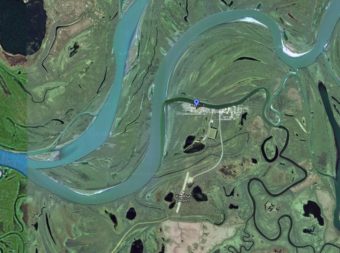
The new resolution shows the mine has lost significant regional support from tribes.

Henry Hunter Sr., the chair of Bethel’s Orutsararmiut Native Council and its AVCP delegate, introduced the resolution. Hunter said that in back in 2006, many tribes didn’t understand the possible environmental risks, especially from Donlin Gold’s proposed tailings dam. Hunter said that this year, tribes came armed with more information about the risks of the proposed mine.

Donlin has to build a dam that would hold its mine waste forever. Hunter said that one of the biggest concerns is what would happen to the Kuskokwim River should the dam collapse. The company said that they plan to build the mine as safely as possible.

After the resolution was introduced, Wayne Morgan, Aniak’s delegate, asked to table it, which would have put it on hold for at least another year.

AVCP is a tribal consortium that represents 56 tribes and 48 villages in the YK Delta. Forty-one delegates attended the Wednesday morning session.

Last year, AVCP tabled two anti-Donlin resolutions because they were not submitted on deadline.

ONC tribal member Gloria Simeon said that moment shamed her, because she felt their voice was being suppressed.

“So we had to spend a year with ONC planning to make sure that we do not get knocked out by someone standing on procedure,” Simeon said.

But this year, the delegates passed both the resolution withdrawing AVCP’s support and another resolution from Quinhagak opposing the mine. Both resolutions will be sent to the Alaska Federation of Natives annual convention in October.

After the vote, Simeon walked out of the room, trembling. People hugged each other.

“It surprised me that it was so supported to pull and then to say to the world, ‘We are against Donlin,'” Simeon said. “That’s the power of our tribes speaking. That’s true leadership.”

Devron Hellings, the president of the Native Village of Napaimute, opposed both resolutions. Napaimute and Aniak are two of the villages closest to the proposed mine site, which would be built 145 miles up the Kuskokwim River from Bethel.

Hellings thinks that the mine can bring much-needed jobs to the region. She also said that she trusts the proposals Donlin has laid out on how it plans to build its mine.

“Donlin Gold has demonstrated they care about people of Western Alaska. They care about the culture, they know the reliance on subsistence, and we believe they are going to do what they say they will do,” Hellings said.

Hellings said that the reason she and Morgan pushed to table the motion was because their tribes did not have sufficient time to look at the resolutions. Hellings said that it can be difficult for tribes to meet, due to geography and technological challenges.

AVCP sent out the resolutions on Aug. 19; the convention was held Sept. 24. Hellings added that the new resolution opposing the mine doesn’t have much of an impact, since AVCP is “a social service entity.”

“The action in this regard by the body I can’t say holds as much weight as the decisions by individual tribes,” Hellings said.

She said that tribes hold the government-to-government relationship with the Donlin project that AVCP does not. Hellings said that Napaimute supports responsible natural resource development.

Darren Cleveland is the tribal council president of Quinhagak, which supported ONC’s efforts in opposing Donlin at the AVCP convention.

“Each village needs to state where they stand. Are they for it or are they against it? It’s no time to stand neutral. We have to hear everyone’s voice,” Cleveland said.

But how the delegates voted on the resolutions this year does show that Donlin Gold has lost significant support from tribes in the region.

In a two-page statement to KYUK, Donlin Gold laid out its efforts to meet with the 56 YK Delta tribes to hear their concerns over the past two decades.

“We are disappointed that the delegates at the convention of the Association of Village Council Presidents, a group we have long admired and supported, chose to oppose further development and the future operations of Donlin Gold, including its own Comprehensive Economic Development Strategy. We do, however, stand ready to address any and all concerns the convention delegates raised and work toward agreeable solutions,” the statement said.

Calista Corp., which owns the mineral rights, said that it will continue to work with shareholders to build support for the project.

“Calista Corp. respects the delegates at the 2019 AVCP convention. We also respect that a key component of both (the Alaska Native Claims Settlement Act) and (the Alaska National Interest Lands Conservation Act) is resource development,” said Tisha Kuhns, interim vice president of lands and natural resource development for Calista Corp.

Donlin is still gathering state permits and completing its dam safety certification. However, it is unclear when the company plans to start mining.

This story has been updated.

Kwethluk and electric utility to build battery system

Kwethluk is about 12 miles (by air) west of Bethel, Alaska.

Kwethluk is partnering with Nuvista Light and Electric Cooperative to build a battery storage system. It will keep the power on during outages, and could one day help wean the community off diesel fuel.
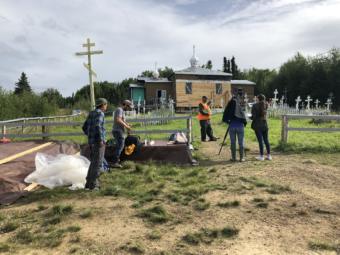
Last year, Tuluksak residents endured several multi-day power outages where many residents lost subsistence food that was stored in freezers. Leaders in nearby Kwethluk want to avoid a similar disaster.

Kwethluk and Nuvista Light and Electric Cooperative have $477,050 from the Department of Energy, or DOE, to build a 675 KWh lithium-ion battery. Kwethluk had to match half of the funds.

“Basically it’s for promoting community resilience for community facilities and tribal members,” said Natalie Hanson, Nuvista’s executive director.

A battery that size has enough power to light up every home in Kwethluk for an hour during its highest demand. Or it can keep a couple of critical buildings, like the health clinic and community hall, going for more than two hours. Hanson estimates that the project will create two temporary jobs for local people.

In the future, Nuvista hopes to include wind energy. Battery storage is necessary to move the village off of costly diesel fuel because it can store extra wind energy to use later, and smooth out any fluctuations from too much electricity flowing through the power lines at one time.

“You don’t have storage, you always have to have your diesel on, running low, so you are always using some amount of diesel,” Hanson said.

Hanson says that a wind farm proposal for Kwethluk is currently being reviewed by DOE’s National Renewable Energy Laboratory, but it’s likely that the battery will arrive first.

This project is similar to ones in Kongiganak and Kwigillingok. Kongiganak installed a lithium-ion battery so that it could meet half of its energy needs with wind.

This month, Sen. Lisa Murkowski visited both of those villages with Energy Department Deputy Secretary Dan Brouillette to show off those projects. In a statement, Murkowski wrote that it was “a great opportunity for Dan to visit more of Alaska, to see firsthand how we contribute to our nation’s energy security, and to learn about the innovation taking place throughout our state.”

At the moment, Donlin Gold isn’t building a mine. But it is building a church.

A Donlin Gold film crew interviews sub-deacon Eric Morgan Sr. about the Chuathbaluk church renovation paid for by Donlin.
A Donlin Gold film crew interviews subdeacon Eric Morgan Sr. about the Chuathbaluk church renovation paid for by Donlin. (Photo by Krysti Shallenberger/KYUK)

Donlin Gold may not be building their gold mine right now, but they are in the middle of construction.

The company that wants to build one of the world’s biggest gold mines is currently renovating a church in Chuathbaluk, a village on the Kuskokwim River. Why? Donlin says that investing in communities near the mine is being “a good neighbor.”

From the outside, Chuathbaluk’s Russian Orthodox church looks like a classic Alaska cabin, but with the iconic pointed domes that resemble the top of an ice cream cone. They are called cupolas. First built in the late 1800s, the church was rebuilt in its current location in 1952. During the renovation they’ve found icons and religious paintings that date back to 1914.

The current church is about 70 years old and was in need of a new roof, a better stove and insulation. Donlin Gold, which wants to build a gold mine 30 miles away from Chuathbaluk, stepped in and offered to pay for the fixes. Calista Corp., which owns the mineral rights to the mine, took over the construction this year.

Eric Morgan Sr. is the subdeacon for the church and is very happy that Donlin is helping with the renovations.

“We can’t express our thanks. I go like this in my chest,” Morgan said, pointing to his chest and beating it with his hand.

“Holding my hands, my chest together. Holding my hand, like thanks from the heart from the whole village,” Morgan added.

The church is close to 70 years old, and it needed a new roof, new stove, and insulation.
The church is close to 70 years old, and it needed a new roof, new stove and insulation. (Photo by Krysti Shallenberger/KYUK)

Donlin spokesperson Kristina Woolston called it the right thing to do.

“It’s important that, you know, that your neighbors show a vested interest, and this is something we are, you know, showing every day, year after year: that we’re investing now, and we’re investing in the future of these communities,” Woolston said.

Donlin’s community relations department is its largest, and the company has been making these efforts for decades. It has already rebuilt a church in Crooked Creek, the village closest to the mine. Donlin also helps communities remove waste.

“In Bethel, we just hosted its first annual recycling event,” Woolston said.

Donlin hands out life jackets along the Kuskokwim River and donates to local nonprofits. Those investments cost about a million dollars each year.

On the same day that KYUK visited Chuathbaluk, Donlin Gold was filming a video about the church renovation.

“We love to gather stories from stakeholders all throughout the region to hear their concerns about the community going forward, what are their priorities, what are their hopes and dreams for themselves and their grandkids,” Woolston said.

Donlin interviewed Morgan for the video. KYUK asked him if Donlin Gold sought his views on the mine for the video.

“No, no. This is just about the church, not about the mine,” Morgan said.

He is grateful for the possible employment.

“I think it will be good for, you know, with no jobs around here, it will help the area, the middle Kuskokwim area,” Morgan said.

But he’s also clear-eyed about the possible environmental consequences.

“There’s always caution,” Morgan said.

Tribal administrator Tracy Simeon doesn’t have an opinion on the mine, and says that everyone can have their own conclusion on what the mine could bring to the region.
Chuathbaluk Tribal Administrator Tracy Simeon said she doesn’t have an opinion on the mine. She said that everyone can have their own conclusion on what the mine could bring to the region. (Photo by Krysti Shallenberger/KYUK)

A mine accident could damage the Kuskokwim River, the main food source for villages like Chuathbaluk. In Chuathbaluk’s tribal office, Administrator Tracy Simeon is more reserved.

“How do I feel? I’m not against it or for it. I just don’t have no opinion right now,” Simeon said.

She also participated in the video. KYUK asked her if she worried that participating would damage her neutrality.

“No,” Simeon said.

Simeon and Morgan’s stance on the mine is very common in the Yukon-Kuskokwim Delta. They are hopeful for the jobs, especially since they are more isolated from employment opportunities found in places like Bethel, but they also understand the risks from mining.

Like its tribal administrator, Chuathbaluk is neutral on the mine, and Morgan emphasizes that Donlin went above and beyond to help them renovate the church.

As for Donlin, it’s still gathering state permits and working on its dam safety certification — two major hurdles the company must overcome before it can start mining.

And that could be years away.

Site notifications
Update notification options
Subscribe to notifications