Climate change is slowly disrupting the subsistence lifestyle in the Yukon-Kuskokwim Delta. And some of its younger residents are documenting the changes they’re seeing through film.
In a two-week workshop hosted by the Lower Kuskokwim School District in Bethel, four high school students composed a short documentary about the climate change impacts to their communities and subsistence lifestyle.
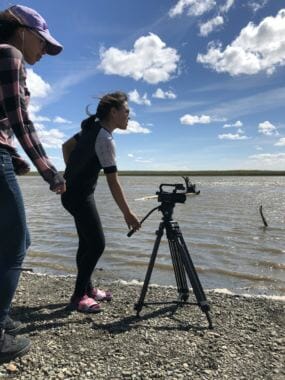
Katie Demientieff from Akiuk is documenting climate change as part of a film workshop. (Photo by Katie Basile / KYUK)
The film opens with Nicolai Fisher, one of the filmmakers who lives in Napaskiak, narrating the importance of subsistence in Western Alaska.
“Yup’ik and Cup’ik people have subsisted off the land and sea for thousands of years. What our ancestors taught us is our way of life,” he says.
The film explores the shifting weather patterns they are seeing in their short lifespans. Changing animal migratory patterns and less snow on the ground are key themes in the piece.
“I’ve noticed the moose going to the coast and the geese heading more and more out of our villages,” Fisher said in an interview.
Erosion is another issue. Sam Tinker, a high school student who lives in Akula, has witnessed erosion worsening in his 16 years.
“The land was starting to fall apart into the water and the river was almost high enough that it’s around your knees and waist area,” Tinker said.
For Katie Demientieff, the youngest of the filmmakers at 14, who lives in Akiak, making the documentary was a way to learn about what the climate was like decades ago.
“I chose climate change because I wanted to know how it was in the past and how it is now,” Demientieff said.
All four students see the film as a wakeup call to their communities.
“I want to spark the mind of the people on why climate change is so important and the subsistence way of living of our land is so important to the Yup’ik and Cup’ik people,” Tinker said.
A total of twelve students completed three films on different topics during the workshop. The videos can be found on the school district’s YouTube channel.
Donlin says it will get most of its major permits out of the way this year. But it still needs 100 before it can begin mining. (Photo By KYUK)
Residents of the Yukon-Kuskokwim Delta have heard about the proposed Donlin gold mine, which would be the biggest in the world. They’ve seen the logo on hats and bags, and on flyers throughout Bethel and nearby villages. But it’s not easy to understand the process involved in getting this complex project approved. The Environmental Impact Statement, or EIS, in particular, with its thousands of pages, is a difficult read.
David Cannon has worked for the Kuskokwim River Watershed Council, the Forest Service, and with the Yukon Delta National Wildlife Refuge as a fish biologist. He’s also a local activist who is trying to educate the region on what he sees as the dangers of the gold mine.
“That document is massive,” he told a crowd that assembled in Bethel to air concerns over the final EIS last week. “I have a degree as a biologist and I struggled to sort through that document.”
The EIS is just the first step in the process and is required for projects involving federal agencies, like the Army Corps of Engineers, that will potentially have significant impact on the environment. A broad range of state and federal agencies and villages directly affected by the mine participated in the EIS process. Donlin must receive at least 100 permits from federal and state entities before it can begin mining.
Because the mine would be located in wetlands, the Army Corps has to issue a permit allowing its placement. And states are required by federal law, through the Clean Air Act and Clean Water Act, to regulate environmental impacts. Kurt Parkan, a spokesman for Donlin, says that while the company anticipates getting most of the major permits this year, the rest will likely be approved within five years.
“Probably within the next two to three years, we’ll probably get the majority of all the permits we need,” Parkan said.
The EIS is probably the most bureaucratic endeavor in the process. It takes years and millions of dollars to complete. It’s been five years since Donlin submitted an application in 2012. But now that the final EIS is out, the company has a much clearer idea of its progress. It already has two permits from the state. The most recent one allows wastewater discharge into Crooked Creek.
During the EIS process, Donlin and the agencies involved calculated the environmental risks from the mine. For instance, as the Army Corps drafted the report, stakeholders gave feedback and studies provided more information on the proposed project. As a result, the company has modified the proposal in response to concerns from the state throughout the process. Donlin’s Parkan says the company is aiming for approval.
“So everything we’ve been doing up to this point is working towards ‘yes,'” Parkan said.
Compared to other proposed mines in Alaska, like the Pebble Mine in Bristol Bay, Donlin is farthest along in the process, according to Faith Martineau, the executive director for the permitting office at the Alaska Department of Natural Resources. She coordinates with federal and state agencies and industries about the permitting process to make sure information can be found in one place. Donlin is one of her projects.
“Donlin would probably be the largest that’s nearing the end of its permitting process,” she said.
Now that the company is in the permitting process, she says that it’s highly unlikely that the state will prevent the company from building the mine. She says the “back and forth” between stakeholders throughout the process helps industries develop a proposal that is most likely to be permitted.
Donlin is now waiting on the combined record of decision from the Army Corps of Engineers and the Bureau of Land Management, which would determine how plans for the current mine proceed. But even once the companies have all the permits in hand, they would be years away from starting construction because they would need to re-evaluate whether the mine makes financial sense.
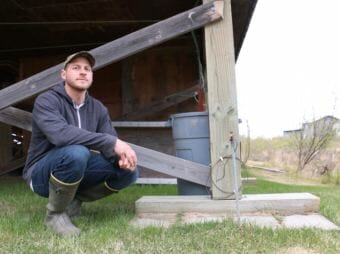
Jeremy Osborne, a Bethel resident, has two repairs to make to his power equipment. They are easy for him to do, but some residents might find their repairs more difficult and must search for an elusive electrician. (Photo by Krysti Shallenberger/Alaska’s Energy Desk)
A recent letter from the Alaska Village Electric Cooperative (AVEC) startled residents in the Yukon-Kuskokwim Delta. The letter told customers to repair their electric equipment by August or have their power cut off. While most of the repairs are minor, others require more professional handling from an electrician, which are scarce in the region.
Jeremy Osborne is one such homeowner. Osborne works at Yuut Elitnaurviat, a workforce development organization in Bethel, and also works part-time as a copy editor at KYUK. He’s one of 450 customers in Bethel who got the letter from AVEC.
“I was a little alarmed at first because they say that your electrical service will be disconnected on or about August unless you make the repairs,” Osborne said.
AVEC took over control from the local utility, Bethel Utilities Corporation, in 2013, and residents have been receiving these letters since then, according to the utility. AVEC recommends that residents hire an electrician to do the work, but in Bethel, that’s not easy.
Michael Langlie, who has co-owned The Lumber Yard for 20 years, says that it can take as much as a month to get an electrician to a house in Bethel. The Lumber Yard stocks the electrical supplies people in Bethel may need for repairs, and Langlie has seen an uptick in people coming into his store for these supplies over the past two years.
Bethel has long nurtured a do-it-yourself culture because of its remote location and lack of services, which may have sparked some of the letters, but AVEC CEO Meera Kohler says that the repairs are not just confined to older homes or the result of do-it-yourself jobs. Homes and business can fail to meet code because of shifting permafrost, wind storms, or other natural causes.
Kohler says that most of the repairs are minor. She says that many just require replacing a ground rod or other repairs that people can do themselves. But what happens when they need an electrician?
Kathy Hanson is another homeowner who received the AVEC letter. She says that the easy part is tracking them down.
“I think it’s not hard getting hold of one,” Hanson said. “ You see them in their trucks driving around. Now to get them to come out to your house and fix something, I think it might be rather difficult.”
KYUK tried to reach out to several electricians that were listed online or given through word-of-mouth. Out of the five that KYUK tried to call, only one, Sea Lion Electric Services, had a working phone number. And they never picked up.
KYUK also drove around Bethel for about an hour to look for one of the vans, but couldn’t find one. Osborne consulted with an electrician who’s also a friend, but is doing the work himself. He says that he’s lucky that he doesn’t have to do more to bring his house up to code. AVEC’s Kohler says that the utility doesn’t require the repairs to be made by an electrician, but she advises homeowners who might not feel up to task to hire a professional.
Close
Update notification options
Subscribe to notifications
Subscribe
Get notifications about news related to the topics you care about. You can unsubscribe anytime.