Krysti Shallenberger, Alaska's Energy Desk - Bethel
Donlin Gold describes clean up plans for their proposed mine


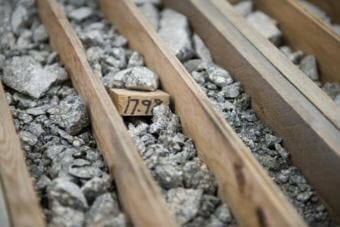
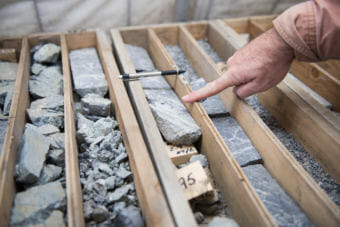
The proposed Donlin Mine could extract roughly 33 million ounces of gold during its initial 27-year production period. (Photo by Katie Basile/KYUK).

Cleaning up a mine is an expensive and time-consuming endeavor.

“We’ve learned from the past and advanced through the environmental review process,” said Dan Graham, who is in charge of Donlin Gold’s reclamation plans and permitting process.

Reclamation is relatively new in the long history of mining in the United States. It came into existence in the late 20th century as more information came to light over the damage that mining does to the environment. What it means is that mining companies must restore the patch of land that they mine. And according to Alaska law, they have to pay for it.

“So the state, TKC [The Kuskokwin Corporation] and Calista will not be on the hook to pay for the reclamation and closure,” said Andrea Gusty, the vice president of The Kuskokwim Corporation. TKC owns the surface rights to the proposed mine site, while the Calista Regional Native Corporation owns the subsurface rights. Both are major players in drafting the reclamation plan.

The reclamation plan and paying for it are separate, but they go hand-in-hand in Alaska. Both have to be approved by the Alaska Department of Environmental Conservation (DEC) and the Department of Natural Resources before the mine can move forward.

Donlin’s draft reclamation plan is more than 400 pages long. And it explains in detailed technical language how it plans to reclaim the mine site during operations and afterwards. The gold mine would permanently disturb about 3,500 acres of wetlands in the Yukon-Kuskokwim Delta and would permanently eliminate two salmon streams. It also requires big treatment facilities for the cyanide used during mining and the mercury that would be released from the rocks. And it has a tailings dam that is a mile long and a mile wide. All of that has to be cleaned up after the mine closes. So how is Donlin going to do that?

The reclamation process is divided into two phases: the physical phase and the water treatment phase after the mine closes. The physical reclamation process includes reseeding the patch of ground that is disturbed by mining operations; Graham says that the mine would try to use as much natural vegetation as possible.

A lot of the phsyical reclamation takes place while the mine is still operating and shortly after it closes. And then, once the mine shuts down, Donlin will divert the water it uses during operations into a pit lake and let it sit for about 50 years, after which Donlin will monitor the water indefinitely.

Donlin is the first mine in Alaska’s history to propose monitoring the water forever; usually mines have come to that decision during operations, according to Allan Nakanishi, DEC’s technical engineer in the Wastewater Discharge Authorization Program.

Closing the mine and monitoring is expensive. Donlin Gold estimates that the cost for the first phase of reclamation is $240 million. A second funding mechanism must be put in place to cover the water monitoring after the mine closes, Graham said. That funding mechanism will likely be a trust fund account that would be used to pay for the monitoring in perpetuity. That price tag is roughly $100 million.

But discussions around the trust fund are still ongoing, and the mine can’t move ahead until the issue is settled. Meanwhile, Donlin Gold has already received three major permits from federal and state agencies this month. The company expects to have most of the major permits out of the way this year.

Donlin Mine nabs two major permits at Army Corps signing

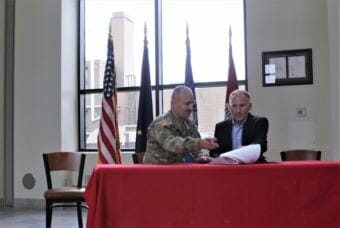
Donlin Gold’s general manager Andrew Cole (right) signs the permits with Colonel Michael Brooks (left), district commander for the Army Corps of Engineers (Photo by Krysti Shallenberger/KYUK).

A huge proposed gold mine in the Yukon-Kuskokwim Delta cleared a major hurdle on Monday, Aug. 13.

“The spirit of this joint record of decision is about everyone coming together and working together and coming up with a quicker decision,” said David Hobbie, of the Army Corps of Engineers’s Alaska District.

Hobbie and other top federal officials joined representatives from the mining industry and Native Corporations at their Anchorage office to commemorate the occasion.

It took six years of environmental review, but Donlin Gold has finally received two major permits from the Army Corps and Bureau of Land Management. Donlin is trying to develop one of the biggest gold mines in the world.

Because the mine will impact thousands of acres of wetlands, it needed a permit from the Army Corps. The plans also include a 315-mile-long gas pipeline, which crosses over federal land run by the Bureau of Land Management. So it needed a permit from them as well.

And for two Native Corporations, the permits means the Y-K Delta could get more jobs.

“This is one of those steps that we need in order to improve conditions we have out in the region,” said Andrew Guy, CEO of the Calista Regional Native Corporation, which leased the subsurface rights to Donlin Gold.

But Donlin faces growing opposition from Y-K Delta tribes. Nearly a dozen have passed anti-mine resolutions in the past two years.

The tribes fear the mine would damage their subsistence lifestyle. And they fear a mine accident could contaminate the Kuskokwim River, a vital food source.

The Orutsararmiut Native Council and the local working group, the Yukon Kuskokwim River Alliance, oppose the mine. They released a statement Monday saying the permitting process left out many voices from the region.

But Andrew Guy says their concerns have been heard throughout the process.

“We are involved in subsistence too with our own families, so that’s a very valid concern that we’ve always kept in the top of our heads,” Guy said.

The gold mine needs at least one hundred permits before it can start mining. Donlin Gold says they plan to get the major ones out of the way this year. The rest of them could be completed in two years.

Army Corps to roll out major decision on Donlin Mine on Monday

The proposed mine could impact 3,500 acres of wetlands in the Yukon-Kuskokwim Delta. (Katie Basile/KYUK)

The Army Corps of Engineers is set to roll out its record of decision for the proposed Donlin mine on Monday, August 13. This could be one of the biggest gold mines in the world, if approved.

“We’re excited. This is a major milestone for the project moving forward,” said Donlin Gold spokesperson Kurt Parkan.

The company needs at least 100 permits before they can start mining, and some of those permits could be granted on Monday as part of a joint record of decision from the Army Corps and the Bureau of Land Management. Donlin is pretty confident that the project will be approved.

“Projects go into the process of getting a permit with the expectation of getting a permit,” Parkan said.

The joint record of decision signals the end of a six-year review process. Throughout those years, Donlin, the federal and state agencies, and other stakeholders have worked together to determine how the project would impact the land and water surrounding it. All that information has been put into a document called the Environmental Impact Statement, which Donlin released earlier this year.

Because the mine would impact thousands of acres of wetlands in the Yukon-Kuskokwim Delta and would include a gas pipeline that runs through BLM land, both agencies have to issue permits.

The record of decision does not mean that Donlin will have the permits in hand on Monday, Army Corps spokesman John Budnik wrote in an email, but it does show how the agencies think the mine should move forward. The actual permits could come a couple months later.

Nearly a dozen tribes have issued anti-Donlin resolutions in the past two months. They fear that the mine could impact their subsistence way of life, which is practiced by the majority of Y-K Delta residents.

The project’s critics also fear a mine accident could contaminate the Kuskokwim River, which supplies a lot of the food for the region. Meanwhile, Donlin still needs more than 100 permits before it starts mining, but expects to get most of the major ones out of the way this year.

State extends comment period on Donlin’s draft reclamation plans

The proposed Donlin Mine could extract roughly 33 million ounces of gold during its initial 27-year production period. (Photo by Katie Basile/KYUK).

A state agency is extending the deadline for the proposed Donlin Mine’s draft reclamation plans. The project would be one of the biggest gold mines in the world.

The Alaska Department of Natural Resources (DNR) says the public can submit comments until September 6. The agency also extended the deadline for comments on how Donlin plans to pay for the clean up.
Last week, the Yukon Kuskokwim River Alliance, a local working group that opposes the mine, sent a letter to DNR and the Department of Environmental Conservation saying there simply wasn’t enough time for the public to weigh in — specifically in the Yukon-Kuskokwim Delta.

It’s the height of the subsistence season, and most people are gathering berries and fishing to stock up for the winter, the letter says, which means people can’t find the time to read and comment on a 400-page document.

The local working group also asked for a public hearing. Faith Martineau, the executive director for the permitting process at DNR, says the agency is considering that request.

Meanwhile, the Army Corps of Engineers is on track to roll out its record of decision on the mine next week. The decision will determine how the project moves forward.

Green Star removes household waste from Y-K Delta villages with help from Donlin Gold

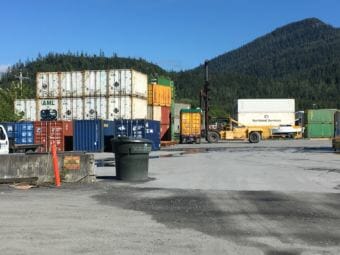
Barges carry containers full of product to ship to Southeast towns. (June Leffler/ KSTK)

It’s expensive to remove household waste from communities in rural Alaska. One organization did just that for six villages in the Yukon-Kuskokwim Delta earlier this month, but it wouldn’t have been possible without help from Donlin Gold, the company developing one of the biggest gold mines in the world right in the heart of the Y-K Delta.

A program called Green Star removed the village’s household waste for them earlier this month. Green Star is part of the Alaska Forum, a non-profit group that looks to supports environmental efforts across the state, and this particular program tackles landfill issues in rural Alaskan communities.
This is the first time Green Star has helped out in the Y-K Delta. Before, villages stored household waste in a container and waited for the barges to come in the spring.

“We had to store them in a conex and wait for winter or summer breakup for the barges to get here,” said Anna Michael, Chuathbaluk’s assistant coordinator with the Indian General Assistance Program.

But even shipping it out by barge can be pricey. Green Star shipped the waste through barges, but at a reduced rate. And it was supported in large part by Donlin Gold, the company developing one of the biggest gold mines in the world in the heart of this region.

“It wasn’t until Donlin Gold stepped in and said ‘Hey, we like your program with the communities and we would be willing to donate funds to your organization if you can go out and clean out the materials in these communities,'” said Doug Huntman, the program director for Green Star.

Donlin Gold contributed $160,000 last year to make sure this happened, said Kurt Parkan, Donlin’s spokesman.

“This isn’t a way of sending a message,” Parkan said. “We are interested in keeping the Kuskokwim River healthy.”

Green Star shipped the waste for six communities in the Y-K Delta: Upper and Lower Kalskag, Chuathbaluk, Napaimute, Crooked Creek, and Aniak. All six communities served by Green Star are close to the proposed mine site.

Donlin plans to participate in more clean-up efforts for Y-K Delta communities next year, Parkan says, but details of that plan have yet to come together.

Science program tries to make amends after sending mixed signals to native youth in Y-K Delta

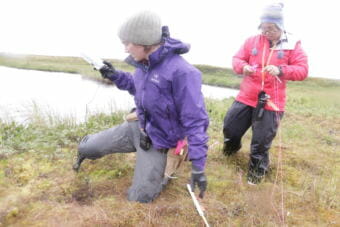
A dozen students head out into the field to study climate change in the Yukon-Kuskokwim Delta. (Photo by Krysti Shallenberger/Alaska’s Energy Desk)

A national organization called the Polaris Project takes young scientists into the field to study climate change in the Yukon-Kuskokwim Delta. They flew participants to a site about 57 miles west of Bethel this year.

But last year, Jasmine Gil, a young scientist from Bethel who participated, said that the group marginalized her project because it relied on traditional knowledge. Now, the organization is trying to make amends.

Darcy Peter was one of the students who returned to the Polaris Project. She is Alaska Native from the Interior village of Beaver. Peter loves the Polaris Project and says that she had a good experience with the organization, but she also saw the fallout last year when fellow scientist Jasmine Gil told KYUK that the organization did not take her project seriously.

“I don’t like how things were handled. I definitely don’t,” Peter said.

Jasmine Gil is from Bethel, and her Yup’ik heritage guides how she conducts her research. She moved with her family to Sitka when she was 10 but spent her summers traveling between Kwethluk and Bethel. She was the only participant from the Y-K Delta last year.

Her project combined traditional Western science and Yup’ik knowledge to find out why lakes are disappearing in the region. In an interview last year, Gil said that some scientists at Polaris tried to persuade her to study something else.

“I said no, no, no, no… this is important to the people here and I want my work here to reflect where I come from; who I am and the people that I care for,” Gil said.

Gil declined to be interviewed for this story. She says that she is moving on from the controversy.

Sue Natali is one of the lead scientists of the Polaris Project, which is part of the Woods Hole Research Center based in Massachusetts. Natali was also present during the controversy last year and claims that at the time, she didn’t know about the tension between Gil and Polaris.

“I was very excited by her science project,” Natali said. “We provided a lot of helicopter time for her, and I really regret that she felt that way because she actually has a really awesome project and really good insight and that was not communicated to me. So as a project leader, what I do is express to everyone to try to communicate with me.”

Now a year later, Polaris is trying to repair the damage. Natali says that they have built in more one-on-one time with students and more group meetings to catch all concerns and potential problems.

Polaris researchers also hosted a community meeting in Bethel this year after their two-week research session ended. As part of the meeting, one of the Polaris Project scientists, Paul Mann, asked the crowd for suggestions.

“What are we missing? And what do you say to the next generation of scientists here about what should be looked at?” he asked.

Many in the crowd replied simply with this: interview the elders.

Peter agreed and added that Western scientists actually need to sit down with elders and the community to find out what they want to know. That way, scientists can also start forming relationships with people who have lived in the area for a long time.

“Science is like the black and white, and traditional knowledge is first hand observance; it’s looking at changes over time because we’ve been there for so long versus scientists who just go there, do a few studies, and then bail out,” Peter said.

Next year, Polaris researchers say that they will do two meetings in Bethel: one before the group heads out to do research, and another after it’s concluded. That way, the group can have more insight from the community and also spend more time building relationships.

Site notifications
Update notification options
Subscribe to notifications