Krysti Shallenberger, Alaska's Energy Desk - Bethel
Donlin Gold still waiting for big state permits

The proposed mine could be one of the biggest in the world — if completed. (Katie Basile/KYUK).

Donlin Gold, the company developing a proposed gold mine in the Yukon-Kuskokwim Delta, says it hopes to get most of its major permits out of the way this year. But so far, progress has been a bit slow.

“The last ones we received was, I think, the [Army Corps of Engineers] permits and the Title 16 [Alaska Department of Fish and Game] fish permits,” said Kurt Parkan, spokesman for Donlin Gold.

The Army Corps of Engineers’ joint record of decision that came out in August is the biggest milestone for the company so far in the permitting process. It capped six years of environmental review for the project, which could be one of the biggest gold mines in the world, if developed. The Army Corps greenlighted the project in a joint decision with the Bureau of Land Management, which had to give Donlin permission to build a lengthy gas pipeline on some of its land.

So, what other permits does Donlin have? It has a wastewater discharge permit from the state, which will let Donlin Gold discharge water from its mining operations into Crooked Creek, a tributary of the Kuskokwim River. The water is treated for mercury and cyanide from its operations to meet the required drinking water standard. The state also issued an air quality permit for Donlin last year.

The Alaska Department of Fish and Game gave Donlin 13 permits in August for disrupting fish habitat. The mine would eliminate one salmon stream and partially destroy another. Donlin is required to mitigate habitat near the site or offsite to compensate for that disruption.

What permits does Donlin hope to get before the end of the year? One is approval of its draft reclamation plans and financial assurances, which are basically how Donlin plans to set aside money for reclamation. But the state Department of Natural Resources (DNR) is still reviewing those plans. Faith Martineau, who coordinates the permitting process for the Donlin project at DNR, says that they will likely reach a decision before the end of the year.

DNR is the lead agency for issuing permits under its jurisdiction and the Department of Environmental Conservation (DEC). Another permit Donlin hopes to get this year is an integrated waste permit from DEC.

“That’s essentially a disposal of all material that’s generated at the mine, like the waste rock, and the garbage from the kitchen, and water flood from treatment plants,” Parkan said.

Parkan says that they are also expecting a public hearing from DNR within the next month or so for its right of way permit for the portion of the pipeline that goes through state-owned land. But Donlin still has a ways to go in the permitting process. It needs 100 permits to begin mining, and its dam safety permits, which will be a major milestone for the company, won’t come for a couple of years.

“The dam safety permits is probably is the biggest permit that will be outstanding after this year,” Parkan said.

Donlin needs these permits to build its tailings dam and other infrastructure. Parkan doesn’t know when the company will begin the necessary drilling and analysis to get those permits.

The article has been updated to include comments from Faith Martineau, who is coordinating the permitting process between DNR and DEC for the proposed Donlin gold mine.

Sen. Lisa Murkowski talks aviation, climate change during Bethel visit

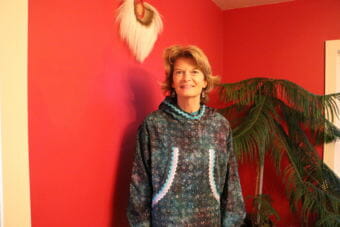
Lisa Murkowski says supporting rural aviation is key for the Yukon-Kuskokwim Delta. On a visit to Bethel Oct. 26, 2018, she laid out how she’s trying to support it at the federal level. (Photo by Dean Swope/KYUK).

Murkowski visited Quinhagak as part of her trip. It’s one of 56 villages in the region and sits on the coast near Kuskokwim Bay.

Like many YK Delta communities, Quinhagak is experiencing erosion from rising sea level and melting permafrost and is struggling to maintain its gravel airstrip.

“[I] had an opportunity to look at the impacts of erosion and some of the issues that they are dealing with whether it is their airport, whether it is their sewer lagoon but just the impacts to infrastructure that will be necessary to review,” Murkowski said.

The Yup’ik community is also the site of a massive archaeological dig. Quinhagak is trying to save its heritage — thousands of artifacts from the Bow and Arrow Wars of the 1600s —from washing into the sea.

Murkowski says she is focused on tackling rural aviation and climate change in her role as Senator. For rural aviation, she says Congress just passed legislation that would prioritize airport construction in “cold weather” locations.

“We just don’t have enough time during the summer season, and the airports are being used all day in, day out,” Murkowski said.

The legislation makes sure safety equipment arrives more quickly at rural airports and allows Alaska cargo planes to deliver fully charged lithium ion batteries

“These are often used in things like pacemakers, well, if you can’t get these fully charged batteries out to the region on an airplane, how do folks get the necessary medical equipment?” Murkowski asked. “So that’s a very specific Alaska exemption.”

Maintaining a rural airstrip also means battling melting permafrost, which can cause dips in the runway. And some villages in the YK Delta like Quinhagak and Newtok face erosion, another big infrastructure problem. And that’s expensive to fix.

If Congress were to define climate change as an emergency under the Federal Emergency Management Agency (FEMA) that would make it easier for communities like Newtok and Quinhagak who are facing relocation and major infrastructure problems because of erosion linked to climate change to get federal funding to replace buildings or move.

But Murkowski doesn’t think that’s a good idea.

“When you think about climate change and the impacts that we are seeing, it’s not a hurricane that has come up within a few days. These are slow-moving disasters,” Murkowski said. “But our reality is, in my view, that FEMA is not necessarily the best entity for addressing the potential disaster that you can see coming.”

She says FEMA is an agency focused on responding to disasters, not trying to prevent or mitigate it.

She thinks it makes more sense for an agency like the Army Corps of Engineers to take preventative measures to contend with climate change. But is that possible with the current when the Trump administration is trying to roll back major environmental regulations that would cut down on greenhouse gas emissions?

“If what we’re talking about is a wholesale kind of overhaul of a department that would allow for prevention, adaptation, mitigation, strategy from the agency, focused specific to climate change — in the two years of the Trump administration…I don’t see that happening,” Murkowski said.

But she says the solution could happen with a little different phrasing.

“If you’re an administration that says ‘well, we want to be smart with taxpayer dollars,’ you work on infrastructure and technologies that will, for instance, be more enduring when you’re looking at how you build out an airstrip,” Murkowski said. “For many in this current administration, it’s how we talk about getting to the same goal, which I think is important.”

Murkowksi says that there are plans underway in agencies to help build more resilient infrastructure that will withstand the impacts of climate change, from more hurricanes to rising sea levels to melting permafrost.


Editor’s note: Some of Murkowski’s quotes have been updated to correct minor transcription errors.

Sen. Murkowski endorses Republican Mike Dunleavy for governor

Sen. Lisa Murkowski visited Bethel on Friday to update the region on her work in Washington D.C. and listen to constituents. (Photo by Krysti Shallenberger/KYUK)

Republican U.S. Sen. Lisa Murkowski endorsed Mike Dunleavy in the battle for the governor’s seat during her visit to Bethel on Friday. Dunleavy, the Republican nominee, is running against Democrat Mark Begich and Libertarian Billy Toien.

Sen. Murkowski says that Dunleavy’s stance on Ballot Measure 1, a controversial salmon habitat ballot measure, was a big factor in her support. Murkowski doesn’t support the salmon initiative —and neither does Dunleavy.
“I have looked at the language of this initiative and as a former state legislator, and one who was responsible we get legislation and laws right, I’m very concerned that the ways this initiative is drafted.” Murkowski said. “It would bring about unintended consequences that will limit our opportunity and ability as individuals and communities to really move forward with even the most simple development project.”

The ballot initiative would toughen the permitting process for large industrial projects proposed in salmon habitat, among other things. This could impact major mining projects like the proposed Pebble Mine in Bristol Bay and the proposed Donlin gold mine in the Yukon-Kuskokwim Delta.

Murkowski said that she supports the intent behind the ballot initiative. If the initiative doesn’t pass, she said she would urge the state Legislature to take up the issue of salmon habitat protection in the next session.

“So what I would like to do, what I want to see happen, is see this initiative rejected and our state legislature look specifically to these issues,” Murkowski said.

Alaskans will get to choose their next Governor and whether or not to pass the salmon habitat ballot initiative on Nov. 6.

Barrick Gold takes Donlin mine development ‘very seriously’ during big merger

Donlin Gold expects to get most of its major state and federal permits this year.

Canadian company Barrick Gold is the biggest gold mining company in the world. A proposed merger with another large gold mining company in South Africa would make it even bigger. Barrick Gold also wants to build one of the world’s largest gold mines, the Donlin gold mine, in the Yukon Kuskokwim Delta. And this merger could have future implications for the project.
“For Barrick and Randgold, it’s an opportunity to bring together a collection of assets that will create the world’s largest portfolio of what we call tier-one gold mines,” said Andrew Lloyd, who is the vice president of Barrick Gold’s communications.

Tier-one gold mines produce a lot of gold, have long lives and low costs. And Donlin Mine could be one such mine, if developed.

Barrick owns 50 percent of Donlin Gold, the company developing the mine. Another Canadian company, NovaGold, owns the rest.

The Donlin mine would be a massive, open-pit mine. If completed, Donlin would be in the top ten percent for gold mines in the world because of its deposit size and production. That makes it a very valuable asset for Barrick.

“There are very few gold deposits of that size and scale in the world anywhere so I think you have to look at that and say there’s a lot of value there,” Lloyd said.

But it’s located in one of the most remote regions in Alaska, and consequently, Donlin needs to build a lot of infrastructure such as roads, a long gas pipeline, a power plant and a port. And that comes with a hefty price tag: $6.7 billion, according to its 2011 feasibility study.

Currently, Barrick and its partner NovaGold are trying to crunch the numbers again to see if the Donlin Mine is worth that kind of investment.

In 2011, the feasibility study said Donlin might be too expensive for Barrick to develop based on the market prices at that time and the company’s internal rate of return, which is essentially a calculation of the costs to produce the gold.

However, Lloyd pointed out that gold mining is a cyclical business.

“Gold prices rise and fall over time, sometimes dramatically, so when you are making an investment decision that might span decades, you want to be sure that operation will be sustainable over the life of the mine,” Lloyd said.

Donlin has been moving through the permitting process after receiving its Environmental Impact Statement from the Army Corps of Engineers in April. Donlin also received many of its most important permits from federal and state agencies this year.

So Barrick and its partner Novagold can start planning an updated feasibility study. That study will be one of the final steps before the companies decide to build the mine. However, the owners are currently working on a series of optimization studies to be completed at the end of this year before they embark on the feasibility study.

Donlin isn’t the only big project in Barrick’s portfolio. Lloyd said that Donlin is comparable to two of their proposed mining projects in Chile: Pascua-Lama ($8 – 8.5 billion in 2012) and Norte Abierto, ($6 billion in 2011).

Lloyd says Barrick decided to halt developing Pascua-Lama earlier this year because of costs — and environmental concerns. Reuters reports that a Chilean court ordered Barrick to cease development because of those issues — and fined the company $11.5 million.

However, he says the company is re-evaluating Norte Abierto.

And Lloyd says Barrick is serious about developing Donlin.

“The challenge is cracking the nut to develop in a way that will work for all parties so again that’s what the owners are very much focused on and I would say, taking it very seriously,” Lloyd said.

Right now, Barrick is focusing on completing its merger and its current mining operations. Lloyd says doing that will help them find more cash that could help them invest in their proposed projects, like the Donlin Mine — if it moves forward.

The Donlin gold mine needs to move a mountain. How close is it to making that happen?

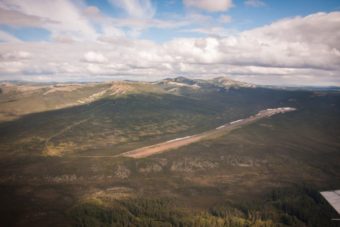
Donlin runway and camp site in summer 2014. (Photo by Dean Swope/KYUK)
The Donlin runway and camp site in summer 2014. Donlin Gold expects to get most of its major state and federal permits by the end of 2018. (Photo by Dean Swope/KYUK)

One of the biggest gold mines in the world could be built along the Kuskokwim River, north of Bethel. The Donlin mine has so far escaped the intense level of public scrutiny aimed at the proposed Pebble Mine in Bristol Bay, but it’s much farther along the permitting process. Supporters say the mine would bring much needed jobs to the region while opponents worry it threatens their subsistence way of life.

There isn’t much at the Donlin mine site right now: just a long airstrip, with clusters of sturdy buildings in the middle of green mountains close to the Middle Kuskokwim River.

Donlin wrapped up most of its exploration before 2012, but workers continued environmental testing and monitoring water quality as the company worked with the Army Corps of Engineers to wrap up its lengthy environmental review. But now the camp is closed as Donlin awaits the rest of its permits.

Right now the extensive mine site is mostly covered in dense black spruce forest. But Donlin’s proposal would turn this area into a large open-pit mine.

That means Donlin will dig two big holes that will eventually merge together to form a large pit. At its peak, the pit will be a more than a mile wide and two miles long. And once Donlin stops mining, that pit will evolve into a dam that will contain the water used in its operations. The water will already be treated by large facilities for the cyanide used in its operations and the mercury that is released from the rocks surrounding the site, Donlin says.

Kurt Parkan, the spokesman for Donlin Gold, says the mine would be in the top 10 percent in the world for a gold mine because of its deposit size and production.

“Basically we’re moving one mountain to another and taking the gold out during the process,” he said.

The site sits in one of the most remote regions in Alaska. So Donlin will have to build roads, a long gas pipeline, a power plant, a port and an airstrip for its operation.

All that infrastructure — and mining — will disrupt 2,800 acres of wetlands. However, Donlin will mitigate about 700 acres – both on site or in a different location – to make up for the impacts. And to do that, Donlin needs about 100 permits from federal and state agencies.

Donlin’s supporters argue the mine would bring jobs to a region with high unemployment and poverty. Bethel resident Moses Tulim says the Donlin Mine will open up economic opportunity.

“Well, you go one to any village and you name basically the same number of employers or identify the same number of employees,” Tulim said.

Tulim was born in Chevak, but has lived in Bethel for the past decade. He’s seen people leave the villages to find work — and not return. He says jobs could help keep young people in the villages.

“As a result, many more young people will be looking at relatives working in the mining industry and they’ll have role models that they’ll be looking up to who have good paying jobs and able to afford more things, snow machines, boats…and help continue on supporting their subsistence way of life,” Tulim said.

But many in the Yukon Kuskokwim Delta have big concerns about the mine. They worry that the extra barge traffic will damage spawning grounds for smelt and chum. And some fear that a mine accident would contaminate the Kuskokwim River.

The first tribe in the Y-K Delta marched against the proposed mine this past summer in Bethel. And a local working group formed to oppose it as well. But most of the protests are local.

Unlike the Pebble mine in Bristol Bay, Donlin has a lot of political support in Alaska. The three gubernatorial candidates have endorsed it. Crooked Creek is the village closest to the mine. Its Traditional Council endorsed the mine in a resolution ten years ago.

But some people in the community have concerns. Mishka Andreanoff is a Yup’ik elder who lives in Crooked Creek. He doesn’t like the mine.

“If we get the mine open, I don’t know if we’ll get any fish up this river or not, because this our life: the fish,” he said. “I live off the land…I do fishing and trapping and hunting when I can.”

Andreanoff says he worked for Donlin during its early exploration days. He used to hunt and trap in the mine site area before the company closed it down. He’s afraid the mine could bring in more people than the village can handle.

“We’re having problems with alcohol and all of that, and there’ll be more of that when the mine opens up,” Andreanoff said.

Donlin’s Parkan says the company understands those concerns. And he says Donlin will build the mine safely.

Parkan can’t say when the mine is likely to break ground, but says it’s years away. Now, the mine is moving through the permitting phase, getting its final Environmental Impact Statement and major permits this year.

“We just received our federal permits, so that’s probably the biggest milestone to date. We’re continuing to work towards getting our major state permits,” Parkan said.

Donlin expects to get most of those this year. But the company will need to determine if gold prices are high enough to begin building the mine.

An analyst with financial firm S&P Global says the current gold market is pretty good for development — and will likely stay that way for a while. However, constructing the mine could cost as much as $6.7 billion.

Parkan says the company already invested $500 million dollars in exploration and the permitting process. He says that means Donlin is serious about developing the mine.

Editor’s note: In a previous version of this story, S&P Global said it would take $4 billion to develop the mine. That is incorrect. Donlin says it would take $6.7 billion. Also, a previous version mistakenly said that the pit would become a tailings dam. The story has been corrected.

Y-K Delta residents speak out against Donlin in tense public hearing

The proposed mine could be one of the biggest in the world — if completed. (Katie Basile/KYUK).

It took nearly four hours — and in that time, nearly 30 people filled the room to express their views about the proposed Donlin gold mine.

Alyssa Rogers is one of the founders of the Yukon Kuskokwim River Alliance, a local organization that opposes the mine. And she’s one of several who testified against the mine during the public hearing.

“This is a subsistence economy,” Rogers said. “It always will be and it always has been.”

The hearing was held at the group’s request — and the public comments were supposed to be focused on the Alaska Department of Environmental Conservation’s (DEC) draft approval of the plans for reclaiming the mine site and its financial assurances. But most of the comments were larger in scope.

William Charlie Brown, an elder from Eek, spoke in Yup’ik against the mine. Brown is afraid that a mine accident would contaminate the Kuskokwim River and its tributaries, which are vital food sources for the entire delta region.

The Donlin mine would impact about 3,500 acres of wetlands and permanently eliminate one salmon stream. Its tailings dam would partially eliminate another. As such, Donlin is required by Alaska law to pay to clean up and restore the land.

But many in the hearing were skeptical about the amount that the state would require Donlin to pay: $317 million. State documents put the actual costs to clean up the mine much higher at more than $1 billion.

But the DEC says that based on their calculations, the $317 million that is bonded to the mine would gather interest over the mine’s operating period – and be enough to cover reclamation costs when the mine shuts down. Donlin Gold expects to operate the mine for 27 years, with a possible extension.

But the question of who pays for the cleanup if Donlin goes bankrupt – and the state doesn’t have enough money to cover it – is where it gets complicated.

The proposed mine is being built on Native Corporation land; the Calista Regional Native Corporation and The Kuskokwim Corporation (TKC) own the subsurface rights and surface rights respectively. Allan Nakanishi, the technical engineer for DEC’s water division, said in the worst case scenario, the fight to pay for reclamation could become a legal battle.

“It’s unpredictable and I can’t predict what will occur once court action occurs,” Nakanishi said.

Maver Carey, the CEO of The Kuskokwim Corporation, which owns the surface rights, was the only representative from a native corporation who spoke at the hearing. Calista’s vice president of land development, Rosie Barr, attended but did not speak. Neither did two representatives from Donlin Gold.

Carey reminded the crowd that TKC’s primary responsibility is to provide value for their shareholders.

“Responsible economic development is a critical factor for our corporation,” Carey said. “Responsibly developing our land and natural resources was what our forefathers and founders identified when selecting lands, including mineral rich lands, for the betterment of all TKC shareholders.”

She added that TKC consulted with independent experts on Donlin Gold’s draft reclamation plans. As a cooperating agency, TKC, along with Calista, worked with Donlin and the state to come up with the current reclamation scheme.

And even with voices opposing the mine through public comment, it’s unlikely those will deter state agencies from giving Donlin the permits it needs to develop the project. DEC personnel say it’s rare that a permit is denied.

DEC’s Nakanishi says he’s worked at the agency for ten years. He never saw a permit in his division that got turned down.

Meanwhile, the public can submit comments to DEC and the Department of Natural Resources until 5 p.m. on September 6.

Correction: A previous version of this article incorrectly said that the Donlin Mine would eliminate two salmon streams. It would only eliminate one, American Creek, with its operations, while partially eliminating another, Anaconda Creek, by filling it in with its tailings dam. The company will restore other streams to mitigate the damage as part of its permitting requirements from the Alaska Department of Fish and Game.

Site notifications
Update notification options
Subscribe to notifications