Krysti Shallenberger, Alaska's Energy Desk - Bethel
More Y-K Delta tribes protest Donlin Mine as permitting process progresses

The proposed mine would be one of the biggest gold mines in the world if completed. (Photo courtesy of KYUK)

As the proposed Donlin gold mine moves through the permitting process, more tribes in the Yukon-Kuskokwim Delta are speaking out against it.  Six tribes have passed resolutions against the proposed mine in the past two months; and eight have spoken out against it in the last two years.

Napakiak is one of the tribes. Tribal administrator David Andrew says the village council is worried about possible impacts to salmon.

“They were concerned about salmon,” Andrew said. “That’s our life. Salmon, our life.”

Subsistence is a way of life for many families in the Y-K Delta. And Donlin would be one of the biggest gold mines in the world, built next to the Kuskokwim River. Many residents worry about the impact to subsistence resources.

The Y-K Delta is also one of the poorest regions in the state, and Donlin Gold, the company developing the mine, promises jobs for locals. But some tribes think the risks to their food and health are too high to support the project.

Minnie Andrew is the assistant tribal administrator for Kongiganak. The tribe passed its anti-Donlin resolution last week, and she says they discussed the potential jobs before the vote.

“They were mostly talking about the cons,” Andrew said. “The pros — it would bring jobs, but the cons are more.”

Several of the tribes passing anti-Donlin resolutions did so after the Orutsaramiut Native Council held their first public demonstration against the project in June.

And most of the tribes with anti-Donlin resolutions so far live about 100 miles down river from the proposed mine site. Only one tribe on the Yukon River took a stance against it. So far, it’s unclear if any tribes directly next to the mine have passed any resolutions about Donlin.

Several of the tribes with anti-Donlin resolutions also signed on to a letter sent to Gov. Bill Walker protesting the mine. However, Walker supports the project.

Donlin Gold spokesman Kurt Parkan says the company plans to develop the mine safely and responsibly.

“We welcome people’s opinions we know there is a variety of opinions in the community,” Parkan said. “We get a lot of people asking us when the jobs are going to start and we also understand that people have concerns that they don’t think can be adequately addressed.”

Meanwhile, Earthjustice, a national environmental group, sent a letter on behalf of four of the tribes asking the Alaska Department of Environmental Conservation to deny a crucial permit for Donlin.

The project needs more than one hundred permits before it can start mining and expects to get the major ones out of the way this year.

Top four gubernatorial candidates voice support for Donlin mine

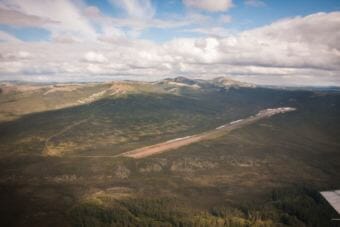
The site of the proposed Donlin gold mine would make it one of the biggest ones in the world (Photo: KYUK).
The site of the proposed Donlin gold mine, which would be one of the biggest in the world (Photo courtesy of KYUK).

Gov. Bill Walker made headlines this past weekend after he requested that the Army Corps of Engineers suspend the Environmental Impact Statement for the controversial Pebble mine in Bristol Bay.

But Walker, who is running for re-election as an independent, and three other top gubernatorial candidates have pledged support for the Donlin mine, which would be the one of the biggest gold mines in the world. Walker says Donlin so far appears to be following the rules of regulatory process.
“I have to have a pretty strong reason to not support something and so I’m still looking at that, but what I know of it I’m comfortable with,” Walker said.

His competitors tout other benefits of the Donlin mine. Former Lieutenant Governor Mead Treadwell is running as a Republican. Treadwell praises Donlin’s promise to bring more jobs to the Y-K Delta.

“There are mines around the state that employ a lot of people and it’s one of the most important things we can do for regional development,” Treadwell said.

The project also proposes a three hundred and fifteen mile long gas pipeline from Cook Inlet to fuel the mine’s operations and power demands. Former state Senator Mike Dunleavy, who is running as a Republican and will face Treadwell in the GOP primary in August, says that pipeline is a huge energy opportunity for the Y-K Delta and the state.

“A lot of spin-off industries will benefit from it in the Y-K Delta and Southcentral Alaska so I think it’s a huge opportunity for Alaska,” Dunleavy said.

Former United States Senator Mark Begich, who is seeking the Democratic nomination in the primary, has voiced support for Donlin for years and believes the project on Native Corporation land can co-exist with the subsistence lifestyle in Western Alaska.

“They’ve understood the value of fishing and they understand the importance of it to subsistence lifestyle,” Begich said.

The Donlin mine would increase barge traffic on the Kuskokwim River, the food source for many residents in the Y-K Delta.

It will require large treatment facilities for mercury and cyanide coming from the mine’s operations. Donlin has already received a water permit from the state to discharge wastewater into Crooked Creek, which drains into the Kuskokwim River.

People living the Y-K Delta are also worried about what will happen after the mine stops producing. The site would have to be monitored forever, once it ceases operations.

Gov. Walker says he doesn’t see the state relaxing monitoring enforcement, even with the budget crunch the last couple of years. He’s confident the state can adequately regulate the mine.

“We certainly we have laws in place,” Walker said. “I believe if we need to strengthen those laws, then let’s strengthen those laws.”

Treadwell and Dunleavy will battle each other in the August primary for the Republican nomination. On the Democratic side, Begich is unopposed, and the winners will face Governor Walker in November.

Stand for Salmon ballot initiative has big implications for Donlin mine

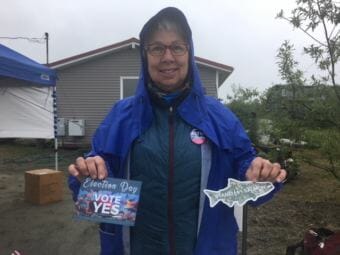
Bethel resident Beverly Hoffman is one of a handful of community members educating the community about Stand For Salmon.
Bethel resident Beverly Hoffman is one of a handful of community members educating the community about Stand For Salmon. (Photo/Krysti Shallenberger/KYUK)

In the Yukon-Kuskokwim Delta, the stakes are especially high for the controversial Stand for Salmon ballot initiative because it could kill one of the biggest proposed gold mines in the world — the Donlin Mine.
Backers of Stand For Salmon visited Bethel a month ago. This is when Bethel resident Danielle Craven first heard of it.

“After learning about it, I realized that this was a coalition of people who are really interested that we as Alaskans and rural Alaskans have a voice in the decisions that are impacting salmon and our waters,” Craven said.

Craven is a member of the Orutsaramiut Native Council. The tribe held their first public demonstration against the proposed Donlin gold mine last week and is the first one to do so in the Yukon-Kuskokwim Delta. Craven sees Stand For Salmon as a way to protect the region’s subsistence way of life.

Craven is also one of the leaders of a new local working group called the Yukon-Kuskokwim River Alliance, and its goals align with the ballot initiative.

“We’re focused on educating and informing people about mining and Donlin Mine, protecting and preserving our subsistence way of life as well as educating those outside who don’t understand the reliance on subsistence living,” Craven said.

If voted in, Stand For Salmon would do a lot of things. First, it assumes that all bodies of water in Alaska supports salmon habitat until evidence proves the opposite. And it would require the Department of Fish and Game to hold big projects in salmon habitat to much tougher standards. It also gives Fish and Game more power to stop projects .

Emily Anderson at the Wild Salmon Center helped draft Stand For Salmon. She claims this is not an anti-mining or anti-development effort.

“This is a proactive way to get ahead of the curve to put strong fisheries protections standards in place that really encourage those responsible development projects that are not trading one resource for another,” Anderson said.

But if Stand For Salmon passes, it means Donlin Gold could not continue development, spokesman Kurt Parkan says.

“If the initiative passed, we wouldn’t be able to get the permits necessary to construct or operate the mine,” Parkan said.

According to legal documents filed by the state, the Donlin mine would permanently eliminate two streams that have had salmon in them. Stand for Salmon would require Donlin to restore those streams and other ones it damages, instead of shifting that to another place away from the mine. Parkan says because Donlin will be constructed in a remote and rural part of Alaska, it makes it “almost impossible to to satisfy mitigation requirements onsite.”

“So we, as well as other big projects in the state, look for offsite areas to mitigate and this initiative wouldn’t allow it to happen,” Parkan said.

And opponents claim Stand For Salmon could also have impacts on small-scale development, like a new road or bridge.

The Kuskokwim Corporationowns the surface rights to the Donlin mine. But the initiative’s effect on the mine isn’t as concerning as compared to the immediate consequences on rural development. TKC’s vice president Andrea Gusty says while the corporation doesn’t have a stance on Stand For Salmon, they do have concerns.

“What we worry is about the unintended consequences tomorrow if something like this did pass or could pass, on a projects like a road in Chuathbaluk so they could build new houses in communities or relocating a graveyard in Kalskag because of the problem of erosion,” Gusty said.

Donlin, along with several big mining companies, is backing Stand For Alaska, a group formed to oppose Stand For Salmon. The company has contributed $1.2 million in cash and donated time to Stand For Alaska so far. Parkan wouldn’t say if Donlin plans to contribute more. Conversely, Stand For Salmon has collected less than $500,000 from a wide range of contributors, including outside venture funds and individual Alaskan residents, according to state filings.

Meanwhile, Stand for Salmon is tied up in a legal fight over concerns that the initiative goes against Alaska’s constitution. So it’s unclear whether or not it even makes it to the ballot this fall.

First Y-K Delta tribe marches against Donlin Gold in Bethel

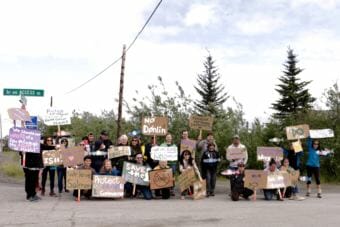
ONC led a public demonstration against the proposed Donlin gold mine in Bethel on Friday, June 22, 2018. (Photo by Christine Trudeau/KYUK)

The Orutsararmiut Native Council held their first public demonstration against the proposed Donlin gold mine on Friday, becoming the first tribe to do so in Yukon-Kuskokwim Delta. The mine would be built in a region where many residents practice subsistence and would be one of the biggest gold mines in the world once completed.

Evon Waska, an elder who marched on Friday, says that the mine has no place in the Yukon-Kuskokwim Delta.

“The subsistence way of life is too important, and the Kuskokwim River provides us with food, and that Donlin gold mine is not the place to have it here on the Kuskokwim,” Waska said.

He joined 30 other marchers from the tribe and Bethel community who want to protect fish from what they say are the dangerous impacts of the proposed gold mine. ONC has voiced concerns through public comment for the mine for a couple of years, but plans to protest fell by the wayside with the death of its natural resource development director, Greg Roczicka, last year. Peter Evon, ONC’s Executive Director, says that the mine’s possible risks outweigh any potential benefits.

“Obviously jobs are very important in the region, but I don’t think there’s a risk we should take of any kind,” Evon said.

The proposed mine would increase barge traffic on the Kuskokwim River, which is the source of the Y-K Delta’s subsistence activities. Salmon and smelt, a smaller fish that comes in the late spring, could be significantly impacted by the increased traffic. Other concerns include the impact on water quality, and possible air pollution from mercury released from rocks during mining operations. But Donlin has touted the job growth it could bring to the region, and has held multiple public hearings on the project as it goes through the permitting process.

Donlin spokesman Kurt Parkan says that the company has worked very closely with Calista Corporation and the Kuskokwim Corporation, which own the subsurface and surface rights respectively, to develop the mine responsibly. But individual tribes may not agree with Calista and TKC, and Parkan says that’s expected.

“That’s a tough question to answer because I think it’s not possible to get unanimous support on any subject in favor of something or against something,” Parkan said.

Walter Jim, the president of ONC’s board, didn’t attend the march, but he told KYUK later that his tribe’s responsibility is to protect its lifestyle from any threats, even if that threat could bring some economic relief.

“My belief is that every tribe’s responsibility is to protect that tribe, and part of those protections is the subsistence way of life. And we see Donlin’s development as a threat to the subsistence of the river,” Jim said.

Jim says that they are reaching out to other tribes along the Kuskokwim to join in the fight against Donlin. He says that there will be more demonstrations down the road.

Meanwhile, Donlin is plugging through the permits it needs to start the mine. The company says that it expects to get most of its major federal and state permits this year. The Army Corps of Engineers is expected to come out with its joint record of decision in mid-August.

A public comment deadline for a state water quality permit is looming; comments are due July 13. That permit basically ensures that any placement of fill or trash from mining will not degrade water quality in Crooked Creek. Parkan says that Donlin is not going to put fill or waste from mining into Crooked Creek. Tailings and waste will be placed in a tailings dam or waste rock facility.

Walker signs bill to help villages run background checks on police

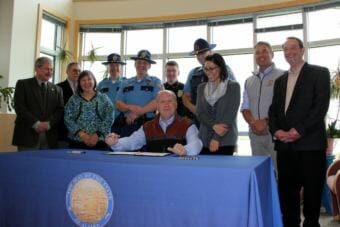
Gov. Bill Walker signs Senate Bill 148 on June 22, 2018. The bill will help villages to run background checks on future police officers, but it is voluntary for village police officers. (Photo courtesy Yuut Elitnaurviat)

Gov. Bill Walker visited Bethel last week to sign Senate Bill 148 into law.

The bill allows the Alaska Police Standards Council to work with villages to conduct background checks for future police officers. But for tribal police officers, it will be voluntary.
Walker’s administration sent a delegation to Marshall two weeks ago to address an ongoing public safety crisis. Marshall’s tribal council had issued a request for an emergency declaration last spring. The community has been without a police force for the better part of two decades and opioid and alcohol epidemics are wearing the town down.

“We looked at ways we could sort of help them transition to have some in that village for public safety,” Walker said.

Marshall’s tribal administrator Nick Andrew Jr. previously told KYUK that the delegation didn’t make any promises. But during his Bethel trip, Walker said that he is committed to finding a solution and that this bill could be part of it. Gov. Walker says that the bill will make sure that village communities and tribes have the tools available to run background checks on potential officers.

“So that has not been available to the rural areas,” Walker said. “As they bring someone into the system, (this) is going to allow them to the background checks as they do in the bigger cities.”

But the new law doesn’t require compliance from tribal police officers. However, Walker hopes it will help with the issues from village police officers, who have made headlines in a recent investigative reporting series in the Anchorage Daily News, which highlighted the lack of vetting for these officers.

In some cases, VPO’s were found have had prior charges and convictions and ended up abusing their positions.

Public funding, or rather the lack thereof, also came up. Walker says that he wants more funding for public safety, but that recent budget cuts are making that hard to do.

“Well, we certainly apply for every federal funding dollar we can, there’s no question about that,” Walker said. “We have done all the cutting, and I think we’re seeing a significant impact in public safety.”

Walker says that should his administration return to office next year, it would try to increase public safety funding in the next budget proposal.

Editor’s note: A previous version of this story incorrectly said S.B. 148 does not apply to village police officers. It applies to VPOs, but not tribal police officers. This story has been updated.

Alaska steps into legal battle over hard rock mining regulation

https://www.flickr.com/photos/usepagov/28820243391/in/dateposted/
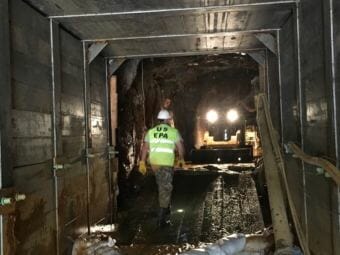
An Environmental Protection Agency employee entering the mine to observe the removal of muck in the Gold King Mine in Silverton, Colorado. Alaska has weighed-in on a legal fight over how much oversight the EPA should have over hard rock mining cleanup. (Photo courtesy U.S. Environmental Protection Agency)

The Environmental Protection Agency’s decision to roll back a regulation to make hard rock mining companies pay for clean up is sparking a new legal battle between Alaska and environmental groups.

The state is intervening in a lawsuit over the EPA’s decision to rescind an Obama-era rule that would make sure hard rock mining companies pay for cleaning up their messes, even if they go bankrupt.

Hard rock mining refers to any type of mining that deals with metals like gold and copper. The proposed Donlin gold mine in the Yukon-Kuskokwim Delta and the proposed Pebble mine in Bristol Bay would fall into that category. 

Then-President Obama issued the rule under the Comprehensive Environmental Response, Compensation, and Liability Act, also known as CERCLA. That law usually targets superfund sites; many massive superfund sites have to deal with dangerous waste left over from legacy hard rock mining. 

Cori Mills, a spokesperson for the Attorney General’s office, says the state already has a program in place to make sure mining companies are held financially responsible, so, it doesn’t need the EPA’s help.

“You know engaging in this CERCLA just on the release of hazardous substances — that would potentially preempt the state’s program which is really more comprehensive than just that CERCLA requirement,” Mills said.

Obama’s decision had come after environmental groups filed a lawsuit a few years ago, arguing that the EPA never created a rule that would make mining companies pay for reclaiming hazardous waste.  Earthjustice attorney Jan Hasselman says the Obama’s rule would not have usurped the state’s program.

“The proposed rule explicitly stated that it doesn’t preempt or usurp any state authorities. In fact, it was designed to work alongside existing requirements,” Hasselman said. “I think the key finding that the EPA previously made was that there were gaps in the state system and that there was need for the federal government to set a uniform floor for these kinds of activities going forward.”

The Trump administration’s new EPA head, Scott Pruitt, rolled back the rule in December of 2017.  Pruitt said that there are already regulations in place from states and federal agencies that require financial assurances for cleanup, even if the companies are bankrupt. .

So environmental groups, including Earthjustice, petitioned the U.S. Court of Appeals for the District of Columbia Circuit to review the agency’s decision.  This lead to Alaska joining seven other states to back up the EPA’s position in this latest legal fight.


Site notifications
Update notification options
Subscribe to notifications