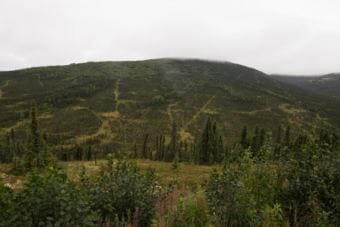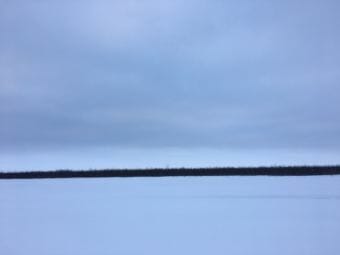
The Kuskokwim River is taking longer to freeze, compelling Yukon-Kuskokwim Delta residents to travel by air instead. (Photo by Krysti Shallenberger/KYUK)
2018 was the second warmest year for Bethel in nearly 100 years of record-keeping. According to Rick Thoman, a climate scientist in Alaska, Bethel has been no stranger to a warming climate, especially in the last five years.
“So this is the fifth year in a row with the average temperature for the calendar year above freezing in Bethel, and there’s never been a five-year period with the average temperature above freezing in the past century until now,” Thoman said.
Those changes are hitting home in a lot of ways. Bethel’s signature sled dog race, the Kuskokwim 300, had to make a last-minute change to its traditional race route in 2018. The Kuskokwim River is taking longer to freeze, so more residents in remote Yukon-Kuskokwim Delta communities have to travel by air instead, which is expensive.
“It’s not frozen up for safe travel, but it’s not really good for boating yet anymore. In that length of time, is that transition season increasing over time in these warming years?” said Thoman.
The fragile tundra is also beginning to erode faster. This is forcing many villages to consider relocation as the impacts hit closer to home. Just a few big storms would be all it would take to wash Napakiak’s school into the river, and the coastal village of Newtok is gearing up to build more infrastructure at its new site in the spring.
“It’s going to mean the increasing greening of the tundra with the shrubs growing taller. Over a very long term, a couple of generations, trees will continue to spread westward. So for instance berry-picking areas, I’ve read that areas that were good berrying in the past are now getting overgrown with shrubs,” Thoman said.
Even though temperatures may fluctuate month-to-month, Thoman reiterated that for Bethel and many other Alaska communities, this trend of warmer winters is not going away.
The proposed mine could be one of the biggest in the world — if completed. (Photo by Katie Basile/KYUK)
Donlin Gold has signed an agreement with the Alaska Mental Health Trust Authority to protect some of the trust’s wetlands in the Cook Inlet area.
The company is trying to develop one of the biggest gold mines in the world in the Yukon-Kuskokwim Delta. The mine, if built, would disturb 2,800 acres of wetlands. Because Donlin can’t restore all of those wetlands, it is required to protect wetlands somewhere else.
This agreement is a big deal for the company if it develops the project.
“Basically what this does (is) we purchase the conservation easement on a portion of the Chuitna River — I think we’re talking 2,000 acres — so that restricts its use from any kind of development, so it protects that habitat,” said Kurt Parkan, spokesperson for Donlin Gold.
Donlin Gold just finished a lengthy — and expensive — environmental review that was led by the Army Corps of Engineers.
As part of that review, Donlin Gold had to lay out its plans to restore or mitigate the wetlands it would disturb. To meet mitigation requirements for the Army Corps and the state, the company proposed to protect wetlands somewhere else in Alaska, like this agreement with the Alaska Mental Health Trust Authority.
The Alaska Mental Health Trust Authority is a state corporation that manages a trust that benefits Alaskans with a broad range of mental health issues. And part of that trust includes 1,000,000 acres of state land.
The trust said this is the first such agreement with a corporation. The Trust Land Office — which the trust contracts to manage its lands — divides the land into different categories of development, and one category allows corporations to sign these “mitigation” agreements to help meet environmental requirements.
Wyn Menefee, who is the director of the Trust Land Office, said the agreement that Donlin just signed with the trust is complicated.
“Donlin hasn’t actually purchased the whole deed restriction yet. They’ve purchased an option for purchasing a deed restriction, so essentially what we’ve done is we’ve said, ‘We will keep that available for you.'”
Under the agreement Donlin agreed to pay $200,000 to the trust, plus additional money each year for 10 years. That buys Donlin time to decide whether or not to go through with the mine.
If they do go ahead with the mine, Donlin will pay $1.3 million to the trust to preserve those 2,000 acres for 99 years.
This agreement isn’t the only one Donlin has made, or will make, to mitigate impacts from the mine. Donlin also signed an agreement with the Tyonek Native Corporation for a conservation easement on 4,000 acres of land. And Donlin plans to sign another agreement with the Great Lands Trust to purchase nine credits — the equivalent of nine acres — to protect 4.5 acres of wetlands in the Mat-Su Borough.
Most of the power has been restored for Anchorage residents. Some outages still remain scattered throughout service areas for all three of the area’s power providers, but those are few and far between.
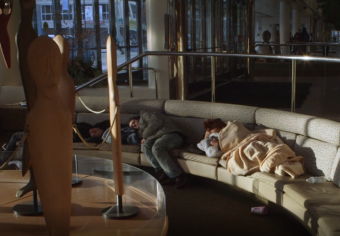
People take shelter at the Egan Center in downtown Anchorage after an earthquake on November 30, 2018. (Video still by Joey Mendolia/Alaska Public Media)
Chugach Electric Association and Municipal Light & Power are still assessing damage but have a better picture of the harm from the earthquake.
Chugach’s spokeswoman Julie Hasquet says one substation at Point MacKenzie sustained some damage, but the utility can still send power to its customers. So far, Chugach’s outage map shows about 90 households without power, but that number quickly fluctuates. You can follow along with their power outage map here.
ML&P’s spokesperson Julie Harris says they will have a broader picture about the damage after the weekend. But all their customers got their power back by 2:45 Saturday morning.
Matanuska Electric Association took the biggest hit in the earthquake, with most of their customers without power for a good portion of Friday.
But Saturday morning is a different picture. MEA says that all their substations are online, with only 20 customers without power, and those are pretty run-of-the-mill issues, according to Kierre Childers, MEA’s spokesperson.
Most of the power issues came from damaged substations and tripped transformers. Power lines swaying and slapping together during the earthquake triggered outages for most of Anchorage.
People take shelter in a lobby after an earthquake hits Anchorage on November 30, 2018. (Video still by Joey Mendolia/Alaska Public Media)
A massive earthquake Friday knocked out power to tens of thousands of people in Anchorage. The city’s two major utilities, Chugach Electric Association and Municipal Light and Power, dispatched all their crews to repair tripped transformers and other possible damage to substations and power lines.
Julie Hasquet, spokeswoman for Chugach Electric Association, was giving a tour of their company headquarters when the earthquake struck.
“It was pretty scary,” she said. “I grew up in Southern California and went through many earthquakes. I’ve lived in Alaska for 32 years and have gone through many earthquakes here, and I will say this is the longest, scariest earthquake I’ve ever been a part of.”
As of Friday evening, 97 customers were without power in Chugach’s service area.
Matanuska Electric Association got hit the hardest. Half of its substations were offline after the earthquake. As of Friday evening, about 2,500 customers were still without power. Most of MEA’s customers live in the Matanuska-Susitna Borough.
Kierre Childers, a spokesperson for MEA, said all crews are out, but they have encountered road closures and damage from the earthquake, making it harder for them to get to the repairs. Customers should be prepared for extended outages.
Municipal Light and Power spokeswoman Julie Harris said they expect to have power restored to most of their customers by the end of today.
By Friday evening, Chugach Electric is reporting that 97 customers are without power. Municipal Light and Power is reporting about 850 customers without power. Both utilities are still figuring out the damage.
Bruce Shelley at Homer Electric Association said the town did experience some outages from the earthquake tripping the lines, but those have since been fixed. There are no structural damages to power plants or other generators there.
Editor’s note: Figures will be updated in this story as new numbers become available.
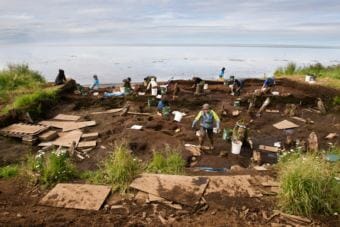
The Nunalleq dig site is located just off the coast of the Bering Sea, close to Quinhagak. A portion of the site already eroded into the sea. And the threat from erosion increases each year as storm surges grow in number because of climate change. (Photo by Katie Basile/KYUK).
A national climate report says what many Alaskans already know: The state is warming twice as fast as the rest of the country. Rural and Alaska Native communities are the first to feel those impacts. For the Yukon-Kuskokwim Delta, the stakes are especially high because the region is home to the most tribes in the state.
Warren Jones is from the village of Quinhagak, which sits close to the Kuskokwim Bay. Just last week, he went fishing for trout. That’s not a normal activity for November.
“Our river should be frozen right now as of (Nov. 28),” Jones said. “Our river is still wide open. I think a couple of boats are out there.”
Jones is also the CEO of Quinhagak’s Qanirtuuq Corporation. The community is trying to save artifacts from an ancient village nearby because they feared their heritage would wash out to the sea from erosion, caused by climate change.
From his office window, Jones can see other climate impacts on the Kuskokwim Bay.
“The bay ice out there, I’m looking out the window, there’s still open water, there’s some white, small icebergs out there, but nothing thick enough to stand on,” Jones said.
Everything Jones has seen is cataloged in the recent National Climate Assessment. One chapter is dedicated to the impacts on indigenous communities, and another on Alaska. Scientist Sarah Trainor helped write the Alaska chapter. She said rural Alaska — and indigenous communities — will feel the brunt of the impacts from climate change.
“Because you are more connected to the environmental change, it affects you more directly,” Trainor said. “You travel on the rivers, so when it’s not frozen it matters to you. Your water source is right there, so if it gets contaminated it’s much more direct connection, which is why the rural communities are more affected.”
About 87 percent of Alaska Native communities are experiencing erosion. In the Y-K Delta, residents rely on rivers freezing over so they can travel to other villages by snow machine or car. And so they can hunt and fish safely in the winter.
Trainor said poor communities will struggle the most from climate change. They’ll see higher infrastructure costs and more threats to their food supply.
The Y-K Delta is the poorest region in Alaska. And its remote communities depend heavily on subsistence.
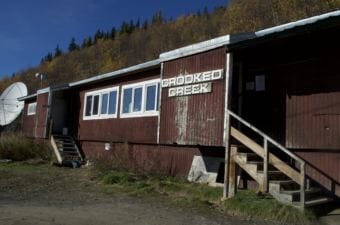
The Crooked Creek tribal administration building. (Photo by Krysti Shallenberger/KYUK)
Crooked Creek, on the Upper Kuskokwim River, is the closest village to the proposed Donlin Mine. In town, the signs of Donlin Gold are everywhere, but the local community is conflicted about the mine. Some residents see the potential for much needed economic development while others see the possible disruption of their subsistence lifestyle.
Two men who grew up in Crooked Creek worked for Donlin Gold in the past. Both see its development as inevitable, but disagree on whether the mine should happen at all.
Crooked Creek is one of the smallest villages in the Yukon Kuskokwim Delta. John Thomas, who grew up in the town says there used to be 150 residents at one point, but now he’s guessing that number is less than 100.
Thomas runs the only lodge in town. It’s been in his family for decades. He says he sees the most traffic in the summer, when people come to fish for silver salmon. But even that is not enough.
“[It’s] a little hard to keep it open because it there’s no business…need more people,” Thomas said. ” We need more.”
If the Donlin Gold Mine begins operating, that could be a financial boost for Thomas. He and his family are some of Donlin’s biggest cheerleaders in Crooked Creek. Thomas helped Donlin haul supplies during the company’s early exploration days. He still does some water monitoring for the company.
The mine would be one of the biggest in the world, if completed. And it would be built about 10 miles from Crooked Creek.
Donlin has promised to offer about 1,000 annual jobs if the mine is developed. That’s a huge deal for the poorest region of the state.
Donlin’s financial support in the region goes beyond jobs. You can see Donlin Gold’s logo everywhere in Crooked Creek. It’s on clothes. It’s emblazoned onto the scoreboard at Crooked Creek’s school. The company also helped rebuild a church; it helped residents recover after a bad flood in 2011. Donlin Gold spokesman Kurt Parkan says the company spends $1,000,000 in the villages throughout the region, including Crooked Creek.
“I think it’s important for any business that is working in an area to be engaged with the communities and the people of the region,” Parkan said.
The village tribal council in Crooked Creek passed a resolution 10 years ago supporting the mine. But the tribal administrator, Ally Zaukar, says the current council is neutral on the mine. She didn’t give any more details on why the status changed.
But one man wearing a blue sweatshirt with “Donlin Gold” in bright big yellow letters across his chest differed from Thomas over the mine.
“I mean the money is good,” said Steven Peter. “You know it’s not forever….What really worries me is contamination.”
Peter doesn’t want the mine, but he does see the economic benefits. Like Thomas, Peter used to work for Donlin
“Yeah, the first early days when I started, I mean, I had numerous jobs but I started core cutting too,” Peter said. “Being a driller helper and geotechnical work with the geologist.”
But Peter relies on subsistence, like fishing and hunting. He’s the main caretaker for his 91-year-old mother, Sophia, who is the oldest elder in the village He says his work trapping helps pay the bills. And he sets his traps near the mine site. Peter says if the mine starts operating, it would hurt his ability to make a living the way he wants to.
“[I have to] provide something for the house and pay bills and whatnot,” Peter said.
The divide between Peter and Thomas over the mine is common in the Y-K Delta. But the stakes are higher in Crooked Creek. Donlin says the company will build the mine as safely as possible — but if there is a mine accident, Crooked Creek is the first community that will feel the consequences.
And Peter doesn’t want to risk that chance.
But on the other hand, supporters say jobs could keep people in nearby communities a little longer. And residents in Crooked Creek tell me that that the Donlin gold mine is inevitable. So all they can do is wait for it to come.
Close
Update notification options
Subscribe to notifications
Subscribe
Get notifications about news related to the topics you care about. You can unsubscribe anytime.