Krysti Shallenberger, Alaska's Energy Desk - Bethel
Donlin Gold suspends drilling program, moves employees from work camp

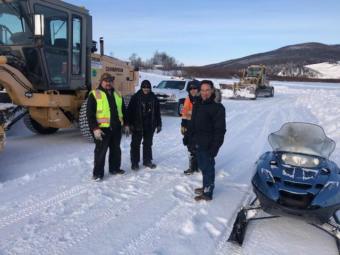
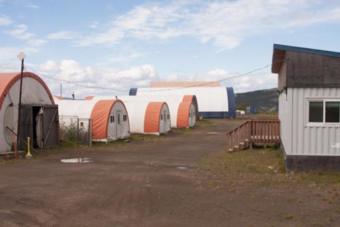
Donlin Gold workers will start leaving the work camp by April 9 as the company suspends its biggest drilling program in 12 years. (Photo by Dean Swope/KYUK)

Donlin Gold has suspended its drilling program and plans to remove most of its employees from its remote work camp in the Yukon-Kuskokwim Delta starting April 9.

This comes as the state ramps up health mandates to prevent the spread of the coronavirus.

It was supposed to be Donlin Gold’s biggest drilling program in 12 years.

The company wants to build one of the biggest gold mines in the world in a remote location in the Yukon-Kuskokwim Delta, but the coronavirus pandemic has disrupted its drilling plan. Like many companies, Donlin is packing up and shutting down.

“The situation has been incredibly dynamic with mandates, and restrictions, and requirements, and suggestions going out,” said Donlin Gold spokesperson Kristina Woolston. She said that the company plans to remove most of their employees, beginning at the end of the week.

Woolston said that eight of those employees came from Yukon-Kuskokwim Delta villages, but she won’t say how many came from Anchorage or from out of state.

Woolston said that they are working with villages to get the employees into the communities while adhering to travel restrictions.

“At this point, we are working directly with communities to have a direct charter flight into communities, so at this point there will be no intra-village travel or intra-region travel,” Woolston said.

Donlin Gold flew in its employees on charter flights, because the only way to get to the campsite is by plane. Woolston said that no one has entered or left the camp since March 26. She also said that Donlin screened employees daily for symptoms and instituted social distancing measures at the camp.

“So when folks got to camp, we have fairly large facilities so we could have shifts come in and out of dining, so we could rotate people in and out,” Woolston said.

Donlin also required only three people to one dining table and did not allow employees to share snowmachine helmets. Workers slept in small cabins that had more space between them.

Alaska state officials have classified mining as “essential infrastructure,” which gives companies permission to keep operating amid the pandemic. Companies are required to adhere to the state health mandates and provide lodging to quarantine out-of-state workers.

A Prudhoe Bay oilfield worker and a Pogo gold miner have both tested positive for the coronavirus.

Meanwhile, Woolston said that Donlin Gold is continuing its community outreach in the region to help villages cope with the pandemic.

“We’re standing by, and we’ve reached out to every tribe, every community. We’ve sent emails and left voicemails to all of the nonprofits in the region to see what we can do to help and partner,” said Woolston.

That includes sending mask kits to villages in the Yukon-Kuskokwim Delta, and working with The Kuskokwim Corp. to send food and medical supplies to the 10 villages closest to the mine site, in response to Ravn suspending all of its operations.

Woolston said that they don’t know when they will restart the drilling program, but she said that the company is keeping a close eye on developments.

Cama-i Dance Festival postponed over coronavirus concerns

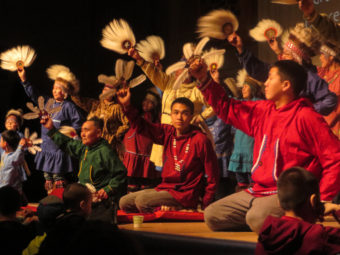
Byron Nicholai (center) and the Toksook Bay Traditional Dancers perform at the 2016 Cama-i Dance Festival in Bethel. (Photo by Laura Kraegel/KNOM)
Byron Nicholai, center and the Toksook Bay Traditional Dancers perform at the 2016 Cama-i Dance Festival in Bethel. (Photo by Laura Kraegel/KNOM)

The Cama-i Dance Festival in Bethel has been postponed until fall 2020 out of concerns over the coronavirus. Dance groups from across the region, the state, and the Lower 48 gather every year in Bethel to share dance, culture, tradition and community.
Linda Curda is the coordinator for the festival. She said in an email that the decision came to protect the health of Elders, and because spring break is in full swing for many schools with teachers and families who are traveling. Many of them would return the weekend of the festival, and Curda didn’t want to place anyone in jeopardy should someone be carrying the virus.

Health officials expect to detect a case of COVID-19 in the state soon, and the Yukon-Kuskokwim Health Corp. has suspended all non-essential out-of-state business travel for its employees. YKHC is one of the largest employers in the Yukon-Kuskokwim Delta.


Calista, Doyon deny rumors of an exit from Alaska Federation of Natives

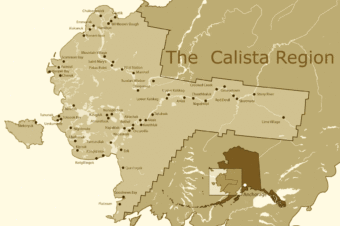
Calista is the regional Native corporation for much of Western Alaska. (Image courtesy of Calista Corp.)

Calista Corp. has reaffirmed its Alaska Federation of Natives membership in response to a caller on a Feb. 28 KYUK talk show, who claimed that Calista had pulled out of the organization.
In a statement, Calista said “a Calista Board Director attends and participates in AFN board meetings. Additionally, Calista staff are actively supporting and participating in efforts with AFN staff, including Census outreach.”

Anchorage-based Calista is made up of Yup’ik and Athabascan shareholders from the Yukon-Kuskokwim Delta.

Rumors have swirled about another corporation leaving AFN: Doyon Ltd., the regional corporation for Interior Alaska.

A video circulating on social media showed Doyon CEO Aaron Schutt saying that the regional Native corporation is having discussions about its AFN membership. As of last week, Doyon and AFN say that Doyon is a current member.

In December, Arctic Slope Regional Corp. departed AFN following a hotly-contested decision to pass a climate change resolution at the October convention last year. The Utqiaġvik-based corporation serves Iñupiat shareholders living primarily in the North Slope region. ASRC was the biggest opponent to the climate resolution, saying that it would hamper the corporation’s ability to pursue oil and gas resources.

The corporation said that the decision to pull out took about a year and a half to make and was not exclusively based on the resolution passing.

Alaska’s Energy Desk reporter Nat Herz contributed to this story.


‘This is their shot’: BLM urges community for input on mercury mine cleanup plans

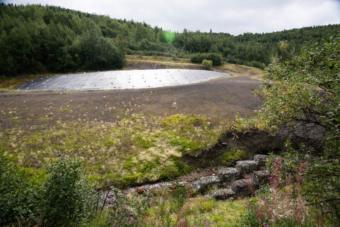
A liner covers the mine tailings left over from the Red Devil mercury mine near the village of Red Devil. (Photo by Katie Basile/KYUK)

The Red Devil mercury mine used to be the largest in the state. But once it was no longer profitable, the owners walked away, leaving behind a toxic mess for someone else to clean up.

There’s a sign at the entrance of what used to be the mine: “Red Devil Mine, U.S. Department of Interior, Bureau of Land Management. DANGER. Material at mine site may present human health risks.”

After the mine shut down in 1971, it was discovered that the mine tailings were leaching into Red Devil Creek, a tributary of the Kuskokwim River, as well as the surrounding groundwater. Those tailings are made up of mercury, which can cause neurological damage, especially to unborn babies. The tailings also contain arsenic and antimony, which can cause cancer.

The federal Bureau of Land Management took on the responsibility of cleaning up the mine in 1987, more than a decade after the owners walked away. Now, almost 40 years later, BLM has finally proposed a plan to remediate the site.

There are four alternatives in the plan, but BLM has a preferred option: first they will dig up contaminated soil by the mine site, less than a mile down the Kuskokwim River. Then they will cover the tailings about 300 feet above Red Devil Creek with layers of dirt and fabric that will keep the tailings from leaking out. One of these layers is called a geo-membrane.

“That’s essentially no permeability, but we call it low permeability,” said Mike McCrum, the project manager. “It’s very effective preventing rainfall and snowmelt getting into the main contents of the repository.”

The bottom will not be lined, but McCrum says that BLM is assuring that the proposed design would help prevent the tailings from leaking into Red Devil creek and the groundwater.

“This is a standard design. EPA [The Environmental Protection Agency] has designed repositories like this for all over the Pacific Northwest, and really all over the country,” McCrum said.

But the design is not final. That’s where community input comes in.

“This is the first time that these communities have a chance to go on record on their thoughts and their ideas for this proposed cleanup plan,” McCrum said.

BLM has held information meetings for years in surrounding communities, but this is the first official public comment period on the clean-up.

“If there is one message that we would like to get out at this point, it’s ‘this is their shot’,” McCrum said.

Rebecca Wilmarth grew up playing on the abandoned mine. She plans to attend the public hearing in the village of Red Devil next month.

“I think there are a lot of people who are going to question their plan, but like I said, I’ll wait to see what they have to say,” Wilmarth said.

The public comment period opens up March 1 and ends on April 30. McCrum says that they hope for a final record of decision in 2021 at the earliest.

A record set in ice: The Kuskokwim River’s 355-mile ice road is its longest ever

The ice road on the frozen Kuskokwim River has been plowed to its longest length ever: 355 miles.

That’s longer than most traditional highways in the state, but it’s likely a bit rougher in places — since the road is a frozen river. Still, it allows for snowmachine and vehicle traffic in a region that otherwise relies on unpredictable airplane travel in the winter.
There’s a famous saying: It takes a village to raise a child. And in the Yukon-Kuskokwim Delta, it takes several villages to plow a road on a frozen river.

Tim Zaukar maintains the roads for the village of Crooked Creek. Zaukar was part of a crew that plowed a road on the frozen Kuskokwim River to Sleetmute, 70 miles away.

“That was Mark’s idea to get all the way up to Sleetmute, to see if it could be done, and to show it could be done. And it’s a good thing to have a good marked trail for people to travel on,” Zaukar said.

Zaukar is talking about Mark Leary, who works for the village of Napaimute. This winter, Leary and Zaukar helped lead efforts to plow the Yukon-Kuskokwim Delta’s longest-ever ice road.

The plow truck steadily moves toward Sleetmute. (Image courtesy of Mark Leary)

Leary has been on the road — or the frozen river — since Feb. 7. He and four others left Bethel to plow the road up to Sleetmute. They picked up at least two extra men along the way to help out.

Taking care of the ice road typically begins in January. Crews cleared the river and marked the road so that travelers could make it to villages near Bethel. The average length of the ice road, according to Leary, has been about 200 miles.

The farthest Leary has ever plowed has been to Crooked Creek. But this time, Leary wanted to go 42 miles further: all the way to Sleetmute.

“Our role was just to prove that it could be done. People were skeptical,” Leary said.

Cold temperatures have lingered this winter, with the average temperature in January -5 degrees Fahrenheit, according to Rick Thoman, a climatologist for the Alaska Center for Climate Assessment and Policy. That has kept the river frozen and made it safer for heavier vehicles to travel.

Leary asked Donlin Gold, a mining company, for money to extend the ice road. Donlin Gold wants to build one of the world’s largest gold mines in the region. The company contributed $20,000 as part of their community outreach.

The Crooked Creek crew helped plow the 42 miles to Sleetmute. (Image courtesy of Mark Leary)

Many villages in the middle Kuskokwim area don’t have health clinics or a permanent health aide, so residents rely on planes to travel for health care needs in the winter.

Zaukar said that it’s important that residents now have other means of travel.

“It was hard to travel with the normal means of travel, with snowmachines and four-wheelers and stuff, because of all that rough ice down there and snow we’ve been having,” Zaukar said.

The rough ice was particularly bad between Chuathbaluk and Napaimute, communities south of Crooked Creek. That prevented people from traveling to Aniak, the hub of the middle Kuskokwim River area, for food supplies and health care needs.

It was so rough that Leary’s crew had to bulldoze it before they could plow. It took them nearly two days to clear 14 miles.

Once they hit Crooked Creek, where Zaukar was waiting for them, Leary said that it got a little easier.

“That’s their country. They know it,” Leary said.

Leary and Zaukar said that the ice got thinner the closer they got to Sleetmute, because of the late freeze-up and lots of snow insulating the ice. Close to Bethel, the ice measures 3 to 4 feet. Closer to Sleetmute, it only measured 2 feet. Zaukar and his crew helped navigate the thinner ice, and by Feb. 15 they made it to Sleetmute.

The community of Sleetmute welcomed the plowing crew with a potluck. (Image courtesy of Mark Leary)

Rebecca Wilmarth lives in Red Devil, which is about 10 miles south of Sleetmute and one of the villages that now, for the first time, has an ice road.

“It was a historical moment to extend the ice road all the way up to Sleetmute,” Wilmarth said.

The community of Sleetmute held a potluck for the two crews to thank them for their efforts.

But while the ice road is plowed, Wilmarth and Zaukar say that maintaining it is another challenge. Red Devil doesn’t have a tribal council or city government with funds to help them out.

“I’m kind of in the same boat as Tim. Not really sure what the next move is and who the responsibility will lie with at this point,” Wilmarth said.

Zaukar said that the road means more traffic, which means more potential for stranded drivers. That could be a burden to search-and-rescue groups.

But for now, residents are grateful to have a road, so that they can get to the next village or a health clinic without having to rely solely on flying.

The video included in this story is courtesy of Rebecca Wilmarth and Corey Nicholai and is used with their permission.


Bethel taxis stop taking Medicaid vouchers for medical trips

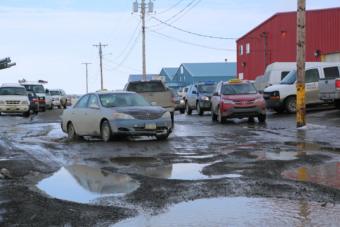
Cabs line up at the Bethel Airport’s Ravn terminal to take passengers to their destinations. (Photo by Amara Freeman/KYUK)

Cab companies in Bethel have decided to stop accepting Medicaid vouchers for payment. Taxis are a main form of transportation to and from medical appointments for people who travel to Bethel for health care.

The Yukon-Kuskokwim Health Corp. got a call this month from Kusko Cab owner Naim Shabani, who said that the Medicaid vouchers were too expensive. Shabani said that Medicaid’s growing list of regulations was the main reason they decided to stop accepting those vouchers.

“There’s a roughly 100-page handbook on being a Medicaid transportation provider. There’s a lot of regulations, so there’s not a specific regulation, but just over the years that they had to implement more and more and again,” Shabani said.

Shabani said that the cab company was losing money on the cab vouchers because of the amount of work it took to make sure the company followed regulations.

Kusko Cab is one of three taxi companies in Bethel, and Shabani said that the other cab companies are following Kusko’s lead. A call to a different taxi company, Alaska Cab, was not returned in time for publication.

YKHC spokesperson Mitchell Forbes confirmed that all of Bethel’s cab companies have decided not to accept Medicaid vouchers. He said that Medicaid patients will still see their full benefits.

“Just in Bethel’s case, there was the one vendor who is accepting the transportation vouchers. They are no longer accepting that voucher,” Forbes said.

YKHC is now offering more shuttle services to Medicaid patients instead of vouchers that would cover the cost of a cab.

Forbes said that YKHC has added shuttle service to hotels where Medicaid patients stay, in addition to adding more hours to its airport shuttle service for all YKHC patients.


Site notifications
Update notification options
Subscribe to notifications