Search & Rescue

Medevac crew rescued after plane crashes near Unalaska

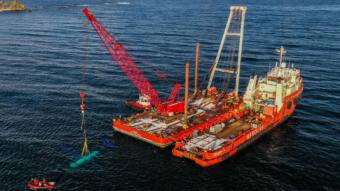
A small launch from the Resolve Magone Marine salvage vessel Makushin Bay returns to the ship after placing a marking buoy at the fuel sheen from the submerged wreckage of a LifeMed Alaska King Air plane which crashed during takeoff around 8 a.m. on Jan. 16. (Photo by KUCB)

A LifeMed medevac flight crashed into the water Thursday morning near Unalaska shortly after taking off from the island’s airport. No one was seriously hurt.

The air ambulance was headed to Adak to medevac a patient. It went into the water about 100 feet northwest of the end of the airport runway.

Unalaska Acting City Manager Marjie Veeder said city rescuers responded after a 911 call came in at 8:04 a.m.

“Our dispatchers immediately dispatched the ports vessel Tidebreaker to the scene, and the three persons on board the plane … had self-evacuated to a life raft. They were transferred to the Tidebreaker at 8:24 a.m.,” Veeder said.

LifeMed CEO Russ Edwards said he’s grateful the crew escaped serious injury. He said the cause of the mishap wasn’t immediately clear.

“Factors we’ve checked into as far as weather conditions were VFR weather conditions, a little wind, some gusts,” Edwards said. “But nothing unusual for Dutch Harbor this time of year.”

Edwards said a different air carrier was able to pick up the Adak patient.

State environmental regulators responded to a potential spill of hundreds of gallons of fuel. The Alaska Department of Environmental Conservation said the plane spilled jet fuel into Unalaska Bay, which is home to several federally-listed endangered species, including Steller sea lions, Northern sea otters and Steller’s eiders.

DEC said divers were unable to reach the submerged plane on Thursday.

The National Transportation Safety Board is investigating the crash.

Thursday’s crash was the third air ambulance crash in Alaska in less than a year. Nearly a year ago, a Guardian Flight plane crashed in Southeast Alaska, killing the three-person crew. And in November, a Security Aviation ambulance crashed while en route to Seward. Three people were killed in that crash as well.

Coast Guard suspends search for 5 missing fishermen west of Kodiak

Coast Guard helicopter
An aircrew aboard an MH-60 Jayhawk helicopter makes an approach on their return to Coast Guard Air Station Kodiak, June 5, 2019. (Public domain photo by Petty Officer 1st Class Bradley Pigage/U.S. Coast Guard)

Update (Thursday, 4:43 p.m.) — Hope McKenney, KUCB-Unalaska

The U.S. Coast Guard has released the names of the crew members of the FV Scandies Rose.

The five missing are Gary Cobban Jr. (Master), David Lee Cobban, Arthur Ganacias, Brock Rainey and Seth Rousseau-Gano. The two survivors are Dean Gribble Jr. and John Lawler. They were treated for hypothermia at a hospital in Kodiak, but sustained no other serious injuries. (Read more.)

Original story

The U.S. Coast Guard suspended its search on Wednesday evening for five people feared lost after their 130-foot fishing boat sank on New Year’s Eve near Sutwik Island, off the Alaska Peninsula.

The Coast Guard rescued two people and have suspended the search for the rest of the FV Scandies Rose’s seven-person crew.

According to the Coast Guard, the search spanned over 20 hours, 1,400 square miles, and included four MH-60 Jayhawk helicopter crews, two HC-130 Hercules airplane crews, and the Coast Guard Cutter Mellon.

Rear Adm. Matthew Bell, 17th District Commander, said Wednesday evening that after exhausting all leads and careful consideration of survival probability, the Coast Guard decided to suspend its active search pending new information or developments.

“The decision to suspend an active search-and-rescue case is never easy, and it’s only made after careful consideration of a myriad of factors,” said Bell. “Our deepest condolences to the friends and families impacted by this tragedy.”

Rescuers on scene said the elements were against them: 40 mph winds, well-below-freezing temperatures, and high seas as they searched for the boat and crew.

Petty Officer Evan Grills is the rescue swimmer who rescued two crew members from a life raft.

“When we were down there, it was pretty wild,” said Grills. “It was 20-30 foot seas, and tremendously cold, so the dexterity in my hands was starting to go. And just trying to battle keeping situational awareness between the helicopter, table management, keeping the survivor’s face out of the water, and making sure we both didn’t get tumbled in waves … it was definitely challenging.”

Coast Guard spokesperson Melissa McKenzie said the pair that was rescued at about 2 a.m. New Year’s Day were wearing Gumby survival suits.

“When our helicopter crew arrived on scene, they found two life rafts in the search area,” said McKenzie. “One had two survivors (in it) and the other one was empty.”

The 34-year-old and 36-year-old survivors reportedly had spent four hours in the life raft. They were hypothermic and admitted into a Kodiak hospital but had no other injuries.

Lt. Jon Ardan, co-pilot on the MH-60 Jayhawk helicopter, said the life raft was within 10 miles of the Scandies Rose’s last known position. No wreckage or debris had been found as of Wednesday evening.

“We landed back in Kodiak with not a lot of fuel, so we didn’t have very much time to search for additional survivors, or even to search for the (two we rescued),” said Ardan. “So it was truly a miracle that we found them so expeditiously, that we were able to pick them up without incident, and that we started making our way back home with a good tailwind to push us.”

The Coast Guard has not determined the cause of the incident off the Alaska Peninsula, about 170 miles west of Kodiak Island.

The Scandies Rose is homeported in Dutch Harbor. Its website describes the 41-year-old ship as a steel-hulled crabbing vessel that works in a number of fisheries, including as a summer salmon tender in Southeast Alaska and Bristol Bay.

Worsening ice jam in Willow Creek leaves floodwater nowhere to go

Flooding from Willow Creek in the Matanuska-Susitna Borough continues to make problems for local residents and emergency responders.

Since the weekend, an ice jam in the creek has caused unusual winter flooding, damaging nearby homes and property and rendering the Deneki Road impassable. The closure leaves residents almost totally cut off.

As local officials try to find a solution, they are contending with cold, snowy weather and rapidly changing conditions. On Thursday, Dec. 26, responders discovered they can no longer access the staging areas they used before.

“The ice jam around the vehicles that were stuck has expanded, to where it’s limiting our access in and out right now. So we’re having trouble getting in there,” said Ken Barkley, who directs emergency services for the borough.

Dramatic video footage released by the borough earlier in the week shows roads flooded with thigh-high, ice-choked water as responders evacuated sled dogs on inflatable rafts.

Many residents opted to stay in their homes rather than evacuate, but temporarily left the area with emergency officials to stock up on food, fuel and supplies. Unsuccessful attempts to cross the flooded area have lead to rescues and abandoned vehicles, according to a statement from the borough.

Borough managers said that an unknown individual tried to clear the road on his or her own on Dec. 26. That made the situation worse.

“It created more problems because it put berms on each sides of the road, which is now holding the water in,” Barkley said. “So now the water level is much deeper than what it was.”

Officials are asking the public not to perform any work on the Deneki Road.

According to Barkley, there are approximately 31 homes in the affected area, some of which are seasonal. The Borough believes there are 16 occupied houses in the affected area.

Matanuska-Susitna Borough Mayor Vern Halter issued a local disaster declaration and is asking the state for help. Local, state and federal groups, including the National Guard and private engineering contractors met on Dec. 26 to develop short and long-term plans for the flooding.

‘I just kept digging’: How an Anchorage man rescued a hiker buried in Flattop avalanche

Debris from an avalanche Saturday on Flattop Mountain that buried a hiker. (Photo courtesy of Chugach National Forest Avalanche Information Center)

A hiker buried by an avalanche on Anchorage’s popular Flattop Mountain survived after another man happened to see his legs sticking out of the snow and rescued him.

According to a report by the Chugach National Forest Avalanche Information Center, the hiker was alone Saturday when he was caught in an avalanche near the Blueberry Loop trail and fully buried before he was able to kick his legs free. The hiker, who has not been publicly identified, is believed to have been buried for as long as an hour and able to breathe because the large pieces of avalanche debris left space for an air pocket.

The rescuer, Anchorage software developer and avid hiker Alex Kuprienko, said he was looking up at the avalanche debris when he saw the man’s legs.

“That’s why it’s a miracle, first of all, that he survived there for so long and didn’t give up, and that it was just me looking in the right spot at exactly the right time,” Kuprienko said.

Kuprienko said it didn’t register at first what had happened but he could tell something wasn’t right. He rushed to the legs and started digging toward the man’s head.

“So the snow was really kind of set up, icy snow, and all I had was my fingers basically. I was kind of clawing at it the snow, trying to break it,” Kuprienko said. “And I kind of had this thought that I should get my gloves out, but then I thought, ‘That guy down there, he feels much worse than I do at this point,’ and I just kept digging.”

When he reached the rest of him, Kuprienko said the man’s skin was so cold that snow had stopped melting on it. He seemed lethargic, and Kuprienko hugged him and shielded him from the gusting wind. He called 911, and when the man said he could walk, Kuprienko helped him down the mountain, trying to keep him moving to generate body heat.

For a time, Kuprienko thought the man’s estimate that he’d been buried for as long as an hour wasn’t true and had to be an exaggeration. But based on what time he had started hiking, how far he’d gone and another hiker’s report of seeing fresh avalanche debris convinced Kuprienko that the man had, in fact, been buried that long.

Kuprienko even drove the man home after paramedics checked him and a ranger had given him some hot cocoa. And, if that wasn’t enough, Kuprienko said he also drove a separate man to the hospital from Flattop who’d been stricken with severe abdominal pain.

That night, Kuprienko said, he called his father ⁠— a longtime lifeguard and skier ⁠— in Russia to tell him what happened. Kuprienko said his father told him, “Now you’re a man, you saved somebody’s life.”

Asked how he felt about having saved the man’s life, Kuprienko said he was simply in the right place at the right time.

“I’d like to think that anyone in my place would do the same exact thing. Maybe not without freaking out, but they would figure out that they need to dig the guy out,” Kuprienko said. “I’ve been thinking about it, and I’m not sure what to think. I was just super glad he was alive when I found him.”

Kuprienko said he hopes news of the rescue will encourage people to seek avalanche safety training and to always be vigilant while traveling in avalanche terrain.

Boat adrift in Gastineau Channel prompts a little mystery

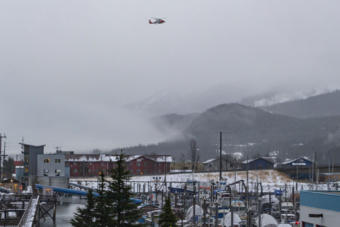
A Coast Guard Jayhawk helicopter flies over Gastineau Channel in Juneau as authorities investigate a pleasurecraft that had been reported unmanned and adrift with its motor running on Friday, Nov. 29, 2019. The Coast Guard later reached the vessel's owner and someone entrusted to move it and called off the search.
A Coast Guard Jayhawk helicopter flies over Gastineau Channel in Juneau as authorities investigate a pleasurecraft that had been reported uncrewed and adrift with its motor running on Friday. The Coast Guard later reached the vessel’s owner and someone entrusted to move it and called off the search. (Photo courtesy of Brian Wallace)

The Coast Guard spent most of Friday’s daylight hours in Juneau looking for a possible missing person.

Petty Officer 3rd Class Amanda Norcross is a spokesperson for the Coast Guard District 17 office in Juneau. She said the search was prompted by a referral from local 911 dispatchers around 10:30 a.m. about a pleasurecraft adrift in Gastineau Channel — with no one on board and its engine running, but not in gear.

No one had been reported missing, but, just in case, the Coast Guard initiated a search, which included a Jayhawk helicopter flying up and down the channel.

By sunset around 3:15 p.m., the Coast Guard reached the boat’s owner and someone who’d been entrusted to move it, both of whom were safe and sound.

“In addition to the fact that there’s been no sightings or other reports of people in the water, the search was suspended,” Norcross said.

Norcross said the Coast Guard wasn’t able to come up with an explanation for how or why the motor was running. She suggested it may be a matter for the Juneau Police Department to investigate.

Police Sgt. Ben Beck said the department helped the Coast Guard in this matter, but said further investigation is unlikely.

Alaska mariners raise concerns about Coast Guard’s emergency radio outages

Coast Guard Station Ketchikan and Coast Guard Cutter Adelie boat crews assisted in dewatering and towing a fishing vessel that began taking on water near Ketchikan, Aug. 28, 2019. (Courtesy photo from U.S. Coast Guard)

Mariners in distress are without a decades-old means of contacting the Coast Guard in much of coastal Alaska.

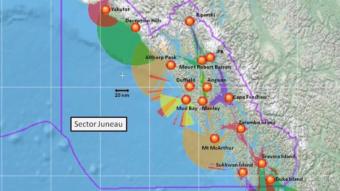
The federal search-and-rescue agency said its VHF signal is experiencing outages, making communication on channel 16 unreliable. The issue has been ongoing since this summer.

As Sitka fishers go, Matt Donohoe is somewhat of a veteran. This summer he was trolling for salmon when he heard a distress call over his VHF radio.

“A boat called mayday, but it was on channel 16, and I expected the Coast Guard to respond and they didn’t,” he said.

It turns out it wasn’t too serious — the skipper had broken down and was drifting. Donohoe continued to try and reach the Coast Guard over his radio as well, with little luck. He was relieved that nobody’s lives were at risk that day.

“But there’s a problem with the infrastructure, and it needs to be addressed before somebody dies,” he said.

His story isn’t unique. In fact, fishers across Southeast Alaska have been reporting similar problems. The Coast Guard first publicly acknowledged the problem last month, but it has been broadcasting automated notices this summer to mariners — guys like Joe Donohue, who trolls around Sitka.

“I wrote down where the outages were, and it was from Yakutat all the way down to Cape Edgecumbe,” Donohue said. “I had a bunch of friends that were just finishing up with seining, were getting ready to go longlining, and I thought, ‘Boy I hope they get that fixed.’”

It hasn’t been fixed. At least eight Coast Guard towers are down in Alaska. The outages are affecting Prince William Sound all the way down to Sitka and other Southeast communities.

Some of these repeaters have been completely down since June.

Coast Guard Lt. Scott McCann said repairing these remote towers isn’t a simple task.

“In most cases these towers are only accessible by helicopter. And in that case, the helicopter can only fly when the weather is conducive to flying up to the top of the mountain and dropping off personnel and parts,” he said.

But this is the Coast Guard, isn’t flying helicopters in remote stormy conditions what they do?

“True, the Coast Guard has a reputation for flying in nasty weather, but these tower maintenance contracts are with other agencies. So they have different flight standards, and you want them to be safe when they go out there,” McCann said.

That contractor is Lynxnet, LLC, a Virginia-based subsidiary of NANA Regional Corp., the regional Native corporation based in Kotzebue. Neither the company nor the Native corporation responded to requests for comment.

But if inclement weather held up the contractor in the summer, the dark and frigid winter certainly won’t help.

In the meantime, the Coast Guard has been advising mariners to carry backup communication devices, like satellite phones and high frequency radios.

Those are much more expensive. The industry wants assurances if they need the Coast Guard they can use the radio that’s found on every deck of every boat in the fleet — not to mention anglers and hunters with only handheld equipment.

“VHF radios have been for decades the primary go-to source to get a hold of the Coast Guard,” said Jerry Dzugan, the director of the Alaska Marine Education Safety Association in Sitka. “That’s what we’ve taught everyone in our classes for decades, so what they’re saying is ‘Well you’re going to have these other things instead,’ and that’s unacceptable.”

The Coast Guard also recommends mariners have working emergency position indicating radio beacons, or EPIRBs. But Dzugan said that’s a last resort option.

“Fishermen don’t want to hit the panic button if you don’t really have to. Which means that it’s going to delay a problem,” he said.

An EPIRB sends a continuous radio signal to search-and-rescue units in order to provide the exact location of the vessel in distress. But VHF radios allow mariners to check in with the Coast Guard before a situation gets to that point.

“The Coast Guard’s always saying ‘if you have a problem let us know, even if it’s not an emergency yet, so we can keep an eye on you’,” Dzugan said.

McCann urges mariners to be patient. He said they’ll be fixed — eventually.

“These towers are here to stay. VHF is here to stay,” he said.

Fishers and industry groups have been in contact with U.S. Sen. Lisa Murkowski’s office to try and speed up the process. Murkowski’s office released a short statement saying it’s aware of the issues.

With additional reporting from KCAW’s Katherine Rose in Sitka.

Site notifications
Update notification options
Subscribe to notifications