Search & Rescue

Rescuers found lost Nunam Iqua children in a hole in the snow, huddled around the youngest child

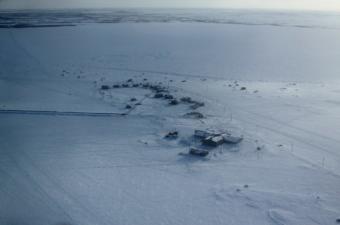
The community of Nunam Iqua, photographed in 2009. (Photo courtesy of Department of Commerce, Community and Economic Development; Division of Community and Regional Affairs’ Community Photo Library)

Bryan Simon and his team of search and rescue volunteers left Scammon Bay around 10:30 Monday morning. Snowmachining along the Black River, Simon scanned the white landscape for any minute detail, like he’s been trained to do. A hundred yards away, on the highest snowdrift, he saw something he said was suspicious.

“It didn’t look like anything. And then as I got kinda closer, I seen movement,” Simon said. “I couldn’t believe my eyes.”

Simon was 18 miles south of Nunam Iqua, a small village near mouth of the Yukon River along the Bering Sea in western Alaska. He was looking for four children — Christopher Johnson, 14, Frank Johnson, 8, Ethan Camille, 7, and Trey Camille, 2 — who’d left on a snowmachine Sunday afternoon. They’d been heading for the dump near the community, but a blinding snowstorm had come in, and the children disappeared. It had been more than 24 hours since they were last seen.

Simon and others from neighboring villages had been searching a vast, uninhabited stretch of lakes and tundra. The temperatures since the children vanished had been just below freezing, with gusting wind and snow, according to weather.com. With windchill, it was just above 0 degrees.

Simon signaled the rest of his four-man team. They approached. There was something alive in the snow.

“Right away, I look for that little infant. When I got kinda close to them I thought I only seen one kid,” Simon said.

That’s because Simon saw just one mass, all four children bundled together. They had dug a hole in the snow, about a foot deep and three feet in diameter.

“The infant was in there,” Simon said. “And the boy laid over the infant, and on his left side, a little older boy covering the draft. And the seven-year-old was laying right above them like he was blocking the wind.”

“They were protecting the baby,” said Herschel Sundown, Simon’s teammate.

Sundown, a former health aide, approached the scene and started assessing the children. The oldest had on a pair of sweatpants that had become soaked. One of the other boys was missing gloves.

“I won’t get in exact detail, out of respect for the boys, ’cause from what I hear, they’re still in some critical condition, I’ll just say it didn’t look good,” Sundown said.

The rescue team immediately got to work, slowly warming up the boys’ bodies. They removed the boys’ wet clothes and wrapped them in parkas the search members had been wearing.

“One of the guys put a canvas tarp over us and we huddled with all of them to try to give out some heat to them,” Sundown said.

Then he started peppering the boys with questions.

“What they can and cannot feel,” Sundown said. “If they’re able to feel us touching them.”

He did not say what the boys’ responses were.

The search team’s leader radioed the Coast Guard.

“And I wanna say 15 minutes or less, we were able to hear a helicopter coming,” Sundown said.

The boys already defied the odds. For one, Sundown says their rescue was lucky. They were in an area other searchers had passed through multiple times without seeing the children.

“And it’s just the angle that we came in that we were able to spot them,” Sundown said. “We didn’t think we would find them, but we did.”

Plus, they survived over 24 hours outside, through the night, forming a human shelter for their 2-year-old brother to stay warm.

“In all honesty, I don’t know how they survived,” Sundown said. “The will to survive in these boys is amazing. I have never seen anything like that.”

In addition to Scammon Bay, local groups from Nunam Iqua, Alakanuk, Emmonak, and Kotlik also participated in the search. Hooper Bay and Chevak were available on standby while the U.S. Coast Guard and National Guard provided assistance from the air. Alaska State Troopers coordinated the state-wide effort that brought the four missing boys from Nunam Iqua in from the cold.

According to the boys’ mother, Karen Camille, the boys are expected to make a full recovery. She spoke with her sons Wednesday morning by phone.

“I just asked how they’re doing and they said they’re good and they just want me to go to them,” she said.

The boys range from 2 to 14 years old.

Alaska State Troopers reported that all four children were initially transported to the Yukon Kuskokwim Health Corporation in Bethel. Troopers report one brother is still there, and another was flown to the Alaska Native Medical Center (ANMC) in Anchorage.

ANMC spokesperson Shirley Young confirmed that 7-year-old Ethan Camille is currently hospitalized in their facility, and that his condition is “serious but stable.”

Troopers report the other two brothers were released from the Yukon Kuskokwim Health Corporation in Bethel.

The boys’ mother added that her 14-year-old son, Christopher Johnson, was in bad condition after shielding his younger siblings from the wind.

Alaska Public Media editor Julia O’Malley in Anchorage contributed reporting to this story.

This story has been updated.

Children who went missing in a storm in Nunam Iqua found alive but severely hypothermic

Nunam Iqua area map (Google maps)

The four children who went missing Sunday in Nunam Iqua have been found, but are fighting severe hypothermia, according to an Alaska State Trooper.

The siblings — Christopher Johnson, 14, Frank Johnson, 8, Ethan Camille, 7, and Trey Camille, 2 — took a snowmachine ride to Nunam Iqua’s dump on Sunday around 1:00 p.m. A winter storm blew in reducing visibility, and they never came back. The search began later that afternoon and continued into Monday. They were found approximately 18 miles south of Nunam Iqua at around 4:25 p.m. on Monday, Feb. 3, by ground searchers.

The search team from Scammon Bay found the four missing children on top of a snowbank. The searchers said the children had no shelter. They were exposed. One of the children didn’t have gloves.

According to the searchers, they had dug a hole in the snow and placed the two-year old in the middle. The older brothers huddled around to block the wind. When the searchers arrived, all four children were able to verbally respond to their questions. The searchers said they looked bad, and would not comment further on the children’s physical condition. All four kids are being treated for severe hypothermia at the Yukon Kuskokwim Health Corporation in Bethel.

A U.S. Coast Guard helicopter responded and transported the children to Bethel. Search teams from Emmonak, Kotlik, Alakanuk, Nunam Iqua, and other villages also participated, along with the National Guard.

Alaska State Troopers led the search effort. Communications Director Megan Peters says 15 teams from neighboring villages looked for the missing children on the ground today.

Peters said the U.S. Coast Guard was the only group who took the search to the sky. That included an HC-130 airplane crew from Kodiak and a MH-60 helicopter from Cold Bay, according to Coast Guard Public Affairs Officer Melissa McKenzie.

This story has been updated.

Coast Guard notes VHF emergency radio dead zones in coastal Alaska

A map showing VHF signal coverage areas in Southeast Alaska.
(Graphic courtesy of U.S. Coast Guard)

The U.S. Coast Guard has released a list of communications towers in Alaska that may not be receiving VHF radio broadcasts and is warning mariners to bring back up communications systems.

Seven of the problem towers are in Southeast Alaska, including Duke Island, Sukkwan Island, Zarembo Island, Cape Fanshaw, Duffield, Althorp Peak and Deception Hills. The areas near those towers are dead zones where the Coast Guard won’t be able to hear distress calls on emergency channel 16.

Other sites in Alaska are Pigot Point, Bede Mountain, Raspberry Island and Cape Gull.

A map showing VHF signal coverage areas in Southcentral Alaska.
(Graphic courtesy of U.S. Coast Guard)

The Coast Guard has hired a contractor to do repair work.

“Specifically to Southeast, there’s some towers that we’re looking into and making repairs on parts of the towers to get them up and running, back to full running status,” said Matthew Schofield, assistant public affairs officer for the Coast Guard’s District 17 in Alaska.

One of the issues is getting power generators back up and running at the communication towers. Schofield said the fix is happening as soon as possible.

“I don’t necessarily have a timeline. I don’t want to assign something that isn’t 100% here for that, but at this point some of the sites are able to receive. They’re able to receive some of the signals and some of the calls, but they may not be able to transmit, so we’re also working that,” he said.

The Coast Guard this month warned that, even with a fully functioning system, it cannot hear all VHF calls in Alaska’s mountainous terrain. VHF radio is the cheapest means for emergency calls by mariners in distress. But the Coast Guard is recommending other communications systems as a backup, like satellite phones or texting devices, emergency beacons or even cellphones where there’s service.

“Any means that people can take when they’re out on the water to contact the Coast Guard is obviously recommended,” Schofield said. “But we’ll get to the calls the best we can, and we do want to ensure safe passage throughout the water and throughout the fishing season.”

Commercial fisheries are ongoing in Southeast through the winter. This winter has already brought hazardous conditions, with freezing spray warnings, strong winds and a deep freeze.

Coast Guard tracks emergency beacon to partially submerged boat in Harris Harbor

A Coast Guard helicopter hovers over Harris Harbor on Thursday, Jan. 23, 2020, in Juneau, Alaska. (Photo by Mikko Wilson/KTOO)
A Coast Guard helicopter hovers over Harris Harbor on Thursday in Juneau. (Photo by Mikko Wilson/KTOO)

A Coast Guard helicopter circled over downtown Juneau on Thursday searching for an emergency beacon.

The beacon, also known as an EPIRB, or Emergency Position Indicating Radio Beacon, was unregistered meaning the Coast Guard had no way to determine who it belonged to.

A beacon is usually activated when a fishing boat sinks or a plane crashes, allowing rescuers to hone in on the last known location.

The helicopter eventually tracked the signal to a partially submerged boat in Harris Harbor.

Lt. j.g. Micheal Civay of Coast Guard Sector Juneau said they frequently chase down EPIRBs that are activated when boats are overloaded with snow or rain in the harbor. But, they also are tripped by planes landing hard at the airport or even people making dump runs.

“People will think an EPIRB is inert,” Civay said. So they’ll take it to the dump. Then, it will activate.

“It is pretty common,” Civay said. “We try (to) track these down. When owners register them, then it makes it a lot easy on us so we can contact them and follow up to make sure they’re safe.”

Two Coast Guard boats also participated in the search.

Medevac plane removed from Unalaska Bay following crash

The Resolve Marine small boat crew deployed a tag line over the tail of the aircraft to aid in a smooth and controlled transition of the plane onto the barge on Monday, Jan. 20. (Photo courtesy of Aleutian Aerial)

Divers, a tug vessel and a crane barge crew from Resolve Marine were able to remove a LifeMed medevac plane from Unalaska Bay on Monday. It had been in the water since it crashed near the airport last week.

The three-person air ambulance crew was en route to pick up a medevac patient in Adak when the Beechcraft King Air aircraft went into the water about 100 feet northwest of the end of the Unalaska Airport runway on Jan. 16.

The pilot, paramedic and nurse were all rescued from a life raft and sustained no serious injuries. There were no patients on board.

Resolve Marine was contracted by Aero Air — the aircraft owner — to recover the plane.

Resolve Alaska General Manager Edgar A.W. McAfee said a nine-person crew secured and pre-rigged the plane on Saturday so it would be ready to lift out of the bay.

“We put our divers in the water from the Makushin Bay (salvage vessel) and we assessed the plane, where it was and its level of stability,” said McAfee. “After that, we were able to close up the fuel vents to prevent any spillage of fuel into the water. We wanted to isolate that and secure that first. And after that, we started to deploy rigging to the divers and pre-rigged the plane.”

The crane barge they used to lift the aircraft required shutting down the airport runway. Rather than disrupt a number of scheduled flights over the weekend, the salvage company worked with the airport and decided to wait on removal until Monday, according to McAfee.

It took the Resolve Pioneer and a crane barge, with an eight-person crew, four divers and a salvage master to remove the 16-foot plane from Unalaska Bay on Monday. (Photo courtesy of Aleutian Aerial)

The whole process took approximately 12 hours, from the time the crew left the facility, lifted the plane and transported it back to the dock. It took the Resolve Pioneer — a tug supply vessel — and a crane barge, with an eight-person crew, four divers and a salvage master to remove the approximately 16-foot plane.

“It’s remarkable how fast everybody reacted and got out,” said McAfee. “There were no injuries in the plane going down and no injuries in the operation, and that’s very important to us. And we were also able to minimize whatever hydrocarbon release was there. So all that’s good news, and it was a successful operation.”

The plane had been sitting in 50 feet of water and released an unknown amount of Jet A fuel into the bay, according to the Alaska Department of Environmental Conservation.

Officials determined there were approximately 440 gallons of fuel on board at the time of takeoff. They will be assessing how much was released now that the plane is on land.

The Alaska Department of Fish and Game determined no animals appeared to be affected by the fuel release, and McAfee said there was no visible sheen on the water as of Monday’s plane removal.

Unalaska Bay is home to several federally-listed endangered species, including Steller sea lions, Northern sea otters and Steller’s eiders.

Resolve Marine is set to lift the plane from the barge and transport the plane back to the airport today.

The National Transportation Safety Board is still investigating the cause of the crash.

Tyson Steele made national headlines after his cabin burned down, leaving him alone for weeks in subzero temps

Tyson Steele was rescued by Alaska State Troopers in January 2020, after surviving three weeks outside after his cabin, near Skwentna, burned down. His story made national news. (Photo courtesy of Alaska State Troopers)

Tyson Steele has made national headlines recently, after his remote home outside Skwentna burned in December, leaving him alone and without communication for three weeks in sub-zero temperatures. He’s now in the Lower 48, but he plans to return soon.

Tyson Steele said that in the overnight hours of a cold December night, he woke up and stoked his wood stove. Since the fire had died down, he used a piece of cardboard to start it back up, then went back to bed when the fire was going again. Unbeknownst to him at the time, an ember from the stove landed on the roof, which was mostly made of greenhouse plastic sheeting, and started a structure fire.

“The spark lands, and it ignites the plastic. I don’t know that yet, until plastic fire starts dripping through the roof,” he said.

Steele says he didn’t panic at that point. Assuming it was a creosote fire in the chimney, he put snow in the stove, hoping the steam would put it out. On his second trip, he noticed the problem was much worse than he initially thought.

“The whole roof above my room is on fire, and, at that point, I knew there was…less than a minute to react,” he said.

Realizing time was running short, Steele says he thought of the two things many Alaskans would: cold weather gear and his dog, Phil.

“I go to my bed. I throw a bunch of blankets and sleeping bags on the bed, roll it in a blank it, hoist it over my shoulder, and urge my dog off the bed,” he said.

Steele says his dog was huddling away from the flames, but eventually got off the bed. He lost sight of Phil while making his escape from the house as the roof began to collapse. He was able to make a return trip to retrieve a gun that was not yet in the flames. That’s when he made a terrible discovery: Phil was still inside. Steele says that’s when panic set in. He knew there was no way to get his only companion out of the burning house.

“The fire spread. I have to leave. I have no choice. I have my gun, but I have no bullets, because they’re on fire and exploding. It’s like a war zone,” he said.

The loss of his dog left Steele stunned, and he says he just sat in the snow for a little while. Soon, though, he realized he needed to get to work if he was going to save what was left of his food. After hours of shoveling snow onto the remains of his home, however, the fire refused to go out.

“It just seemed hopeless in a lot of ways, because it just kept igniting. I’d cover the entire thing with snow…and it felt like the fire was out, and it would reignite,” he said.

Eventually, the fire did go out, and Steele was able to salvage some of the canned goods that were part of his two-year supply of food. With some quick rationing math, he figured he could eat for thirty-five days. Steele had been calling his family in Utah about once a week, but his phone, along with an inReach device and a VHF radio, had burned. He estimated that his family would start making phone calls if they didn’t hear from him by New Year’s Day.

With food to last well past then, he worked to address a bigger problem: Temperatures at the time were dropping past thirty degrees below zero, and Steele had lost his shelter. For the first couple of nights, he slept in a snow cave. Over the course of six days, with only gardening gloves to wear, he set to work using materials on his property that survived the fire to build a makeshift shelter one nail at a time.

With the shelter up, Steele says the best way to keep warm and thaw out his cans of food was the very same wood stove where the fire that took his house and his dog began.

“It’s actually a pretty strange love-hate relationship with the stove, because it started my house on fire….But I had to keep this thing that did this horrible thing to me, I had to keep it going,” he said.

Life continued that way through the first week of January. While Steele was expecting someone to eventually come for him, he assumed it would be his usual pilot in a fixed-wing aircraft. He says he was a little surprised, and a bit anxious, when he heard a helicopter approaching.

“When I heard it was a chopper, I realized this is a bigger deal….I was just happy to see a friendly face,” he said.

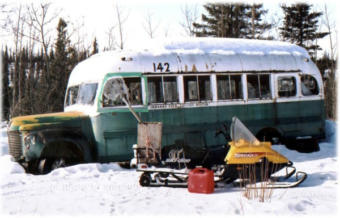
The story of Steele’s surviving in the harsh climate of an Alaska winter alone in the wilderness has spread throughout the country. He says it has resulted in comparisons to Christopher McCandless, whose story was made famous by the book and film “Into the Wild.” Steele says he doesn’t like that comparison because, unlike McCandless, he was supplied and prepared and, as a result, survived.

For now, Steele is with his family in Utah. He managed to avoid frostbite and serious injury, and says his time in Alaska is not over. He plans to return and rebuild.

Read Steele’s full account.

Site notifications
Update notification options
Subscribe to notifications