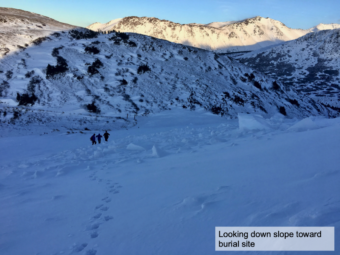
The dispatch says 26-year-old Andrew Tse of New York was rescued Friday thanks to the coordinated efforts of Juneau Mountain Rescue, Sitka Mountain Rescue, Capital City Fire/Rescue and state troopers. The dispatch made no mention of Tse’s condition.
Original story
Rescue teams have found a hiker who was stranded overnight Thursday on Mount Roberts.
“They’re on scene with him now, warming him up and coming up with a way to extract him from his steep terrain,” said Ray Dwyer, lead command center controller for Coast Guard District 17. He spoke Friday afternoon.
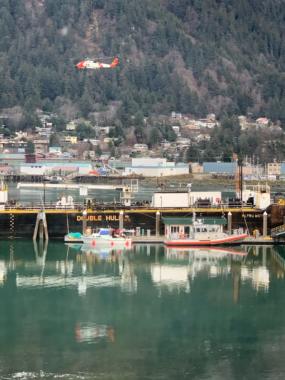
Dwyer said the Coast Guard had sent a helicopter from Sitka to assist with rescue efforts late Thursday night.
“Due to the low ceilings, poor visibility and high winds, (the team) was not able to see the individual or access his location to try to hoist him out,” Dwyer said.
Dwyer said the Coast Guard flew members of Sitka Mountain Rescue to Juneau, who linked up with Juneau Mountain Rescue for the ground search.
He also said Alaska State Troopers were coordinating the effort. A Troopers spokesperson could not immediately be reached for comment.
Editor’s note: This story was originally published with an incorrect byline. KTOO’s Jeremy Hsieh, not KTOO’s Adelyn Baxter, was the author of this story.
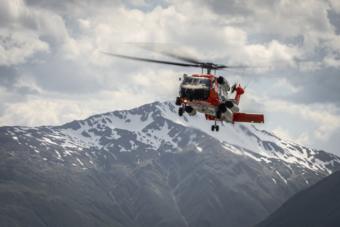
A Coast Guard Air Station Sitka MH-60 Jayhawk helicopter, July 17, 2018. (Public domain courtesy photo by Stephen Prysunka)
The U.S. Coast Guard medevaced a patient from Admiralty Island Saturday after he reportedly sustained critical injuries in an explosion.
In a tweet, the Coast Guard says a 60-year-old man lost the fingers on his left hand in the explosion in the Hawk Inlet area.
Saturday, a #USCG Air Station Sitka aircrew medevaced a 60YOM near Green's Creek Mine in Hawk Inlet. He was in an explosion that caused him to lose the fingers on his left hand. A local paramedic put a tourniquet on his hand before aircrew arrived to transport him to Juneau.
Hecla Greens Creek Mine spokesperson Mike Satre wrote in an email that the crew of a nearby commercial fishing tender provided first aid and transported the victim to Greens Creek Mine, where he was stabilized by the mine’s medical staff.
According to Satre, the injured man does not work at the mine but owns a floathouse in the northern part of Hawk Inlet nearby.
A Coast Guard crew from Air Station Sitka transported the victim to Juneau for further medical treatment.
Bartlett Regional Hospital declined to comment on the victim’s status.
Editor’s note: The headline for this story has been revised to avoid confusion about the precise location of the explosion.
The 382-foot-long MV Kennicott pulls out of Whittier in 2011. (Photo by Ed Schoenfeld/CoastaAlaska)
An Alaska Marine Highway System ferry rescued five people after a small boat capsized Friday morning near Bella Bella, British Columbia, in the Inside Passage. A sixth passenger, the boat’s captain, was still missing.
The Bellingham-bound ferry Kennicott responded to a distress call that a 26-foot boat was sinking near Humchitt Island, about 200 miles south of Prince Rupert, British Columbia.
The ferry dispatched its fast rescue boat, ferry officials said.
“The crew and master of the Kennicott did a very professional job in quickly assisting with the rescue,” Alaska Department of Transportation and Public Facilities spokesperson Meadow Bailey wrote in a statement. “All vessels and crews in our fleet drill for these types of situations as part of the AMHS’s strong safety program and safety culture.”
The partially-submerged vessel’s captain was still missing as of Monday, Royal Canadian Mounted Police said.
“There were six people on board, and all but the captain made it safely to shore on Humchitt Island,” RCMP Cpl. Madonna Saunderson wrote in a statement Monday.
The rescue delayed the ferry by about four hours, Bailey said. She added the Kennicott cut its time in port short to get back on schedule.
Firefighter Craig Brown with A-1, Capital City Fire/Rescue’s newest Airport Rescue Firefighting, or ARFF, vehicle, at Juneau International Airport in August 2018. This vehicle might be used during a disaster exercise planned at the airport on Saturday, July 20, 2019. (Photo by Matt Miller/KTOO)
Airport officials have organized a disaster exercise for Saturday.
Capital City Fire/Rescue, the Juneau Police Department, Bartlett Regional Hospital, the American Red Cross and a whole host of volunteers will participate in the drill on airport grounds.
Scott Rinkenberger, superintendent of the Juneau International Airport, said the exercise is required to be held every three years as part of their certification by the Federal Aviation Administration as an operating airport.
“We want to be prepared, and we want to test our emergency response agencies in support of the airport’s emergency action plan,” Rinkenberger said.
He couldn’t reveal beforehand the exact nature of the simulated accident on the airport grounds, but he said it would likely include an incident involving the largest scheduled commercial passenger aircraft routinely handled by the airport, some props and smoke, and volunteers role-playing victims and family members.
The airport and runway are expected to remain open for routine operations, and there is expected to be no impact on scheduled flights during the exercise.
Listen to the interview with Scott Rinkenberger, superintendent of the Juneau International Airport:
The ‘first-outs’, or the first ARFF vehicles dispatched to an incident at the Juneau International Airport, are parked outside the Glacier Valley Fire Station in this August 2018 photo. (Photo by Matt Miller/KTOO)
Interview transcript
Matt Miller, KTOO
Airport officials are holding a disaster exercise tomorrow morning. Capital City Fire/Rescue, Juneau police, Bartlett Regional Hospital, Red Cross and a whole host of volunteers will participate in the drill on airport grounds. And with us on the line to tell us more is Scott Rinkenberger, superintendent of the Juneau International Airport. Good morning, Scott.
Scott Rinkenberger, Juneau International Airport superintendent
Good morning, Matt.
Matt Miller
What’s been simulated at the airport tomorrow?
Scott Rinkenberger
Well, the Juneau airport is a federally-obligated airport that receives funding from the FAA for various airport improvements. So therefore, as part of our certification with the FAA, as an operating airport, we’re required to conduct a full-scale emergency exercise at least every three years. So what we are planning on doing tomorrow is we’re going to be simulating an aircraft accident or emergency here on the airport grounds. And we’re using, or recruiting I should say, many volunteers to portray injured passengers or role play and other aspects that would be involved in emergency, like distraught family members or bystanders, etc. So we’re going to be setting up a scenario and some props here on the airport that simulates an aircraft accident, on the airport grounds, so we will have various people portraying these injured passengers. And we will also have some props that may involve live burning, some smoke. So we want to let the public know that this is just an exercise. It’s like a fire drill, when we were in grade school. We want to be prepared and we want to test our response for our emergency response agencies in support of the airport’s emergency action plan.
Matt Miller
And what kind of exercise are we talking about? What kind of accident? Is it going to be a crash? Or can you specify, or you don’t want to give things away here?
Scott Rinkenberger
Well, to keep the realism of the scenario and to make the response as natural as possible to a real world emergency, we kind of keep the nuts and bolts of this scenario kind of a tightly-held secret. Because we don’t want people to really know. We want them to respond to the incident and the scenario as it unfolds. But what we have to do is we have to involve in the simulation the largest scheduled aircraft that comes in and out of the general airport which is the 737-900 which carries approximately about 170 or so passengers. So we’re going to be building our scenario … around that aircraft.
Matt Miller
So … people are going to see a lot of sirens, or hear a lot of sirens, see a lot of flashing lights, see possibly fire and smoke from somewhere on the airport, somewhere there, right?
Scott Rinkenberger
That is correct. There’s going to be a lot of increased activity on the airport grounds, there’s going to be emergency equipment, there’s going to be the crash trucks are going to be driving around on the airport responding to the simulated emergency with their lights and sirens flashing. Airport vehicles responding to the simulated accident with their lights and sirens. There’s going to be a lot of people on the ground, milling around the accident scene itself, which will give our responding agencies the opportunity to maintain crowd control, etc. So, and there’s also the possibility of a temporary plume of smoke. If the scenario indicates that or unfolds that the aircraft or one of the engines caught fire, for example.
Matt Miller
And tell me about the volunteers. Are they going to be role-playing victims essentially?
Scott Rinkenberger
Yes, a lot of our volunteers are going to be role-playing as injured passengers with varying degrees of injuries. We have several makeup artists that are going to be assisting us with doing moulage, which is kind of a French term for fake injuries, if you will. So they’ll be putting some simulated blood on their arm, or making a simulated injury or something to that effect. Just like in the movies, we have some makeup artists who are gonna make up our injured passengers to really give our first responders an opportunity to practice their triage and sort through the various injured people to see who goes to the hospital.
Matt Miller
So as part of the exercise, they’re actually going to be transported to the hospital, and they have to deal with them there as well, too, right?
Scott Rinkenberger
That is correct. Bartlett Regional Hospital is also going to be exercising their mass casualty incident plan. So all of our simulated role players, or our simulated injured passengers, will be physically transported to the hospital, which is part of the airport’s responsibility in getting medical aid to injured people in an aircraft accident.
Matt Miller
Is the airport going to be shut down during this?
Scott Rinkenberger
No … we have planned this exercise so it will have no impact on airport operations or any scheduled flights. There’s air traffic control towers involved, all the aircraft — or I should say airlines — are involved from Alaska Airlines, Delta Airlines, Alaska Seaplanes, and so forth. So all our scheduled services will run uninterrupted. This will kind of be staged in an ancillary area on the airport.
Matt Miller
OK, that’s Scott Rinkenberger, superintendent of the Juneau International Airport, telling us about tomorrow’s exercise on the airport grounds. Thanks a lot for talking with us this morning, Scott.
Scott Rinkenberger
You bet Matt. Thank you so much.
Five fishermen were rescued Sunday morning when their vessel sank near Back Island several miles north of Ketchikan.
The U.S. Coast Guard base in Ketchikan is seen from a floatplane window. (Photo by Leila Kheiry/KRBD)
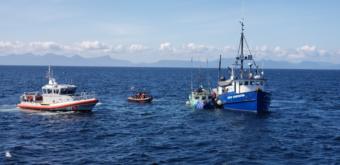
At about 11 a.m. Sunday, Coast Guard Sector Juneau received a distress call from the operator of the 49-foot fishing vessel Daffnie, stating the vessel had capsized and sunk. According to a Coast Guard news release, all five people on board had abandoned ship into a skiff. The occupants provided coordinates and stated there was only one life jacket on the skiff.
A 45-foot response boat from Coast Guard Station Ketchikan and an Alaska State Trooper boat responded. Troopers arrived shortly after noon and confirmed the location of the skiff.
The Coast Guard crew and good Samaritans aboard the fishing vessel Lovie Joann arrived about 10 minutes later.
The Daffnie sank in approximately 500 feet of water. She carried a maximum of 400 gallons of diesel fuel on board
The Coast Guard crew reported a visible sheen while on scene. Pollution and potential salvage response are pending further investigation.
The pilot and sole occupant of a small private plane died Thursday afternoon when the aircraft crashed on the south end of Gravina Island near Blank Inlet.
According to the Ketchikan Gateway Borough, the name of the pilot will not be released until next of kin have been notified.
Coast Guard spokeswoman Amanda Norcross says the plane was reported overdue by Ketchikan Airport Flight Service at 3:04 p.m. The last communication with the plane was around 2:30 p.m. The plane was near Blank Inlet at that time.
The Coast Guard sent out small boats from Station Ketchikan, and a search and rescue helicopter from Air Station Sitka. Ketchikan Volunteer Rescue Squad crews were mobilized, and the volunteer rescue squad found the crashed plane.
Alaska State Troopers coordinated the search efforts.
According to the borough news release, the National Transportation Safety Board will travel to Ketchikan Friday to start an investigation.
This was the fourth plane crash in the Ketchikan area this summer.
Gravina Island near Ketchikan in August 2009, with Pennock Island on the left. (Creative Commons photo by Wknight94)
Close
Update notification options
Subscribe to notifications
Subscribe
Get notifications about news related to the topics you care about. You can unsubscribe anytime.