Search & Rescue

Update: Washington climber dies after Mendenhall Towers fall near Juneau


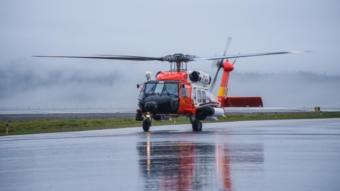
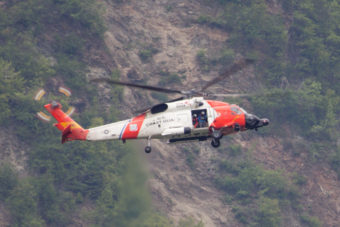
An MH-60 Jayhawk helicopter crew from Air Station Sitka hoists an injured hiker at Mendenhall Towers outside Juneau, Alaska, June 28, 2019. The climber was flown to an awaiting Capital City Fire/Rescue crew in Juneau and taken to the hospital. (Public domain video by U.S. Coast Guard/Air Station Sitka)

Update (June 29, 11 a.m.)Matt Miller, KTOO

Bartlett Regional Hospital spokesperson Katie Bausler says Bryson Allen died at 11:27 a.m. on Friday. She said she did not have authorization to disclose the nature of his injuries.

Original story

A Coast Guard helicopter was dispatched to the Mendenhall Towers early Friday morning to rescue a climber hurt in a fall.

Alaska State Troopers say one of the climbers was on rappel when his anchor released and he fell 20-30 feet.

The injured climber, identified as Bryson Allen, 23, of Washington state, was picked up by the Coast Guard helicopter and flown to Bartlett Regional Hospital. Troopers say Allen was unconscious after he fell. They did not disclose the extent of his injuries.

Allen’s two climbing companions, identified as Isaac Hardy, 25, of New York and Bowen Schwanke, 24, of Juneau, were not injured, according to state troopers. They returned to base camp on their own.

The Mendenhall Towers are a set of mountain peaks on the Juneau Icefield, roughly 7 miles north of the Mendenhall Glacier’s terminus.

In March 2018, George “Ryan” Johnson, 34, of Juneau and Marc-Andre Leclerc, 25, of British Columbia, went missing while climbing the Mendenhall Towers. They were later presumed deceased.

Correction: A previous version of this story incorrectly stated that the Coast Guard helicopter was dispatched Thursday night. According to an Alaska State Troopers dispatch, the helicopter was dispatched early Friday morning.

Searchers recover two missing from mid-air collision, bringing death toll to 6

Six people are confirmed dead from a mid-air collision Monday near Ketchikan and crews recovered the final two on Tuesday evening.

Three survivors are being treated at the hospital in Ketchikan and three have been released. Four other survivors were transported by medevac to Seattle.

The plane crash happened a little before 1 p.m. Monday as the two tour planes returned from trips to Misty Fjords National Monument.

PeaceHealth Ketchikan Medical Center’s Dr. Peter Rice said that’s when local medical responders were notified to prepare for incoming victims. Those victims started arriving about an hour later.

“In total, we received 10 patients,” he said. “Three were ultimately determined to be in serious condition, and seven in fair condition.”

Dr. Peter Rice, left, and PeaceHealth Ketchikan Medical Center spokeswoman Mischa Chernick talk to media Tuesday morning at the Ketchikan hospital lobby. (Photo by Leila Kheiry/KRBD)

That evening, four of the patients were stabilized and air-lifted to Harborview Medical Center in Seattle, a Level-1 trauma center.

Rice said the hospital has trained for this kind of emergency. But, he said, everyone is affected by the crash.

“Our entire medical staff is profoundly saddened by this tragic accident,” he said. “Our hearts are heavy for those families that lost a loved one in the accident. We send our deepest condolences.”

Harborview confirms four of the patients were transferred there. Of those patients, a 67-year-old man is in serious intensive care. In satisfactory condition are a 63-year-old woman, a 61-year-old woman and a 61-year-old man.

Injuries include broken ribs, pelvis, arm and spine.

The U.S. Coast Guard reported that 14 of the people on board the two small floatplanes were American, one Canadian and one Australian.

Jerry Kiffer of Ketchikan Volunteer Rescue Squad said Tuesday morning that ground crews were searching on shore for the missing two people, and divers were searching in the water.

“We’ve got a search dog in the area. The search dog is going to go over the debris field as well,” he said. “And we’re going to expand our shoreline searches to include some data that we received from the Coast Guard.”

That data involves tides and currents that could move people further away from the accident site.

Ketchikan residents pray outside of PeaceHealth Ketchikan Medical Center. About 150 gathered to pray for those involved in Monday’s plane crash. (Photo by Leila Kheiry/KRBD)

About 150 Ketchikan residents gathered at noon Tuesday in front of the hospital to pray for those involved in the plane crash. Organizer Rhonda Bolling said it’s way for locals to show they care.

“If we can get together and pray for all of those – for our family here in Ketchikan that was affected, for the tour operators, for the victims, and the tragic losses of life and their families,” she said. “We just want to show our love and support and encouragement, and ask God to rain down on this community and all involved.”

Prayers went out to the victims, their families, emergency responders and search crews.

A Coast Guard Station Ketchikan 45-foot Response Boat-Medium boat crew searches for survivors from downed aircraft in the vicinity of George Inlet near Ketchikan, Alaska.
A Coast Guard Station Ketchikan 45-foot Response Boat-Medium boat crew searches for survivors from downed aircraft in the vicinity of George Inlet near Ketchikan, Alaska, May 13, 2019. (Courtesy photo by Ryan Sinkey via Coast Guard)

Search dogs harness their super-powered noses

Brew, a 9 year old Golden Retriever, returns to SEADOGS’ Mark Sanders to let him know that he’s found where the scent of a missing person (actually a training volunteer) had veered off into the muskeg. (Photo by Matt Miller/KTOO)
Brew, a 9-year-old Golden Retriever, returns to SEADOGS’ Mark Sanders to let him know that he’s found where the scent of a missing person (actually a training volunteer) had veered off into the muskeg. (Photo by Matt Miller/KTOO)

If you become lost or injured in Alaska, your best chance of being found may rest in the paws of an unassuming hero: a search dog. Man’s best friend has a superpowered sense of smell that can detect just about anyone, anywhere. Highly trained and ready to respond with their dedicated handlers at a moment’s notice, search dogs can’t brag about their abilities. The only reward they ask is a chance to play.

I learned more about the world of search dogs by – what else? – volunteering to get lost.

Listen to the story about SEADOGS and their training:


I crouch down against a wall and behind a couch in a darkened room in the back of a vacant building in Juneau.

My rescuer! Bizzy, the 5 year old McNab California ranch dog who found me inside a vacant building, poses for a picture outside. (Photo by Matt Miller/KTOO)
My rescuer! Bizzy, the 5-year-old McNab California ranch dog who found me inside a vacant building, poses for a picture outside. (Photo by Matt Miller/KTOO)

A few minutes later, I hear a dog enter the room. She climbs on top of the couch, then tentatively peeks around the end of it, sniffs at my microphone, and then barks.

“You did it. Good girl!” said Kerry Kirkpatrick, co-owner of Bizzy, a 5-year-old McNab California ranch dog.

She’s found me.

“Atta girl!” More praise from Kirkpatrick as she throws a ball for Bizzy to play with.

“I decided to get a small, fast dog because I’m getting slower,” said Mike Pilling, the other owner of Bizzy. “So, that dog is like lightning compared to a Lab.”

Juneau volunteers with SEADOGS, or Southeast Alaska Dogs Organized for Ground Search, do this training every week. It may be in a vacant building one week and then out in the muskeg the next.

SEADOGS’ Liam Higgins holds on to Oskar, his 5-month-old German Shepherd, as a friend volunteers to run off into the muskeg with the dog’s favorite toy. (Photo by Matt Miller/KTOO)

“They say you don’t practice until you get it right,” said SEADOGS Liam Higgins. “You practice until you can’t get it wrong. So, it’s just over and over and over again.”

Outside the building in a muskeg across town, Higgins is training Oskar, his 5-month-old German Shepherd, the very basics.

SEADOGS’ Liam Higgins holds on to Oskar, his 5 month old German Shepherd, while he looks to make sure that a volunteer is hidden before giving the command to “Find him!”. (Photo by Matt Miller/KTOO)
SEADOGS’ Liam Higgins holds on to Oskar, his 5-month-old German Shepherd, while he looks to make sure that a volunteer is hidden before giving the command to “Find him!” (Photo by Matt Miller/KTOO)

“Oskar! Where’s he going?” asks Higgins.

“Come get me,” yells Higgins’ friend A.J.

Higgins hands Oskar’s favorite toy to A.J., who then runs off and disappears into the brush.

Higgins tries to hold on to Oskar as he whines in excitement and anticipation.

“Find him!” commands Higgins.

We chase after Oskar as he goes upwind way past where A.J. is hiding, but then the dog circles around to pick up the scent again.

“Good boy! What a good boy!” praises Higgins.

Compared to a human, the part of the dog’s brain devoted to processing smells is as much as fifty times bigger. That’s why scientists believe a dog’s sense of smell is not just several times better, but several orders of magnitude – or as much as 100,000 times – better than ours.

Higgins says dogs can smell like we see.

“One example I was given was like when you come home and your significant other is making beef stew. You smell beef stew when you walk in the door,” Higgins said. “The dog smells beef, carrots, onions, potatoes, each ingredient individually the same as we would as if we looked in the pot.”

A dog’s sense of smell is so sensitive that they can locate a body underwater from the gases that rise to the surface. Or they can find someone buried in a mudslide or avalanche from a scent rising up through the soil or snow.

Higgins says searching the thick gooey mud of the 2015 Sitka landslide, as flowing water carried the scent away, was the most challenging work he and his dog ever did.

“So, it was kind of hard to know what search technique you should really focus on predominately because it was a little bit of everything,” Higgins said.

SEADOGS’ Geoff Larson introduces a gauze bandage with a missing girl’s scent to Tango, a 4-year-old Golden Retriever which is trained as a trailing or scent discerning dog. (Photo by Matt Miller/KTOO)
SEADOGS’ Geoff Larson introduces a gauze bandage with a missing girl’s scent to Tango, a 4-year-old Golden Retriever, trained as a trailing or scent discerning dog. (Photo by Matt Miller/KTOO)

Teamwork is critical to the success of the dogs. Handlers must be aware of how terrain, water currents, wind and temperature changes affect a scent, and guide their dog to the best place for them to do their job.

“Take scent,” commands SEADOGS’ Geoff Larson.

For some dogs, the job is not just to find anyone – but to find a particular person. Inside the building where Bizzy found me, Larson is introducing Tango, his 4-year-old Golden Retriever, to a piece of gauze rubbed with the scent of a missing girl.

“Good girl! Yahoo!” SEADOGS’ Geoff Larson takes off his sock so that Tango, a 4 year old Golden Retriever, can play after finding a volunteer who was hiding under a desk in a vacant building. (Photo by Matt Miller/KTOO)
SEADOGS’ Geoff Larson takes off his sock so that Tango, his 4-year-old Golden Retriever, can play after finding a volunteer who was hiding under a desk in a vacant building. (Photo by Matt Miller/KTOO)

“Tango, track!” Larson commands.

Tango trots out on a long 40-foot rope, sniffing room to room, and occasionally doubling back in the hallway.

Tango is a trailing, or scent discerning, dog. Trailing dogs can detect a unique scent dropped by our hair or skin particles. Such dogs come in handy, for example, searching for an Alzheimer’s patient lost in a busy public place already inundated with many other human scents.

“You found her! You found her!”

Tango has found the girl hiding under a desk in one of the back rooms.

“Good girl! Good girl!”

But Larson has a made a mistake. A big one. He forgot to bring Tango’s toy.

So, Larson improvises. He quickly takes off a shoe and lets Tango play tug with his sock.

“Good girl! Good girl! Yahooo! Yahooo!”

Playtime is the big reward for Tango and the other search dogs. Every dog gets play and praise after every search.

For the handlers, the rewards are not so straightforward. They might get reimbursed for damaged gear and their travel to search sites, but they don’t get paid.

They’re volunteering all of their time during training and searches.

Mike Pilling recalls when he and another of his dogs found the body of a missing man. The man’s widow later sent their dog a new collar and ball for Christmas.

“The rewarding ones are when the family appreciates that you’ve found the body of somebody that they didn’t think would be found otherwise,” Pilling said. “Some families have been very, very appreciative of that, and that kind of makes it worthwhile. It’s been pretty cool.”

Alaska first responders train up on urban search and rescue techniques

Iola Young and her mute, naked friend wait for rescue during an urban search and rescue exercise in Juneau on April 12, 2019.
Iola Young and a dummy “friend” wait for rescue during an urban search and rescue exercise in Juneau on April 12, 2019. (Photo by Matt Miller/KTOO)

A lot of search and rescue situations in Alaska involve someone missing or injured in the wilderness. But in the case of an earthquake or avalanche, first responders need to be equally prepared to search for or treat someone in a collapsed building.

An exercise held recently in Juneau provided that training for emergency workers from around the state. And they learned from a Washington group that has unique expertise and experience in responding to these kinds of disasters.

Listen to the story about urban search and rescue:


Retired physician assistant Iola Young has rolled out an air mattress and a sleeping bag next to a large shipping container. She’s brought a good book.

“And breakfast and lunch, and they provided me with earplugs and safety glasses,” says Young. “I’m set.”

She and a dummy are role-playing as victims of a building collapse.

“My friend here is unconscious and slowly dying. And needs help. Just needs help. That’s all that I know,” Young laughs.

There are three shipping containers arranged to represent the ceiling and a few walls of the damaged building Young is trapped in, like an open-sided giant dollhouse without any furniture.

But rescuers have discovered the building’s entrance is damaged. Before they can safely enter, they need to fabricate wood shoring on the spot.

This exercise is part of urban search and rescue training. First responders from around the state are learning how to locate and treat victims in an urban environment that’s been wrecked by a massive earthquake, a major avalanche, or a mudslide like the one that killed three people in Sitka in 2015.

The teachers of the course have unfortunate expertise in this subject. They responded to the 2014 Oso mudslide in Washington state that killed 43 people and wrecked dozens of homes. It was the deadliest mudslide of its kind in U.S. history.

“If you could imagine if somebody just took a bunch of mud and trees and houses and put them in a blender, then dumped it out on the ground. That’s really what it was like,” said Master Sgt. Chris Martin of the Washington National Guard‘s 10th Homeland Response Force. “There was hardly any structure left. The houses were pancaked.”

Martin’s team specializes in searching confined spaces in collapsed buildings or wide-area searches, like for an avalanche or a mudslide like the Oso disaster.

“We drove across the state to the collapse site. We worked on the pile for 10 days straight,” Martin said. “By that time, it was a recovery operation and we were helping extract remains from the slide.”

Even though he’s based in Washington, Martin said his team could be asked to help if a disaster happened in Alaska, working alongside local responders.

Tech Sgt. Charolette Kane (right) of the Washington National Guard provides support for Tech Sgt. Derek Reese as he jackhammers through reinforced concrete during an urban search and rescue exercise in Juneau on April 12, 2019. Two victims are awaiting rescue on the other side of the slab.
Tech Sgt. Charolette Kane (right) of the Washington National Guard provides support for Tech Sgt. Derek Reese as he jackhammers through reinforced concrete during an urban search and rescue exercise in Juneau on April 12, 2019. Two victims are awaiting rescue on the other side of the slab. (Photo by Matt Miller/KTOO)

Searching for people inside collapsed buildings is very different from searching for people lost in the woods. It requires different tools and different skills — even for dogs.

“In a building, your scent is all over the place, spilling out,” said Geoff Larson of SEADOGS, or Southeast Alaska Dogs Organized for Ground Search.

Larson and his dog Tango are practicing looking for victims in a dark, largely-vacant building. He said the wind may carry the scent in an ever-widening, cone-shaped path outdoors. But it’s different inside a building.

“Your scent is probably going to go up from you, because you’re 98.6 degrees Fahrenheit. It’s going to go up and hit the ceiling and on a cold wall. It’ll sink, or it might go up across a room, and the dog will come in,” Larson said.

There are also hazards in damaged buildings that the dogs aren’t used to outside. Things like hazardous materials, additional structural collapses, gas leaks or live electrical wires.

Young ends up hanging out in her sleeping bag next to the simulated building collapse for several hours.

Rescuers are drilling and jackhammering their way through a six-inch thick, reinforced concrete slab that is in their way. It’s grueling, punishing, time-consuming work.

In addition to practicing using power tools to extract victims from the building, the first responders also practicing talking to victims, getting important information about their health and situation, and keeping them calm.

“Can you touch him? Is he stuck under something?” asks Capital City Fire/Rescue’s Meghan Desloover, a rescue team leader for the exercise.

“He’s not stuck under anything,” Young answers. “He feels cold.”

“Do you know who he is?” Desloover asks.

“No, I don’t know,” Young responds.

Desloover later reassures Young that help is on the way. It just may take a while.

Body recovered from Mendenhall River

Mendenhall River
The Mendenhall River as seen from the Mendenhall Loop Bridge in 2015. (Photo by Casey Kelly/KTOO)

Police pulled the body of an unidentified man out of the Mendenhall River Wednesday.

According to the Juneau Police Department, a man reported finding a body wedged between rocks in the river across from View Drive around 11:22 a.m.

Police and a special team from Capital City Fire/Rescue went to the scene and a police officer retrieved the body from the water shortly after noon.

Police said there were no obvious signs of trauma on the body.

JPD spokesperson Erann Kalwara said police have not released a name but have reason to believe the deceased is not from Alaska.

She said they will continue to investigate while awaiting results from an autopsy by the State Medical Examiner Office in Anchorage.

Autopsy results could take anywhere from several days to several weeks.

The night a Guardian Flight vanished, the Coast Guard’s nearest helicopters couldn’t fly

Wreckage from the Guardian Flight’s Beechcraft King Air 200 was salvaged March 28, 2019, by crews working for the air ambulance company. (Photo courtesy of the NTSB’s Alaska regional office).

When the Coast Guard received a report from the Kake clinic of an overdue air ambulance, its nearest helicopters at Air Station Sitka were about 40 miles away.

Coast Guard Commander Michael Kahle said the air station maintains three MH-60 Jayhawk helicopters: one disassembled for parts, one as a backup; the third is the “ready bird” for rapid response.

“The goal that we should shoot for is, from the time of notification, 30 minutes to get off the deck,” Kahle said in a Monday interview. “And then two hours to be on scene, and that’s where our assets are positioned to enable that.”

But according to mission logs obtained by CoastAlaska under the Freedom of Information Act, the Sitka air station’s “ready bird” Jayhawk immediately ran into problems.

The logs indicate an engine contingency switch had malfunctioned — effectively grounding the helicopter overnight.

“So now we are looking for other aircraft to bring in,” Kahle, who was incident commander, recalled. “We reached out to the Air National Guard and they said, ‘Well, we can get aircraft probably in the morning time.'”


Mission logs obtained in a Feb. 1 Freedom of Information Act (FOIA) request reveal a string of mechanical breakdowns grounded the MH-60 Jayhawk helicopters at Air Station Sitka.

After crews in Sitka weren’t able to get their helicopters cleared for take off, a second Jayhawk was requested from the Coast Guard’s Air Station Kodiak — 600 miles away.

“That process ends up taking about, you know, through the evening,” Kahle said. “And at first light, they’re basically on scene with a new aircrew, aircraft and underway out on scene.”

That meant there was no aerial search over Frederick Sound for the first 12 hours.

On the water it was a different story. The Coast Guard had quickly alerted the Cutter Anacapa, which was already in the area, and local search and rescue teams also searched for signs of the missing plane overnight.

Air Station Sitka got its Jayhawk in the sky the following morning. After completing a single search, the logs indicate it ran into the same mechanical problem. Its crew refueled in Petersburg and returned to Sitka for more repairs.

The longest federal government shutdown in history had ended just a few days before. Kahle said the Coast Guard’s maintenance schedule had been affected. He confirmed parts of an article in The New York Times that stated dockside maintenance to ships in Sector Juneau were delayed.

But the commander said the mechanical breakdowns of its Sitka-based helicopters weren’t shutdown-related. He called them “a mechanical issue that happened at the wrong time.”

The Coast Guard acknowledges its aerial response was delayed that night. But Kahle said it didn’t impact the overall response.

“Certainly we work very hard to keep our aircraft in a posture — so that we can respond within the Coast Guard’s goal or ahead of the Coast Guard’s goals,” Kahle said. “And I think we do a good job overall of maintaining that readiness.”

Federal authorities still don’t know what caused the Beechcraft King Air 200 to plummet more than 2,500 feet in 14 seconds before vanishing from radar.

NTSB investigator Brice Banning examines the recovered flight recorder from the Guardian Flight plane that crashed Jan. 29 over Frederick Sound. (Photo courtesy of NTSB).

The cockpit’s voice recorder was recovered by searchers contracted by Guardian Flight.

But Clint Johnson, the National Transportation Safety Board’s regional chief in Anchorage, said it’s in poor condition.

“We’re not sure if it’s actually impact damage or if its water immersion damage,” Johnson said Monday. “However, not all is lost at this point. Right now, our engineers in our cockpit voice recorder lab are working very, very hard to try and recover that information.”

He added the lab should know whether the data is recoverable within the next week.

Most of the plane’s wreckage has since been recovered around 22 miles west of Kake. It’s now in a hangar in Juneau. Representatives from Raytheon and Pratt & Whitney which built the airframe and engines will be assisting NTSB investigators.

Johnson said it’ll likely be some time before the public gets any answers.

“It’ll probably be another probably six, eight months, at least before anything else is released,” he said.

Following the Coast Guard’s intensive three-day search, Guardian Flight spent two months looking for its lost aircraft and crew.

Last week the company announced it had wrapped up its search. The bodies of Juneau-based pilot Patrick Coyle, 63; paramedic Margaret Langston, 40 and nurse Stacie Rae Morse, 30, remain lost at sea.01KAKE

Site notifications
Update notification options
Subscribe to notifications