Science & Tech

Orange goo made up of spores

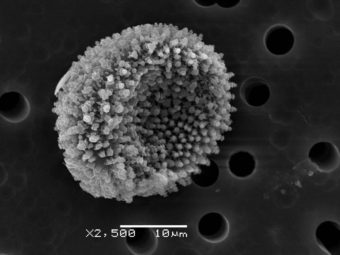
Picture from an electron scanning microscope of Kivalina spore
Picture from an electron scanning microscope of Kivalina spore - Courtesy NOAA

Not eggs, after all.

Scientists have done a more detailed examination of that mysterious orange goo that showed up recently in a lagoon near Kivalina.

They are fungal spores.

Samples were sent down to the NOAA’s National Ocean Service Center for Coastal Environmental Health and Biomolecular Research in Charleston, South Carolina. Doctor Steve Morton, a research oceanographer there, said they used an electron scanning micrograph to examine in greater detail the tiny orange balls that were seen in earlier pictures.

Close-up of spines on surface of spore
Close-up of spines on surface of spore - Courtesy NOAA

“It was just a very interesting, unusual event,” said Morton. “I’ve been during oceanographic work on red tides for 20 years now. This is the first one I’ve ever seen that’s caused by a fungal spore.”

Morton says the spores are consistent with a fungus that causes rust, or the discoloration that appears on plant leaves and stems. But it’s still unclear which of the 78-hundred types of rust fungi is the Kivalina goo.

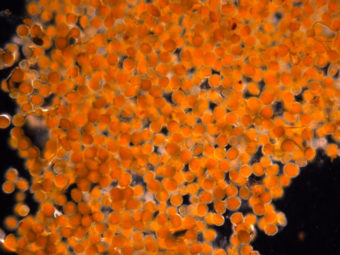
Initial analysis by NOAA’s Ted Stevens Marine Institute at Auke Bay showed what appeared to be a concentration of microscopic eggs, possibly of an invertebrate like a copepod.

Photo taken from a microscope of the Kivalina goo that were believed to be eggs
Photo taken from a microscope of the Kivalina goo that were believed to be eggs - Courtesy NOAA

Kids learn chemistry through cooking

What makes dough rise? How do you preserve milk? Twenty-seven young chefs are learning the answers to those questions and more this week at a Juneau Economic Development Council summer camp designed to teach kids the science of cooking. Casey Kelly has more.

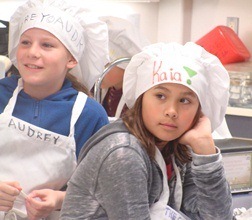
Young chefs learn about the science of cooking at the Juneau Economic Development Council's Kitchen Chemistry camp. (Photo by Casey Kelly/KTOO)

Its day three of the Kitchen Chemistry camp and students are making mozzarella cheese in the culinary classroom at Thunder Mountain High School. Working in groups of four or five, they start by warming a gallon of milk and just over a teaspoon of lime juice – a substitute for citric acid – in a large pot on the stove. But most of the kids are a little unsure about the next step.

“After I think we cook it, we just gotta wait awhile or bake it or something,” says Hunter Hill, a fifth grader at Gastineau Elementary School. He says he signed up for the camp because he really likes cooking at home – mostly desserts.

“I like making crepes for my family that I get from a library book. And yeah, other than that, I like making cookies, brownies and cake, stuff like that,” Hill says.

JEDC Education Specialist Bob Vieth says the purpose of the cheese making exercise is to teach kids one way to preserve milk. During the week they also learn how to preserve cucumbers by pickling them, about leavening agents by making pizza dough, and about sweeteners by making fudge.

Making mozzarella cheese at JEDC's Kitchen Chemistry science camp. (Photo by Casey Kelly/KTOO)

“And along the way we’ve been trying to emphasize the science aspects and the chemistry aspects of the various cooking techniques that they’re using,” says Vieth.

Simon Smith learned what happens when you use baking soda instead of baking powder to make scones.

“The whole class tasted them and wasn’t so good,” Smith says.

Vieth admits there have been a fair number of failures. All the kids are going into either fourth or fifth grade, but he says some of them are pretty good chefs already, and they’re learning advanced science years before they would in school.

Budding chefs at JEDC's Kitchen Chemistry science camp. (Photo by Casey Kelly/KTOO)

“They’re learning concepts and vocabulary terms here that they normally wouldn’t be exposed to until high school chemistry,” Vieth says. “So when they do get them in chemistry, they’ll say ‘Oh yeah, I remember that from the cooking class.'”

Sophia Harvey says there’s another benefit of going to a cooking summer camp.

“I like eating the stuff after,” Harvey says.

Kitchen Chemistry is the last of this year’s JEDC Summer Camps. Previous camps include building underwater gliders, rocketry, and LEGO robotics. All the camps are part of JEDC’s STEM education program, which stands for Science, Technology, Engineering and Math. In Juneau, I’m Casey Kelly.

Mysterious orange goo identified as mass of microscopic eggs

Photo courtesy NOAA Alaska Fisheries Science Center’s Auke Bay Laboratories

Federal scientists say they have tentatively identified the mysterious orange goo that showed up recently in a lagoon near Kivalina. It appears to be a concentration of microscopic eggs.

Jeep Rice, research biologist at the Ted Stevens Marine Institute in Auke Bay, says their lab staff first tried to figure if it was plant, animal, or mineral. Several chemists were called in after the samepls arrived Saturday because of concerns that the substance may be some form of chemical pollution. But Rice says the chemists weren’t needed once they spotted the basic egg structure under a high powered microscope.

“They’re down in the micron range,” says Rice. “A herring egg would be a thousand microns. So (these eggs are) down in the one to ten microns, maybe larger. They’re very, very small.”

Since the eggs are so small and their internal features are very hard to distinquish, it’s unclear what laid the eggs. Rice suspects some sort of invertebrate, perhaps a crustacean like a copepod. But Rice says it’s hard to tell for sure.

The orange color of the goo seems to come from a lipid oil droplet in the center of each egg.

The eggs that were collected for sampling either dried up or died despite being refrigerated for transport.

Area residents were concerned earlier this month when the never-before-seen substance showed up. Rice says it’s possible the eggs just happened to concentrate in that lagoon because of wind or tidal action.

Even though the goo was determined to be natural, Rice would advise against eating or consuming the eggs. There’s a remote possibility they could be toxic in some form.

Alaska seeks long lost moon rock

You might think we’re trying to sell you the moon with this next story…

A long lost piece of moon rock, given to the State of Alaska by President Richard Nixon more than 40 years ago, is now the subject of a legal battle between the state and a former resident turned Deadliest Catch boat captain, who claims to have found it when he was a teenager.

Casey Kelly has more on this truly bizarre tale.

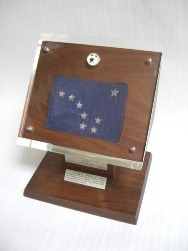
This Apollo 11 moon rock was given to the State of Alaska in 1969 by President Richard Nixon. Until recently, it was believed to have burned in a fire. (Photo courtesy Alaska State Museum)

From 1969 through 1972, NASA’s six Apollo missions returned to Earth with hundreds of pounds of moon dust. The Nixon White House mounted samples of the dust onto plaques and called them Goodwill Moon Rocks – given to all 50 states, hundreds of countries, and a few individuals. The moon rock Alaska received from the 1969 Apollo 11 mission ended up at the State Museum in Juneau, which loaned it out to other facilities until it went missing in the early ‘70s.

“I kinda figured we’re never going to find this moon rock,” says Elizabeth Riker, a University of Phoenix criminal justice graduate student from Detroit. As part of a class assignment she began investigating Alaska’s missing lunar fragments. Last August she wrote about it for the Capital City Weekly.

“I got quite a few emails from citizens in Alaska, asking me questions and saying they remember seeing the moon rock when they were in elementary school,” says Riker. “But obviously they all said this was back, late ‘60s, 1970, that time frame. But nobody had seen it since.”

So, what do moon rocks have to do with criminal justice? Riker’s professor, Joe Gutheinz is a retired Senior Special Agent with NASA’s Office of Inspector General.

“I would conduct criminal investigations and civil investigations impacting NASA,” says Gutheinz. “And in 1998, I went undercover in Operation Lunar Eclipse to recover the Honduras Goodwill Moon Rock.”

Gutheinz says there’s no shortage of missing moon rocks, so the investigation assignment is one he commonly gives to his students.

“About 160 moon rocks are missing that were given to the nations of the world,” he says. “And we’ve also determined that 18 Apollo 11 moon rocks given to the states and nine Apollo 17 Goodwill Moon Rocks given to the states are also missing. Lost, destroyed, or stolen.”

In December, a man named Coleman Anderson filed a lawsuit against the state seeking clear title to Alaska’s Apollo 11 moon rock. Anderson claims his step father was the curator of the State Transportation Museum in Anchorage when it was destroyed by arson in 1973. In the days after the fire, Anderson – 17 at the time – says he found the moon rock in a trash heap. Daniel Harris is Anderson’s Seattle-based attorney.

“The curator of the museum, basically signed off on him taking them,” Harris says. “And they sat in Coleman’s basement or wherever for about 30 years and then he read about somebody having sold moon rocks and he said, ‘Boy, maybe I have something of value here.'”

According to Harris, Anderson currently resides somewhere in the southern United States and hasn’t lived in Alaska for several years. But he was the captain of a Bering Sea crab vessel – even appearing in season one of the reality show Deadliest Catch.

On the black market moon rocks have been known to go for millions of dollars. So, if Anderson is awarded ownership, he could sell the Alaska rock for quite a bit of money. But Harris says his client is interested in cutting a deal with the state.

“We’re very open to ideas as to how a compromise could be reached,” Harris says.

The moon rock Anderson claims as his hasn’t been authenticated. Nevertheless, the state has filed a counterclaim against him charging that he trespassed and assumed ownership of state property without permission. In addition, the state is seeking return of the moon rock and its plaque, and damages for the years in which residents lost use of them. Bob Banghart is chief curator of the Alaska State Museum.

“I think that would be appropriate, if it turns out to be the real thing,” Banghart says of having Anderson return the moon rock. “It would be part of the mission for us. We don’t like to lose things, no matter how it occurs.”

Retired Special Agent Joe Gutheinz – now an attorney in private practice – agrees.

“And I’m not talking about the law. I’m talking about morality here,” Gutheinz says. “And my opinion: That moon rock was given to the children of Alaska.”

Remember that Honduras moon rock Gutheinz recovered in 1998? It was the subject of a 5-year court battle before a judge ordered it to be returned to the US government, which gave it back to Honduras. Whether Alaska gets its moon rock back remains to be seen.

Site notifications
Update notification options
Subscribe to notifications