Science & Tech

Alaska watershed groups plan more collaboration

Juneau's Jordan Creek watershed has undergone a stormwater impacts assessment. Photo courtesy Southeast Alaska Watershed Coalition.

Activists across Alaska are organizing to protect local watersheds. They met last week in Juneau to compare notes and make plans for future efforts.

They include a Haines group studying a hydropower dam’s possible impact on salmon and a Prince of Wales Island organization focusing on habitat restoration. Other groups and officials came from Juneau, the Kenai Peninsula and the lower Yukon River.

Click here for iFriendly audio.

Southeast Alaska Watershed Coalition Coordinator Jessica Kayser says those involved are gathering a wide range of information.

“And what the coalition works on specifically is trying to get resources in to community development professionals or natural resource professionals that are working locally,” she says. “So, we can make more informed decisions about where we should develop, where we should conserve or where we should restore lands.”

She says some of the groups work in relative isolation. That was much of the motivation for the three-day Juneau meeting, which was cosponsored by the National Forest Foundation.

Municipal leaders, resource agency staff, tribal governments, businesses, and environmental groups were among those attending the Community-Based Watershed Management Forum.

Kayser says the groups discussed a major wetlands initiative.

“Those systems deal with water quality, flood control, fish and habitat, tourism and recreation. In addition, we want to support sustainable, industrial enhancement projects. And how we can assess our watersheds to know best where those enhancement projects should be,” she says.

She says the coalition does not want to block development. But it hopes to make sure fish habitat, water system intakes, natural flood control and watershed ecosystems are protected.

“We have mines, but then there’s also harbor projects, there’s hydroprojects that are being looked at. And then on a smaller scale, there’s schools, fire halls, those type of things,” she says.

Kayser says those at the meeting agreed to collaborate more, sharing information, techniques and successes.

Learn more about some of the watershed groups:

Juneau Watershed Partnership

Taiya Inlet Watershed Council

Yakutat Salmon Board

The Nature Conservancy


Rare Steller’s Sea Eagle seen in Juneau

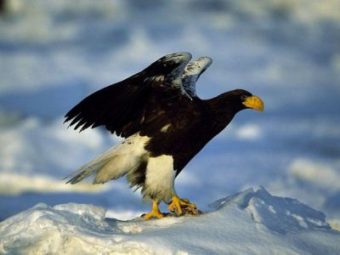
Steller's Sea Eagle. Courtesy National Geographic.

A Steller’s Sea Eagle has been seen in downtown Juneau – far afield from its habitat of eastern Russia.


Research wildlife biologist Dave Douglas saw the rare eagle Friday morning when he was looking out the window of his office in the NOAA building on Gastineau Channel.

He says the bird was inflight at about 200 feet, “and it was back dropped against the dark spruces, the dark of the mountain. You know the first thing that catches my eye is the glaring white and dark contrast on its wings.”

The bird had bright white on its wings. Douglas says for the first second he was “trying to coerce himself” into thinking it was a guillemot or a white-winged scoter.

“But yet it’s huge. It’s undisputedly an eagle. So then I try to wrestle for another second or so thinking that a bald eagle has something stuck on its wings, like white garbage bags, or something, (or) it flew through some paint, I don’t know, something,” he says. “Then it had just perfect form. There was nothing trailing or stuck on this eagle.”

He described what he was seeing to a colleague – a professional birder — who confirmed it was the Steller’s Sea Eagle. He says he jumped on the Internet and was quickly viewing what he had just seen in flight.

Douglas conducts satellite tracking studies for the U.S. Geological Service’s Alaska Science Center. In past jobs, he has spent countless hours identifying birds for the U.S. Forest Service and Fish and Wildlife Service, but he had never seen the rare eagle in the field.

Word of the sighting spread through an online eagle chat forum, confirming a story that a Steller’s Sea Eagle was seen up the Taku River about 1989.

Steller’s Sea Eagles are most commonly found on the Kamchatka Peninsula, where they breed. In the winter many individuals migrate to Japan, while others move to open water. Annual salmon runs provide much of their diet.

Douglas says they are occasionally seen in the Kodiak area. Click here for more information on the Steller’s Sea Eagle.

Dead deer puzzles biologists

This partially eaten deer was found Monday morning in Juneau's Starr Hill neighborhood. Photo courtesy Amanda Chisholm.

A partially eaten deer found in a Juneau neighborhood on Monday has Alaska Department of Fish and Game biologists scratching their heads.

“The deer was kind of eerily placed directly under the streetlight on the 4th Street walkway, next to a stump. And it looked like it had been drug up a few feet from where it started to bleed,” says Amanda Chisholm, one of a group of neighbors that found the dead animal Monday morning.

“The hindquarters was what was attacked, you could say,” Chisholm says. “It just looked like it had been chewed up pretty good on its hindquarters.”

After a preliminary investigation, Fish and Game Area Management Biologist Ryan Scott says it’s not clear how the animal died. He says it’s unusual to find a partially eaten deer in a residential neighborhood.

Scott says it was an older female that may have been having a hard time this winter. He says several paw prints were found around the animal. So it’s possible that it was attacked by a dog. Scott says another biologist followed deer tracks up the hill from the carcass and saw a lone coyote. But he says the coyote was probably just scavenging and followed its nose to the dead deer.

Scott says the carcass was removed from the area.

Taku River meetings to begin

Tulsequah Chief Mine officials are expected to be part of a Taku River task force meeting later this week.
The fact-finding group meets Thursday evening for the first time since Juneau legislators created it in September. A second meeting is scheduled for Saturday.

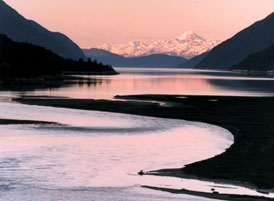
The eight-member task force will primarily gather facts about the salmon-producing Taku River. One catalyst is mine redevelopment on the Canadian side. The Tulsequah Chief closed down in the 1950s, and acid mine drainage has been a concern since. Mine owners Chieftain Metals installed a treatment plant at the site this fall, and water coming out of the old mine is now being treated.

Chieftain Metals moved water treatment plant and other equipment by barge from Juneau to the mine last summer. Courtesy Chieftain Metals.

The issue that seems to have Juneau most anxious is barging. Former Tulsequah owner Redfern Resources proposed an air-cushion, or Hover barge, towed up the Taku River by an amphibious vehicle. But Redfern went bankrupt and Chieftain Metals announced last year that they want year round road access to the mine. Chief Operating Officer Keith Boyle says even traditional barging up the Taku – as the company did last summer – is difficult.


“Our preference is the overland route, just simply because it’s a much lower risk alternative for the operation. We’ve seen a huge variability in what Mother Nature has dealt in terms of river levels and the ability to barge,” Boyle says. “The financial communities are nervous when they see you can’t get your product to market in a consistent manner.”

Chieftain last year struck an agreement with Taku River Tlingit First Nation that covered mine exploration, water treatment and employment. But the company is still negotiating on a road through First Nation territory. It could be years before a road is ever built.

Chris Zimmer is Alaska Director for Rivers without Borders. He says the state must make sure barging doesn’t harm the river and salmon resource.

“It raises all kinds of issues about spills, of diesel fuel and toxic materials and groundings and damage to habitat, so we really want to see the task force take this on, and understand that barging will happen for the next few years and very likely beyond that,” Zimmer says. “That’s something Alaska doesn’t really have a regulatory or permitting handle on.”

The task force is an outgrowth of an effort last year to create a legislative group to study Taku River issues. Meetings between sport and commercial fishermen, and property owners, proved to be very contentious. Juneau legislators said it was clear everyone needed more information and less opinion before any new river protections could be considered.

Task force facilitator Kevin Ritchie says the group will hear about river habitat and salmon stocks as well as current regulatory protections, which are not clear.

“So this is going to be a very valuable process of determining exactly the types of things that will occur if there are specific industrial or other types of issues that involve the Taku River,” Ritchie says.

Chieftain Metals C-O-O Boyle is expected to participate by teleconference in Saturday’s task force meeting. The company is headquartered in Toronto, Ontario, Canada, and has offices in Vancouver and Atlin, British Columbia.

The Taku River Fact-Finding Task Force will meet Thursday from 5 p.m. to 8 p.m., and Saturday, from 9 a.m. to noon, in House Finance chambers at the state capitol.

State releases 2012 forecast for Taku River Chinook

For the sixth time in seven years, the Alaska Department of Fish and Game is projecting a directed commercial fishery for Taku River King salmon in 2012.

The department says the number of Taku Chinook should be up from last season. The forecast calls for a summer run of about 48,000 Kings, with an allowable catch of about 6,700 for commercial fishermen in Alaska.

But fishery manager Kevin Monagle says projections don’t always turn into reality.

“In some cases we have had a number similar to this or maybe a little lower to go after, and we have decided to wait until we had in-season information and to make our management decisions based on that information alone, not the forecast,” says Monagle.

Case in point, in 2011 the forecast called for a run of about 41,000 Kings, with an allowable catch of about 1,500. But a directed fishery was not allowed once managers were able to collect in-season data.

Monagle says it can be a difficult fishery to forecast, because the Alaska catch is set according to a treaty with Canada, which shares the Taku with the United States. And Canada gets first crack at the fish.

“The first 5,000 fish surplus, Canada gets that and we get none of it,” says Monagle. “So, in recent years when you have very small surpluses to go after, if the forecast changes even a little bit – 2 to 4 percent – then that U.S. allowable catch goes away.”

Monagle says Canadian managers also regulate the Taku King fishery according to in-season data, and that biologists on both sides of the border are in regular communication before and after fishing starts.

May 1st is the first day a fishery is allowed to open in Alaska. Monagle says the department will release more information closer to that date.

Taku River Task Force schedules first meeting

After a three-month delay, the Taku River Fact-Finding Task Force will meet next week for the first time. The task force was created in September by Juneau’s legislative delegation to gather facts about the river and possible impacts of Tulsequah Chief Mine redevelopment on the Canadian side of the Taku River watershed.

The Taku River is the most abundant salmon-producer in Southeast Alaska.

Scheduling difficulties prevented task force members from meeting with Fish and Game, Natural Resources, and other agency experts until January 5th, about three weeks after a report to Juneau legislators was due.

Facilitator Kevin Ritchie says the first two meetings will chart the course of the task force. No formal deadline has been set for the report.

He emphasizes the task force’s fact-finding mission:

“It’s not out there to make decisions, or recommendations, or to propose legislation or anything like that, but to provide the community, legislators and other folks information about what the issues area, what kind of things the state can do and so on,” Ritchie says.

Task Force members represent the Alaska Native community, commercial and private property owners, commercial fishing and fish processors, sport fish and charter boat operators, and include a retired biologist.

Ritchie says they will review the biological health of Taku River fish stocks, habitat, and game; determine the agencies responsible for monitoring industrial river traffic, vessel safety and spill response; and also assess the effectiveness of current state and federal statutes and regulations.

Ritchie says Tulsequah Mine developers Chieftain Metals have been invited to the task force meetings.

Construction on the multi-metal mine is to begin sometime next year. Chieftain recently reached agreement with Denver-based Royal Gold to pay up to $60 million for the right to gold and silver produced from the mine. Royal Gold has pledged a $10-million advance payment at closing of the deal, and an additional $50 million mine construction.

Site notifications
Update notification options
Subscribe to notifications