Science & Tech

Clues to the future of Anchorage’s water supply locked away in ice

Anchorage is one of the few North American cities that depend on a glacier for most of their drinking water. The Eklutna glacier also provides some of the city’s electricity, through hydro power. So a team of researchers is working to answer a very important question: How long will the glacier’s water supply last?

To get that answer, those researchers have to shovel a lot of snow. “It gets to be the consistency of really strong Styrofoam once you get down, maybe six or eight feet,” glaciologist Louis Sass says as he flings pristine snow out of a growing hole in the glacier.

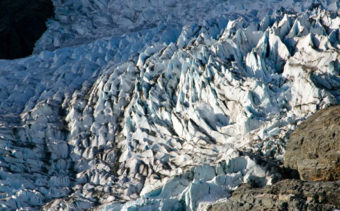
It may be a tough job, but it comes with a stunning view. The white glacier sprawls out around Sass, who has spent years researching the Eklutna glacier. It looks a little like a huge lake, covered by a giant, fluffy marshmallow and rimmed with sharp peaks.

Mike Loso, who leads the project, says workers at the water-treatment plant brag that they have the best job in the world. “If you look around, you understand why,” Loso says. “The guys here just have to turn this into drinking water; they just have to figure out how not to screw it up.”

The Anchorage utilities want to know how much meltwater they can expect the glacier to feed into the reservoir they draw from in the years ahead. So six years ago, Loso, an earth sciences professor at Alaska Pacific University, started bringing his students into the field to study the problem.

They spend three weeks each May camping on the glacier, skiing to several research plots to gather data. On a recent afternoon, that means weighing cake-sized pieces of snow sliced from the wall of the snow pit.

A student slides the snow into a plastic bag to weigh it on a portable scale. The precise measurements will help the team determine how much snow accumulated on the glacier last winter. The students are learning how to gather data in the field and stay safe on the glacier.

Haley Williams, a college junior, says she wants to be a scientist.

“I have a fascination with glaciers and volcanoes, and I’m trying to figure out which I like better,” she said. “So I figured I’d come out here, see if I have what it takes to be a glaciologist.”

The students determined that the Eklutna glacier has been shrinking rapidly since the 1950s. The Anchorage utilities are in good shape now because the glacier is actually supplying extra water as it melts, and that should last for at least the next few decades.

Loso can’t predict precisely when the water will start to slow, but he says it’s something Anchorage and its nearly 300,000 residents should think about.

“Does that mean we don’t have electricity, and no water comes out of the tap? No,” he says. “But it does mean that an exceptional source of super clean, really cheap water is going to have to be augmented by what are likely to be more expensive sources of water and electricity.”

Loso says that hit to Anchorage residents’ pocketbooks will seep in slowly, over several decades.

As Loso’s team prepares to leave the site, they insert a 20-foot steel stake in the glacier. When they come back later this fall, they’ll be able to calculate how much snow has melted by measuring how much of the stake is exposed. Loso says he personally would like a hot summer, but he knows that’s not what’s best for the Eklutna glacier.

Blogging on ice

The Mendenhall Glacier
The Mendenhall Glacier. (Photo by Heather Bryant/KTOO)

The Juneau Icefield Research Program is entering the blogosphere.
For the first time this summer, participants in the long-running glacier exploration project will post their day-to-day findings to a blog.

“I think it really gets the experience out there, in real time,” says the program’s Director Jeff Kavanaugh, who says he got the idea from a Canadian Arctic research program called “Students on Ice,” which has had a blog since 2007.

The Juneau Icefield Research Program has been collecting data since 1946. Students and professional scientists spend two months every summer studying changes to the glaciers within the 1,500 square mile area between Juneau and Atlin, British Columbia – the fifth largest ice field in the Western Hemisphere.

With no broadband Internet service in the field, Kavanaugh says they’ll post text updates to the blog via a satellite connection. Videos and pictures will be put on thumb drives and sent back to Juneau in supply helicopters about once a week.

“It’s important in some ways that they’re not able to e-mail or call themselves on a daily basis, because that separation from their normal lives would be far less complete,” says Kavanaugh. “But the near real time communication regardless of that separation is going to be quite powerful.”

Kavanaugh hopes the blog will attract future students to the program, and help publicize its ongoing research. He says scientists too often fail at communicating the importance of their work.

“The current hot topic of climate change is a great example of that,” says Kavanaugh. “If you ask climate scientists whether they believe the globe is warming due to human action, somewhere between 95 and 98 percent of climate scientists will say, ‘Yes, I believe that human caused forces are causing this change.’ That’s not the perception that’s in the media. I credit that to poor communication by scientists.”

The blog will be hosted on the website glacierchange.org, managed by Matt Beedle, a 1996 graduate of Juneau Douglas High School. Beedle is currently a PhD candidate at the University of Northern British Columbia, studying glaciology.

About 15 students are taking part in this year’s Juneau Icefield Research Program, which starts on Saturday.

Trying to catch a glimpse of Venus

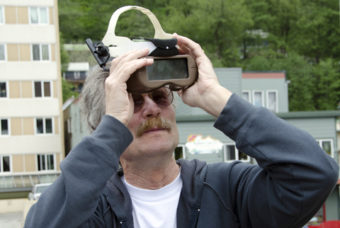
Clark Branch adjusts the eyepiece on a 10 inch Newtonian Reflector Telescope.
Clark Branch adjusts the eyepiece on a 10 inch Newtonian Reflector Telescope. Branch is the vice president of Friends of Marie Drake Planetarium and has been a volunteer for more than 8 years. (Photo by Heather Bryant/KTOO)

High clouds in Juneau today (Tuesday) mostly obscured the roughly twice-a-century transit of Venus across the sun.
“If the sun was the size of a beach ball, Venus moving across the sun would be about the size of nickel,” Marie Drake Planetarium Director of Programs Ken Fix says, describing what could have been seen from Juneau, if there were no clouds blocking out the sun. “So, you’re actually going to be able to see it, even if you just use a filter and you don’t look through a telescope.”

Fix and other amateur astronomers from the planetarium were at Marine Park during most of the 7-hour transit, waiting for a break in the clouds. But alas, despite a few teases, the sun never made much of an appearance.

Venus actually comes between the Earth and the sun five times every eight years. But because their orbits are on different planes, Fix says Venus usually misses passing over the sun’s disk as seen from Earth.

“Venus’ orbit differs from ours by about three and a quarter degrees,” he says. “And it’s only when we lap each other, with Venus on the inside track on the same side of the sun, that we have the possibility of a transit. But we have to be on the same zero line reference to the sun. And that only happens every 105 or 113 years, depending on what part of the cycle we’re in.”

That means it won’t happen again until December 2117. Maybe the sun will be out in Juneau by then.

New DNA tests could help map human migration

An earlier DNA study sponsored by SHI took place at Celebration 2008. Photo by Brian Wallace/SHI.

A new genetic-testing effort could provide more information about the connections Tlingits and Haidas have with other tribal groups. A University of Pennsylvania expert is in Southeast to collect DNA samples. He’s hoping for cooperation from those attending this week’s Celebration 2012 cultural festival in Juneau.


The effort is part of a larger project analyzing the genetics of indigenous North American groups.

Principal Investigator Theodore Schurr says it could ultimately map out human migration routes, as well as link tribes.

“So we’re slowly being able to put together … data to see the more deeper history questions, the connections between communities here with those across all of North American on the broader and deeper scale. But also some of these more regional or even tribally based questions which I think are already understood or are being examined through linguistic studies, historical studies and also oral histories and the work being done by the tribes themselves,” Schurr says.

Schurr will be at Juneau’s Centennial Hall during Celebration 2012, which runs Thursday through Saturday. He’s working with the Sealaska Heritage Institute, which organizes the event.

No one is required to participate. Those interested will have the insides of their cheeks swabbed to provide DNA samples. Those will be analyzed, and what’s learned will be shared with the volunteer. The information will also contribute to the larger research project.

A similar genetic testing effort was conducted in 2008 by Washington State University. Schurr says this project will examine additional elements.

“We are taking, I think, the same approach as the earlier study, although analyzing perhaps a number more markers for the maternal lineages and the paternal lineages,” Schurr says.

DNA samples have already been collected in Yakutat and Hydaburg. The effort at Celebration will reach people from many other communities.

Schurr hopes to expand the effort to other villages. But he’s collecting more than cheek swabs.

“Ultimately DNA evidence will tell you a lot about genetic lineages. But why people bear certain genetic lineages has to have some sort of context for interpreting that,” he says.

Those providing DNA samples will also be interviewed about their genealogy. Schurr says that, and other information, will allow for a higher level of analysis.

“It makes a big difference to have geological evidence, oral history information, the archeology or so forth. Because that tells us something about the context in which people have come to live in a place sometime, who they’ve come into contact with, and how far and wide they might have dispersed because of environmental factors (such as) glaciers, or volcanoes, or things of this sort. And how in fact the diversity we see in certain places may be linked with the languages they speak,” he says.

Work done so far has shown some differences between members of the Eagle and Raven moieties.

Sealaska Heritage Institute President Rosita Worl, an anthropologist, has suggested the two groups were once members of different populations.

“I saw an earlier paper that he did where he begins to see that there is a difference and he was working with limited groups of people. But I think this will give him a larger population level to look at. I’m very hopeful,” Worl says.

She says the institute examined Schurr’s project carefully before agreeing to participate.

“I wanted to make sure that there would be no commercial use, that it would be for the specific purpose of this study. And if they were going to use it for other studies, they would have seek the permission of the donor and if the donor should die, that his or her heirs would make that decision,” she says.

Results should be available this year. Schurr says volunteers will find out about their individual data before group information is made public.

Learn more about the University of Pennsylvania’s Genographic Project: Molecular Genetic Analyses of Indigenous Populations of North America.

Central Council addresses Southeast sea otter issue

Southeast Alaska’s largest tribal organization is pushing for changes in sea-otter management.

Tlingit-Haida Central Council delegates passed an otter resolution at their tribal assembly last week in Juneau.

Sea otter numbers are growing exponentially in Southeast. Council President Ed Thomas says that’s damaging stocks of some key species.

“They seem to be raising havoc around many of our communities. And not just subsistence, but also the divers who go after sea cucumbers and sea urchins,” he says.

Alaska Natives are allowed to hunt otters and give or sell them to other Natives. Proposed legislation would allow whole pelts to be sold to non-Natives.

Thomas says the council wants to do more to slow population growth. But its concerned expanded sales could compete with otter products in the handicraft market.

Tlingit-Haida Central Council President Ed Thomas.

“We don’t want to export anything that will undermine the local utilization. But where there is a potential for surplus we would like to still get some of those exported in the raw and to set up a system whereby they would be able to bring those back, competing with local artisans,” Thomas says.

He says the council is already trying to work with federal officials on otter management issues.

Council delegates also elected officers at the assembly.

Thomas outpolled former Sealaska CEO Bob Loescher to retain the president’s seat, which he’s held for most of the past 30 years. Loescher was named Citizen of the Year.

Six incumbent vice presidents were also re-elected. Thomas says it’s the first time the full Executive Council has gone unchanged.

Funding prospects are always a major topic at the tribal assembly. Thomas says they’re not looking good.

“It’s really very difficult to get into a growth scenario when we have cutbacks. I think there might be some opportunity in energy programs. But, boy, everything else is under fire,” he says.

Thomas expects federal-funding reductions that could lead to staff and program cuts. He says that would start with administrative spending, but likely move into other areas.

Other news from the tribal assembly:

  • Delegates also approved a resolution strongly opposing the exclusion of Alaska Native tribes from the Violence Against Women Act. The federal act is currently going through a re-authorization. The council says the current version of the VAWA (H.R.4154, H.R.4271 and S.1925) discriminates by singling out all Alaska Native tribes with the exception of the Metlakatla Indian Community, and removes the pre-existing authority of Alaska Native tribes to issue civil protective orders.
  • Delegates re-elected 1st Vice President William Micklin of San Francisco, 2nd Vice President Robert Sanderson Jr. of Ketchikan, 3rd Vice President Yodean Armour of Klawock, 4th Vice President Richard Peterson of Kasaan, 5th Vice President Harold Houston of Juneau, and 6th Vice President Lowell Halverson of Seattle.
  • Ed Thomas presented Mary Elizabeth Jones with the President’s Lifetime Achievement Award for her many contributions towards improving healthcare services for Tlingit and Haida people and strengthening Alaska Native women’s political positions within their communities.
  • The Doloresa Cadiente-Hardin Tribal Justice Award was presented to its first two recipients: Tribal Child Support Unit Attorney Jessie Archibald and Alaska Legal Services Corporation Attorney Holly Handler.

Skiing the Sacred Head Waters

Julia Nave rides a pristine slope in the Savred Head Waters region.

A young Juneau woman and four other Americans are on their way home from a six-week tour of British Columbia’s remote Sacred Head Waters to raise awareness of potential development.

Twenty-four-year old Julia Nave is among four 2010 Colorado College graduates, who – armed with cameras, notebooks and a Young Explorers grant from National Geographic – have been exploring the wild headwaters of the Skeena, Nass and Stikine international rivers, considered endangered by some scientists, conservationists, and local communities.

“Part of our skiing trip is to document the winter landscape and to also just try to connect to the area and explore what it has to offer as far as winter recreation and other potential uses,” she said as the team left in mid-February for their adventure. “In British Columbia there’s a lot of awareness about the area and the local people are very aware of what’s happening.”

Back-country skis were the preferred mode of transportation. But Nave says the first 62 miles of hauling in gear were just a slog.

“It really felt like a pilgrimage, sort of, to a land we’d never seen,” she said Monday from Hazelton, B.C., where she was boarding a train for Prince Rupert to catch an Alaska state ferry to Juneau.

Much of the area the group explored and skied is Tahltan Indian territory, some of it slated for mining and oil and gas development, and made even more complicated by land disputes.

“And (there’s) a lot of still disputed land between Tahltan and the Canadian government. And the oil and gas companies, mining companies, who are going to bring in a lot of money with their mineral tenures, just adds another piece of complication,” she said.

First Nations people depend on the salmon from the rivers, and the Tahltan have been actively protesting some of the development. After interviews with elders and local conservationists, Nave says it’s clear they are not anti-development, but want it “done right.”

Forest ecologist Dr. Jim Pojar, of Smithers, B.C., has said the dash to the B.C. transboundary region is like a “gold rush mentality.” He’s among scientists who have petitioned the B.C. government for better control of resource development in the region, where the rivers support all five species of Pacific salmon that sustain Alaska and British Columbia commercial, sport and subsistence fisheries.

Nave says the winter explorers of the Sacred Headwaters will turn their stories and pictures into a film for National Geographic and blog discussions for other sponsors.

Right now, after camping most of the last six weeks, she’s just looking forward to sleeping in a real bed.

Nave is a 2005 graduate of Juneau-Douglas High School and a former Juneau ski racer.

Site notifications
Update notification options
Subscribe to notifications