Science & Tech

Engineers study 2011 Japanese earthquake to prepare Northwest for the Big One

Two major earthquakes last year raised red flags for seismically-active parts of North America. Some of the damage in Japan and New Zealand resulted from a phenomenon called liquefaction, which turns the ground turns into Jell-O-like quicksand.

Transmission towers topple, buildings sink and utility pipes break. Now, geologists in the Pacific Northwest have mapped the spots most likely to liquefy in an earthquake.

Soil liquefaction tilted many houses like this one in Urayasu, Japan.
Soil liquefaction tilted many houses like this one in Urayasu, Japan. (Photo by Tom Banse)

This summer, the sound of hydraulic jacks reverberates through upscale neighborhoods near Tokyo Bay.  Look closer, and you’ll notice some of the homes here are tilted.

We’re in the suburb of Urayasu, home of Tokyo Disneyland. This area escaped tsunami damage. But the district suffered major damage from soil liquefaction.

Darren Chen of the Tokyo Institute of Technology explains what happened.

“This soil liquefaction is due to the fact that you have high water table in this region.”

Chen says much of Urayasu is built on fill. It is land reclaimed from the sea making it prone to liquefaction.

“It usually occurs in sand, in fine sand deposits,” Chen says.

When the earth shook for minutes on end, water pushed upward under pressure. The ground turned to sludge or quicksand.

Mini mud geysers erupted in the yard and street at 77-year-old Toru Kawahara’s house.  Well over a year after the quake, he’s still cleaning up silt that flowed into his home’s ground floor.

Kawahara’s house is structurally sound, but the whole thing settled off kilter. The back corner is nearly two feet lower than the front. All over town, water and sewer connections broke. People had to use porta-potties for months afterwards.

Urayasu, Japan homeowner Toru Kawahara describes damage caused by the March 2011 earthquake.
Urayasu, Japan homeowner Toru Kawahara describes damage caused by the March 2011 earthquake. (Photo by Tom Banse)

“We knew that if an earthquake came, this area would be weak since it’s a landfill,” Kawahara says. “I used to work in the structural engineering industry, so I had some knowledge. If an earthquake were to come, this land probably wouldn’t make it. But we didn’t think with this earthquake was big enough.”

Kawahara’s home is more than 200 miles away from the earthquake epicenter. It was the long duration of shaking, not its severity, that started the cascade of damage.

The major population centers of the Pacific Northwest lie a similar distance from the likely origin of our Big One. That’s why a reconnaissance tour of liquefaction damage in Japan made a big impression on earthquake engineer Scott Ashford of Corvallis. Ashford is now interim dean of Oregon State University’s College of Engineering.

“For these large magnitude-9 earthquakes, we can see liquefaction over hundreds of square miles,” he says. “And for us, that would mean as far as the I-5 corridor.”

Ashford fears we could end up in far worse shape than Japan since the Japanese prepare better for earthquakes than anyone else. He says it’s not a gap that can be fixed overnight.

Ashford figures it will cost billions of dollars to strengthen all of the Northwest’s vulnerable bridges, schools, fuel depots, fire stations, etc.

Defenses against liquefaction include compacting or “densifying” the soil before construction or installing stone columns or pilings beneath a foundation.

“We can’t just stick our head in the sand… and let it liquefy,” Ashford says. “What we’ve got to do is understand where we are, accept that risk and then slowly start mitigating — and understand that it will take a few decades to get where we need to be.”

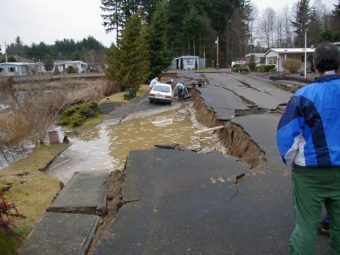
Soil liquefaction and lateral spreading in Tumwater, WA after the 2001 Nisqually Quake.
Soil liquefaction and lateral spreading in Tumwater, WA after the 2001 Nisqually Quake. (Courtesy of UW College of Engineering)

Step one is figuring out where the greatest vulnerabilities lie.

Oregon, Idaho and Washington have all received federal grants to map liquefaction susceptibility.  The Idaho Geological Survey has posted such maps for the Boise area, Idaho Falls to Rexburg, and Teton County. Washington State has completed a statewide hazards map that is searchable online.

In Oregon, the Department of Geology’s chief scientist Ian Madin has finished a similar digital statewide map and says it will go online soon.

“People will be able to go to this web map. They’ll be able to type in their address.  The map will fly them to their backyard. They’ll be able to see their house,” Madin says. “Then they can turn on shaking hazard layer or they can turn on the liquefaction potential.”

In Oregon, the valley areas most prone to liquefaction also happen to have the highest concentrations of people and industry. But Madin also says, “Your house is not going to collapse and kill you because of earthquake shaking in most instances simply because of the way that homes in the Pacific Northwest are constructed.”

“So what people really need to think more about is their community. Where is their water supply coming from? Where’s the fire station? Where are the critical facilities?”

What Madin is talking about is “community resilience,” the ability to bounce back quickly from natural disaster. Right now, committees of experts in both Oregon and Washington are drafting detailed recommendations for highways, utilities, fuel supply and commerce.

The planning process hasn’t gotten much attention yet, but the final price tag for better preparedness likely will.

UAF gets grant to study how Alaskans are adapting to changing environments

The University of Alaska Fairbanks will hire eight new scientists thanks to a $20-million dollar grant from the National Science Foundation.

The award, announced Tuesday, will fund a five-year, interdisciplinary project focusing on how Alaska communities adapt to environmental and social change. It’s being dubbed the Alaska Adapting to Changing Environments, or ACE program.

A total of 47 researchers will focus on three regions of the state. In Southcentral, scientists will examine the effects of land cover and precipitation changes on fisheries and tourism in the Kenai River watershed. Researchers in Northern Alaska will look at how subsistence is affected by thawing permafrost. Here in Southeast, the focus will be on glacial recession near Juneau.

UAF Vice Chancellor of Research Mark Myers and UAA biology professor Lilian Alessa will serve as co-directors.

Pacific Lost and Found: Tsunami Debris Project curated online

Found Harley-Davidson
Studio photo of a Harley-Davidson motorcycle belonging to a Japanese owner that was found washed ashore on British Columbia’s Haida Gwaii. Photo courtesy of Maritime Museum of British Columbia.

The Maritime Museum of British Columbia in Victoria is curating an online exhibit of debris from last year’s tsunami in Japan.

Museum executive director Jon Irwin says they thought that all the potential flotsam headed to the coast would be a relevant part of their maritime history. Although a few items have washed ashore in the Pacific Northwest over the last several months, the bulk of the debris is believed to still be in the middle of the Pacific Ocean. Most of the tsunami debris is expected to arrive along the eastern Pacific coast sometime over the next two years.

Irwin says they’re focusing on some of the sentimental items that may be found. Some examples include the recently found soccer ball and Harley-Davidson motorcycle.

“Take a picture of it. Upload it,” said Irwin. He hopes that will spark discussion and identification of the items that could eventually lead to their repatriation.

Although Irwin said the Museum does not plan to be actively involved in the physical disposition of any items, they may be able to provide connections that could lead to a sentimental item’s return to Japan.

To follow along with their ongoing curated exhibit on Facebook, search for Tsunami Debris Project and “Like” the site.

The Maritime Museum’s website includes a clearinghouse of tsunami information.

Related story: Search for tsunami debris moves north
Related story: Senators say more money needs to be allocated for debris clean up

State wants to be informed on water treatment

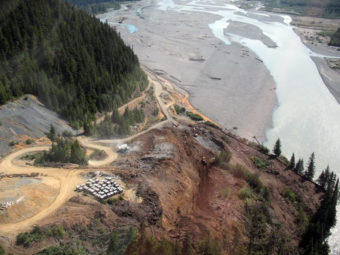
Aerial view of the Tulsequah mining area.
Aerial view of the Tulsequah mining area. (Photo via Chieftan Metals website)

Alaska mine regulators want to be informed on Chieftain Metals’ plans to treat acid rock drainage at the old Tulsequah Chief Mine in British Columbia.

As KTOO has reported, the company shut down its interim water treatment plant last month due to unanticipated costs, telling Canadian regulators it needed to improve plant operations as well as raise money to run it.

In a letter this week to Chieftain, Alaska Large Mine Coordinator Kyle Moselle urged the company to quickly resolve the problems and bring the plant back online.

“And as they’re working through those challenges and working to bring it back on line, I would appreciate it if they kept me in the loop so that I can be responsive to interested public and agencies on this side of the border,” Moselle said.

Acidic water has been draining out of the old mine into the Tulsequah River, a tributary of the Taku River, for more than 60 years. When Chieftain purchased the property two years ago, it inherited the problem and the B.C. government’s requirement to clean it up.

The state has no jurisdiction over the project, but regularly conveys Alaska’s concerns to Canadian environmental officials, including the Taku River’s importance to the commercial, sport and subsistence salmon fishery.

“We’re not regulating this mine; we’re essentially looking over the fence on a project happening in our neighbor’s yard,” Moselle said. “So I want to be kept in the loop on what’s happening, sure, because we want them to be responsive to our concerns about potential downstream effects.”

Chieftain installed the water treatment plant last fall; it’s been operating since December. B.C. environmental officials say water quality from the old mine was significantly improved while it was running. But the company says it has spent more than $9-million on the plant. Chieftain has reduced the number of workers at the mine site while it looks for ways to reduce the costs of operating the facility.

In an email response to Moselle, Chieftain Metals’ Chief Operating Officer Keith Boyle quoted a company news release about the suspension. Boyle also said he would keep Moselle informed as the company works the bugs out of the water treatment system and secures financing for it.

Mine critics call Boyle’s response “totally inadequate,” but Moselle says he’s satisfied. He hopes to get the same information Canadian regulators get from the company.

Last year Juneau’s legislative delegation created the Taku River Task Force to gather information about possible industrial development in the watershed. Rep. Beth Kerttula says the delegation is watching the latest developments as the company continues to study re-opening the old mine, which is likely the solution to ending the acid rock drainage.


Orphaned Beluga calf dies

Update: The rescued calf has died. A necropsy to determine cause of death has been scheduled for this afternoon. The calf was rescued on June 18 and was being cared for at the Seward SeaLife center.

Original Story:
Marine mammal specialists from across the country have descended on an Alaska aquarium to help care for a baby beluga whale that became separated from its mother shortly after its birth.

The male calf is under 24-hour care at the Alaska SeaLife Center in Seward, being fed by a stomach tube while learning how to suckle from a bottle.

“He’s currently doing very well, swimming on his own and he has been from the first time he got here, learning to take food from a bottle, which has been challenging,” said Tara Riemer Jones, the center’s president and CEO.

Caretakers at the Seward SeaLife Center feed the orphan calf. (Photo courtesty of the Seward SeaLife Center)

It’s believed to be the first baby beluga rescue in the United States, at least since federal record keeping began in 1972, she said. Other attempts at rescue resulted in calf deaths or in one case, the calf being returned to its pod.

It’s such a rare event that specialists have been helping with the animal’s care, including staff members from the Georgia Aquarium in Atlanta, Shedd Aquarium in Chicago and SeaWorld in San Diego.

“It’s actually a pretty unprecedented event in certain ways,” said Dennis Christen, the Georgia Aquarium’s director of animal training who was in place 29 hours after the calf arrived in Seward.

The whale was estimated to be 2 days old when it was found near South Naknek, in Alaska’s Bristol Bay, on June 18. Officials believe a storm likely separated the calf from its mother.

Tim Lebling, the Alaska SeaLife Center’s stranding coordinator, flew to South Naknek that afternoon to retrieve the calf.

It was flown 90 minutes back to Seward in dry transport. Lebling said the calf was placed on an air mattress in the plane, positioned so its weight wouldn’t put pressure on vital organs, and then constantly covered with wet towels.

Lebling said it was touch-and-go for the first part of the flight, probably because of stress.

“We thought he took his last breath at one point,” Lebling said, but then he breathed again.

Even though the beluga is still in critical care, caregivers are guardedly optimistic about his rehabilitation.

Survival odds for an animal this age coming into a stranding program are low, said Brett Long, the husbandry director at the center.

“We take it a day at a time,” he said. “We’re very happy to see that we appear to be meeting its nutritional goals and that it’s maintaining its weight, and we’re seeing slow, incremental weight gain.”

Caretakers estimate the calf was around two days old when he was rescued. (Photo courtesty of the Seward SeaLife Center)

The calf is now about 5 feet long and weighs 115 pounds, up 5 pounds since his arrival.

The biggest worry now is the calf’s immune system, which is insufficiently developed because it did not receive any of its mother’s milk.

“We are working with other aquariums to provide supplements that will help aid the development of that immune system, but it’s a waiting game,” Long said.

Jones said there is nothing specifically wrong with the calf medically “other than he’s young and at high-risk.”

“We’re not going to say it hasn’t been without some bumps in the road,” Christen said. “We’re very confident we’re on the right path here, but it’s still an animal that’s in critical care, and we have to be guarded in our optimism, and we’re just hopeful we’re on the right path.”

At the center, the calf has its own pool with toys and constant human companionship. At least three caregivers are with him 24-hours a day, two of them in wet suits and in the pool.

He often will rub up against his human handlers, who also help him learn new swimming patterns and play with him.

He’s being kept out of the public’s view for now in a pool being fed warmer water and in a sanitary environment. The hope is to move him soon to a larger pool, which can be seen from behind glass inside the Alaska SeaLife Center.

It’s running about $2,000 a day to care for the calf, and that’s not including the cost of the visiting marine mammal specialists.

Jones said the cost will strain the private, nonprofit research center’s stranding program budget for the year, and officials are talking with potential donors and possibly setting up a donation matching program for individuals. They’re also planning a 5K Wildlife Rescue Run on Aug. 4, encouraging virtual runners to sign up online to raise funds.

If the calf survives, he’ll never see the open ocean again since there is no way now for humans to teach him survival skills.

The National Marine Fisheries Service will eventually decide where he will be placed.

“There are a number of facilities that would make a great home for this young whale, with companion animals that would likely accept him into their kind of family unit,” Christen said.

Since facilities that take in animals like to be part of the naming process, the Alaska SeaLife Center hasn’t given the calf a name, yet.

But that hasn’t stopped most everyone caring for him from calling him “Naknek.”

NOAA crew surveys beaches for tsunami debris

Marine debris is nothing new, and a NOAA crew found little of note in last week’s survey of outside Panhandle beaches.

Beginning in Ketchikan, five scientists from the National Oceanic and Atmospheric Administration hit 36 sites, looking for debris from the March 2011 tsunami that hit Japan.

They mostly found common stuff, including a lot of Styrofoam.  But large oval black, yellow and orange buoys turned up on 26 of 36 beaches.

“They were pretty ubiquitous throughout our survey area,” lead scientist Jacek Maselko said.

Maselko describes them as molded hard plastic with rings on either end.  Some had English, some Japanese writing.

Jeep Rice of  NOAA’s Auke Bay Lab, says they’re not fishing gear, and likely part of the Japanese fish farming industry.

“So the aquaculture farms with lots of nets and oysters and other things attached were swept up in the tsunami, and these would be the buoys that survived so to speak,” he said.

Rice said the buoys were about two feet in diameter and three and a half to four feet tall, and could support a lot of weight.

“These would be flying really high in the water so to speak, so they’re going to be easily taken by the wind and pushed by the wind further then say the water currents would take them,” Rice said. “Where there’s a conflict of the current versus air or current versus wide, these are going to be taken by the wind.”

The scientists also found a number of five-gallon jugs that appear to contain some type of waste oil.  Some were empty, others broken up, some still had liquid contents.  With no labels for a clue, Rice says the NOAA lab is trying to figure out what the substance is.

“One of them looks like of soapy-like.  I don’t know if that’s maybe kitchen grease and soap, or oil, or did it come out of a transmission? We don’t know” Rice said.

While some notable things have washed up in the Pacific Northwest  from the Japanese tsunami — such as a Harvey Davidson motorcycle, a dock, and the so-called ghost ship sunk in April by the Coast Guard —  Maselko says most of the stuff the NOAA scientists catalogued may have been dumped in the ocean or found its way there years ago.

“We don’t know.  Even finding a ball with name on it, you never know somebody just didn’t lose it playing beach volleyball in years past,” Maselko said. “That’s where the tough part of the proof comes in.”

The scientists will next survey beaches in the Yakutat area. Maselko says he intends to canvass as much of the Gulf of Alaska shoreline as possible this summer, looking for tsunami debris.

Site notifications
Update notification options
Subscribe to notifications