Science & Tech

Can cruise ship wastewater be made cleaner?

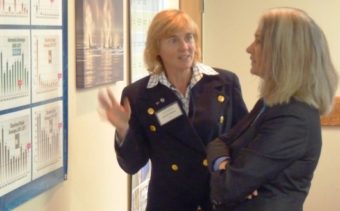
Science panel member Michelle Ridgway and Juneau Rep. Cathy Muñoz talk during the Cruise Ship Science Panel's technology open house Sept. 20 in Juneau.
Science panel member Michelle Ridgway and Juneau Rep. Cathy Muñoz discuss wastewater data during the Cruise Ship Science Panel’s technology open house Sept. 20 in Juneau.

Listen to iFriendly audio

A report that could change the way cruise ships handle wastewater is nearly done. A state science advisory panel met Sept. 19-21 in Juneau and shared some of its work with the public.

Alaska’s Cruise Ship Science Advisory Panel has spent about two years looking at options for cleaning up wastewater. That includes discharges of harmful bacteria, dissolved metals and other pollutants.

Some ships already use systems that can meet elevated standards. Some do not, while  others only discharge outside state enforcement boundaries.

The 11-member group finished its work on a preliminary report during its Juneau meeting. But the document still must undergo review. Division of Water Deputy Director Andrew Sayers-Fay says he hopes it’s available to the public by November 1st.

State Cruise Ship Program Manager Rob Edwardson says it’s an important step in a process started by the Legislature in 2009.

“The science advisory panel is using the preliminary report as a tool to assist and advise the commissioner on his report to the Legislature that’s due Jan. 1st, 2013,” Edwardson says.

A technology open house that was part of the science panel meeting presented the history of cruise ships in Alaska and current water-quality issues.

An informational poster on display during the Sept. 20 science panel’s technology open house.

Edwardson says one is exploration of current cruise-ship systems.

“The second is the availability of additional methods that are economically feasible and technologically effective. And the third is the environmental cost and benefit of implementing any additional methods that they may find,” he says.

The feasibility issue is part of the Legislature’s charge to the panel. That led to examination of water-cleaning systems not yet used on the ships.

Sitka’s Steve Reifenstuhl represents the United Fishermen of Alaska on the science panel.

“We have looked at technology that is used in land-based facilities. There isn’t technology that has been used on cruise ships that can do that at this point. That’s not to say that it’s not feasible in the future – at a very high cost,” Reifenstuhl  says.

Higher standards were called for in a 2006 Cruise Ship Initiative approved by voters, which also created a passenger head tax. (Hear a report on that initiative.) The panel was established as part of a compromise that delayed full enforcement.

Cruise lines argued the standards could be met by allowing discharges to be diluted through mixing zones. Basically, that means sampling water a distance from the ship, rather than from the discharge pipe itself.

Seattle environmental compliance analyst Lincoln Loehr represented the industry on the panel. He says water-cleaning systems in use now are about as good as it gets.

“I don’t see that there is convincing information on the effectiveness of these additional add-ons to consistently meet the water-quality criteria at the end of the pipe,” Loehr says.

Mixing zones, or other forms of dilution, are methods opposed by clean-water activists. (Hear a report on the mixing zone controversy.)

Loehr’s specialty is permitting municipal and industrial wastewater systems. He says cruise ships can make better use of mixing zones than land-based treatment plants.

“The criteria may be met for a municipality within 20 minutes or so. For cruise ships, when underway, they’re going to be met within less than 10 seconds,” Loehr says.

Critics say that would only spread out, not reduce damage to the marine environment.

Representatives of several companies selling water-treatment systems were at the open house.

Erik Neuman of California-based Rochem Membrane Systems says dilution is a key issue that could set an international precedent.

“And that is really the big question that the panel has and that Alaska has is to set that dilution level at a proper level that will really be the basis for other states and other countries to utilize in the future,” Neuman says.

The science panel also includes a marine ecologist, a government inspector, a ship-builder and an environmental engineering professor. Some members declined to comment after state officials instructed them to avoid lengthy interviews with reporters.

Reifenstuhl, who holds the panel’s fishing industry seat, says he’s optimistic about the final results.

“The goal is to protect Alaska’s waters and I think the science panel is going to come out with a report that will do that,” Reifenstuhl says.

The panel’s report to the Legislature is formally a preliminary document. But it’s unclear what might change between its release and the deadline for a final report two years later.

An informational display shown during the Sept. 20, 2012, science panel meeting.

Cruise ship water-treatment technology under review

What’s the most effective and economically feasible method of curbing water pollution from large tour ships?
Alaska’s Cruise Ship Science Advisory Panel meets in Juneau this week to try to answer that question. Members will also review a preliminary report to the state Department of Environmental Conservation.

A membrane bioreactor wastewater treatment plant for installation on board a cruise ship. Courtesy Hamworthy Water Systems.

Rob Edwardson manages DEC’s Cruise Ship Program.

“The report will cover their analysis of the information that they’ve collected for existing and additional systems and methods,” he says.

Lawmakers delayed strict new wastewater discharge limits in 2009 while appointing the panel to consider developing and available technology. Its 11 members represent industry, government, fishing, coastal communities and other interests.

The panel will meet Wednesday and Friday at Juneau’s Goldbelt Hotel. Edwardson says a Thursday session at nearby Centennial Hall will present choices and issues.

“The technology workshop is for members of the public to be able to walk through and look at a number of different displays that detail the history of cruise ships in Alaska, the cruise ship wastewater issues and the panel’s work from the past two years,” Edwardson says.

The panel’s final report is due in 2015. Meanwhile, the Department of Environmental Conservation is developing a new permit for cruise ships that discharge wastewater within state maritime boundaries.

Click here to read the meeting agenda.

Group asks Federal Court to order a deadline for listing of ringed, bearded seals

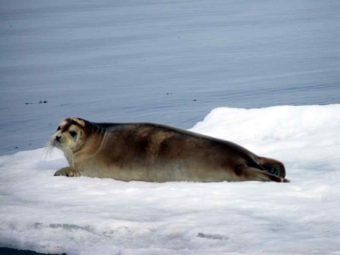
Bearded Seal in Svalbard
Bearded Seal. (Creative Commons photo by Alastair Rae)

The National Marine Fisheries Service has not followed through on its findings that two species of seals should be listed under the Endangered Species Act.  The Center for Biological Diversity asked the Federal Courts on Wednesday  to order a specific date by which bearded and ringed seals be listed.
In documents filed with the courts on Wednesday morning  the Center said – quote – “this mandatory deadline is necessary to ensure the continued survival of ringed and bearded seals in the wild.”

The center originally petitioned the listing in 2008.  After several delays  the Marine Fisheries Service published its own findings that agreed with the petition  and proposed the listing.

Rebecca Noblin, the Alaska Director for the Center,  said that publication in December of 2010 set a one-year deadline for completion of the listing.

“In December of 2011, they issued a public notice saying they were going to take six more months to just make sure their science was right and to have more peer review.  So that would have put them out to June of 2012.  Since then, we haven’t heard any word for why the delay is,” Noblin said.

The court papers say that the lack of the endangered listing will result in irreparable harm to both species.

“Climate change is really, really altering the arctic quickly.  As we’ve seen, this is the lowest sea-ice year ever since we’ve been recording sea ice.  And sea ice is absolutely essential for these seals.  The time to act is now, and NMFS has said that’s it’s planning to act.  And under the Endangered Species Act it’s required to go ahead and finalize the listing decision so we can start getting some protections in place,” Noblin said.

Julie Speegle, with the National  Marine Fisheries Service,  said work on the listing is ongoing, but she is not allowed to comment on litigation.

Study: Otters help combat global warming


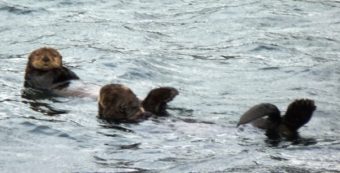
Sea otters rest in waters near Sitka. A new study says otters help kelp growth, which reduces carbon dioxide, which causes climate change. Photo by Ed Schoenfeld.

Click here for iFriendly audio

A new study is adding another dimension to the sea otter debate. The research shows the marine mammals help reduce carbon dioxide in the atmosphere, a major contributor to climate change.

Jim Estes remembers taking a look around the bottom of Sitka Sound about 20 years ago.

“When we were diving in that area back in the early 1990s, the sea floor was just covered with urchins and there was virtually no kelp,” Estes says.

“Two years ago, when we went back and looked at the same sites, there was not an urchin to be found and there was kelp everywhere.”

Estes is a professor of Ecology and Evolutionary Biology at the University of California campus in Santa Cruz.

His latest research takes a look at kelp forests, and how much carbon dioxide they absorb. The otter connection comes because they eat sea urchins, which in turn eat kelp.

Working with existing data and other researchers, Estes took a look at coastal waters with no sea otters and those with a full population.

“The effects of sea otters in that system on carbon dioxide concentrations would be significant. And by significant, I mean whether or not you have otters in the system would account for roughly, approximately 10 percent of the total carbon. That’s a lot,” he says.

And by cutting carbon dioxide, otters also reduce ocean acidification, which results from CO2 dissolving in water.

“That’s a whole other area of work that we and others have been looking at. And if, for example, you look at pH, which is a measure of acidification, and you measure it inside a kelp forest and then a couple hundred yards away, it’s always higher within the kelp forest, which means the acidification level is lower,” he says.

He says the CO2 changes would be in affected coastal areas, not worldwide.

Otter populations are booming in Southeast Alaska. And that’s brought a lot of attention from fishermen, economic analysts and biologists.

“I heard about this research a couple years ago when [preliminary] findings were presented at a scientific conference. And we do work with one of the authors of the study,” says Verena Gill, the U.S. Fish and Wildlife Service biologist who headed up Southeast population studies.

That research shows 12 percent annual growth in the southern part of the region, and 4 percent in the north. Other coastal areas, such as Kachemak Bay near Homer, have seen even larger increases.

She says the new report is good research.

“I just think it adds another piece to the puzzle of the many jobs that sea otters do in a healthy marine ecosystem,” Gill says.

The new study focuses on waters from southern British Columbia to the end of the Aleutian Islands. Southeast and most other areas lost their populations to Russian and American hunters about a century ago. Otters were reintroduced to the outer coast almost 50 years ago.

In an earlier interview, Phil Doherty of the Southeast Alaska Dive Fisheries Association said their rapid spread and voracious appetite hits his members hard.

“The areas that are most affected are the areas that have the largest food source. And those are the species that we harvest … sea urchins, sea cucumbers and geoduck clams,” Doherty says.

Sea otters are a protected species and only Alaska Natives can hunt them. There are also strict limits on how their pelts can be sold. Some commercial fishermen and Native groups have called for measures allowing more to be harvested.

Otter supporters have fought for continued protection in part because kelp forests offer shelter that boosts salmon, herring and rockfish populations.

The new research adds to those arguments. But Estes doesn’t want to exaggerate impacts on the planet’s overall carbon dioxide level.

“It’s going to be pretty small. We haven’t made that calculation, but this is just a teeny little part of the world. So I don’t think the story really is relevant on a global scale. It’s just demonstrates a process on a local scale,” Estes says.

Ester co-authored the study with Chris Wilmers, another U.C. Santa Cruz professor, as well as researchers from other schools, including the University of Alaska Fairbanks.

The study first appeared in the publication Frontiers in Ecology and the Environment.

Earlier reports:

Feds try to clarify rules on use of sea otter

Central Council addresses Southeast sea otter issue

Otter measure drops whole-pelt sales provision

Report says sea otters hitting dive fisheries hard


Scientists search for reason of Cook Inlet beluga decline

Photo courtesy of NMFS National Marine Mammal Laboratory

Scientists studying Cook Inlet belugas have watched the dramatic decline of their numbers from 1,300 in the 1970s to only 300 now.

Biologists, state and federal officials, commercial fishermen and oil and gas developers all speculate about why the belugas haven’t rebounded after they were put on the endangered species list in 2008. But there are no concrete answers.

David Martin is the President of the Cook Inlet Drift Association or UCDA. Martin has been fishing in Cook Inlet for more than 40 years. He thinks food availability for the whales isn’t the issue, saying there is plenty of salmon and eulachon for them to eat. He thinks the decline started with over harvest by subsistence hunters in the 1990s that took the animals too far down.

“And in that same time frame the orca whales, which feed on belugas were increasing in numbers, and the combination of the two, I think have kept the beluga numbers at a low level,” Martin said.

But National Marine Fisheries Service biologist Barbara Mahoney says while there are records of some predation by orcas on beluga whales, there’s nothing that indicates it happens frequently. Instead, NMFS is looking into a wide range of other possible causes of the Beluga’s decline, including industrial development in the inlet that causes noise and possible habitat impacts during calving time. She says they have studied pollutants in the whales bodies but the tests don’t point to a smoking gun.

“For most of the contaminant load study, they are lower than the healthy population in the Chukchi Sea belugas,” Mahoney said.

Bob Shavelson is the advocacy director for Cook Inletkeeper. He says contaminant tests need to search for drugs being flushed down toilets and making their way into the bay.

“One of the concerns is what are called emerging pollutants and these are things like pharmaceuticals and birth control pills and Viagra and even in very, very low amounts these pollutants can have adverse effects on marine life,” Shavelson said.

Shavelson says the EPA’s secondary treatment exemption for the Anchorage Sewage system that allows the city to essentially screen out the solids and add chlorine to the effluent before discharging into the Inlet is a problem. He says the EPA should not treat Cook Inlet like an ocean.

“EPA has failed to characterize Cook Inlet as an estuary. An estuary is a place where fresh water and salt water meet, I mean clearly it meets a definition of an estuary, which brings about an entirely different set of rules, instead EPA says ‘oh no, it’s an ocean and as an ocean it can assimilate a lot more pollution.’ It all comes down to legal definitions and basically a predetermined outcome,” Shavelson said.

Creative Commons photo by Claude Robillard

Shavelson also has concerns about toxins being dumped into the inlet from the oil and gas development industry. But Barbara Mahoney says all of the studies that have been conducted on Cook Inlet belugas and their environment are not conclusive and the reasons behind the lack of a rebound are just not clear.

“You know it’s a great mystery and I think everyone would like to have one point and say this is it and if we fix this we would have the animals recovered, recovering but it could be just a blend of possibilities of why. Everything adds a little more weight to why they can’t recover right now or maybe it’s just taking longer or there might be something that we don’t know at this time and we’re hoping to find out,” Mahoney said.

Funding is a problem and NFMS is working to get more money to investigate the belugas in greater detail. The annual survey results on the estimated numbers of the whales will be out in November. A new report looking at contaminant loads is also due later this year.

Warm Arctic sets record for summer sea ice melt

Scientists say critical ice in the Arctic Ocean melted to record low levels this overheated summer.

The National Snow and Ice Data Center reported Monday that the extent of Arctic sea ice shrank to 1.58 million square miles and is likely to melt more in the coming weeks. That breaks the old record of 1.61 million square miles set in 2007. Figures are based on satellite records dating back to 1979.

Data center scientist Ted Scambos says the melt can be blamed mostly on global warming from man-made emissions of greenhouse gases.

Scientists say Arctic sea ice – ocean water that freezes – helps moderate temperatures lower on the globe and is crucial for polar bears. Greenland has also had record melt this year.

Site notifications
Update notification options
Subscribe to notifications