Science & Tech

Salmon fill Auke Creek with shorter, earlier runs

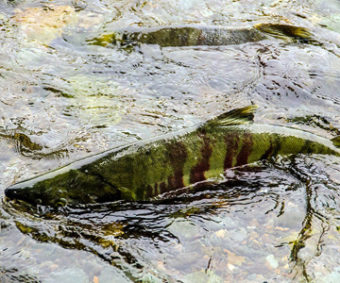
Auke Creek salmon are running earlier and for fewer days than 40 years ago, according to decades of research.
University of Alaska Southeast biologist David Tallmon combed through data on sculpin, salmon and salmon relatives at the Auke Creek weir.

He says the temperature at Auke Creek has raised 1.34 degrees Celsius since 1971. Salmon are sensitive to temperature changes.

Tallmon told an Evening at Egan audience Friday that animal species will sometimes move north when their habitat warms, but Alaskans rely on steady local salmon runs.

[quote]“If you’re a commercial fisherman, or a subsistence fisherman, if salmon move up to the Beaufort Sea, that’s of little comfort. What you want to have is salmon in your local stream so you can harvest them,” Tallmon says.[/quote]

Researchers have counted Auke Creek salmon runs for the last four decades.  The weir funnels the fish into a place where they are counted before continuing their migration. Tallmon says most Pacific salmon migrate earlier now than they did 40 years ago. He says in the 1970s salmon runs lasted 79 days, now they migrate for about 55 days. Sockeye are the only salmon that buck this trend.

Tallmon’s study of Auke Creek pink salmon indicate that some had a gene that told them to migrate late in the season, which kept them from breeding with salmon that migrated earlier. Now there is no late migration. Tallmon says over the years, warming temperatures may have hurt salmon with that gene, causing them to lose a little of the genetic diversity that buffers them from a changing environment.

Such changes mean that salmon predators, such as bears and humans, have to harvest the season’s return in less time. Tallmon says Auke Creek salmon are part of a community that stretches to the ocean, and all the species salmon encounter along the way are going through similar environmental changes. 

“It’s important to not think about these species in isolation, but the species that they eat and that eat them as well, and that how they’re going to respond to climate change is also going to influence the success of salmon,” Tallmon says.

But Tallmon says the Auke Creek salmon are as abundant now as 40 years ago.

[quote]“We’re also fortunate in the sense that Alaska salmon have it fairly easy. It’s not like the fish down south, there’s not huge impacts from the 4 H’s – hydropower, hatchery, habitat and harvest. I mean obviously we have harvest here, but we’ve also got our habitat largely intact and we don’t have that much influence from hydropower or hatcheries,” Tallmon says.[/quote]

In the future Tallmon plans to tie the Auke Creek research to data from other weirs to see what the trends are elsewhere. He says it could be difficult to expand the study. Other weirs have data gaps, or are more influenced by hatchery fish.

Tallmon says Auke Creek could be the only weir with decades of continuous information.

Can small wood-gas systems lower energy costs?

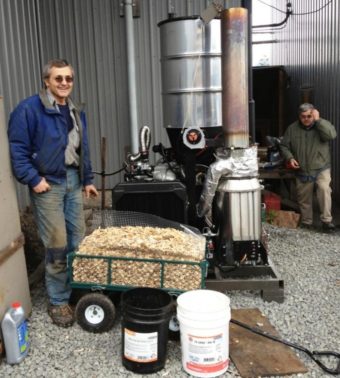
Wes Tyler, left, stands by a new wood gasifier at Icy Straits Lumber in Hoonah. John Hillman of the Hoonah Indian Association is on the right
Wes Tyler, left, stands by a new wood gasifier at Icy Straits Lumber in Hoonah. John Hillman of the Hoonah Indian Association is on the right. Photo courtesy Sealaska.

Wes and Sue Tyler run Icy Straits Lumber & Milling in Hoonah, about 40 miles west of Juneau. They make log cabin kits, siding, beams and other finished products out of Southeast Alaska wood.

But high energy prices have increased operating costs. A particular problem is equipment used to dry damp wood.

So Wes watched closely as a new system using wood chips to generate electricity was turned on earlier this month.

“All of a sudden the engine comes to life and we’re able to go in and turn on all the lights in the building and a fan that was pushing some warm air around in the dry kiln and with a few more KWs involved, why you could ultimately have the dry kiln running on that sort of fuel,” Tyler says.

The system is called wood gasification.

It’s part of an experiment to see if compact devices – this one is 4 by 4 by 8 feet high – are a viable alternative to oil-powered systems.

So far, the generator at the Tylers’ has been working fine.

Sealaska Executive Vice President Rick Harris, speaking at a press briefing in Juneau, says Icy Straits Lumber is the right place to try it out.

“He’s already got the wood supply there. He has the technical know-how to deal with these kinds of things. But based upon his experience then we can see if we can transfer this type of technology to other areas,” Harris says.

In fact, a second unit is also being tested at the mill, for eventual use at a Hoonah tourist attraction.

Wood gasification is not new technology. It’s been around, in one form or another, since the late 1800s. Small gasifiers were even used to power cars, trucks and trains in German-occupied territory during World War II fuel shortages.

How they work is not that complicated.

“So what we do in a gasifier is burn part of the wood and generate heat, which converts the solid to a gas,” says consultant Tom Miles of Portland. He worked with Sealaska’s Haa Aaní subsidiary and Icy Straits Lumber to select and install this particular system.

“And then the mixture of the gas with charcoal solids further reduces the fuel to a fuel gas. And the fuel gas is about half nitrogen, about 20 percent carbon monoxide, and about 20 percent hydrogen. And that will burn in an internal combustion engine,” Miles says.

Sealaska’s Rick Harris talks about wood gasifiers at a Thursday press briefing while consultant Tom Miles listens. Photo by Ed Schoenfeld.

It’s not as efficient as gasoline or propane. And it won’t replace hydropower. But if wood scraps or leftovers from milling or thinning trees are easily available, it can be cheaper.

Miles says it can take about a third off the cost of a diesel-powered generation. (Read more about wood gasifiers.)

“We will be not only generating electricity but we can capture waste heat from the engines so it’s micro-scale combined heat and power [system],” he says.

Sealaska’s Harris says a Hoonah lodge-owner has already shown interest in the system.

And the corporation is working with the Icy Strait Point tourist attraction, which is owned by Hoonah’s village Native corporation, to use gasification to power and heat a cultural center, and eventually, a greenhouse.

“It’s one of those things where in the summer they have a lot of visitors come in. So we can grow in the greenhouse certain plants and vegetables that they can use. And then in the winter when they’re not using it, we can move that stuff into the Juneau market or the local market,” Harris says.

Sealaska and its consultant have looked at a lot of gasification options. Harris says the Hoonah experiments will show whether they chose the right technology.

“In a month, Wes may tell us this just isn’t going to work. I think we’re fairly optimistic that it will work. But that’s why we’re doing it in a place where we have the ability to make the necessary adjustments and to prove it can work in a rural community environment,” he says.

Sealaska’s energy experiments have been funded in part by the federal Department of Energy and other sources.

It’s already heating its Juneau headquarters with a wood-pellet boiler, which is cheaper than diesel heat. It also considered building a waste-wood ethanol plant at Ketchikan’s Ward Cove, but concluded it wasn’t economically feasible.


Climate Politics: It’s Laugh Lines Vs. ‘Not A Joke’

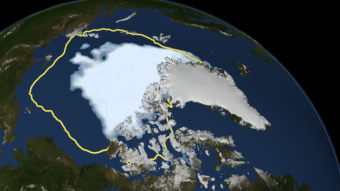
This Sept. 16 image released by NASA shows the amount of summer sea ice in the Arctic, at center in white, and the 1979 to 2000 average extent for the day shown, with the yellow line. Scientists say sea ice in the Arctic shrank to an all-time low of 1.32 million square miles on Sept. 16, smashing old records for the critical climate indicator.

Scientists view climate change as one of the world’s most pressing long-term problems. But the issue has barely surfaced in the U.S. presidential race. President Obama has taken steps to address climate change during his time in office. Republican challenger Mitt Romney would not make it a priority in his administration.
In fact, as Romney stood on the stage to accept his nomination at the Republican National Convention, he used global warming as a laugh line.

“President Obama promised to begin to slow the rise of the oceans,” he said, pausing for the applause and laughter to rise, “and to heal the planet.”

Romney promised an administration that would instead focus on taking care of American families. Obama rebutted that comment at the Democratic National Convention a week later.

“Change is not a hoax,” he said. “More droughts and floods and wildfires are not a joke. They are a threat to our children’s future. And in this election, you can do something about it.”

In fact, Obama came into office with climate change as one of his major issues. At international talks in Copenhagen, he pledged to reduce U.S. emissions by 17 percent over 2005 levels by the year 2020. At that meeting and since, he pressed to get more aggressive action out of China, India and the world’s other biggest carbon dioxide emitters.

But the president’s plans didn’t make it past strong Republican opposition in Congress. So instead, he has settled for actions the president can take without congressional action.

“First there was the stimulus, which is the largest ever investment in clean energy technology, really hoping to jump-start that sector,” says Carol Browner, who is an adviser to the Obama campaign on energy and climate issues, and former administrator of the Environmental Protection Agency. She runs down a quick list of accomplishments: “The first ever greenhouse gas standards for cars, the power plant requirements — proposed new power plant requirements — as well as more efficient appliances.”

These don’t add up to the 17 percent reduction the president aspired to at the Copenhagen climate talks. Browner says he will keep trying to make incremental changes.

So this is an issue where the candidates sharply disagree.

The president sees action on climate change as creating new jobs in the clean-energy sector.

Romney sees cheap energy as the best energy. He doesn’t even mention climate change in his energy plan, which is overwhelmingly about increasing production of fossil fuels.

The Romney campaign would not provide a spokesman for this report. But the campaign’s domestic policy adviser, Oren Cass, did address these issues at a debate at MIT, which was webcast by E&ETV.

“Gov. Romney’s position on climate change is very straightforward, which is that the United States taking action unilaterally is not able to address what is a global problem,” Cass said.

And since China is still building more coal-fired power plants every week, Cass argues that having the U.S. cut emissions is a waste of effort.

He also opposes what was once a Republican-backed idea: Put a price on carbon pollution to encourage the free market to develop technologies that are better for human health and the global environment. He says pricing carbon won’t work.

“What it is going to do is hurt our economy very seriously,” Cass says, “and is going to drive a lot of industrial activity from the United States to countries that are, frankly, less efficient in their use of energy.”

And less efficient countries produce more carbon dioxide, potentially making the problem worse.

So, in essence, the Romney position is that climate change won’t be a priority because it’s too hard to solve. The one action the campaign has advocated is spending more federal dollars for research on climate science and renewable energy.

That’s a contrast with President Obama, who argues that developing clean energy is good for the U.S. economy — and important on the world stage, where climate change is regarded as a very serious issue.

UAF’s new research vessel launches out of dry dock

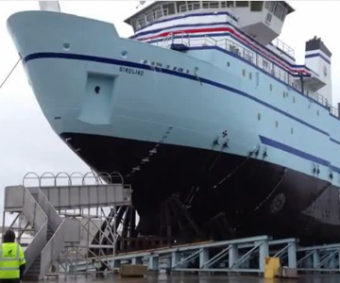
The University of Alaska Fairbanks realized a dream over the weekend, with the launch of a new arctic research vessel.  The 261 foot Sikuliaq splashed into a river feeding Lake Michigan in Marinette, Wisconsin Saturday.  The 200 million dollar vessel project is largely supported by federal economic stimulus funding. The ship is owned by the National Science Foundation and will be operated by UAF.    The launch culminated decades of planning and advocacy by the university.

It doesn’t take long for a big ship to go from dry dock to afloat.

The Sikuliaq slid sideways from a steel cradle at the Marinette Marine Corporation ship yard into the Menominee River in matter of seconds, a dramatic splash capping a project that took 40 years to get there.

“One of the things that characterizes us is persistence and that paid off,” Vera Alexander says.

Alexander and fellow UAF emeritus marine science professor Bob Elsner are co-sponsors of the ship, who pushed the project throughout long careers at the university and into their retirements.

“We’d been through three major designs of vessels. Each one went to the model testing and there was no money to continue. But the National Science Foundation supported all of these efforts over the years. If it hadn’t been for them it would never have happened. We were on the final design, we had just about got it ready, when the stimulus monies came along and NSF got a bunch and there we were. We were in,” Alexander says.

Alexander and Elsner’s feelings about finally getting the ship transcend simple gratification.

“I would say that is a fairly honest expression of our enthusiasm,” Elsner says.

The pair played key roles at Saturday’s launch, during which cold, wind and rain reduced the expected crowd, and made it tough for Alexander to carry out the ship’s christening. The first bottle of champagne slipped from her hands and it required a few hits to break a backup bottle over the bow.

“It was really hard, I had these gloves on. The second time was better,” Alexander says.

Elsner had it easier, simply pushing a button that released the ship.  Elsner, a marine mammal biologist who long worked with Alaska Native seal hunters, recounted how they helped him settle on a name for the new ship.

“These guys scan the horizon, and they said ‘well this is first year ice and our name for that is sikuliaq.’ And I though gee that’s kind of a nice name,” Elsner says.

The Sikuliaq is designed to travel its namesake waters, first year ice in the arctic and Antarctic.  U.A.F. Chancellor Brian Rogers says the ship’s capacity will broaden research opportunity.

“This ship is special because it’s ice strengthened. It has the ability to go through up to three feet of new ice in places we have not been able to go before on longer voyages, and to really host a large quantity of scientists–nearly two dozen scientists on board. Wonderful laboratory facilities and the ability, using telecommunications, to communicate with students back in the classroom as well,” Rogers says.

The Sikuliaq is the National Science Foundation’s first new ship since 1981.  During a speech at the launch ceremony, N.S.F. Director Subra Suresh recognized the vessel’s significance given increased focus on the arctic.

“At a time when there is a significant change in recorded history that we observe in Alaska, in the arctic area, significant economic, scientific, and other interests-commercial interests in the arctic, nothing could be more timely than the launch of the Sikuliaq at this point,” Suresh says.

The Sikuliaq replaces the NSF’s retired ship the Alpha Helix, which was home ported in Seward, just like the Sikuliaq will be.  U.A.F.’s Seward based Sikuliaq project manager Dan Oliver says it’s a major step up.

“They used to call the Alpha Helix the Ralpha Helix because it rolled so bad. The Sikuliaq has a much better hull shape for heavy weather conditions. In addition, it has an anti-roll tank system to help dampen out the roll when you get into heavy sea state,” Oliver says.

Oliver says the biggest chunk of the ship’s 12 million dollar yearly operating budget is fuel, and being able to stay at sea increases efficiency.  Oliver is also excited about the Sikuliaq’s sophisticated gear and technology, including the latest in sampling and scanning equipment.  U.A.F School of Fisheries and Ocean Sciences Director Mike Castellini says research projects are already in cue for the Sikuliaq’s first season in 2014.

“There’s one already scheduled to go in July and August back and forth across the Canadian border to bring up deep-water fish from that region, which there’s no ship that can do that right now. So the scientists are so excited. In fact, their answer to me the other day was ‘can’t we have the ship tomorrow? Let’s do it tomorrow instead than 18 months from now.’ Everyone’s really chomping at the bit for it,” Castellini says.

The Sikuliaq has a ways to go before it’s ready for full on service.  The ship will remain in Marinette for outfitting and testing before sailing through Lake Michigan, out the St. Lawrence Seaway, and into the Atlantic next year. It will undergo sea trials and then go through the Panama Canal and up the west coast to Alaska.  It’s scheduled to arrive in Seward in early 2014.

Tsunami debris may be caught in Gulf of Alaska, spun out to shore

iFriendly Audio

Sub Tropical Convergence Zone

Washington researchers have come up with new estimates of debris from last year’s tsunami in Japan. Of course, not all of it is expected to come across the Pacific Ocean.

“The dominant part of that floating debris may never even make landfall,” said Ian Miller, coastal hazards specialist with Washington Sea Grant.

Based on previous research, Miller expects much of the debris will end up in the Pacific Sub-Tropical Convergence Zone. “What’s known colloquially as ‘The Garbage Patch’,” said Miller.

There will still be a significant amount of debris that avoids the Zone and could eventually roll up on the Alaska coast. Miller was co-author of a report last month that was based on available peer-reviewed marine debris literature. It was intended to provide more-detailed information for those managing clean-up activities.

“How many dumpsters do we need to have on certain beaches? How many volunteers may we have to mobilize? Those are the kind of questions that we were trying to help managers grapple with,” said Miller.

Drifters

Japanese estimates of debris washed out to sea range as high as 5-million tons. Of that, about 1.5-million tons may not sink and instead be carried into the Pacific, either pushed by winds or carried by currents. Miller says there’s a lot of uncertainty in those numbers. He says they then considered results of 14,000 satellite-tracked drifting drogues that roamed the global ocean and Dr. Curtis Ebbesmeyer’s research of container ship cargo knocked overboard. That was used to fine-tune assumptions on tsunami debris that might make landfall, as low as 2-percent to as much as 25-percent. That’s comes out to as much as 131 tons of debris for every mile of shoreline. But it’s more likely within a range of .5 ton to 6.7 tons per mile in Washington state and it could be spread out over multiple years.

Higher concentrations may head for the southern Alaska coastline after the debris is caught in a counter-rotating Gulf of Alaska gyre and is then spun out to shore over time.

Report on Debris Accumulation Scenarios in Washington State from the March 2011 Tohoku Tsunami.

No surprise: September wetter than normal

September ended and October began cool but with some sun. Snow could be seen in the mountains. Photo by Casey Kelly.

Twenty-seven of 30 days in September were rainy in the capital city, according to the National Weather Service.

Just over 11-inches of rain fell, more than 2.38 inches above normal September rainfall of 8.6 inches.

Normally September and October are Juneau’s rainiest months, but this year the nearly constant rain began in May.

Take heart, says forecaster Rick Fritsch, it was actually rainier in British Columbia.

“With as cool as our summer has been, the jet stream never really got as far down to the south as it normally should go. As a consequence a lot of those storms that are being driven or steered by the jet stream were being steered into the west coast of North America — something halfway between the typical winter locations and the summer locations. So we had it bad certainly, but British Columbia got a soaking even worse than we did this summer,” he says.

Average temperature in Juneau was .04 degrees below normal.

As for the last day of the month, the first frost of the season hit in several parts of the Mendenhall Valley. Even at Juneau International Airport, the official climatology site for the borough, the overnight low dipped to 38 degrees.

New snow also fell in the mountains, even a few flakes at the top of Eaglecrest.

If the cool, wet summer and early autumn are a predictor of winter, it could be another good snow year. But Fritsch says an El Nino is forecast this winter.

“The El Nino is when the surface of the sea water right around the equator on the west coast of South America is the tongue of warmer than normal water that extends to the west along the equator,” he explains. “And then through lots of interactions between the oceanography and meteorology, what that translates into for us up here on the Gulf of Alaska, is a warmer than normal winter time seasonal temperatures.”

Fritsch says you can’t conclude anything from knowing it’s an El Nino year.

“There’s also this thing called the Pacific Decadal Oscillation which is related to the sea surface temperature in the Gulf of Alaska. And for over 18 months now, we’ve been in a negative PDO, which translates into cooler than normal ocean surface temperatures in the Gulf of Alaska,” he says.

Predicting what all these patterns mean for Juneau winter is “like playing the roulette table in Las Vegas,” Fritsch says.

Site notifications
Update notification options
Subscribe to notifications