Science & Tech

Quake wakes SE residents, tsunami warning issued for outer coast

Sat Jan 05 09:02:28 UTC 2013 event picture

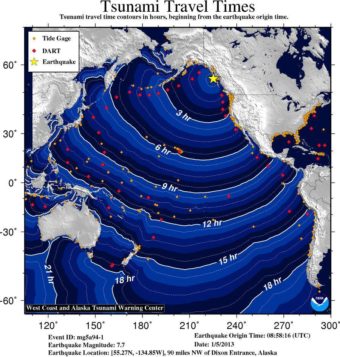
A major earthquake Friday night shook Southeast Alaska residents awake and prompted some in coastal areas to move to higher ground after warnings of a possible tsunami.

The West Coast and Alaska Tsunami Warning Center reported that the 7.5 magnitude earthquake occurred at 11:58 p.m. Alaska time Friday.

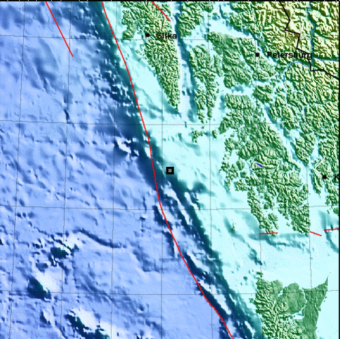
The epicenter was located 75 miles northwest of Dixon Entrance, or about 63 miles west of Craig or 208 miles south of Juneau. The quake occurred at a depth of 3.1 miles.

There were no reports of any significant damage or injuries.

GCI released a statement saying the earthquake damaged fiber optic lines serving Wrangell. The company said a crew had arrived in the community Saturday to repair the damage.

A tsunami warning was initially issued for the coast of Alaska and British Columbia ranging from Cape Suckling down to the northern tip of Vancouver Island. Full evacuation of those areas was suggested.

A tsunami advisory was issued for the coast of Alaska ranging from Cape Suckling to Kennedy Entrance and for the Pacific Northwest Coast from the northern tip of Vancouver Island to the British Columbia-Washington border. Residents were advised to stay away from shore.

Officials in Sitka and on Prince of Wales called for an evacuation of low lying areas. Bleary-eyed Petersburg residents drove or walked up the hill to the local ballfields, the post office, and airport.

Chris Cook was working the night shift at downtown Petersburg’s Scandia House Hotel when the earthquake hit.

“I haven’t felt an earthquake before so I actually thought it was a wind gust,” Cook said. “But then I realized that wind would have been louder and doesn’t shake things quite on the inside.”

A wave of a half-foot was reported in Port Alexander at 1:07 a.m. Alaska time and a wave of a few inches was later reported in Sitka.

At 1:17 a.m., the tsunami advisory was canceled for the coastal areas of British Columbia from the Washington-British Columbia border to the north tip of Vancouver Island, British Columbia.

The City of Craig reported at about 1:45 that they were closing the tsunami evacuation points. A minor tidal surge was experienced, but no tsunami damage was reported.

At 1:58 a.m., tsunami warnings and advisories for all of Alaska, British Columbia, and Washington coastal areas were cancelled by the West Coast and Alaska Tsunami Warning Center.

In an analysis published online by the U.S. Geological Survey shortly after the quake, geologists said Friday night’s shaker was related to last October’s 7.8 magnitude Haida Qwai earthquake. The more-recent earthquake was the result of shallow strike-slip faulting near the plate boundary between the Pacific and North America plates, and it broke a fault approximately 50 kilometers in length and slipped about seven meters.

The Pacific plate is moving northwestward with respect to the North America plate at a velocity of 51 millimeters per year. U.S.G.S scientists say that area of the plate boundary has hosted eight earthquakes of magnitude 6 or greater over the past 40 years.

As of 12:30 p.m. on January 5, at least thirteen afterschocks ranging in magnitude from 3.5 to 5.1 have been recorded in the same area.

Midnight earthquake shakes Juneau

Update:

The U.S. Geological Survey says the magnitude 7.5 quake struck at midnight Friday Alaska time and was centered about 60 miles west of Craig, Alaska.
The tsunami center says a tsunami with a “significant widespread inundation of land is expected.”

The first wave was expected around 1:15 a.m. (2:15 a./m. PST) in Craig, and 2:50 in Cordova, further to the north.

The center says widespread dangerous coastal flooding is possible.

Reports from Sitka so far don’t indicate any sizable waves.

——————

That rumbling that started at approximately midnight was an earthquake roughly 50 miles south of Port Alexander and 70 miles west of Craig. The preliminary information from the Alaska Earthquake Information Center pegs the quake as a 7.2 in magnitude.

There is a tsunami warning in effect for the coastal areas from the northern tip of Vancouver Island to Cape Suckling, Alaska, approximately 75 miles southeast of Cordova.

An advisory is in effect for areas along the coast between Cape Suckling to Kennedy Entrance approximately 40 miles southwest of Homer.

So far there are no reports of damages in Juneau.


This is a developing story. Check back here for details.

Small but insignificant increase in Cook Inlet belugas, NOAA reports

Belugas
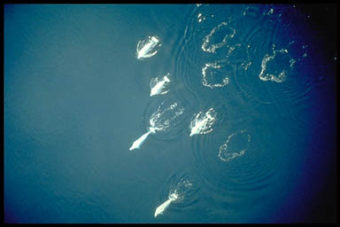
Beluga whale pod. Photo courtesy NOAA’s Alaska Fisheries Science Center.

The number of endangered Cook Inlet beluga whales is up a bit from last year, but not enough to indicate a turn-around in the population’s slow decline.

That’s according to the National Oceanic and Atmospheric Administration’s Alaska Fisheries Science Center, which announced Thursday that the 2012 whale population is 312 animals, up from 284 in 2011. During the past ten years, the number of belugas has ranged from 278 whales to a high of 366.

In the 1970s, the population was an estimated 1,300.

NOAA scientists say more research is needed, but a 2011 review and assessment describes a number of sub-lethal stresses on Cook Inlet belugas. Those include pollution, diminished habitat, and changing water temperatures.

The agency is developing a recovery plan for the Cook Inlet beluga whale, which in 2008 was listed as endangered under the Endangered Species Act.

Report: Dispersants used after blowout had few ill effects

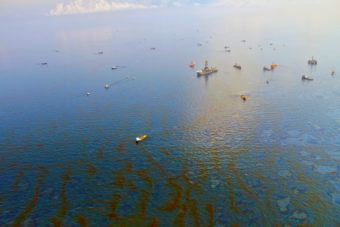
Deepwater Horizon oil well in the Gulf of Mexico. (Photo courtesy Green Fire Productions)

The Deepwater Horizon blowout of 2010 marked the first time that chemical dispersants were injected into an oil spill underwater. Now a report from government scientists finds remarkably few ill effects from these chemicals. That has heightened concerns of several Native groups, and others who have been pushing for tighter regulation of dispersants.

Lead author of the report, Doctor Jane Lubchenko, the head of the National Oceanic and Atmospheric Administration, was a key advisor to Environmental Protection Agency head Lisa Jackson when she made the decision, shortly after the blowout, to allow them to use dispersants underwater.

“It was our judgment that use of dispersants would help the oil be naturally biodegraded more naturally, and that certainly seems to have been the case” Lubchenko said.

Nearly two million gallons of dispersants, mostly Corexit, were used on the spill, close to half of it underwater while the oil and gas was gushing out of the wellhead and the broken pipe a mile deep in the waters of the Gulf of Mexico.

The result was a sort of undersea fog of droplets of oil mixed with Corexit. Just months later, scientists couldn’t find the fog, and there is some evidence that oil eating micro-organisms ate it. Depending on which scientist you talk to, it’s either gone or it made its way to the bottom and is still percolating through the food chain. The report says the location of the fog has yet to be determined.

But what if a spill happened in cold arctic waters? Would dispersants do the same thing? That’s a question everybody wants the answer to. The industry and government laboratories have just begun research to try to get answers. Cheryl Rosa is deputy director of the Arctic Research Commission, which recently issued a set of recommendations for what needs to be done to improve arctic oil spill response capability:

“The amount of dispersant that was applied in Deepwater Horizon was unprecedented,” Rosa said. “It was basically the world’s supply, from what I understand. And we need to be extremely well informed with respect to the Arctic about how that’s going to work. If they get applied, what the toxicity issues are, what the community concerns should be and hopefully this new research will start to get at some of those some of those questions.”

Jane Lubchenko and the co-authors of the Deepwater Horizon science report talk about a public perception problem about the safety of seafood from the Gulf of Mexico. The government had a series of fisheries closures near the spill site and within a year re-opened all the fisheries. Lubchenko says the evidence for contamination just never showed up.

“We did learn a lot about that and discovered that in fact the fishes in particular, we were not able to find levels of dispersants in them after they had been swimming around in the ocean for awhile.”

She was quick to add that shellfish would not metabolize the chemicals as fast as finfish. She went on to say that any adverse effects that might have been found would not have been included in her report — because such damages are still the subject of litigation.

“Our papers don’t talk about consequences of dispersants because we don’t know that yet and the information that may be in hand, may be part of the legal proceedings,” Lubchenko said.

There is evidence on the record that oil mixed with dispersants is more toxic than oil on its own, particularly to larvae of marine life. And along the northern shores of Alaska, with their biologically rich lagoons, Cheryl Rosa says the questions about what such mixes could do are critically in need of answers.

“Basically dispersants get applied, drive oil into the water column where it is broken down to parts and pieces,” Rosa said. “They’re trying to figure out what the consequences of wide scale use of dispersants are. And that’s a work in progress as far as I can tell. And as far as the arctic goes, that question is still very open. It’s something in need of research.”

In August, Earthjustice and other environmental organizations sued EPA to force tighter regulation of dispersants. Then last month, a number of scientists and doctors joined several Alaska Native organizations in petitioning the EPA to ban Corexit or any other dispersant of undisclosed composition.

Lubchenco stepping down from top NOAA post next year

NOAA Administrator Jane Lubchenco will not be part of Obama administration’s second term. The Commerce Undersecretary for Oceans and Atmosphere told her staff Wednesday that she will be leaving the post early next year.

“I announced to the NOAA family today that I’ll be leaving at the end of February,” she said. “So I’m really proud of all we’ve been able to accomplish and can leave knowing things are in good hands, cause there’s a lot more to be done.”

Lubchenco helped lead the administration’s response to the Deepwater Horizon spill in the Gulf of Mexico and is responsible for fishery policies and marine mammal management, as well as the National Weather Service.

The National Oceanic and Atmospheric Administration’s support for expanding quota share programs for fisheries has been controversial in Alaska.

Before going to work for the administration, Lubchenco was a professor of marine ecology at Oregon State University, and a longtime advocate for science and science communication to the public.

She says she will continue those efforts.

“I envision myself continuing to play a role in being a champion for science and for use of science especially in making environmental decisions,” she said.

“The scientific information helps us do a better job managing fisheries so they can be sustainable, in protecting healthy ocean and ocean ecosystems, because we depend on them for so much. And if we want to be good stewards then the scientific information can help us understand how to do that.”

Lubchenco is a former President of the American Association for the Advancement of Science and has been part of President Obama’s science team.

Fun with physics at the Roller Coaster Riot

The floor of the Juneau Arts and Culture Center is a mess of construction paper, tape and elaborate design drawings.

There are no rules at the Roller Coaster Riot. Students are given kits that include various tracks, loop-de-loops, funnels and corkscrews, and told to use their imaginations to create a roller coaster that gets a marble from point A to point B.

“First we got 30 minutes to plan, and then we went over there to that table and got the paper, some scissors, and some tape,” says nine-year-old Brianna McKeel. She’s standing next to her group’s creation, “The Dolphin,” so named because the twin starting tracks at the top resemble a dolphin tail.

McKeel goes to Riverbend Elementary School, but for this project she’s working with students from other schools around the Capital City. As part of the Juneau School District’s Extended Learning Program for gifted students, they’ve been learning about physics, specifically Newton’s three laws of motion.

“The first law is an object in motion stays at motion unless a force acts on it,” McKeel says. “And Newton’s second law is an acceleration of an object is related to the force applied on it and is inversely related to its mass.”

That second law is expressed in the formula f = ma, or as the kids learn it, “F equals mama.”

McKeel also recites Newton’s third law: For every action – or force – there is an equal and opposite reaction. In a paper roller coaster, she says there are two forces at work on the marble.

“The force is from the gravity, like us dropping it, and [from] the way our tracks are tilted,” she says.

Ten-year-old Auke Bay Elementary School student Ben Ng says his group’s roller coaster, “The Ultimate,” went through several redesigns to get the right combination of forces acting on the marble.

“In one of our first designs we had a flat track and a loop-de-loop, and the ball barely made it up the loop-de-loop,” Ng says. “So we had to make more speed.”

Ng says they solved the problem by making their roller coaster taller.

“Gravity forces the ball to go down, and it builds up more momentum, so it goes faster,” he says.

Amy Jo Meiners is an Extended Learning teacher at both Auke Bay and Riverbend Elementary Schools. She says Roller Coaster Riot is a great way to teach kids physics at an early age.

“They have to use critical thinking skills and be creative in their problem solving,” Meiners says. “And it’s a great set up to do that.”

The activity is a partnership between the school district and the Juneau Economic Development Council. JEDC’s STEM education program is designed to expose kids to concepts and activities that lead to careers in science, technology, engineering and math.

The Roller Coaster Riot activity is partially funded by a grant from NASA.

Site notifications
Update notification options
Subscribe to notifications