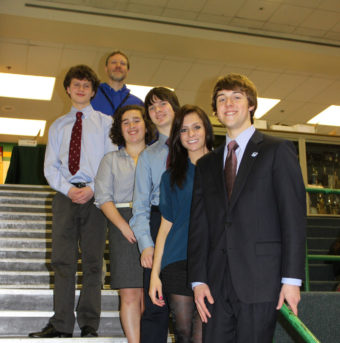
Team Pogonophoraphobia of JDHS, from front to back: Sam Kurland, Olivia Raster, Johnny Elliott, Ruby Steedle, Johnny Connolly and coach Ben Carney. Photo courtesy Sharice Walker.
A group of Juneau Douglas High School students won the Alaska Tsunami Bowl last weekend in Seward.
The final round of the annual marine science competition pitted Team Pogonophoraphobia from JDHS against the Mat-Tsunamis from Mat Su Career & Technical High School in Wasilla.
The Juneau-Douglas team, consisting of Johnny Connolly, Johnny Elliott, Sam Kurland, Olivia Raster and Ruby Steedle, will represent Alaska at the National Ocean Sciences Bowl in Milwaukee, Wisconsin in April.
The competition consisted of both a research project, including a 20-page paper and 20-minute oral presentation, and a timed quiz style match with two teams facing off against each other.
Teams from 17 schools participated in the competition, including one from Juneau’s Thunder Mountain High School.
The Alaska Forum on the Environment held its 15th annual conference last week in Anchorage, bringing together people in business, rural and urban Alaska, science, and tribes. Sessions covered everything from oil spill response, and youth-led projects, to invasive species.
Moderator Justin Wilson, a retired Cheeshna tribal council member, says the goal of a session on climate change was to let tribal participants know that the kinds of events they’re seeing are part of a widespread pattern:
“People have a tendency to live in silos. And this discovery is so new they don’t talk about it. But today, people have come out and started saying it’s here and it’s all over the state,” Wilson says.
In his own area, eastern Interior Alaska, Justin says warmer temperatures are allowing plants to grow at higher altitudes:
“Over the years, long-term, we’ve watched the vegetation go up the sides of the mountains a thousand foot at a time. When I was about fifteen, we’re talking 3500 foot level for greenery, now at 5500 foot, which is near the passes where the ice used to be. That’s one change,” Wilson says.
Tina Tinker, of the Aleknagik Traditional Council, in the Bristol Bay region, remembers when fish were so plentiful nets quickly became heavy with salmon:
“One year they had a really good salmon subsistence. Our net was sunk and we had to have three skiffs bring that net up to Aleknagik. That was more than two hundred fish. It fed the whole village. Now we get 20 fish here, 30 fish there,” Tinker says.
Mike Brubaker, of the Alaska Native Tribal Health Consortium says surveys of villages across the state are showing changes that can affect health:
“We see new challenges for water safety and supplying water and building sustainable infrastructure to provide water all across the state and a really big issue for Alaska Natives is the ability to harvest foods,” Brubaker says. “We’re seeing around the state harvest failures and more and agencies and the research community is looking very closely at climate change as one of the contributing factors.”
Brubaker says surveys in communities across Alaska also show mental health effects — such as anxiety, fear, and grief over flooding, forest fires, storms, and food loss.
Victoria Hykesteere, an Alaska Pacific University assistant professor of Alaska Native studies, says different communities are going to be facing different issues. She urges people to start conversations in their communities to come up with local solutions:
“The pride in taking ownership of finding our own solutions is really critical long term to how we adapt to what’s happening. It’s a great way to encourage our young people to see themselves as capable, as real human beings with their own kind of knowledge and beauty. We don’t have to mimic what everybody else is doing. We don’t have to be everybody else. We can keep our communal society intact but we have to choose to do so,” Hykesteere says.
The Alaska Forum on the Environment conference wrapped up Friday.
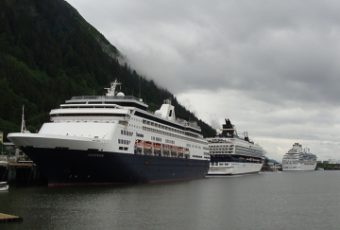
A bill sponsored by Gov. Sean Parnell to relax cruise ship wastewater standards passed the House on Monday. House Bill 80 was approved on a 27 to 9 vote. A similar measure is nearing a floor vote in the Senate.
In committee hearings on the measure, much of the testimony has focused around a preliminary report by the Cruise Ship Wastewater Science Advisory Panel. The report concludes that cruise ships have gone as far as possible toward meeting the state’s standards, and that there’s little benefit to the environment to be gained – even by spending millions more on technology.
A member of the majority opinion on the Science Advisory Panel stands by that claim, but the co-author of the 2006 ballot initiative which imposed the standards disputes it.
Haines resident Gershon Cohen’s background is in molecular biology. He’s frustrated by how proponents of the bills are framing their argument.
Well the department’s trying to say they’re doing this on the basis of the best science. And that’s completely backwards. The best science are the water quality standards – those are the limits which have been found, through scientific experimentation, to provide protection for fish, or humans, or whatever standard you’re using.”
In this case, the standard is for marine organisms. Cohen calls the administration’s effort to relax wastewater standards risk management, not science.
That’s a black-and-white world. And we don’t live in a black-and-white world.”
Sitkan Steve Reifenstuhl has been on the Cruise Ship Wastewater Science Advisory panel since 2009.
It’s important to look at the context. If we applied these standards to the City of Sitka, the Blue Lake dam would look cheap.”
Blue Lake is priced at roughly $140-million, the most expensive project in Sitka’s history. Reifenstuhl is a biologist, and a pragmatist.
The effluent and the waiver that every city that’s on the ocean’s gotten – from Anchorage to Ketchikan – puts out way more effluent, even the metals (they don’t even have to document nickel and zinc) copper, ammonia. It’s many times what the cruise ships put out.”
Gershon Cohen was initially appointed to the science advisory panel, but his name was pulled three weeks before the group convened, because of opposition from the industry, he says. Cohen, who co-wrote the language in the initiative that created the panel, says it was supposed to be looking at alternative technologies, like reverse osmosis.
And they ended up spending a lot of their time talking about how they were going to change the rule, and whether or not the discharges there now are okay, and the equipment satisfactory. And that wasn’t what they were supposed to be doing.”
Cohen says there is no recognized standard for Advanced Wastewater Treatment Systems used by cruise ships. He calls AWTS a “public relations term.” The bills before the House and Senate would sample wastewater – not at the point of discharge, but in a mixing zone outside the ship. Proponents say this is what coastal cities do. Cohen says ships are cities – that move.
You can’t survey the organisms, and what the water quality is like before, during, and after the discharge. So there’s absolutely no accountability.”
Reifenstuhl says cruise ships have been toeing the line since the late 1990s, following a series of egregious discharge violations. He suggests they’re less accountable than the rest of us for the cleanliness of the water.
If you just look at the million people that visit Alaska on cruise ships every year, and take 70-percent of those – 700,000 – compared to the 700,000 citizens of Alaska who are here 365 days. You do the math on that – which I’ve done – and it’s twenty times more.”
Reifenstuhl has a vested interest in fisheries. He’s visited several ships and seen the effluent that’s discharged – it often looks clear. But heavy metals wouldn’t color a glass of water. I asked him what if a cruise ship discharged in front of Bear Cove, where NSRAA’s Medvejie Hatchery sits just outside of Sitka. He said this was already happening in Juneau, where every ship calls.
There’s 15 million chum salmon, there’s chinook salmon released right there. Those fish are going to swim right by the cruise ships. There’s also 100-million chum salmon released just north of Gastineau Channel. And so those fish are in those waters. And so would I be comfortable? As long as it’s what’s happening in the Juneau waterfront, I would be comfortable.”
Cohen says the passage of the bills would be a setback to Alaska’s image, and provide a toehold for the farmed fish industry.
So much for Alaska producing fish that’s coming from pristine water. I think it’s a serious mistake, and it’s basically caving in to an industry demand that’s absolutely unnecessary.”
The 191-page report from the Cruise Ship Wastewater Science Advisory Panel is preliminary, and references about 500 pages of data. Reifenstuhl thinks the panel could meet for at least another two years to finish its work. He welcomes peer review of the group’s findings.
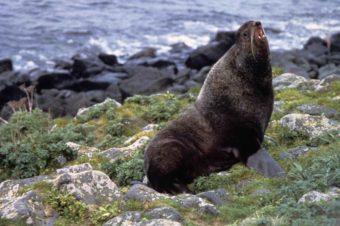
The Northern fur seals that breed on the Pribilof islands have been on the decline for decades, but a smaller colony just 200 miles away is thriving. A new study of these colonies is challenging scientists’ assumptions about what marine animals need from their environment — and how they get it.
The National Marine Mammal Laboratory sends a team to the Pribilofs every two years to count new Northern fur seal pups. Since 1998, the overall production of pups has dropped by 45%, but according to the latest count, the Pribilof fur seals bucked the downward trend for the first time in 15 years.
Rod Towell, a statistician from the mammal lab, says pup production increased a tiny amount in 2012 – just 0.5%. While it’s not statistically significant, Towell says that the data is promising.
“In my estimation, it’s a good sign in the sense that it didn’t decline again,” Towell says.
Meanwhile, on Bogoslof Island, it’s a different story. Pup populations have increased every year since the first pup was spotted there in 1980. A group of researchers has been studying why this island’s on the rise, while the Pribilofs are in decline.
Andrew Trites is a fisheries professor at the University of British Columbia. Trites was on the team to study the animals’ diets for clues.
“It was to really understand how top predators, [like] seabirds, and fur seals interact with the environment. How do they find their prey? What drives their numbers to increase? What causes them to decline?” Trites says.
One of the biggest issues is how they eat. The Northern fur seals, black-legged kittiwakes and thick-billed murres that the group studied all have to make tradeoffs between the energy they spend to reach their prey, and the energy they get from that food source.
Until recently, scientists weren’t sure how the animals judged that tradeoff. Contrary to what they expected, Trites and his fellow researchers found that the seabirds and fur seals don’t go to areas with the highest biomass of prey, or even the highest number of prey. That information is what fish management decisions are based on.
But the fur seals and seabirds don’t behave like resource managers. Instead, they behave more like fishermen. Just like trawlers searching for schools of fish, the fur seals and birds go to patches – areas where there’s a dense school of fish or krill – and eat there.
Those patches change often, depending on a slew of conditions that affect the prey’s behavior, and the researchers don’t yet understand why the animals use them.
In a presentation at the Marine Science Symposium in Anchorage, Trites went over his piece of the research, which compared Pribilof foragers to Bogoslof foragers.
“Primarily, the murres and the fur seals in the Pribilofs where they’re declining — they really eat a lot of pollock. And we discovered down at Bogoslof, they’re not eating pollock. They’re eating mostly squid and Northern smoothtongue, or these deepwater fishes that are high in energy. So a big difference in diet,” Trites says.
Trites thinks that the Pribilof seals are declining because they’re eating juvenile pollock, which he says don’t have enough energy. He says the group’s research shows that in order for the seabirds and fur seals to recover, the ecosystem around the islands would have to shift.
“You can see that under the right feeding conditions, if you’ve got high-energy prey near these islands, they can rebound. And hopefully we’ll see that return one day too to the Pribilofs,” Trites says.
The results of the Bering Sea study were published in January in the journal PLOS ONE.
This poster illustrating cruise ship wastewater was displayed at a Sept. 20, 2012, science panel open house.
The Parnell Administration wants to change another part of the 2006 cruise ship initiative.
The voter-approved measure required strict new standards for wastewater discharges.
Bills introduced this session at the governor’s request would effectively allow more chemicals and minerals to be released into the water. Backers say the levels would still be safe.
Senate Bill 29 had its first hearing Wednesday before the Senate Resources Committee.
Environmental Conservation Commissioner Larry Hartig told the panel the bill would allow a more practical approach to controlling pollution.
“It recognizes that it’s really difficult, if not impossible, for many dischargers to meet the water quality standards at the point of discharge,” Hartig says. “So they allow a limited area of mixing the treated effluent … with the receiving water at the edge of the mixing zone. “
The industry has asked state officials to make such a change. Cruise lines say strong new standards that start in 2015 are impossible to meet.
Hartig says wastewater-control measures would remain in effect under the legislation.
“It can’t bioaccumulate, it can’t have toxic effects, it can’t affect anadromous fish that would be going through that area, it can’t affect that water body’s ability to produce aquatic life in the future. It just goes on and on about the things it can’t do,” Hartig says
The committee took no testimony, but the measure has opposition.
“I think the bill is unnecessary,” says Chip Thoma, president of Responsible Cruising in Alaska, which backed the 2006 initiative standards.
“And the reason is because the cruise ships and DEC have made such great improvements in the last few years in lessening the effects of some of their discharge problems,” Thomas says
Thoma and Hartig both agree it’s important to remove copper from cruise-ship wastewater. That’s because, among other things, it affects salmon behavior.
Thoma says copper-removal is an example of how new technology can reduce pollution.
“These are older ships that were all piped with copper. The new ships are all flex-piped with plastic. It’s an incredible revolution. Just in the last few years, we’ve eliminated the copper problem on the new ships,” he says.
An appointed science panel has been investigating technological solutions for about two years. Hartig says it hasn’t found economically-viable equipment.
The Senate Resources Committee will hold another hearing Friday afternoon where it will take public comments on the bill. An identical bill will be heard that day in the House Resources Committee.
The Legislature has already rolled back one part of the cruise ship initiative.
At the administration’s request, it reduced head taxes that fund local tourism projects by more than 50 percent. It did not change a portion of the tax that funds onboard environmental monitors.
Southeast Alaska residents reported feeling a moderate earthquake on Monday morning that was located in the same place as another major temblor that occurred earlier in the month.
The 5.4 magnitude earthquake occurred at about 5:55 a.m. Monday and was located about 62 miles west southwest of Craig, Alaska.
No tsunami warning, watch, or advisory was issued as a result.
The location is about the same place as a 7.5 magnitude earthquake that occurred at 11:58 p.m. January 4th and prompted a tsunami warning for part of coastal Alaska and British Columbia.
Dozens of aftershocks followed in the days after that larger earthquake. No significant damage or injuries were reported.
Seismologists say two light earthquakes were felt in Southcentral Alaska on Sunday.
The Alaska Earthquake Information Center says a 4.7 magnitude earthquake occurred shortly before 4 a.m. Sunday and was felt in Anchorage, Homer and Chugiak.
It was centered about 54 miles northwest of Ninilchik.
A 3.7 magnitude earthquake occurred at 7:14 a.m. Sunday and was felt in Anchorage.
That quake was centered 32 miles southwest of Willow.
There are no immediate reports of damage from either quake.
Close
Update notification options
Subscribe to notifications
Subscribe
Get notifications about news related to the topics you care about. You can unsubscribe anytime.