Science & Tech

Australia’s Heron Island: A Canary In The Coal Mine For Coral Reefs?

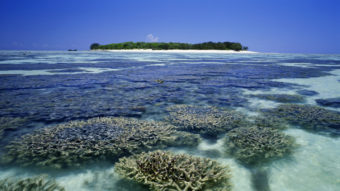
Heron Island is located on the southern end of the Great Barrier Reef, about 25 miles off the northeast coast of Australia. Ted Mead/Getty Images

NPR Science Correspondent Richard Harris traveled to Australia’s Great Barrier Reef to find out how the coral reefs are coping with increased water temperature and increasing ocean acidity, brought about by our burning of fossil fuels. Day 1: Richard gets a hefty dose of bad news.

I’ve seen the future, and it isn’t pretty.

That’s a tough sentence to write because the setting for this unhappy discovery is spectacular. Heron Island sits in tropical turquoise waters about 25 miles off the northeast coast of Australia. It’s an island on the far southern end of the Great Barrier Reef — one of our planet’s most dramatic natural features, akin to the tropical rain forests, only submerged.

The low vegetation is filled with fearless and noisy sea birds. Snorkelers watch as graceful turtles swim toward the coral sand beaches — it’s egg-laying time for them.

Within earshot of the lapping waves is a modern scientific laboratory, the Heron Island Research Station. And that’s where the topic turns from tropical relaxation to a nagging anxiety about the future of the world’s coral reefs.

Sophie Dove, from the University of Queensland in St. Lucia, has spent the past couple of years crafting an experiment to see what will happen to coral reefs as the ocean absorbs ever more of the carbon dioxide and heat we’ve added to our planet’s thin skin. She’s gathered a variety of coral species from the island’s nearby reef and placed them in tanks that look like a cross between a kettle drum and an oversized plant pot.
Into one set of these pots, she has put seawater at the reef’s current temperature and carbon dioxide concentration. A second set circulates water that’s somewhat cooler and has less carbon dioxide — conditions the reef experienced 100 years ago, before we started burning fossil fuels and pouring huge amounts of carbon dioxide into the atmosphere.

Two final sets of tanks hold water that’s warmer and contains far more carbon dioxide than the oceans absorb today. These are glimpses into our perhaps not-so-distant future.

Carbon dioxide matters to coral because when it soaks into sea water, it turns into carbonic acid. We’ve put so much carbon dioxide into the atmosphere that the oceans are already 30 percent more acidic now than they were before the Industrial Revolution. And as acidity increases, it becomes harder and harder for corals to build their calcium structures. Eventually, corals will need to expend a lot of energy just to prevent their skeletons from dissolving into seawater.

Heat is also a problem. Most of the additional heat that Earth has absorbed as a result of the enhanced greenhouse effect has in fact been soaked up by the world’s oceans. In fact, we’re really experiencing ocean warming more than global warming.

The result?

Dove opens up the first of these tanks — present-day conditions. The corals look like they came from a picture book of life on the reef. The second tank, pre-industrial, looks about the same, though Dove says those corals are actually growing faster and are healthier than those growing in modern-day seawater.

This composite image of pots used in the experiment shows how healthy coral (left) is dramatically affected by higher carbon dioxide levels and sea temperatures (right). Courtesy of Sophie Dove

The third and fourth tanks are the shockers. Most of the corals have died in this “future” world. A gelatinous black slime floats across the top of one tank. Corals still hanging in there have lost the colorful organisms that live inside those calcium skeletons, so they are bleached white.

Scientists have been worrying about this for well over a decade. It’s taking some time for the experimental evidence to catch up with the basic chemistry, which strongly suggests that many marine animals that build shells from calcium are going to have it rough as carbon dioxide builds up in the water. Add heat, and the situation for these corals is grim.

That’s not the end of the story, thankfully. This experiment offers a glimpse at our most likely future, but it’s not the only possible path. Carbon dioxide levels and sea temperatures depend on what humanity does over the coming decades.


Read original article

Australia’s Heron Island: A Canary In The Coal Mine For Coral Reefs?

Alaska Senate set to approve anti-Frankenfish resolution

Frankenfish
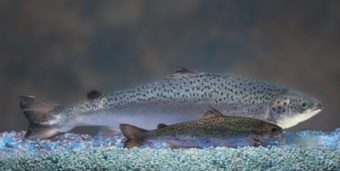
A genetically modified salmon seen next to a wild salmon. The fish are bio-engineered to grow twice as fast. Photo courtesy Rep. Geran Tarr.

A resolution opposing genetically engineered salmon is likely to pass the Alaska Legislature this week.

The so-called “Frankenfish” resolution cleared the Senate Resources Committee on Friday, its last stop before a vote on the Senate floor. The resolution unanimously passed the House about a month ago.
Seward High School sophomore Griffin Plush was in Juneau last week with Alaska Youth for Environmental Action. He says a genetically modified fish could escape its holding pen and cause harm to the environment and Alaska fisheries.

“It would be devastating to fishing communities like Seward, who rely on the salmon population and a healthy salmon population for tourism and the fishing industry,” Plush said.

He had hoped to testify on the anti-Frankenfish measure, but had to leave town before Friday’s hearing.

Masachusetts-based AquaBounty has spent more than $70 million to develop the genetically modified fish, which is an Atlantic salmon with genes from a king salmon and an eel-like fish to make it grow faster.

The company is seeking US Food and Drug Administration approval for the product. A preliminary FDA report says the fish would have no significant impact on the environment.

But Representative Geran Tarr, the Anchorage Democrat who sponsored House Joint Resolution 5, says the FDA doesn’t have enough evidence to back up that finding. If the agency approves AquaBounty’s petition, Tarr says it would be the first time a genetically modified animal product is approved for human consumption.

“This resolution, should we be successful in passing it, will be sent along with a letter and submitted as public comments on behalf of the legislature,” Tarr said. “And I like to say it’s a great opportunity for Alaskans to speak out in one unified voice, because the Congressional delegation has already spoken out in opposition, the governor has spoken out. So, the legislature kind of fills in that last bit of representation.”

Senator Peter Micciche, a Kenai Republican, is a co-sponsor of the measure on the Senate side. At Friday’s Resources Committee hearing, Micciche said resolution enjoys broad public support.

“I have never, since this came to us several years back, have I ever heard a single statement of support for genetically engineered salmon,” Micciche said.

The FDA is taking public comment on AquaBounty’s petition through April 26th.

Past Century’s Global Warming Rates Are Fastest On Record

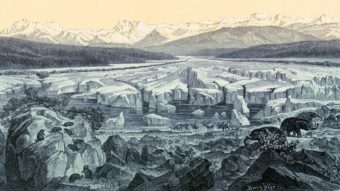
Scientists say they have put together a record of global temperatures dating back to the end of the last ice age, about 11,000 years ago. This historical artwork of the last ice age was made by Swiss geologist and naturalist Oswald Heer. Oswald Heer/Science Source

There’s plenty of evidence that the climate has warmed up over the past century, and climate scientists know this has happened throughout the history of the planet. But they want to know more about how this warming is different.

Now a research team says it has some new answers. It has put together a record of global temperatures going back to the end of the last ice age — about 11,000 years ago — when mammoths and saber-tooth cats roamed the planet. The study confirms that what we’re seeing now is unprecedented.

What the researchers did is peer into the past. They read ice cores from polar regions that show what temperatures were like over hundreds of thousands of years. But those only reveal changes in those specific regions; cores aren’t so good at depicting what happened to the whole planet. Tree rings give a more global record of temperatures, but only back about 2,000 years.

Shaun Marcott, a geologist at Oregon State University, says “global temperatures are warmer than about 75 percent of anything we’ve seen over the last 11,000 years or so.” The other way to look at that is, 25 percent of the time since the last ice age, it’s been warmer than now.

You might think, so what’s to worry about? But Marcott says the record shows just how unusual our current warming is. “It’s really the rates of change here that’s amazing and atypical,” he says. Essentially, it’s warming up superfast.

Here’s what happened. After the end of the ice age, the planet got warmer. Then, 5,000 years ago, it started to get cooler — but really slowly. In all, it cooled 1.3 degrees Fahrenheit, up until the last century or so. Then it flipped again — global average temperature shot up.

“Temperatures now have gone from that cold period to the warm period in just 100 years,” Marcott says.

So it’s taken just 100 years for the average temperature to change by 1.3 degrees, when it took 5,000 years to do that before.

The research team tracked temperature by studying chemicals in the shells of tiny, fossilized sea creatures called foraminifera. Their temperature record matches other techniques that look back 2,000 years, which supports the validity of their much longer record.

Climate scientists predict that the current warming will continue, given the amount of greenhouse gases going up into the atmosphere.

“The climate changes to come are going to be larger than anything that human civilization and agriculture has seen in its entire existence,” says Gavin Schmidt, a climate researcher at NASA’s Goddard Institute for Space Studies. “And that is quite a sobering thought.”

The research appears in the journal Science.


Read Original Story

Past Century’s Global Warming Rates Are Fastest On Record

Otter-bounty bill faces opposition


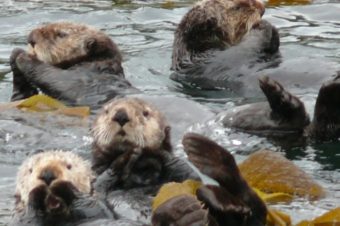
Sea otters groom their fur near Sitka. A bill paying hunters a $100 bounty per pelt targets controlling population growth. Photo by Nathan W/Creative Commons

Legislation proposing sea-otter bounties will get its first hearing next week. It’s already drawing opposition from environmental groups and the federal marine mammal protection agency.

Fishermen harvesting Dungeness crab, geoduck clams and some other ocean-floor species have been coming up empty in recent years.

The reason is the rapid expansion of the sea otter population. The marine mammals mostly eat clams. But as they bring their voracious appetites into new areas, they clear out many of the shellfish sought by commercial, subsistence and personal-use divers and fishermen.

“So what we’re trying to do is come up with some assistance for the folks in the area that want to go out and harvest them to afford to be able to do so,” says Sitka Republican Senator Bert Stedman. He represents Kake, Prince of Wales Island and other coastal Southeast communities where otters have moved in.

He’s authored a bill that would give Alaska Natives – the only people who can legally hunt marine mammals – a $100 reward for each pelt they take.

“You’ve got your costs of your fuel and other items you need. Also, there’s tanning cost issues. We’re just trying to assist in the harvest,” he says.

Otters were once widespread along the West Coast from California out to the Aleutians. Russian and American hunters virtually wiped them out, except for a few remote areas.

They were reintroduced to Southeast about 50 years ago. Recent studies say their numbers have grown by as much as 12 percent a year in southern Southeast and 4 percent in the north.

Federal legislation protects otters, only allowing Alaska Natives to harvest them for traditional purposes.

U.S. Fish and Wildlife Service spokesman Bruce Woods says states can’t impose bounties.

“The Marine Mammal Protection Act prohibits any state from enforcing a law that affects the take of a marine mammal without first soliciting and receiving management authority for that species from the Secretary of the Interior,” Woods says.

The agency is working with Native hunters and craftspeople to better define the legal use of pelts. That could increase the overall harvest.

But Woods says Stedman’s legislation, and a similar bill in the House, are trumped by federal rules.

“We’ve got nothing to say about whether the law could be passed or not. But if the law were enforced, at least by an initial reading of the MMPA, that enforcement would be illegal,” he says.

Opposition to the bill is growing among some of the same organizations that campaigned against wolf control. They say otter population growth is a good thing.

“They’re a keystone species,” says Tina Brown, president of the Alaska Wildlife Alliance.

She points out that otters eat sea urchins, which eat kelp, allowing coastal Southeast to return to its natural balance.

“When you have the kelp forest, you have nurseries for finfish and it’s thought that the kelp forest can increase herring populations and salmon populations. Another benefit is they reduce CO2 emissions and slow ocean acidification,” she says.

Brown says the alliance is talking with other groups, as well as legislators and attorneys, about the bounty bill’s impacts.

“I can’t say whether it makes a difference in the numbers of sea otters. I can say that it makes a difference on the way Alaska appears before the rest of the country and the world,” Brown says.

And what about the hunters?

Tlingit-Haida Central Council Economic Development Director Carrie Sykes has been working on the issue. She says tribal members have mixed feelings.

“Some people think that it would be a good idea, in that it could offset the cost of hunting and tanning,” she says. “The others are worried about what the perception will be from different organizations, like Defenders of Wildlife. And we’re not sure how it would really work.

Sykes says local tribes have more influence on the issue than the regional Central Council.

Stedman, the Senate bill’s author, says it should be considered a first draft. He expects changes as it’s considered by the Legislature.

“Maybe we end up having this just a Southeast program and we exclude areas where the sea otters are elsewhere, out in the Aleutians and other places,” he says. “We’re not trying to eradicate, but we’re trying to control the growth.”

He also expects organized opposition.

“And I recognize that there are a lot of citizens outside of Southeast Alaska that might just think this is a ghastly thing to do. But I can assure you we’re better prepared to take care of our own backyard than people in San Francisco and Florida are,” Stedman says.

His legislation comes before the Senate Resources Committee on March 13. The House version, introduced by Anchorage Republican Representative Charisse Millett, is not yet scheduled.

What are biologists learning about Juneau bears?

Bear 25 is a collared female frequently spotted near Mendenhall glacier.
Bear 25 is a collared female frequently spotted near Mendenhall glacier. (Photo from summer 2012 by Heather Bryant)

It may still be winter, but it’s not too early to start thinking about bears in Juneau.

A few black bears have been out and about all season, according to state Fish and Game wildlife biologist Ryan Scott.  He says he’s gotten more reports of bears this season than previous winters.

Some of them are wearing radio collars.  Biologists have been putting the tracking equipment on Juneau-area bears for years.  Scott says they add a bear or two to the study group every summer.  And what have they learned?

“We don’t know as much about bears as we think we do,” Scott says.

Bears in an urban place like downtown Juneau often get themselves in trouble; becoming the unwitting victims of humans who do a poor job of taking care of garbage.  But Scott says the damage isn’t permanent:

“Really the underlying problem is why is the bear there.  And generally speaking it doesn’t take us very long to figure out what food source they’re using there. And it’s most often a human food source.  Over time, what we’ve seen is they spend X-amount of time in urban locations usually taking advantage of human food sources, but they have a large component of their time spend in more wild settings, even on the periphery of downtown or in the valley.  So bears know how to utilize natural food sources.”

Trackers also know that moving a bear from town doesn’t fix the problem, especially along the road system.  Scott says the bears just come right back to their favorite haunt.

“If you really want to have some success with that, you have to put a lot of water between you and the bear.  But’s that’s not a given that that’s going to work.,” Scott says.

Some bears took short naps this winter and are already out; others will be coming out of their dens soon.  And while it looks like spring, there is little food available for them yet, so garbage will look attractive. Scott reminds Juneau residents to properly store your garbage all year around.

Scientists Are The New Kings (Or At Least Secretaries) At Energy Department

Massachusetts Institute of Technology scientist Ernest Moniz is introduced by President Obama as the nominee to run the Energy Department, Monday at the White House. Mandel Ngan/AFP/Getty Images

With President Obama naming Ernest Moniz to be the nation’s next energy secretary, he continued a relatively recent trend of putting scientists atop a part of the federal bureaucracy once overseen by political types.

If confirmed by the Senate, Moniz, an MIT physicist, will follow Nobel laureate Steven Chu, a University of California physicist who served as Obama’s first-term energy secretary.

And Chu came after President George W. Bush appointee Samuel Bodman, who was no slacker in the field of science either. He held a doctorate in chemical engineering from the Massachusetts Institute of Technology, where he also taught as an associate professor.

All right, it might be a stretch to include Bodman, since by the time Bush named him to the Energy Department post, he had long before traded academia for big gigs in corporate America. Still, he did have that engineering doctorate.

It might seem like a no-brainer to have an individual with a strong science background at the helm of a federal department that oversees a lot of complex science projects, like maintaining the nation’s nuclear weapons labs and researching new energy technologies.

But Washington isn’t a city that necessarily does no-brainers well.

Which helps explain the heavy dose of political figures — a former senator (under President George W. Bush); a former governor (under President Reagan); a former House member (under President Clinton); a former big city mayor (also under Clinton) — who dominate a list of previous energy secretaries, a list that also includes lawyers, businessmen and a retired admiral.

Obama has clearly broken away from the pattern by naming two highly regarded scientists to lead a department that in the past has had a reputation for dysfunction. And some might be inclined to give George W. Bush credit for, at the very least, naming a secretary with a STEM doctorate.

Of course, Obama’s choices at Energy can be read as something of a rebuke to that same Bush, whose officials were known to question scientific consensus, such as humans contributing to climate change. Obama has repeatedly promised to “restore science to its rightful place.”

If it’s a trend, it may be too soon to know if it will take hold.

When I asked Paul Light, a professor of public service at New York University, how we got from Hazel O’Leary (an energy secretary under President Clinton) and Spencer Abraham (who served Under President George W. Bush) to Steven Chu and Ernest Moniz, he told me:

“It’s a trend that’s well worth replicating elsewhere. … We do pay attention to it in places like the CDC and other scientifically oriented agencies. but it would be nice if the first thing you asked as a president, or as a candidate was, ‘Can they do the job and do they know anything about it?’

“That’s actually a good thing. We like politicals. For whatever reason, Energy is breaking out of it. That’s terrific. It sets a higher bar and maybe we’ll get that in other key posts. It is an interesting trend, I’ll give you that one.”


See Original Story

Scientists Are The New Kings (Or At Least Secretaries) At Energy Department

Site notifications
Update notification options
Subscribe to notifications