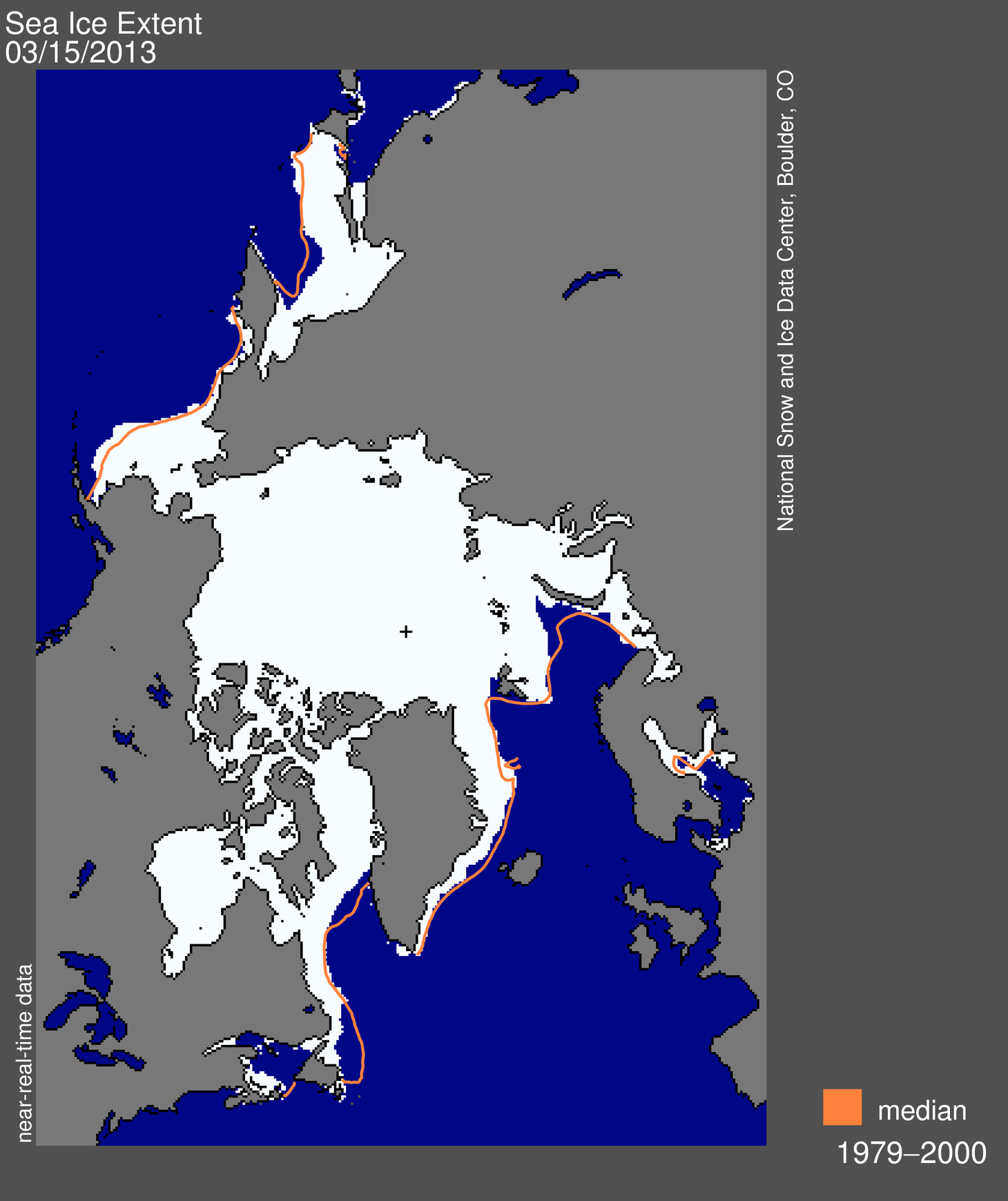
This year’s winter-time sea ice extent is the sixth lowest since the National Snow and Ice Data Center started keeping satellite records in 1979. Walt Meier is a research scientist at NSIDC.
“In winter, we used to be about 16 million square kilometers, which is about double the lower 48 United States.”
Based on this year’s satellite records, Meier says winter sea ice covered roughly 15.13 million square kilometers of the Arctic this year. That’s roughly ten times the size of the state of Alaska. It’s also equivalent to more than 337 billion football fields.
“We’ve kind of lost about a couple million square kilometers. On the order of about 10 to 15 percent, so that’s kind of like the eastern sea board of the United states in terms of the ice loss.”
Arctic sea ice extent on March 15 was 15.13 million square kilometers (5.84 million square miles). The orange line shows the 1979 to 2000 median extent for that day. The black cross indicates the geographic North Pole. (Credit: National Snow and Ice Data Center)
Meier says recent Arctic sea ice records show a more pronounced seasonal cycle. Data show more of the winter time sea ice that does exist is first-year ice, meaning it develops each winter but melts as temperatures warm in the spring and summer.
“It used to be for example from Barrow Alaska, you’d see things open up, but you could take a boat out and reach the ice edge, but nowadays, the ice edge is much farther from the coast and the ocean is more exposed during the during the summer time.”
Sea ice acts as the Earth’s air conditioner. When it reflects sunlight, it cools the planet.
“But now when we lose the ice cover, the ocean is much darker than the ice. That absorbs all that solar energy that’s coming and that heats up the ocean. It’s like your air conditioning is running out of coolant. It’s not as efficient in terms of cooling the rest of the planet.”
NSIDC has measured the ten lowest winter sea ice extents in each of the last ten years, with the lowest ever measured in 2011. At the beginning of April, NSIDC scientists will release a detailed analysis of this year’s winter sea ice conditions in the arctic.
For the first time, new federal science standards recommend teaching K-12 students about climate change.
By the time today’s K-12 students grow up, the challenges posed by climate change are expected to be severe and sweeping. Now, for the first time, new federal science standards due out this month will recommend that U.S. public school students learn about this climatic shift taking place.
Mark McCaffrey of the National Center for Science Education says the lessons will fill a big gap.
“Only 1 in 5 [students] feel like they’ve got a good handle on climate change from what they’ve learned in school,” he says, adding that surveys show two-thirds of students say they’re not learning much at all about it. “So the state of climate change education in the U.S. is abysmal.”
We all learn the water cycle. But how many can draw a picture of the carbon cycle? It would include plants taking in carbon to grow, then dying, and eventually turning into fossil fuels like coal and oil, which then put carbon back into the atmosphere when burned.
Even when this is taught, McCaffrey says, climate is often sidelined. Why take Earth science, when what you need to get into college is biology and chemistry? A recent report on climate literacy recommends sweeping changes to address such issues.
Political Pressure
On top of this, there’s the political battle over how climate change is taught. Last month, Colorado became the 18th state in recent years — including seven this year — to consider an “Academic Freedom Act.”
“The bill will go toward creating an atmosphere of open inquiry,” Joshua Youngkin of the Discovery Institute told state lawmakers. The institute is the same group that’s long questioned evolution and the way it’s taught. Now it has crafted suggested legislation that also targets global warming, although Youngkin testified that the aim is not to ban teaching about climate change.
“It just gives teachers a simple right,” he told lawmakers, “to know that they can teach both sides of a controversy objectively, and in a scientific manner, in order to induce critical thinking in their student body.”
But critics point out there is no controversy within science: Climate change is happening, and it’s largely driven by humans. So far, only Tennessee and Louisiana have passed legislation meant to protect teachers who question this.
Still, educators say the politicization of climate change has led many teachers to avoid the topic altogether. Or, they say some do teach it as a controversy, showing Al Gore’s An Inconvenient Truth one day, and the British documentary The Great Global Warming Swindle the next. The end result for students? Confusion.
The new science guidelines could provoke more push back.
“To the extent that these standards do paint a picture that I think runs counter to the scientific evidence, we’re going to make sure that we point that out,” says James Taylor, a senior fellow with the Heartland Institute. The free-market think tank is working on its own curriculum questioning humans’ role in global warming.
Raising Difficult Issues
The new science standards are voluntary, but 26 states helped develop them, and about 40 say they’re likely to adopt them.
“There was never a debate about whether climate change would be in there,” says Heidi Schweingruber of the National Research Council, which created the framework for the standards. “It is a fundamental part of science, and so that’s what our work is based on, the scientific consensus.”
Schweingruber says a lot of thought did go into how to deliver what can be crushingly depressing information, without freaking kids out. For instance, while students will learn that humans cause global warming, they’ll also be taught what kinds of actions can have a positive impact in helping to reduce it.
McCaffrey, of the National Center for Science Education, says many teachers will need training themselves on climate science. He’d also like to see them prepared for the pressures that come with teaching it.
“We’ve heard stories of students who learn about climate change,” he says. “Then they go home and tell their parents, and everybody’s upset because the parents are driving their kids to the soccer game, and the kids are feeling guilty about being in the car and contributing to this global problem.”
McCaffrey says this raises all kinds of psychological and social issues that are difficult to grapple with, yet essential for this generation of students to take on.
An Alaska sea otter pup has a new home at the Vancouver Aquarium. The yet-to-be named pup was found stranded on a road in Homer last October. Only 8 weeks old at the time, the pup needed intensive 24/7 care.
A crew of volunteers were unable to locate the pup’s mother, leading U.S. Fish and Wildife to authorize the rescue of the pup.
Dr. Tara Riemer Jones is the President of the Alaska SeaLife Center where the pup was rehabilitated:
“We had this otter for almost 6 months. For part of this time, staff at the Vancouver aquarium were invited up to help us care for this otter. For the most of the winter we had a couple staff members from the Vancouver Aquarium in Seward helping us with round the clock care. So for 6 months we had someone 24/7 with this otter making sure that it was eating properly and that it had everything that it needed.”
Jones says that otters aren’t a common patient for the center. Some years there have been 3 or 4 and other years there won’t be any at all. Since sea otters can give birth year round, pups can strand at any time.
“With some other animals that we respond to, like harbor seals we tend to get about 10 or 12 every summer that generally come in late May or early June and those are a little more like clockwork. But most of the other animals that we respond to is a little more random and we just don’t know what we’re going to get until we get the phone call.”
Jones says that the rescue and rehabilitation program for otters doesn’t receive any federal funds and is entirely supported by donations.
“We’re always looking for contributions to this program. It takes a lot of effort to raise a sea otter. They eat an awful lot. They eat a large portion of their bodyweight every day in food. And they eat very expensive food—shellfish. We very much thank the Vancouver Aquarium for providing staff time during the time that the animal was here”
The female otter was transferred to the Vancouver Aquarium last Friday where she now lives with a couple of other SeaLife Center alums, Tanu and Elfin.
“We’d like to extend our sincere thanks to the Alaska SeaLife Center and its I.Sea.U care team for their gracious hospitality over the past few months—it was a valuable learning opportunity to be able to exchange knowledge and best practices on animal care with their esteemed team,” says Brian Sheehan, Vancouver Aquarium curator of marine mammals in a press release.
The Vancouver Aquarium is having a Twitter Contest for naming the new pup by choosing one of three names chosen by the Ocean Sciences Club. The club—made up of middle school students from Seward—picked Susitna, Katmai and Glacier as options.
People can vote on a name by following @vancouveraqua and tweeting their vote using #otterlove. Tweet your vote by March 31 to be counted.
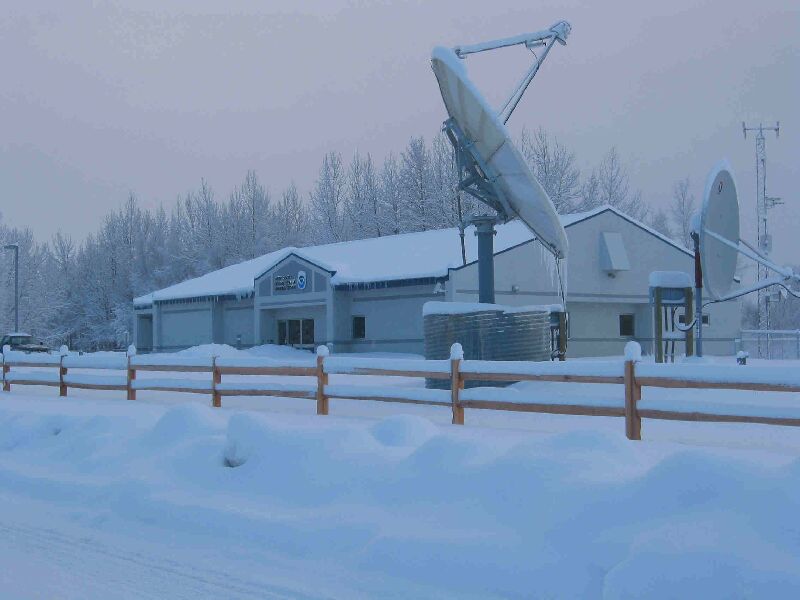
Winter view of West Coast and Alaska Tsunami Warning Center in Palmer courtesy of the National Oceanic and Atmospheric Administration
Alaska’s tsunami warning communications system will be tested as part of Tsunami Preparedness Week.
The test will occur sometime between 9:45 a.m. and 10:15 a.m. Wednesday. It may be heard or seen on radio or televisions stations around the state, and on NOAA weather radio.
Some video messages may not specify that Wednesday’s message is a test, although the audio should clearly specify that it is only a test.
And so, that tests, basically, the plumbing of the system all the way through from generation here at the Warning Center to activation at the (National Weather Service) forecast offices, and then through propagation through the broadcasters in the Emergency Alert System.”
The test will be cancelled if excessive earthquake activity is already underway.
If you live in a coastal area, you can provide feedback on the test by going online at ready.alaska.gov/survey
Activities for Tsunami Preparedness Week include a tsunami exercise on Wednesday and an open house at the Palmer center on Saturday afternoon.
The 49th anniversary of the Good Friday earthquake is Wednesday, March 27th.
Wednesday, March 27th 9:30 a.m. update:
Whitmore says they constantly monitor about 600 stations around the world for possible activity. If an earthquake is detected and it meets certain criteria, then Whitmore says they’ll immediately issue a warning. Then, as more data comes in, they’ll continuously refine their modeling for any potential waves and revise their warnings.
As an example of some of their criteria used in issuing tsunami warnings, Whitmore says they may immediately issue a warning for parts of the Alaska coastline if they detect a North Pacific earthquake of 7.0 magnitude or greater that’s centered near the coast or just offshore, and is not located too deep.
Wednesday, March 27th 11:30 a.m. update:
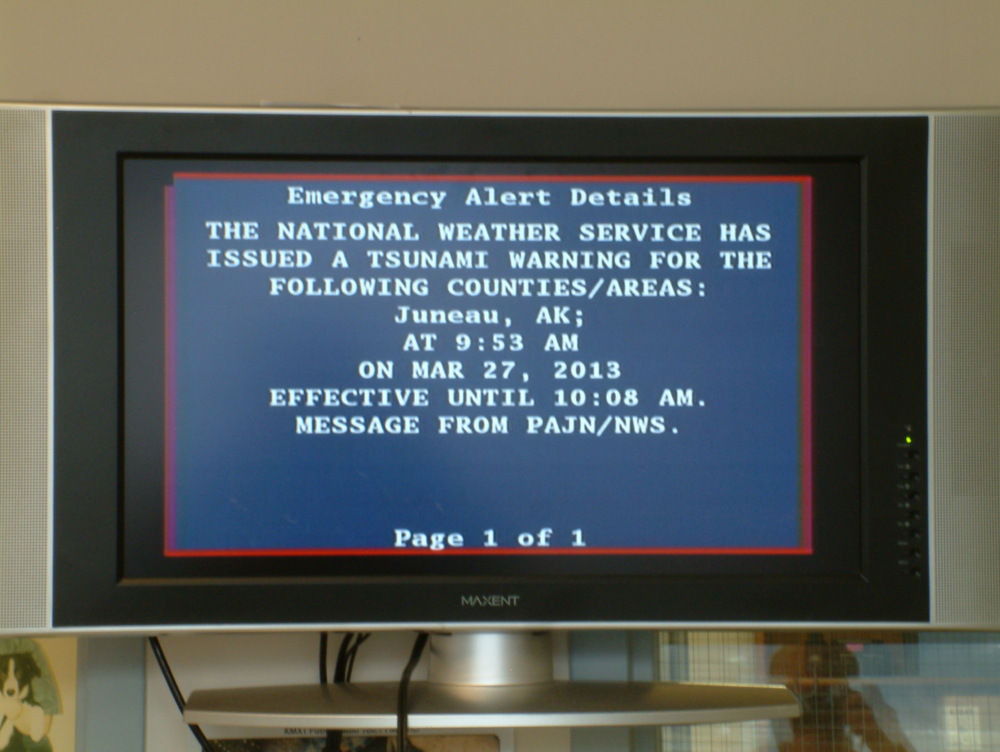
EAS test occurred at 9:53 a.m. AKDT
EAS test as received by 360North/Gavel Alaska television through GCI cable. The test message was not rebroadcast though KTOO, KRNN, or KXLL FM in Juneau. But KTOO engineers have already identified potential fixes for proper relay of emergency alerts. Photo by Matt Miller/KTOO News
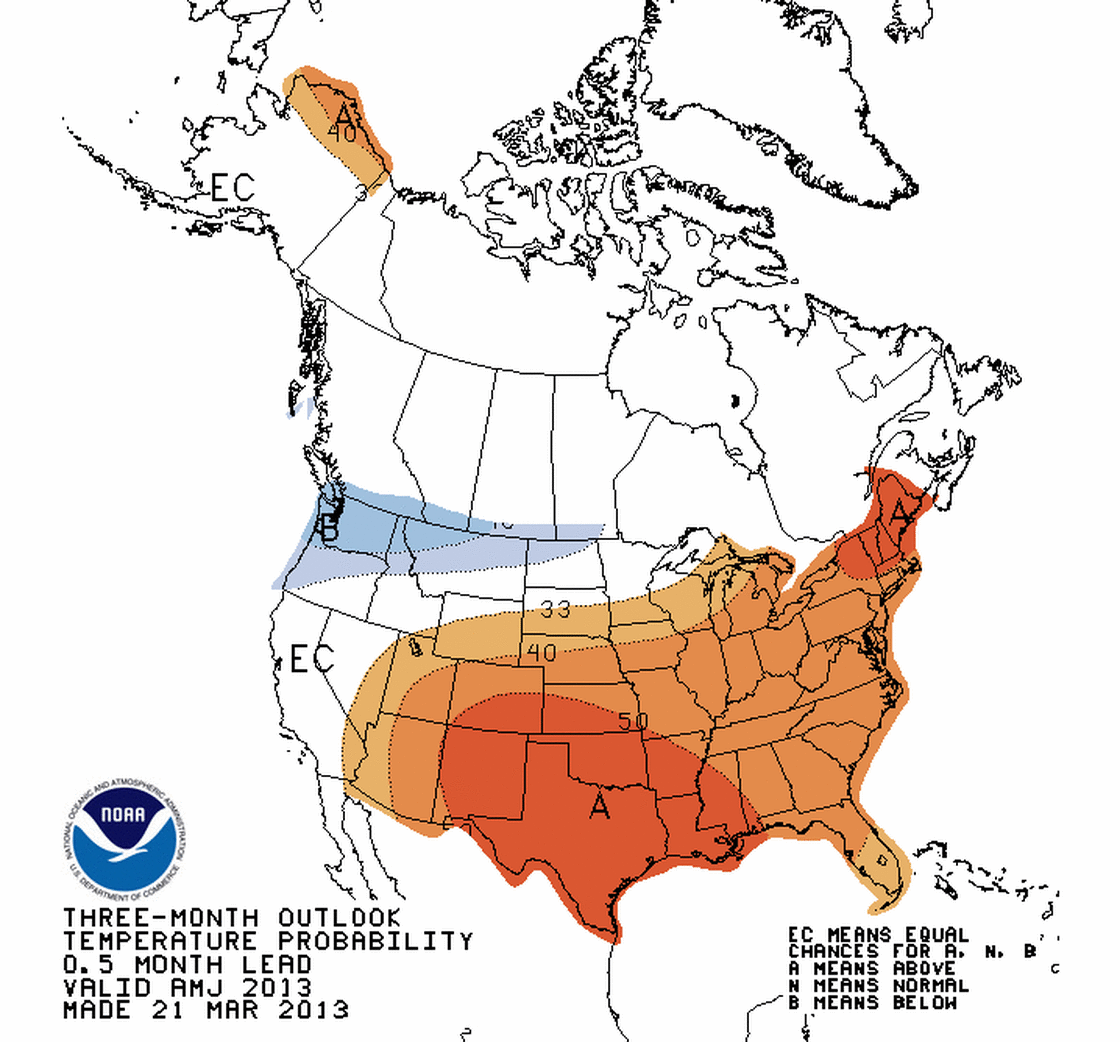
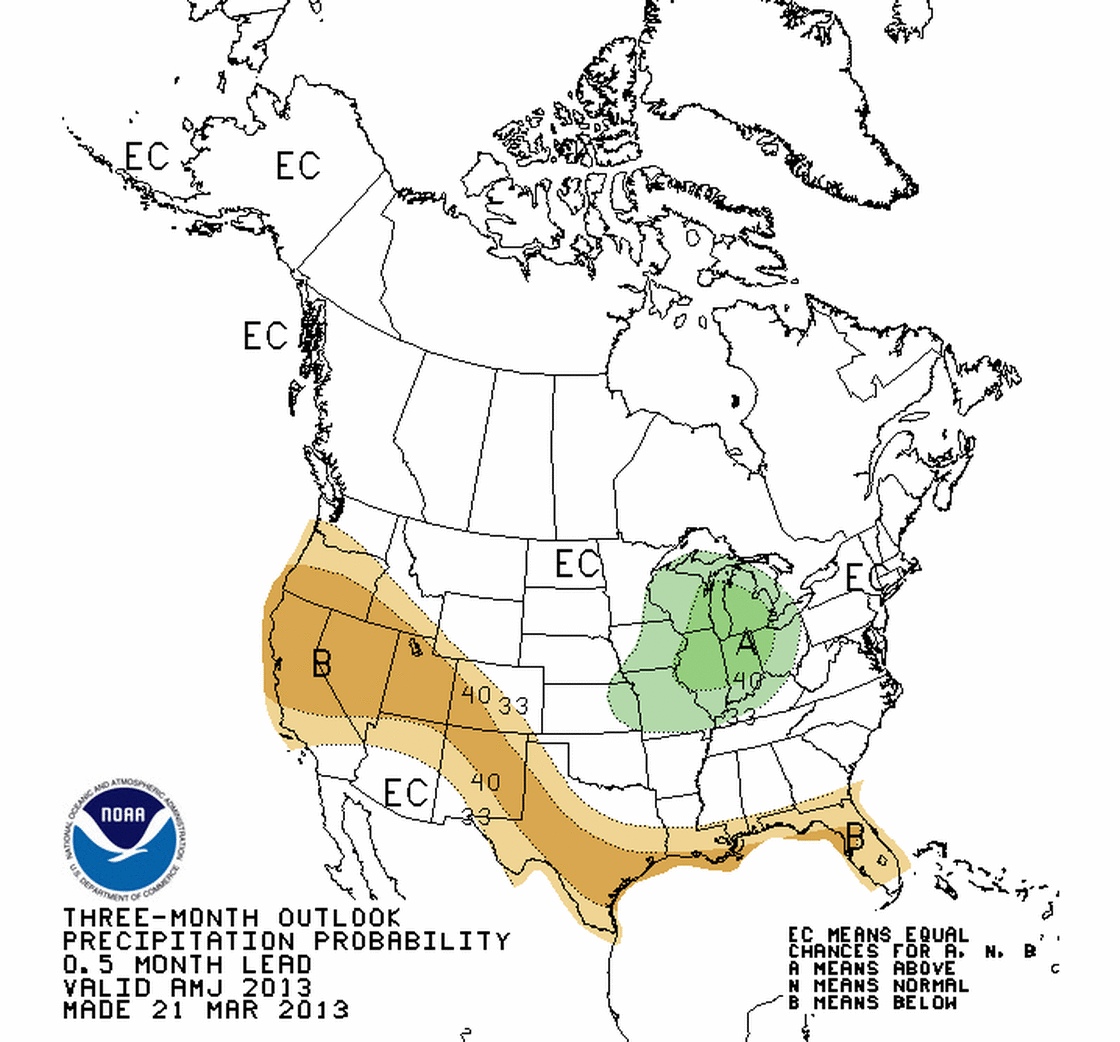
“Above-normal temperatures this spring are most likely across most of the continental U.S. and northern Alaska. Below-normal temperatures are favored for the Pacific Northwest and extreme northern Great Plains. For precipitation, odds favor wetter-than-normal conditions in the Great Lakes and Ohio Valley regions. Drier-than-normal conditions are most likely in much of the West, the Rockies, parts of the Southwest, much of Texas, along the Gulf Coast and Florida. Hawaii has an enhanced chance of being cooler and drier than normal.”
In a more serious prediction, NOAA says that it expects the drought in the central and western regions of the United States will persist and new drought is expected to develop “in California, the Southwest, the southern Rockies, Texas, and Florida.”
We’ll leave you with two maps. First a temperature map:
A map showing above-normal temperatures in an orange hue. Below-normal temperatures are shown in blue. NOAA
Next a precipitation map:
A map showing below-average precipitation in tan and above-average precipitation in green. NOAA
Actor Bruce Willis on the surface of an asteroid from the movie Armageddon. Lawmakers are questioning the likelihood of the movie’s plot becoming reality. Frank Masi/Associated Press
Without “a few years” warning, humans currently have no capacity to stop an asteroid on a collision course with the planet, scientists told a Senate panel Wednesday.
“Right now we have no options,” said former astronaut Ed Lu. “If you dont know where they are, there’s nothing you can do.”
Scientists are calling for continued funding and support for NASA satellites and observation programs that look for “near Earth objects.” The scenario from Hollywood blockbuster Armageddon is on the minds of lawmakers after two hulking rocks exploded in the air over Russia in February. More than 1,000 people were injured, bringing the risks of future incidents — and measures to prevent them — into clearer focus.
“I was disappointed that Bruce Willis was not available to be a fifth witness on the panel,” joked Ted Cruz, R-Texas, during the hearing.
While scientists put the odds of asteroids one kilometer in diameter or larger colliding with the earth as “once every few thousand year” event, they said cuts in space funding to monitor and detect space rocks could have devastating consequences.
“What [the film Armageddon] did was basically convince the American people that if anything bad happened, people would get in a shuttle and fix it,” said Joan Johnson-Freese, a professor at the U.S. Naval War College. “That is myth. That is not reality.”
Scientists were simply sharing a grim reality NPR and others have written about in recent weeks — that the rules of physics mean there’s almost no way to stop asteroids and debris from hurtling toward earth. It didn’t stop the doomsday-scenario questioning from Sen. Bill Nelson, D-Florida:
“What would an asteroid that is a kilometer in diameter, what would it do if it hit the earth?,” Nelson asked.
“That is likely to end human civilization,” said Lu, who is now CEO of the B612 Foundation, which aims to hunt devastating asteroids.
Decades of lead time is the only way to prevent that level of destruction, said scientists. With decades of advance notice, Lu said, American astronauts currently do have the capacity to destroy or make small changes to the trajectory of flying space objects to keep them from hitting earth. But detection requires investment, they said.
“It’s important to know what we’re up against, and this decade in particular is great for us to do the research necessary that will contribute to potential mitigation concepts,” said James Green, NASA’s planetary science director.
Lu estimates there’s a 30 percent chance this century of relatively smaller asteroids hitting a “random location” on the earth to create a five megaton impact. Casualties would depend on the population of the area of impact.
If detected early enough, the cost of a mission to prevent a hit would cost at least a billion dollars, Lu said. “But … you’d have to compare that against the losses of a massive, megaton impact.”