Science & Tech

Wolves in Yukon-Charley National Preserve drop by more than half

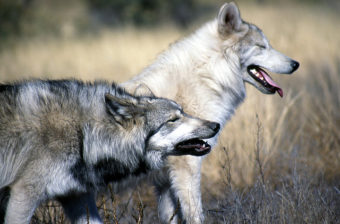
Grey wolves. (Flickr creative commons image by Caninest)

Alaska’s predator control program has resulted in the number of wolves in Yukon-Charley Rivers National Preserve dropping by more than half, according to the National Park Service.

The Park Service counted 80 wolves in 9 packs in November, 2012. This spring, biologists have only been able to account for 28 to 39 wolves in six packs.

That’s more than a 50 percent drop, which is the highest drop in population since the park service began tracking wolves 19 years ago says Deb Cooper, Associate Regional Director for NPS.

Natural deaths and subsistence and sport hunting and trapping account for some of the loss, but Cooper says those rates are fairly consistent from year to year.

“This year there has been predator control efforts along the boundary of Yukon-Charley Rivers National Preserve, particularly in the 70-mile country which is kind of bounded on three sides by the preserve. The predator control program has taken quite a few animals. We know a number of them are from packs that are previously monitored.”

The Park service will be closely monitoring the wolves to see if the numbers can rebound.

“As long as there is a breeding pair or some sort part of the pack structure intact, they can come back. This year, we know that we lost one pack that was 24 animals in size. There was two other packs that we think there’s only one animal left which is really no longer a pack, just a transient animal. When you lose whole packs that can have more of a long term effect.”

Fish and Game's Upper Yukon Tanana Predator Control Program Area
Fish and Game’s Upper Yukon Tanana Predator Control Program Area. (Image from Annual Report to the Alaska Board of Game on Intensive Management for Moose and Caribou with Wolf Predation Control in the Upper Yukon/Tanana Rivers – February 2013)

The wolves play an important part in keeping the forty-mile caribou herd at healthy levels. Cooper says the herd is at a level above the state’s goal for its population and is starting to show signs of over population.

“The herd is beginning to show signs of nutritional stress. So the ramifications that has to a national preserve is there’s some deterioration of the habitat like over-grazing or where there’s so many caribou they begin to not have enough to eat,” Cooper says.

“We’ve had no formal communication from the State of Alaska on results of their helicopter and fixed wing predator control work in the Forty mile country,” said Yukon-Charley Rivers Superintendent Greg Dudgeon in a press release. But according to Cooper, this is a local issue and the field biologists for the department and the park service have been communicating informally.

“We have two different mandates. It’s the state’s policy to grow caribou and moose for hunters. Which in this case is involving the manipulation of populations of ungulates and predators and we’re bumping up against the preserve which has the responsibility and obligation to preserve the natural dynamics of an ecological system,” Cooper says.

 We were unable to reach anyone at Fish and Game for comment today and will update the story as soon as we can get in touch with them.


View Yukon-Charley Rivers National Preserve in a larger map

Could western Alaska become the new Panama Canal?

Arctic Sky
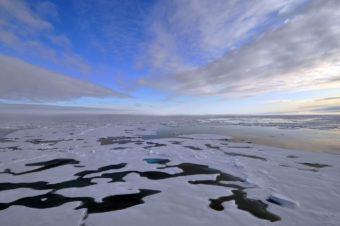
Clouds over the Arctic Ocean. Photo by Patrick Kelley, U.S. Coast Guard. Flickr/Creative Commons.
The time has come to stop talking and start acting when it comes to changes in the Arctic.

That was the message of a talk to the Juneau World Affairs Council this week by Alaska Dispatch owner and publisher Alice Rogoff.

Though she does not have a science background, Rogoff took an interest in the Arctic about five years ago and has travelled extensively in the region from her home in Anchorage. In 2011 and 2012, she organized the Arctic Imperative Summit, a policy gathering in Alaska that looks at opportunities and challenges posed by melting sea ice.

Next week she will be in Washington, D.C. with Iceland’s President to announce a new nonprofit designed to promote international cooperation on Arctic issues.

Experts say if sea ice continues to melt at the rate it is today, a new shipping channel will open up through the Arctic Ocean by the year 2050. Alice Rogoff says that scientific prediction informs her vision of Alaska’s future.

“That means the Panama Canal runs along the western coast of Alaska,” Rogoff says.

She envisions a year round deep water Arctic port in Nome or Port Clarence; smaller seasonal ports in Barrow and Kotzebue; and increased search and rescue capabilities and other services for the shipping industry throughout the region.

“If you were looking down from Mars in 2050, the western coast of Alaska would be all lit up,” says Rogoff. “There would be some form of commercial activity all the way from Barrow to Dutch Harbor.”

Obviously, she says there will be consequences – namely pollution and the loss of subsistence lifestyles. Some communities may disappear. Others might see their populations grow.

But Rogoff sees an opportunity for the state as a whole to broaden its economy.

“Low and behold, we would no longer be an oil dependency,” she says.

Rogoff thinks Alaska should take the lead in preparing for the future of the Arctic. For instance, she believes the state should designate Nome as the location for a deep water port rather than wait for the federal government to make a decision.

She worries about local communities having a voice in the process, however, especially since the Alaska Coastal Management Program was dismantled in 2011. ACMP gave communities greater input into state and federal decisions regarding coastal development.

“To me in a democracy it’s hard to imagine that the state is going to make decisions for every one of these local communities,” Rogoff says. “You all know that in the Lower 48 there’s not a town in any state that would let the state tell them what was going to happen in their town, right?”

But she warns preparations for major changes in the Arctic need to happen relatively soon.

“First of all, 2050 might be too far down the road. We might need this by 2030,” says Rogoff. “We’re talking 20 years. How long does it take to build a port? How long would it take to build a road and a rail line that would link that port complex in Nome to Fairbanks? To the road system? To make it all work as infrastructure for a new and vibrant economy?”

Rogoff notes that China and Russia are already pouring billions of dollars into Arctic research and exploration, while the United States spends a fraction of that. But rather than take a negative view, she says the state and nation should be looking for ways to cooperate with other Arctic countries.

Ten years ago, Rogoff says, virtually nobody was talking about changes in the region. Today, she says there’s a new conference on the subject seemingly every week.

“And if you’re someone like the President of Iceland who’s asked to speak at every one of them, you’d never get off an airplane,” she says.

On Monday, Rogoff will be in Washington, D.C. to announce the formation of a new nonprofit, Arctic Circle, with Icelandic President, Ólafur Ragnar Grímsson, who she met through her work on Arctic issues. She serves on the nonprofit’s advisory board, which also includes Lieutenant Governor Mead Treadwell and former North Slope Borough Mayor Edward Itta.

Rogoff describes Arctic Circle as similar to the World Economic Forum, which brings international leaders in finance and politics to Davos, Switzerland every year to plot global business strategy. But she says it will be for Arctic states and issues.

“The notion is we will do these gatherings at least once a year, and in a different Arctic location every year,” Rogoff says. “So that as a result of going to the gatherings we will all become more familiar with one another’s Arctic neighborhoods.”

The first Arctic Circle conference is scheduled for October 12th through 14th in Reykjavík. Rogoff says she’s talked to officials with the Institute of the North, founded by former Governor Wally Hickel, who plan to be in Iceland for the inaugural meeting.

New report serves as a ‘call to action’ on arctic development

The Canning River
The Canning River (Image courtesy Wikimedia Commons)

Dozens of federal, state and local agencies have a say on how development happens in arctic Alaska. A report released today (Thursday, April 4th) makes the case for doing a better job coordinating the work those agencies are doing as big decisions are made on important arctic issues.
If your eyes glaze over when you hear the words “integrated management plan” you’re not alone. Mine did too, when I read the press release from the Department of Interior about the new arctic report. But Fran Ulmer has a better way to describe it:

“It’s a call to action.”

Ulmer is chair of the United States Arctic Research Commission. The report is called, “Managing for the Future in a Rapidly Changing Arctic.” It describes those rapid changes and many of the proposed developments in the region, in energy, tourism, shipping and even fishing. Ulmer says the report makes the case that in the past, agencies charged with making decisions on development, haven’t done a good job coordinating with each other:

“The piecemeal decision making approach, which has been mostly how things have happened, won’t cut it in the arctic, given what a very special place it is. That its both valuable and vulnerable, that its important to the people who live there, Alaska Natives, but also to the future of the state and to the nation.”

Ulmer says the report invites people to the table to do a better job coordinating activity in the arctic. Susan Murray, with the environmental group Oceana, is especially pleased the report emphasizes using science along with local and traditional knowledge when making big decisions. She says she’s optimistic the report will lead to more comprehensive planning in the arctic:

“It’s always good when we take the time to look and plan. It’s the times that we rush into something where we end up with mistakes and disasters and it is always heartening to us when we see our government stop and take a look so we’re not just doing it piecemeal and turning it into essentially a goldrush that we then have to correct in the future when we make mistakes.”

Along with the report, the Arctic Research Commission is launching something it calls the Arctic Science Portal. Ulmer says it’s an attempt to make research more accessible to the general public and to industry and regulators:

“It’s a door that unlocks other doors. So if you’re interested in what research has been done on ice or marine mammals or on anything else, it will help you find where you need to go to get information about that research. So it doesn’t answer the question about ice, it tells you where to go to get that.”

Ulmer says the web portal is still a work in progress. And that also describes the plan to do a better job coordinating development in the arctic. Ulmer says a lot of people in the lower 48 still don’t even realize the United States is an arctic nation. So it’s tough to get the attention and resources that are necessary for arctic planning.


See Original Post

‘A Call To Action’ On Planning Arctic Development

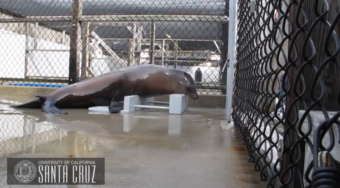
Video: In The Name Of Science, Head-Bobbing Sea Lion Keeps The Beat

While rhythm can often be hard enough to find among humans, finding it in the animal kingdom has been even more rare.

But thanks to a 3-year-old sea lion named Ronan who knows how to keep the beat, previous notions of rhythmic ability among animals are now being challenged.

The research team at the University of California at Santa Cruz’s Pinniped Cognition and Sensory Systems Laboratory says Ronan is the first nonhuman mammal to show evidence of beat keeping, something previously seen mostly in parrots and cockatoos.

“The fact that we showed Ronan could do it means that there’s a raw capability in sea lions,” lead researcher Peter Cook, a graduate student in psychology at UC-Santa Cruz, told NBC News.

Previously, Cook says, beat-keeping ability was thought to be tied to vocal mimicry, which is why birds can do it. Sea lions, however, are not vocal mimics, so Ronan’s ability to bob her head to the beat of “Boogie Wonderland” and The Backstreet Boys could mean that rhythmic ability in the animal kingdom might be more common.

We’re not quite sure what this means for science, but it sure is cute.


Read original article

In The Name Of Science, Head-Bobbing Sea Lion Keeps The Beat

James Hansen, NASA Scientist Who Raised Climate Change Alarm, Is Retiring

NASA scientist and climatologist James Hansen in 2009. Christopher Furlong/Getty Images

“After nearly half a century of research in planetary and climate science for NASA, James E. Hansen is retiring on Wednesday to pursue his passion for climate activism without the hindrances that come with government employment,” The New York Times‘ Dot Earth blog writes.

As Morning Edition reported in 2009, Hansen “first warned Congress about global warming in 1988.” Over time, he became more outspoken and active:

“After spending three or four years interacting with the Bush administration, I realized they were not taking any actions to deal with climate change,” he told NPR in ’09. “So, I decided to give one talk, and then it snowballed into another talk and eventually to even protesting and getting arrested.”

He became, as The Washington Post says, “NASA’s most famous climate scientist.” It rounds up some of the “more notable moments of his scientific career,” from the 1988 testimony that was “one of the first and clearest public statements on global warming” to his arrest in February of this year at a protest outside the White House. He was among those objecting to the proposed Keystone XL Pipeline that would carry crude oil from Canada to the U.S. Gulf Coast.

The Times notes that:

“Perhaps the biggest fight of Dr. Hansen’s career broke out in late 2005, when a young political appointee in the administration of George W. Bush began exercising control over Dr. Hansen’s statements and his access to journalists. Dr. Hansen took the fight public and the administration backed down.”

Now 72, Hansen is leaving NASA after 46 years. He tells the Post he wants to “spend full time on science, drawing attention to the implications for young people, and making clear what science says needs to be done.”


Read original article

James Hansen, NASA Scientist Who Raised Climate Change Alarm, Is Retiring

How does kelp complicate the sea otter equation?

Sonia Ibarra wears a wet suit while diving in California. In Alaska, she wears a dry suit. Similar to how otters stay warm by trapping air in their pelts, Ibarra's dry suit keeps a thin layer of air between her and the frigid Alaska water. Photo courtesy Sonia Ibarra.
Sonia Ibarra wears a wet suit while diving in California. In Alaska, she wears a dry suit. Similar to how otters stay warm by trapping air in their pelts, Ibarra’s dry suit keeps a thin layer of air between her and the frigid Alaska water. Photo courtesy Sonia Ibarra.

Southeast Alaskans and their furry neighbors have had some tense relations for the last fifty years. Reintroduced sea otters compete with commercial fishermen and subsistence users for food.

Scientists know sea otters have a profound impact on their ecosystem, but in Southeast Alaska the details of those interactions are hazy.

As legislators and fisherman search for a management plan, one graduate student has set out to answer the questions on communities’ minds.

For University of Alaska Fairbanks marine biologist Ginny Eckert, the math is simple. Sea otters plus fishermen equals too much demand and not enough shellfish.

“The sustainability of these fisheries is likely not sustainable in the presence of sea otters,” Eckert says. “And so, how we adapt is a critical feature. And we would like to help provide solutions, or at least some advice as for what might be happening in the future.”

UAF marine biologist Ginny Eckert displays one of her research subjects, a juvenile red king crab.

Eckert is an associate professor at the university’s Lena Point Fisheries Facility near Juneau. She collaborates with a team of sea otter scientists and graduate students to answer the public’s questions about how sea otters impact dive and Dungeness crab fisheries. She says that impact is a big one.

“I’ve heard stories of people that have said ‘Well, you know, I used to take a garbage can out, and pick abalone off the rock and fill a garbage can.’ And that’s pretty hard to imagine,” Eckert says.

In the 1800s, fur traders nearly wiped out sea otters from Southeast. The Department of Fish and Game reintroduced otters in the 1960s, and since then the population has grown from 400 to 25,000 animals. That’s led to friction between sea otters and shellfish crab fishermen.

“It would be really nice to understand the relationship between humans, shellfish and sea otters. Because at one point they did all coexist,” Eckert says.

Eckert directs MESAS, or the Marine Ecosystem Sustainability in the Arctic and Subarctic Program, a UAF initiative to integrate ecology with sustainable solutions.

Sea otters rule their underwater surroundings. They’re a top predator, which means the ocean landscape changes with any rise or fall of their population. When otters aren’t around to eat sea urchins, the urchins munch on kelp.

Eckert says Alaskans need to take the whole ecosystem into account, rather than just one animal’s impact on a fishery.

“If you harvest one species and it eats another, then that’s going to have cascading effects throughout that whole food chain,” Eckert says.

Eckert’s newest student is Sonia Ibarra. Ibarra says the difference between diving in a place with kelp and a place without is like moving from a forest to a desert. Fish and other animals seek refuge in kelp all the way from the rocks on the seafloor to the canopy at the water’s surface.

Ibarra will look at how sea otters change their ecosystems over time, and how that impacts Southeastern communities. Her thesis will draw from local knowledge and her observations underwater. Ibarra is still in the planning phase of her five-year doctorate.

“I just feel like a lot of management strategies or plans are kind of based on very limited science. Sometimes it’s not because people don’t want to make better informed decisions, just the science is not out there,” Ibarra says. “And so I just hope to inform people about these effects, the good and the bad.”

Ibarra will look at whether kelp forests move in after sea otters sweep through, providing habitat for various fish species. But the commercial shellfish, crab, sea cucumber and sea urchin fisheries weren’t around when sea otters were last in Southeast, so there’s little data for comparison.

If Ibarra finds the kelp forests are coming back, herring and rockfish might move into those new forests. But it would take time for kelp forests and their fisheries to return.

Like in Alaska, kelp forests in California provide habitat and shelter for a variety of fish species. Photo courtesy Sonia Ibarra.

 “Otters are going to eat urchins and sea cucumbers and geoducks. I mean, they’re just really good at it.” Ibarra says. “And so, what’s a potential tradeoff? Can people that live in these communities make a tradeoff between those and the potential fisheries that develop in these areas. How long is that going to take, nobody really knows. And can people transform their livelihoods? There has to be some type of alternative livelihood for the people in this area.”

And until scientists untangle the underwater food web, they say any otter management alternatives could trigger unintended consequences.

Site notifications
Update notification options
Subscribe to notifications