Science & Tech

More humpback whales could cause problems

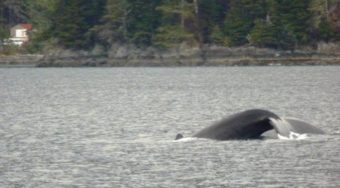
A humpback whale begins arching its back and showing its tail just before diving for herring Nov. 3 in Sitka Sound.
A humpback whale begins arching its back and showing its tail just before diving for herring Nov. 3 in Sitka Sound. Photo by Ed Schoenfeld.

There’s a baby boom going on with Alaska’s humpback whales.

Slow-but-steady population growth is good news for the species, as well as whale-watchers. But it could be bad news for boaters, hatcheries and the herring fleet.
The healthy population was visible during a boat tour held as part of the Sitka WhaleFest Science Symposium, held Nov. 1-4.

“There’s a few more whales further out. I’m not sure if they’re whales we’ve had close views of this morning, but we’ll find that out,” says Capt. John Dunlap as he pilots a catamaran through a protected area of Sitka Sound.

The Allen Marine vessel is carrying several dozen passengers, plus expert marine biologists.

Humpback researcher Jan Straley shows whale baleen to a passenger during a Nov. 3 whale-watching tour in Sitka Sound.
Samples of baleen are examined during a Nov. 3 whale-watching tour. Baleen filters krill and small fish from sea water. Photo by Ed Schoenfeld.

One is Jan Straley, festival science director and a University of Alaska professor who’s studied the marine mammals for more than 30 years.

“The population increase in humpbacks is going gangbusters,” Straley says.

“They are reproducing at about 6 to 7 percent a year in Southeast Alaska. So that means for every hundred whales we get six or seven more whales the next year. And their mortality rate isn’t that high, so we’re just getting more and more whales, which is a good thing, but it also comes with some problems,” she says.

Those problems aren’t evident on this day. Passengers gather on deck to watch, photograph – and hear – some of the sound’s spouting humpbacks.

The numbers are up as the species continues recovering from global commercial whaling. But researchers say trouble’s ahead, as the population grows.

John Moran is a research biologist with the National Marine Fisheries Service in Juneau. (Scroll down to hear Moran’s speech, Living in a Humpback World: The Shenanigans of a Recovering Population.“)

“The amazing thing is that there’s not more issues. There’s a lot of cruise ships, a lot of whales, and there’s a lot of gear in the water,” Moran says.

Whales do get hit and killed by the big ships. And they do become tangled in commercial fishing lines. But Moran is more worried about interactions between whales and skiffs, cabin cruisers and other small vessels.

“People don’t really pay attention when they’re driving boats like they do when they’re of driving a car. And small boats are fast and whales are big. And it’s like hitting a brick wall and I don’t think people fully realize that,” he says.

A humpback whale shows its tail as it dives for food in Sitka Sound.
A humpback whale shows its tail as it dives for food in Sitka Sound. Photo by Ed Schoenfeld.

Passengers watch several whales arch their backs, show their tails and dive. Captain Dunlap asks everyone to keep their eyes open.

“We’re in relatively deep water. It’s over 350 feet deep here. And depending on where these whales are feeding, they could be down for quite a while,” he says.

Some people think humpbacks eat only krill, a small, shrimp-like crustacean filtered out by their baleen. But Straley tells the whale-watchers they also feed on fish.

“There’s a nice layer of herring right on the bottom that’s about 80 fathoms deep. So these whales come right now, and they’re feeding prior to their migration, just bulking up because they don’t feed a lot in Hawaii,” she says.

That’s where most Sitka whales go during winter months. Some also swim from Prince William Sound and other locations to Mexican waters.

Research shows the growing humpback population eats enough herring to reduce local stocks.

Moran says they take about 20 percent of the biomass in Prince William Sound — about the same as the commercial harvest before the Exxon Valdez disaster. The whales may be slowing herring recovery since the oil spill.

Moran says humpbacks are very effective herring hunters.

“The whales dive down into the school and more whales come and they start breaking up this big school into smaller schools. Fish get stunned, fish are scattering, and it’s a lot easier for a sea lion,” he says.

That’s another impact of humpback population growth. Their feeding helps other marine mammals, as well as birds, which sometime follow whales.

Sea lions touch noses as one clambers onto a buoy near feeding whales in Sitka Sound. Sea lions follow humpbacks, eating herring stunned or killed during feeding.
Sea lions touch noses as one clambers onto a buoy near feeding whales in Sitka Sound. Sea lions follow humpbacks, eating herring stunned or killed during feeding. Photo by Ed Schoenfeld.

Then there’s the salmon hatcheries. At Baranof Island’s Hidden Falls, and some other sites, whales have learned to feed on newly released fry.

“One thing they’re really good at is being maneuverable,” Moran says. “They have those really long pectoral fins that allow them to turn real sharp so they can get in really close to shore and they can work around the net pens and they figure out this is a great place to eat.”

Marine scientists continue to study humpback population growth, and what it might mean for the ocean ecosystem, as well as people.

But on this cruise, more whales just means more photos.

A whale spouts, and the cameras go “click-click-click.” The shutters sound even more as it lifts its tail to dive.

“Beautiful,” one wale-watcher says.


Underground fuel tanks compound the severity of fuel leaks

Rainbow sheen seen on the creek.
Rainbow sheen seen on the creek. August 20, 2012 (Photo courtesy Alaska Department of Environmental Conservation)

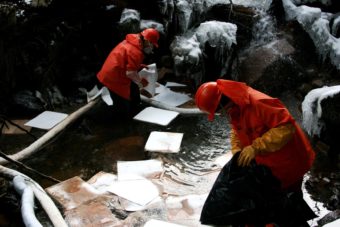
The smell of diesel and rainbow sheen on a Douglas Island creek in July led environmental responders on a complicated three-month hunt to a leaking underground fuel tank.
The Alaska Department of Environmental Conservation answered a homeowner’s call about the foul smell and oily creek. Investigators traced the sheen back to the soil around an old culvert that runs under Nowell Avenue.

Complicating the search for the source was the number of apartment complexes in the area—many with buried fuel tanks says Crystal Smith who was part of the response team.

“Years ago a number of them were put in just because people didn’t want to have a tank in their backyard. It’s not the prettiest thing to have in your backyard. So people put them underground not knowing the risk of having them underground,” Smith says.

The team checked tanks for water which can indicate if a tank is leaking. But none of the tanks showed high amounts of water. They reviewed fuel records for the complexes to see if any had large number of deliveries coming in, but again nothing seemed out of the ordinary. City crews pulled manholes and storm drains; they rigged up cameras in culverts.

By the end of August the response team narrowed down the potential tanks and used special dyes that could travel with the fuel.

It was a waiting game punctuated with manning absorbent materials in the creek to try and clean up the spill.

On Halloween, the team finally started to see some color in the creek and after a couple days it turned in a bright red that had been added to one of the tanks. It had taken 63 days for the dye to travel from the tank to the creek.

Since then, the owners of the tank have started the lengthy and expensive process of cleaning up.

[quote]“We’ve actually crunched the numbers around here and asked an environmental consultant. For every gallon of fuel that is lost in a fuel spill, the cleanup cost is about $100 a gallon. So 75 gallons lost would be $7,500 just in the cleanup cost,” Smith says.[/quote]

The size of the area that the fuel contaminated is hard to guess because the tank was buried.

“It’s really hard to estimate because we don’t know how long it’s been going, but in looking in how much they recovered underneath the tank and how big of an area that it was spread over we’re saying it’s probably over a 1,000 gallons that was released, “ Smith says. “It’s really hard to make an estimate with these, but we know it was a large amount. We know that it was leaking for at least 3 months.”

Smith stresses the importance of closely monitoring underground tanks and even replacing them with an above-ground tank before a spill happens. The integrity of underground tanks can be checked by testing for water and oil tank pressure.

“If they want their tank to be tested for water, then we here at the state are more than happy to come out and test their tanks or they can ask their fuel providers. A lot of times people carry the water finding test on their trucks and they can do it right then and there.”

Absorbent material is still sopping up fuel from the creek. Tank owners are required to maintain it until the water runs clean.

But DEC officials are calling it a successful cleanup. They’re using it to educate others to pay attention to their buried, unseen tanks.

The DEC website has guidance on how to inspect fuel tanks and what to do in the event of a leak.

Correction: An earlier version of this story stated that the dye took 36 days to travel from the tank to the creek. It was actually 63 days and the story has been corrected to reflect that.


New partnership seeks to protect and maintain salmon habitat

Wild Pacific Northwest salmon face a bleak future, boasting but a tiny fraction of their historical population size, according to an alliance of salmon biologists and conservation advocates.

Alaska enjoys a healthier salmon harvest than the Lower 48.  A new organization dedicated to protecting and maintaining fish habitat invited Oregon State University’s Robert Lackey  to talk about the future of salmon and consequences of salmon habitat destruction.  Lackey teaches political science and fisheries science and co-edited the Salmon 2100 anthology.

The Southeast Alaska Fish Habitat Partnership connects state and federal agencies, conservation groups and Alaska Native corporations who have an interest in salmon protection. The National Fish Habitat Board recognizes the group as a candidate partnership, and partners must show they are pursuing conservation goals before being recognized as a formal partnership.

Robert Lackey’s lecture was the organization’s first public event. Steering committee chair Neil Stichert said partners also were invited to display posters and share their own research.

“So we thought it would be a great way to draw in folks, consume information that was derived from their own Southeast Alaska backyard, and have a moment to settle in for a lecture, ” Stichert said.

Spawning sockeye salmon

Lackey told the audience of about 75 that wild Pacific salmon populations are in danger of dropping to unsustainable levels by 2100 because of habitat destruction from human development.

The Salmon 2100 project was a 2006 collaboration of 33 scientists, policy analysts and advocates. It looked at ways to return Pacific Northwest wild salmon populations to a healthy, harvestable size.

“We know more about salmon than any other group of fish in the world, so don’t say we don’t know enough about salmon. If we don’t know enough about salmon, we don’t know enough about any of the other species,” Lackey said.

Salmon populations used to extend from Russia to Southeast Asia, across much of Europe, down the northern East Coast, and as far southwest as San Diego.  Lackey said salmon runs on the West Coast, excluding Alaska, have fallen to five percent of their historical average, before the Gold Rush.

“’People knew what was happening. The newspapers of the day said ‘The runs are being decimated,’” Lackey said.

Now, that five percent excludes hatchery fish.  Lackey and his collaborators wanted to know how past habitat destruction impacted wild salmon from California to Alaska.

“There are arguably more salmon alive than there’s ever been in history. The vast majority are in cages,” Lackey said.

Because there’s less development in Alaska, Lackey said the future of salmon is not as bleak.

[quote]“If you continued on to Alaska, you’d find runs roughly the size of historical runs. There are issues, there are challenges, there are problems, but the runs in Alaska will still be pretty good. If I was in the Lower 48, this would basically be undeveloped land. I mean if you look at the mining operations these are trivial compared to the lower 48,” Lackey said.[/quote]

Lackey said “salmon is the stereotype of death by a thousand cuts.”

“You put a mine in, you put a school in, you really just don’t help salmon,” Lackey said.

The Salmon 2100 team looked at data that suggests California and the Pacific Northwest could quadruple their human populations by 2100, making the region as packed as Europe.  Seattle could as large as Mexico City. He said the free market doesn’t factor in the toll of development on salmon habitat; irrigation agriculture in the region would put farmers and salmon in competition for the same water.

“Fish, salmon, need water. That’s your biology lesson 101. And a compromise is always a loss for salmon. It’s not likely someone’s going to come up with a substitute for water for salmon,” Lackey said.

Lackey and his team conclude that current policy yields a troubling forecast for wild salmon populations in 2100.

Heather Hardcastle is a commercial fisherman who works with the national conservation group Trout Unlimited. She called the lecture a “wakeup call.”

[quote]“If we don’t take steps now to protect habitat, it could be lost. For a place like Southeast Alaska where salmon is so important, it’s good to heed that warning from the Lower 48,” Hardcastle said. [/quote]

The future for southern salmon populations was sobering. Biological science technician Thor Eide works with restoration projects for the Forest Service. He believes Alaska’s salmon runs have an encouraging future.

[quote]“The nice thing about Alaska is that people are very connected with salmon, it’s a part of their life, so they have a vested interest in seeing healthy salmon runs,” Eide said. [/quote]


In the spring, the Southeast Alaska Fish Habitat Partnership plans to draw from research across Southeast Alaska and will hold a multi-day symposium on fish management in the region.

Ancient marine reptiles are topic of recent Norwegian journal and Fairbanks scientist’s research

It’s hard to imagine that oceans in the far north once teemed with ancient marine reptiles.  But 145 million years ago, that’s exactly what was happening a couple hundred miles north of mainland Europe. A region east of Greenland and north of Norway used to be home to a whole slew of giant sea-faring reptiles. “It is literally one of the richest places in the world for marine reptiles like Plesiosuars and Ichthyosuars,” says Pat Druckenmiller.

He’s the Earth Science Curator at the University of Alaska, Fairbanks Museum of the North.  His latest work on Svalbard was recently published in a large volume of the Norwegian Journal of Geology.

Druckenmiller is a member of the Spitsbergen International Research Group.  It includes geologists, sedimentologists and other scientists who’ve spent the past seven years digging up ancient marine reptiles on Svalbard, a group of Norwegian islands above the Arctic Circle.

[quote]“So what we were really doing there wasn’t just looking at marine reptiles but getting a big picture view of the whole ecosystem,” he says. “What were the ocean conditions like, what was the water depth, what was the water temperature, what kind of invertebrates were living in the sea at the same time that may have been at the base of the food chain for marine reptiles so we really took a big picture approach.”[/quote]

Druckenmiller just wrapped up his seventh field season.  To be fair, Svalbard, was located further south, by about ten degrees latitude during the Late Jurassic – a geologic period that begin 160 million years ago. Back then, the region was slightly warmer.  It’s home to what Druckenmiller calls a “bonanza” of giant reptiles.

“We’re not really sure why it’s so rich.  That’s sort of still the million dollar question,” he explains.  “What we focused on is ok, let’s take advantage of the fact that it’s so rich and document the new types of things we find here and low and behold really almost all the material we uncovered turned out to be new species,” says Druckenmiller.

There are two major groups of marine reptiles from this period: Plesiosaurs and Ichthyosaurs.   Since 2006, the group has excavated 37 enormous skeletons of each from a band of rock that spans four million years.

[quote]“37 skeletons over seven field seasons to put that in perspective, I would estimate that there have been probably not much more than 20 skeletons excavated in the rest of the world anywhere else,” he says. “It also means that this process of discovery is going to be going on literally for years to come as that material gets cleaned up and we start to examine it in new light,” says Druckenmiller.[/quote]

At least six of the skeletons represent new species. Two of them come from a Pliosaur – a type of Plesiosuar.  It was a 40 foot-long, top marine predator.

[quote]“This animal has a skull that would have been two and half meters, in other words six to seven feet long just the skull with teeth larger in diameter than the teeth of a t-rex,” he explains.  “So this was the consummate underwater predator this was the animal that all others quivered at the presence of.  We also named three new types of long-necked Plesiosaur, the ones that looked like the mythical Loch Ness monsters.  One of them was pretty incredible because it had 60 vertebrae in its neck.”[/quote]

… In other words, that Plesiosaur’s neck was eight feet long.  It’s the longest neck ever discovered from an animal living during the Jurassic anywhere in the world.

All of the material uncovered on Svalbard is currently housed at the University of Oslo in Norway.  The team will clean the bones and make molds and casts of them.  While the field work has come to an end for the time being, Druckenmiller says that doesn’t mean the project is complete.

“I would estimate we easily have another ten years of fossil preparation just to see what we have.  Plus as we’re uncovering that material it often takes a year or two of work just to properly document and describe… so it’s a slow process and I suspect I’ll be working on this  material for another twenty years of my career  so that will keep me busy for quite a while,”he laughs.

Druckenmiller says it’s likely the group will head back to Svalbard to continue digging in a few years.  He says it’s quite possible at least one of the marine reptiles discovered could make its way to Fairbanks one day.
For more photos of Druckenmiller’s and the rest of the team’s work, click here: http://www.nhm.uio.no/om/presse/foto/svalbard/

Updated: BC quake prompts tsunami warning for SE Alaska

A tsunami warning was posted Saturday evening for the outer coast of Southeast Alaska from Cape Decision to to the tip of Vancouver Island, British Columbia.

Two earthquakes, magnitude 7.7 and 5.8, were reported near the Queen Charlotte Islands at about 7:04 and 7:14 Alaska time Saturday night. Several additional afterschocks were also reported Saturday evening and Sunday.

There were various reports by Juneau residents through social media that they felt the main quake with some shaking and swinging of hanging light fixtures, but no damage was initially reported.

Wave heights were reported at about four inches in Craig and Port Protection, about nine inches in Winter Harbour, B.C., and  two waves of about eight inches were detected at Langara Point.

Although Sitka was outside of the warning area, officials asked everyone to briefly leave the harbor area as a precaution. Juneau and other communities located within the inside waters of Southeast Alaska were not expected to see any significant change in water levels.

The tsunami warning for Alaska was eventually downgraded to an advisory and then cancelled late Saturday night. However, a tsunami warning was later posted for the Hawaiian Islands as propagation and travel maps indicated possible arrival of a wave there. A tsunami advisory for that area has since been cancelled after a five-foot wave was reported at Maui.

Pet rat aboard Deadliest Catch boat draws state scrutiny

A recent episode of the Discovery Channel series Deadliest Catch could be used as evidence in a criminal case. The crew of the F/V Northwestern is under investigation by the state and they may have unintentionally ratted themselves out on camera.

Burdell makes his first appearance during the fifth episode of season eight. It’s a slow stretch of fishing for the Northwestern, and there’s not much human drama for the cameras to film. Until:

Deckhands: “It’s a [expletive] rat. Rat is in the box.”

As the deckhands corral the terrified rodent into a bucket, Captain Sig Hansen imparts some folk wisdom.

“The Norway rats are good luck on boats.”

The crew decides to hang on to Burdell, whose name is never explained, and then the pots start rolling in full.

Narrator: Captain Sig honed in on the crab once again.

Sig: Hey! Rats are good luck!

Narrator: And his good luck charm gets a stay of execution.

Sig: We’re not going to toss him over the side. I say we release him in Akutan.”

If that segment of reality TV actually does reflect reality, Hansen’s decision to keep the rat could end up costing the Northwestern up to $200,000. Regulations passed in 2007 make harboring rats a class A misdemeanor in Alaska. Releasing them into the wild is definitely illegal. State Troopers are investigating the incident and wouldn’t comment for this story, but if they do prosecute, it would be the first time the rat laws have been applied.

Joe Meehan is a biologist with the Alaska Department of Fish and Game and something of a rat expert. His reaction to the video:

“Yeah, I thought it was odd. I had never heard that rats could be considered good luck.”

In fact, Meehan says, they’re often distinctively unlucky.

“Rats can chew on wires and communications equipment, they contaminate foods through their feces and urine. There’s just a whole host of problems that rats can cause for humans.”

That’s leaving aside their considerable environmental impacts, like destroying seabird colonies. Many of the Aleutian Islands – including Akutan – already have resident rat populations, but Meehan says new rats could strengthen their genetic pool or introduce new diseases.

“And of course, not all of the islands in the Aleutians already have rats, and so we certainly don’t want to get rats on any new islands.”

People in the rat field also don’t want celebrities giving other fishermen ideas. Rodent eradication is expensive. Getting rid of the vermin on Hawadax — formerly known as Rat Island — cost $2.5 million.

In the end, Burdell never had the opportunity to colonize any islands. A Deadliest Catch web extra suggests he was accidentally tossed off the boat.

Crew: Rat overboard!!
Captain: What it looks like to me, is that he abandoned ship. I think our stowaway just went for a swim!”

Fish and Game’s Meehan says while he’s happy Burdell didn’t get released on Akutan, tossing rats overboard isn’t the preferred method of disposal. Rats are strong swimmers, so trapping or poisoning them is the only way to ensure their demise.

Site notifications
Update notification options
Subscribe to notifications