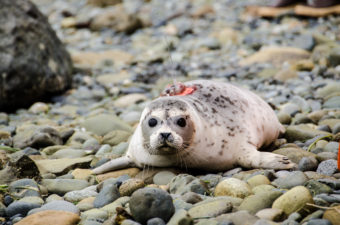
On Friday, two young harbor seals had an audience at False Outer Point as the seals made their way into the ocean for the first time since they were rescued in May.
The seals arrived on the beach in two large crates, greeted by the excited whispers of school kids. Dozens of children from around Juneau were on hand to bid the seals goodbye.
Olympia, a female harbor seal, was found in Haines in early May. The young pup was taken to the Alaska Sea Life Center where she joined Picabo, a seal pup rescued in Juneau. Both seals were born premature and were abandoned.
They spent three months at the SeaLife center recovering and learning how to fish.
The young seals were hesitant to leave their crates but eventually made their way down the beach. The crowd cheered as the two entered the water.
Dozens of children and their families line the beach waiting for the seals to be released. (Photo by Heather Bryant/KTOO)
Olympia pauses at the water before diving in. Olympia is a female Harbor Seal that was rescued in Haines, Alaska in May. The young pup was premature and abandoned. She was rehabilitated at the Alaska SeaLife Center. She and another harbor seal, Picabo, were released into the wild in Juneau, Alaska on Aug. 14. (Photo by Heather Bryant/KTOO)
Picabo is a young female harbor seal. She was rescued on the dock at Allen Marine in May. The young pup was born premature and was abandoned. Rehabilitated at the Alaska SeaLife Center, she was released back into the wild on Aug. 14 in Juneau. She wears a special satellite tracker so that the SeaLife Center can follow her whereabouts until she sheds the tracker. (Photo by Heather Bryant/KTOO)
Children line the beach to watch the seals swim. (Photo by Heather Bryant/KTOO)
Not quite ready to go, the shy seals headed back up the beach before being herded towards the water. (Photo by Heather Bryant/KTOO)
A comprehensive survey of the outer coastline got underway before the expected bulk of tsunami debris arrives in Alaska waters. But observers have already spotted items pushed by North Pacific winds coming ashore, and some of that debris may be unhealthy if consumed by coastal wildlife.
“We’re seeing a lot of foam. We’re seeing a lot of these buoys,” said Wasilla-based pilot Tim Veenstra as he described recent flights along the Southcentral coast. He also reports also spotting sections of what appears of building walls with urathane foam sprayed inside.
As head of Airborne Technologies Incorporated, he flies an amphibious Cessna 185 that skims as low as 700 feet off the beach while dodging poor weather and sensitive wildlife areas.
“We’ve got the pilot upfront and the camera operator in the back that is running the equipement,”said Veenstra.
“Everything is all tied together with GPS. It’s all digitial imagery.” High-definition video and high-resolution still cameras are mounted in the belly of the aircraft.
“If there’s a piece of foam that’s about the size of golf ball, we can typically define that as ‘Yes, that is definitely a piece of foam.’”
Veenstra is on a state contract to fly and photograph as much as 3,000 miles of outer coastline from Cape Muzon in the southeast out to Cold Bay in the west. It’s for a baseline study before the first big wave of tsunami debris washes up on Alaska beaches. The black polyurethane oyster buoys, large styrofoam floats, and other foam pieces seen on Alaska beaches are likely wind-driven, arriving earlier than submerged or current-driven objects.
Veenstra is very careful to avoid positively identifying any of the debris as originating during last year’s tsunami. That will require collection and examination by people on the beach.
For example, he overflew two sites that had some odd, concentrated collections of debris. They include black flyswatters with a white sports logo and what appeared to be basketballs which were the size of Nerf balls. Later, Veenstra said that they discovered those were the contents of containers that washed overboard from a freighter in the North Pacific.
Veenstra’s contract with the state Department of Environmental Conversation is the first recent aerial survey of Alaska beaches, but not the first survey overall.
Elaine Busse Floyd is the acting director of DEC’s Division of Environmental Health. She says the state is paying nearly $200,000 for the aerial survey. A potential grant from NOAA will likely go to actual clean-up.
“Our plan with that money is to contract it out in the marine debris community so the money is used for boots or boats on the ground to actually remove the tsunami debris,” said Floyd.
But that NOAA grant is only $50,000.
“And that’s a start,” said Dave Gaudet, marine debris program coordinator for the Marine Conservation Alliance Foundation. He believes that cleaning up many of the beaches on the outer coast will be a challenge.
“Using volunteers is probably not really an option,” said Gaudet. “Even with volunteers, getting them out there is going to be expensive.”
“It’s either by helicopter or on the rare days when you can actually get a boat ashore in the surf,” said Gaudet.
Meanwhile, the Parnell Administration just set up a webpage devoted to tsunami debris. It serves as a clearinghouse of information and contacts for reporting debris or helping with the potential clean-up, including the corresponding State agency for every potential issue.
As an example, consider some of the impacts on wildlife. Much of that Styrofoam will be nearly impossible to clean-up after it is broken up by wind and wave action. Floyd says they’re worried about marine mammals and birds ingesting it.
“It can block their gastrointestinal tract,” said Floyd. “The animal or bird would die from malnutrition. Or they could choke on it.”
Veenstra hopes to wrap up his flying surveys by the end of August with an analysis completed in October.
“We’re going to find hotspots, and we’ve already identifed a number of beaches that are heavily debrised,” said Veenstra. But he said a baseline survey is still important to compare to debris levels next year and the year after.
Floyd says they expect to quickly share that data with other state agencies, NOAA, and various stakeholders.
Or, you can go to the DEC homepage at dec.alaska.gov and scroll down to the very bottom until you see the picture of the yellow float and red and white container.
An artist’s rendering shows a rocket-powered descent stage lowering the one-ton Curiosity rover to the Mars surface. (NASA/JPL-Caltech)
The best place to stand in the entire solar system at 1:14 a.m. ET Monday was about 150 million miles away, at the bottom of Gale Crater near the equator of the Red Planet.
Looking west around mid-afternoon local time, a Martian bystander would have seen a rocket-powered alien spacecraft approach and then hover about 60 feet over the rock-strewn plain between the crater walls and the towering slopes of nearby Mount Sharp.
A gangly vehicle, about the size of a small car on Earth, descended from the spacecraft on nylon cords amid blowing crimson dust. As soon as this machine touched the soil with its six wheels, its delivery craft abruptly disconnected the cables and, with the last of its fuel, safely careened away from its passenger. NASA’s new Mars rover, Curiosity, had landed.
Fourteen minutes later, news of these strange happenings reached the people on Earth who were responsible:
“Touchdown confirmed!”
With those words, the mission control team at the space agency’s Jet Propulsion Laboratory in Pasadena, Calif., erupted in cheers, applause and hugs. And as the first pictures began to arrive from their nuclear-powered explorer, the celebrations grew louder and continued well into a televised news conference an hour later.
NASA/JPL-CaltechCuriosity’s shadow on the surface of Mars, just minutes after the rover landed on the surface of the planet.
“Needless to say there’s a lot of excitement in this room,” said the laboratory’s director, Charles Elachi.
When it comes to visitors like the $2.5-billion Curiosity rover, Mars has been a reclusive, get-off-of-my-lawn host. Of 13 previous attempts to land space probes on the Red Planet over the past four decades, nearly half failed or immediately lost contact.
Those odds were enough to make for a tense scene at mission control in the days and hours leading up the landing. “You can’t believe the tension and uncertainty here at JPL,” NPR science correspondent Joe Palca reported from the laboratory. “The anxiety just couldn’t be denied.”
The novel use of the rocket-powered “sky crane” to lower the one-ton robot to the Martian surface only added to the drama.
“I was on the edge of my seat,” former astronaut and NASA Administrator Charlie Bolden Jr. told NASA TV moments after the landing.
With the suspenseful landing behind them, mission controllers quickly turned their attention to Curiosity’s coming months of work on the Martian surface. The rover is expected to spend two years exploring Gale Crater and the three-mile-high mountain within it.
“Tomorrow,” JPL’s Elachi said, “we’re going to start exploring Mars.”
NASA TV has been streaming video of the overnight events at the Jet Propulsion Laboratory and plans to carry the next scheduled news conference at Noon ET.
For more details on this historic event, check out NPR’s ongoing coverage here.
More ships than ever are operating in the Bering Strait and off the north coast of Alaska, but many of the nautical charts for the region haven’t been updated in more than a century. Now, the National Oceanic and Atmospheric Administration is trying to fix that. The research vessel Fairweather set off Wednesday for a surveying trip in the Arctic.
The crew of the Fairweather will be tracing a path from Kotzebue to the Canadian border over the next month. It’s the first mapping expedition of the north coast using modern equipment.
Smoke comes out of a Celebrity Cruise Line ship stack as it sails into Juneau today (July 30). New EPA rules require cleaner fuel and fewer emissions.
Some Alaska communities are pushing back against a new requirement that ships sailing within 200 miles of the coast burn cleaner fuel. They say the rule, which goes into effect Wednesday, Aug.1st, will hurt cruise traffic and increase shipping costs.
One community is Skagway, where tourism dominates the summer economy.
“It takes years to get a cruise line. And it takes a second to drive one away,” says Steve Hites, owner of the Skagway Streetcar Company and a member of the town’s Port Commission.
He’s telling Skagway’s assembly about new air-emission limits set by the federal Environmental Protection Agency. They cover ships in coastal Emission Control Areas, also called ECAs.
Hites says cleaner fuel is more expensive, and cruise lines will pass that on to customers.
“The cost of the ECA on a cruise ticket could be $150, or three times the cost of the Alaska head tax. We lost five big ships because of the head tax. By extrapolation, will we lose 15 ships?” he asks.
Skagway’s assembly passed a resolution Hites asked for by a unanimous vote. It calls for state officials to fight the new requirement, which lowers sulfur dioxide emissions within 200 miles of shore.
The northern Lynn Canal community is not alone. Haines and Sitka are among other Southeast towns passing similar resolutions. (Read the Sitka resolution.)
Anchorage Mayor Dan Sullivan also issued a statement saying the rules could impact barge traffic. And U.S. Senator Lisa Murkowski took to her chamber’s floor to point out that rural Alaska would see the highest price hikes from more expensive shipping.
“The EPA’s one-size fits all approach to environment regulation. Perhaps you can’t quite shoehorn that in, in all situations,” Murkowski says.
The statements and resolutions came after the Parnell administration sued the EPA and other federal agencies to block or amend the rules.
The industry is also fighting the EPA. Alaska Cruise Association President John Binkley says ships might shift to other countries without such regulations.
“Alaska is an expensive destination because there are long distances to travel. So fuel becomes a much more important component of the overall cost of the ship,” Binkley says.
The EPA wouldn’t provide anyone for an interview. But a press release says sulfur pollution from bunker fuel, used by cruise ships and some barge lines, has been linked to respiratory illnesses. It says children, the elderly and asthmatics are among those most at risk. (Read some history of the emissions issue.)
Some Alaskans support that approach.
“Compared to having a tremendous amount of air pollution in Alaska waters, personally, I think that it’s worth it,” says Gershon Cohen, a Haines clean-water-and-air activist who’s been involved in cruise ship issues.
“It’s not going to come out of the cruise industry’s pocket one way or another. They’re going to pass that cost on the consumers. And for the thousands that the consumers are spending, I don’t think they’re really going to ever notice,” Cohen says.
Cohen says the real issue should be reducing dangerous pollution. He says it’s clearly visible as ships sail between Skagway, Juneau and points south and west.
“There is a pall over Lynn Canal. There is a tremendous amount of air pollution there. A lot of folks in Skagway are concerned. They saying the air pollution is killing the trees above Dewey Lake. So, if we’re killing people in our coastal communities from air pollution from ships, that this is probably like a pretty good idea to take care of it and make them use cleaner fuel,” he says.
The cruise industry says it will comply, but wants the EPA to enact an alternative plan that would cost less money.
While some barge lines, such as Totem Ocean Trailer Express, will be affected, others will not.
“In the Southeast market, Ketchikan all the way to Haines and Skagway, no,” says Kevin Anderson, president of Seattle-based Alaska Marine Lines. “Our tugboats burn diesel and these regulations are not going to affect us. So there’s not going to be an added fuel surcharge because of that.”
The state ferry system is also not affected. Marine highway chief Mike Neussl says the change was made years ago.
“It wasn’t a big switch and the switch that the marine highways made was not in direct response to this upcoming implementation of the ECA,” he says.
There’s another way the emission limits could affect shipping and travel. Binkley of the cruise association suggests they could increase competition among buyers.
“There will be more competition for the ultra-low-sulfur diesel, like is burned in trucks and whatnot. Presumably the price will go up for that as there’s more demand for that part of the barrel of oil that’s refined,” Binkley says.
Canada and a number of other nations are also imposing the new standards, which are part of an international treaty.
Opponents worry that impacts will be far worse in 2015. That’s when the EPA will further limit fuel sulfur content by a factor of 10.
The ferry Malaspina sails by downtown Sitka during 2010 Alaska Day festivities. Ed Schoenfeld Photo.
New federal air-pollution restrictions will affect cruise and some other vessels sailing Alaska waters.
But they will not impact state ferries.
“It is a big issue for the state of Alaska, it is not necessarily a big issue for the Alaska Marine Highway System. All of our ships operating within 200 miles of the coastline already burn low-sulfur fuel,” says Captain Mike Neussl, the state’s deputy commissioner of marine transportation.
State ferries made the switch a number of years ago, before Neussl came on board.
The new air-emission limits come from the federal Environmental Protection Agency. They apply to what are called Emission Control Areas, or ECAs, within 200 miles of the coastline.
Officials say they’re part of an international effort to lower pollution that contributes to human illnesses and deaths.
Neussl says the required fuel is already available at ferry ports.
“The suppliers there already carry ultra-low sulfur diesel because that’s what they have and that’s what we use. So it wasn’t a big switch, and the switch that the marine highways made wasn’t in direct response to this upcoming implementation of the ECA,” he says.
The new rules go into effect Wednesday, August 1st
Close
Update notification options
Subscribe to notifications
Subscribe
Get notifications about news related to the topics you care about. You can unsubscribe anytime.