A climate action plan, designed to help the City and Borough of Juneau achieve a reduction in greenhouse gas emissions, is up for adoption at tonight’s (Monday) Assembly meeting.
In 2007, the assembly set a goal of reducing Juneau’s emissions by 20 percent by the end of 2012. With less than half of that accomplished to date, the city is unlikely to meet its target.
The climate action plan sets a new goal of a 25 percent reduction by 2032. At a recent assembly work session, Consultant Zoe Morrison explained how the plan lays out potential actions and strategies that can be used to help achieve the objective.
“We don’t expect that all of these actions will be completed, but it provides a list of the range of things that you can do to reduce emissions,” Morrison said. “And the thinking is that the state, the CBJ, federal agencies, home and business owners, and residents will select the actions based on cost effectiveness, new technology, the potential for reduction, and what makes the most sense in each situation.”
At that work session, assembly members Carlton Smith and Randy Wanamaker voted against forwarding the plan to the full assembly. Wanamaker wanted to know how much the plan would cost to implement.
“We know there will be costs to us and we need to understand what those costs will be,” Wanamaker said.
Assembly woman Karen Crane argued that a cost estimate is unnecessary at this stage in the plan.
“I really looked at these as not saying that we’re going to do all of these things, but as potential suggestions for future action,” said Crane.
In addition to the climate action plan, the assembly tonight will hold public hearings on several spending ordinances. The biggest one would appropriate 6.6-million dollars for the Juneau Airport’s runway safety area project. Most of those funds come from a Federal Aviation Administration grant.
Tonight’s meeting starts at 7 p.m. in City Hall Assembly Chambers. It can be heard live on KTOO.
Like it or not, discussions about climate change in the United States are awash in political overtones.
The vast majority of scientists agree that the planet is warming as a result of man-made greenhouse gas emissions, which itself raises serious social and political questions. But skeptics say the problem is blown out of proportion, and that mankind may not be to blame.
Political scientist and economist Detlef Sprinz is a senior scientist at the Potsdam Institute for Climate Impact Research. Sprinz will give the keynote address at the Juneau World Affairs Council’s conference titled “the Politics of Global Climate Change.” His Friday evening talk poses the question: ‘Is long-term climate policy politically feasible?’
“Yes but it’s difficult,” says Sprinz. “In the most clear sense it needs parliamentary and here legislative majorities. But also it needs credibility with the mass public. But it also needs entrepreneurship, finding more interesting and cheaper technologies to move us closer to low greenhouse gas or low carbon future.”
Ultimately, Sprinz says any successful policy begins with a period of uncertainty.
“We have to move away from essentially short term profits to long term profits, and we also have, like for any new problems, to be very experimental. But frankly we do this all the time,” he says.
Sprinz points to an example right here in Alaska of a long-term policy decision that started with uncertainty, but which has been quite successful – the Alaska Permanent Fund.
“They are definitely in for multiple generations. And with climate change we have a similar challenge, because we have to think at least to the end of this century and maybe beyond,” says Sprinz.
Much of the uncertainty about current climate change policy has to do with doubts about the science behind it.
“No climatologist disagrees that there are two causes for climate changes. One is natural change and the other is man-made change,” says Syun-Ichi Akasofu, founding director of the International Arctic Research Center and professor of physics at the University of Alaska Fairbanks.
Akasofu will be appearing on the opening panel that will review of the current state of climate change science as well as the contrarian view. Akasofu says he may be a contrarian, but don’t call him a skeptic.
“I don’t like the term ‘skeptics’ or ‘deniers,” he says. “According to my study, 5/6ths of the present warming is due to natural changes. Only 1/6ths is due to man-made. And if you want to correct that you’re wasting your time, money, because natural change you cannot stop it.”
As director of the Arctic Research Center, Akasofu oversaw a study that showed natural changes in ocean currents are causing some of warming in the Arctic Ocean.
“Warm water from North Atlantic is very, very crucial in understanding the changes of the ice conditions,” Akasofu says.
He says other evidence suggests that the current warming trend is part of a recovery period from a 400-year “Little Ice Age” that ended in the 19th century.
“As you know in the Juneau area, you have glaciers, and I studied a whole bunch of glaciers and they start to recede around the 1800s, and it’s still continuing. And in the 1800s there was very little CO2, but the receding began even before 1800,” he says.
Biologist Brendan Kelly will appear with Akasofu, but bring a different point of view. Currently deputy director of the Arctic Research Division at the National Science Foundation, Kelly has studied sea ice ecosystems in the Arctic for 35 years. He’s convinced man-made greenhouse gas emissions are responsible for the rapidly accelerating rate of climate change in the last two decades.
“The evidence is pretty compelling,” Kelly says. “Greenhouse gases are there, we know the physics of it, we know how it works to re-radiate heat back into the atmosphere that otherwise would have escaped. Yeah, it’s not rocket science. It’s science, but it’s not that hard to verify.”
Lately Kelly’s work has focused on how melting sea ice is affecting species like polar bears and ring seals.
“Ring seals actually give birth under the snow on top of the sea ice, and we’ve seen very dramatic changes in the frequency of early melts in that snow cover, for example, which can have a very negative effect on the seals,” says Kelly.
He also notes that a significant chunk of the world’s human population lives at or near sea level.
“All you have to do in Alaska is look at communities like Shishmaref that are being severely threatened by increased coastal erosion,” says Kelly. “This not only a function of sea-level rise, but also a function of sea ice loss and increased storminess on the coast.”
Kelly says scientists can argue over the cause of climate change. But that won’t stop it from happening, and it doesn’t mean that mankind shouldn’t try to mitigate the effects of it.
“We don’t really have the luxury of spending a lot of time debating whose fault it is or isn’t,” says Kelly. “We need to get sober about the fact that this is, as I say, a rate of change that’s very hard for ecosystems and biological systems to respond to, and ultimately can be very hard for society to respond to.”
The Juneau World Affairs Council’s climate change conference starts tonight at the University of Alaska Southeast. Tonight’s panel and Friday’s keynote speech will be held at the Egan Library. All other events will be held in the Egan Lecture Hall.
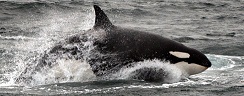
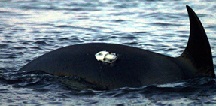
Researchers recently attached recording devices to killers whales in Southeast Alaska which revealed clues about how they search out prey and when they prefer to feed. This story is an encore of an interview done in 2007.
Killer whale leaps on top of a fur seal during the initial stage of an attack out west (not part of DTAG project) - Photo by Dave Ellifrit courtesy of Marine Mammal Research Consortium
Here’s Dr. Volker Deecke’s initial Marine Mammal Research Consortium blog entry on DTAG research, and part 1 and part 2 of follow-up entries
Killer whale with DTAG on back - Photo by Filipa Samarra courtesy of the Marine Mammal Research Consortium
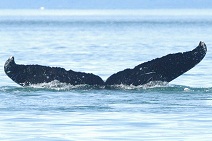
Biologists in Glacier Bay earlier this month recorded whale song that they believe came from one particular humpback, a male called 1652 that has not been observed singing before. He’s been identified as number 1652 because of his very distinctive fluke shape and markings (see picture right). Every summer since 2000, he’s believed to be one of 200 whales that now feed during the summer in Glacier Bay, before heading off for the winter breeding season in the warmer waters of Hawaii. Scientists say song is not usually observed or heard in Southeast Alaska. Vocalizations are usually in the form of simple contact or coordinating feeding behavior.
Whale biologist Chris Gabriele describes how they made the link to 1652 in this interview along with some of the sound of the recording.
We have more links that include the page where the National Park Service posted recordings of #1652, other sounds recorded in Glacier Bay, a Fluke ID Catalog of humpbacks in Glacier Bay, and another interview that Gabriele did a few years ago.
An unidentified flying object over Juneau Sunday night had one Douglas couple rubbing their eyes in disbelief.
At about 10 p.m., Matt Culbreth and his wife were watching TV, when they glanced out their living room windows overlooking Gastineau Channel in time to see, “A large greenish blue fireball come down from the sky, and disappear behind Mt. Roberts.”
Culbreth says the object was too big to be a flare, and way bigger than any other shooting star he’s ever seen. It was in the air for a few seconds before disappearing, and both he and his wife were surprised that it didn’t make any noise.
“Definitely coming down to Earth, though. It wasn’t something really high in the atmosphere,” he says.
Steve Kocsis, a volunteer with Juneau’s Marie Drake Planetarium, says the Culbreths most likely saw a meteor. That’s a fiery streak of light that occurs when mineral objects from space hit Earth’s atmosphere and disintegrate. Shooting stars are meteors, but Kocsis says some look bigger than others.
“They’re called a bolide the brighter ones, and they’ll actually leave kind of like a smoky trail that will change shape from high altitude winds, just like jet vapor trails. And the really close ones, people will actually hear them. There will be a sonic boom,” says Kocsis.
He says it’s not unusual to see one, even in Juneau.
“The main unusual part is to have a clear night to actually see the meteor, but it’s not unusual to see random events,” Kocsis says.
Most meteors burn up completely when they hit the atmosphere, but if part of one falls to Earth it’s called a meteorite. Kocsis says it’s possible to triangulate the location of a meteorite, if it’s seen falling from more than one vantage point.
In January 2000, several Juneau residents saw a falling meteorite that was later found in fragments near frozen Tagish Lake in the Yukon Territory.
“A local there at Atlin was able to go out on the ice and recover it while it was still warm, and he had the foresight to send it to one of the museums,” says Kocsis. “Turned out to be a very rare one, one with organic chemicals in it.”
Matt Culbreth says his wife posted about Sunday’s celestial event on Facebook, but so far they appear to be the only ones who witnessed it. He’s hopeful that with a little publicity, maybe others will step forward.
“I hope so. I hope there was at least a few other people out there that had seen it. I don’t know how you could miss it if you were facing that direction at that time of night. It was just an amazing event,” Culbreth says.
For those who aren’t lucky enough to see a random shooting star, there are two big meteor showers every year – the Perseids in August and the Leonids in November. If the weather cooperates, you might even be able to see them in Juneau.
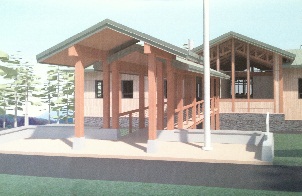
Conceptual rendering of the U.S Forest Service's Pacific Northwest Research Station Juneau Forestry Sciences Laboratory planned for near Auke Lake.
Nearly three decades after it was first proposed and designed, construction is now getting underway on the Pacific Northwest Research Station’s Juneau Forestry Sciences Laboratory.
Ground was broken Thursday afternoon on the new lab adjacent to the University of Alaska Southeast campus, just down the foot and bike path from the Egan Library.
The U.S. Forest Service’s Paul Brewster, assistant director of the Research Station and head of the Juneau lab, says funding for the $8.3 million dollar facility was finally approved in the last year and a half.
“They have a national priority list for facilities,” say Brewster. ”This being a research facility, it’s sort of looked at separate from other administrative facilities like the Juneau Ranger District office out there.”
Brewster believed its location next to UAS and potential opportunities for students to become involved with forest research could have helped bump the lab to the top of the priority list.
About twenty Forest Service employees are expected to move into the facility when it’s completed and opens in the latter half of next year.
Research Station Lab members are currently working out of the old NOAA fish laboratory in Auke Bay.
Previously, they worked out of facilities on Sherwood Lane, just down the street from the Alaska State Troopers and Department of Motor Vehicles. But an audit revealed health and safety concerns, and poorly functioning lab space.
For more on the new laboratory, check out the story in this newscast that aired Friday morning:
Close
Update notification options
Subscribe to notifications
Subscribe
Get notifications about news related to the topics you care about. You can unsubscribe anytime.