Sports

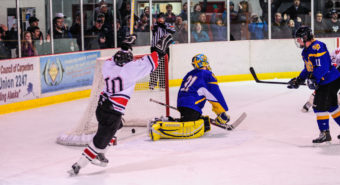
JDHS hockey picks up a weekend win

Juneau Douglas High’s hockey team returned to action for 2014 and split a two-game series versus visiting Bartlett High School last weekend. Juneau won the first game, 4-1, and dropped a 5-4 overtime decision on Saturday night.

JDHS and West Valley will play this weekend at the Treadwell Arena.

All photos by Steve Quinn.

Committee wants feedback on middle school sports travel report

Students and parents protest the middle school sports travel ban during a school summit at Thunder Mountain High School last month. Leanne Ng, left, is an organizer of the repeal campaign. (Photo by Heather Bryant/ KTOO)
Students and parents protest the middle school sports travel ban during a school summit at Thunder Mountain High School in September.  (Photo by Heather Bryant/ KTOO)

A community task force recommending middle school sports teams be allowed to travel is taking comments on its draft report.

The Juneau School Board in September voted to ban sports travel at the middle school level, prompting a public outcry and organization of the task force.

The group has researched the issue and come up with options that would allow 6th, 7th and 8th graders to travel outside Juneau for athletic competition.


Rhoda Yadao chairs the Floyd Dryden Middle School site council.  

I hope the school board makes a decision that speaks the voice of the community.

From responses to the school board’s decision, it appears the public felt left out of the process leading to the policy limiting athletes’ travel at both Juneau middle schools.

So parent Jon Kurland organized the Stakeholder Committee on Middle School Sports Travel. The stakeholders included parents, teachers and coaches from Dzantik’i  Heeni and Floyd Dryden middle schools as well as community  members.  It did not include any school board or district officials.  When the committee formed, board president Sally Saddler said the school district had spent enough energy on the issue.

Dzantik’i Heeni has not allowed its sports teams to travel outside Juneau since the 2011-12 school year, while Floyd Dryden’s teams continue to compete with other Southeast Alaska schools. The new policy is to take effect next fall, putting Floyd Dryden on par with DZ.

Kurland said the committee tried to address concerns raised by school board members and principals at both schools, and offer solutions.

And the hope is that both the principals would be able to get behind this or whatever the final version is and say OK there’s a reasonable set of conditions here and we can live with that and those are reasonable side boards to put on the rules allowing  out of town travel.”

Last week Kurland took the draft report to each school’s site council for input.  Yadao says she knows the Floyd Dryden site council will wholeheartedly endorse the committee’s options when the report is finalized.

“We’ve supported our travel teams. You know we live with the motto ‘no child left behind,’ that if there’s funding that ‘s needed for a child who financially can’t go that there are means, whether it’s the sports activity itself and its members, or the families of students in that sport, to contribute to allow for all students to be able to travel,” Yadao said.

Click here to read the full report.

The report suggests the Floyd Dryden travel policy would be a good model for the board to follow.

It recommends principals limit the cost per student for travel, as well as the number and length of trips.

Floyd Dryden teacher Molly Box was part of the Stakeholder Committee.  She says it’s important the public understands that travel is not restricted to the best players.

“Traveling opportunity is for all kids regardless of skill level and regardless of economics. So that all kids can fund raise, we make sure that teams fund raise together as much as we can,” Box said.

With budget cuts, both schools have lost office staff, making travel logistics more difficult to coordinate.

The report offers several options to address the problem, including the most  obvious – that the district could handle middle school arrangements as it currently does for some high school activities.

Kurland also took the report to the district’s Activities Advisory Committee, which did not endorse the ban, though the school board last fall said it had.

“That couldn’t be farther from the truth,” said long-time coach Tom Rutecki.

He has been an AAC member since it was formed in 2008. He said the group is adamant the school board retract its statement. But he also said the district should develop a philosophy for middle level sports programs before it comes up with a new travel policy.

School district athletic director Sandi Wagner said most middle school sports polices are based on high school athletics, and the belief is the younger students should be involved in more developmental than competitive programs.

“We need to come up with philosophy and guidelines for middle school activities,” Wagner said.  “Probably the most important things about it is the concept that all kids should be involved and there should be a no-cut policy. ”

Wagner said an AAC subcommittee is just beginning to work on the middle school guidelines.

Meanwhile, Wednesday is the deadline for comments on the Stakeholder Committee’s report.  Kurland plans to present the final recommendations to the school board next month.

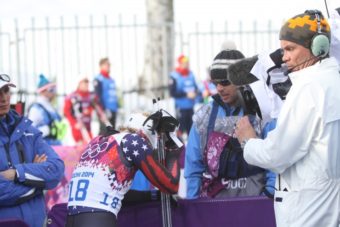
Holly Brooks hopes to ski past her (younger) competitors

Anchorage resident and U.S. Ski Team Member Holly Brooks is in the middle of her World Cup Season. And she just made her second Olympic team.  Four years ago, Brooks had just started pursuing her long-shot Olympic dream. Now as she prepares for Sochi, she’s in a very different position, with several years of international experience behind her.

Holly Brooks
Holly Brooks

On a frigid day at Hatcher Pass, north of Anchorage, Alaska, cross-country skier Holly Brooks glides up to a start line.

This race is just a practice with her Alaska Pacific University teammates. It’s a chance for Brooks to test her skills before heading to Europe for the busy World Cup season, and then to Sochi in February for the Winter Olympics. Brooks is now a seasoned member of the U.S. Ski Team, but a little more than four years ago, she was on the sidelines.

On July 4, 2009, that all changed.

Brooks was competing in Mount Marathon, the Super Bowl of Alaskan sports. It’s a rugged mountain running race, straight up and back down a nausea-inducing incline.

“It was actually this really awkward and odd epiphany,” Brooks says. “I was leading, and I suffered [an] extreme case of dehydration, and I passed out right in front of the emergency room, which is conveniently along the course of Mount Marathon.”

She was just a few tantalizing blocks from the finish line.

“And just how close I came to winning, it’s like it flipped this switch in my mind and my body. And I was laying in the emergency room, and I said to myself — I didn’t tell anyone — ‘I want to go to the Olympics.’ ”

It was an improbable goal. At the time, Brooks was 27, at least a decade older than most cross-country skiers who set their sights on the Olympics. Brooks had done well in two popular recreational races, but had zero international experience. The Winter Games in Vancouver were just seven months away.

“You know, there were a lot of people that told me, ‘Oh, with your background, you can never do this,’ ” Brooks says. “Or, ‘You’re too old; the U.S. Ski Team will never nominate you.’ You know, ‘You’re past your prime.’ ”

But Brooks believed she had a shot, and so did many of the athletes she coached, like Don Haering, whom she coached when he skied in high school and college. He says that when the team was training, Coach Brooks was always right there with them.

“I knew Holly was fast,” Haering says. “It’s not like she would stand there on the side of the trail and tell you where to go; she would go ski with you the whole time, and if you did a hard interval set, she might do the whole thing with you. And then you go home and rest, and meanwhile, Holly has another session to do, and I would assume she would do the same thing with them, too.”

Brooks pursued her dream with “reckless abandon,” as she puts it, and it paid off. In 2010, she eked her way onto the Olympic squad; four years later, she has a shot at a relay medal in Sochi. Looking back, Brooks says she can’t exactly recommend her unusual path to other skiers. But she says her background gives her something many of her younger competitors lack: perspective.

“You know, I am the oldest one on the team. I know that I don’t have 10 more years in my career, so there’s a certain amount of — I hesitate to call it urgency, but I’m really excited for what’s to come.”

Back at Hatcher Pass, Brooks is rounding the last corner of the racecourse, eyeing the finish line. This race may be just for practice, but Brooks doesn’t hold anything back. She wins by 3 seconds and finishes exhausted — but with a huge smile on her face.

Ice safety workshop to be held this weekend

People on the ice in front of Mendenhall Glacier. (Photo by Heather Bryant / KTOO)

Juneau’s fickle winter is prompting lots of warnings to stay off lake ice.   And on Saturday, Capital City Fire and Rescue and the Forest Service will hold ice safety training at the Mendenhall Glacier.

Events this winter at the glacier show just how unstable ice can be.

Rocks are sliding off Mount Bullard, Mendenhall Glacier is constantly calving, and Juneau has been in a freeze/thaw weather pattern for weeks.

 The natural events that happen just tend to make that ice very unsafe.    

Capt. Dave Boddy says it could even be a lethal combination.

Boddy is a first responder when someone falls through the ice in Juneau, a place with lots of lakes and ponds and opportunities to venture out during the winter.

He also understands the events that make ice unsafe.

Like a recent rockslide down Mount Bullard near popular Nugget Falls.

The scar down Mt. Bullard from a recent rockslide. Photo courtesy of Laurie Craig, U.S. Forest Service.

Forest Service Naturalist Laurie Craig first spotted it late last week through the telescope in the Visitors’ Center observatory.

“This is just so obvious on the landscape, which is just sort of speckled with white and dark, and there’s this huge gash just right down, sliding down Bullard mountain,” and onto the ice, Craig says.

Another Mount Bullard landslide in late November actually created a tsunami under the ice.

University of Alaska Southeast Geologist Cathy Connor says this year’s freeze / thaw, rain/ snow cycle is compounding Mount Bullard’s rock slide activity.

“If you dump water into rock fractures and then freeze it, it acts like a hydraulic jack.  So you do that over a lot of seasons for a long period of time, it doesn’t take much to set it off,” Connor says.

Then there are the ice bergs.  Naturalist Craig often sees skiers and skaters approaching the beautiful blue bergs, though like the glacier, those bergs are always on the move.

“So even though they’re frozen into the lake, there are still changes happening because they are thawing underneath the lake ice in the water,” Craig says, “because there’s still a current flowing.”

So what do you do if you ski into an open hole of water under the snow and fall through the ice?

That’s one of the questions Capital City Fire and Rescue’s Captain Boddy and Captain George Reifenstein will answer during Saturday’s workshop.

“What are you going to feel? How long do you have that you muscles and your body is continuing to work and kind of do what you want it to do and what are the best techniques for either getting out of the hole or staying alive in a hole until somebody gets you,” Reifenstein says.

The water under that ice is likely to be in the mid to low 40s this time of year.

With the recent warming trend, Reifenstein says there are about 3 to 4 inches of slush on Juneau-area lakes. The ice underneath varies in thickness.

“I was auguring Auke Lake over the weekend and under the slush there was probably five inches of ice in the place that I augured,” he says. “But over at the glacier near the Visitors’ Center we went down through a foot of ice, under 4 inches of slush.”

Capital City Fire and Rescue’s ice rescue team was formed in 1992.  Reifenstein and Boddy have been training and teaching others about ice safety ever since.  Boddy says people often assume Mendenhall Lake ice is really thick because it’s in front of the glacier, but that’s not the case.

“One of the biggest fears we have is the instances that have traditionally happened in other parts of the country where people fall through the ice and other people try to go out and rescue them and they end up becoming victims themselves,” Boddy says. “That’s one thing we’re really trying to avoid is compounding the situation by getting more people stuck in the ice.”

Saturday’s ice safety training will start inside the Visitors’ Center and include video from Canadian researcher Dr. Gordon Geisbrecht, also known as “Dr. Popsicle” for his cold water immersion studies.

Then the Juneau team will move outdoors for an actual rescue from an icy pond next to the Visitors’ Center.  The guinea pig from CCFR will be wearing an immersion suit.  That’s usually not the case when most people fall through the ice.

Saturday’s ice safety training begins at 1:30 p.m. at the Mendenhall Glacier Visitors’ Center. The event is free.


(Editor’s Note: An earlier version of this story said the event begins at 11:30. It actually begins at 1:30 p.m. The story has been updated to reflect the actual time of the event.)

Middle school sports travel task force on schedule for recommendations

Floyd Dryden Middle School athletes continue to travel to games this school year.  That will end next year unless the ban is modified.  Photo by Rosemarie Alexander.
Floyd Dryden Middle School athletes continue to travel to games this school year. That will end next year unless the ban is modified. Photo by Rosemarie Alexander.

A community task force on middle school sports travel expects to have draft recommendations finished by the end of the month.

The group is called the Stakeholder Committee on Middle School Sports Travel, chaired by parent Jon Kurland, whose children are out of middle school and would not benefit if policies changed.

In September, the Juneau School Board imposed a ban on all travel for middle school athletes, to go into effect next year.  Dzantik’i Heeni Middle School eliminated sports travel last year. The board’s action extended it to Floyd Dryden students.

Kurland asked the board to create a committee to look at the policy, but the board said it would not be involved. The task force is comprised of parents, district officials, teachers and coaches.

Instead, the board will consider recommendations from the committee in the spring.

Kurland told school board members Tuesday he plans to have a draft to middle school principals and site councils in January.

“We want to get feedback from additional folks. They will doubtless point out areas that can be improved. We will make those improvements, we will build in that feedback and then we will come back to you with a final report, most likely in February,” Kurland said.

In an interview with KTOO, Kurland addressed what he called a misconception that school district funds are used for middle school travel.

“There are appropriated district funds that are used for travel at the high school level, but at the middle school level they’ve relied on fundraising for a long time,” he said. “There are some ancillary costs. There are costs of substitute teachers when the teacher coaches travel, and classes need to be covered. There are staff costs in just making the arrangements for travel and the logistics and so forth.  I don’t mean to suggest there’s no cost at all, but the actual cost of ferry tickets and what have you is not something the district’s been  paying for in the past.”

Kurland said the task force is following the school board’s direction to get the report and recommendations to members in time to take action at the May meeting – that’s if they agree the policy banning middle school sports travel should be changed.

Eaglecrest is runner up in Ski Town Throwdown

Eaglecrest is looking at expanding the facility in 2014.
West Bowl on a powder day. To thank Juneau folks who voted in Ski Town Throwdown, season pass prices have been reduced through Sunday, Dec. 15.(Photo by Rosemarie Alexander/KTOO)

The results are in and Eaglecrest Ski Area is the runner up in Powder Magazine’s Ski Town Throwdown.

When the final round of voting ended on the magazine’s Facebook page at 4 p.m., less than a hundred votes separated Juneau’s city-owned ski area from Crested Butte of Colorado. The final tally was 17,063 votes for Eaglecrest to 17,156 for Crested Butte.

People from all over North America cast votes in the March Madness-style competition, which started with 64 ski areas pitted in head-to-head matchups against each other.

Eaglecrest Marketing Director Jeffra Clough says there’s no shame in finishing second.

“We don’t look at this as we lost,” she says. “We won so much, and we have so many followers in the community, and across the state, and across the nation. And people now know a little bit more about Eaglecrest. And it’s dumping snow! So we’re looking forward to an awesome season, and we thank the entire community for your support.”

Thanks to all the new snow Juneau has seen in the past 72 hours, Eaglecrest is opening the Ptarmigan Chair this weekend.

The ski area’s season kicked off last weekend with just the Porcupine lift open.

Eaglecrest is lowering season pass prices through the weekend to thank all those who supported the ski area during the Ski Town Throwdown. Until Sunday, passes start at $519. A normal adult season pass is $719.

Site notifications
Update notification options
Subscribe to notifications