State Government

Lawmakers to review Coastal Management initiative

A joint hearing of the State House and Senate Judiciary Committees is scheduled for Monday afternoon to discuss a citizen’s initiative that aims to revive the Alaska Coastal Management Program.

If the initiative qualifies for the ballot, lawmakers have the option of overriding it by passing “substantially similar” legislation this session.

Testimony at Monday’s hearing is by invitation only. The Legislature’s Legal Services Director Doug Gardner will be on hand to answer lawmakers’ questions. Department of Commerce Community and Economic Development Commissioner Susan Bell, Office of Management and Budget Senior Economist John Boucher, and Division of Elections Director Gail Fenumiai are also scheduled to testify.

Juneau Mayor Bruce Botelho – the initiative’s main sponsor – will also be available to discuss the proposed ballot question.

Botelho has said sponsors would like to avoid a costly statewide campaign to get the initiative approved by voters. As of Friday morning, the Division of Elections had verified about 23,600 signatures submitted by the Alaska Sea Party. That’s about 2,000 short of the number needed to get the initiative on the statewide ballot. The group also had to get signatures from at least seven-percent of registered voters in 30 of the state’s 40 House districts.

The federally-funded Coastal Management Program allowed the state government and local communities to have input on federal permitting issues for development along Alaska’s vast coastline. It closed last year after lawmakers and the Parnell administration failed to reach a compromise to reauthorize it. The administration fought efforts to expand the role of local communities in the program.

Monday’s hearing will be at 1 p.m. in the Butrovich Room, number 205, at the Capitol Building. It will be broadcast on Gavel to Gavel and streamed online at Alaskalegislature.tv.
Stevens’ portrait unveiled

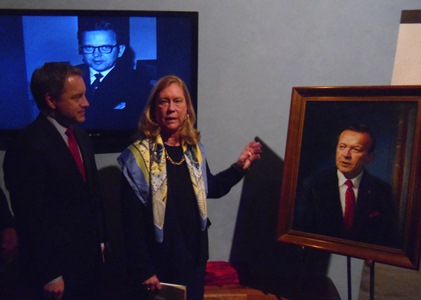
Catherine Stevens reacts to her late husband's portrait. A video of Stevens in the U.S. Senate is running behind her. Gov. Parnell is at left. Photo by Steven Perrins.
A portrait of the late Senator Ted Stevens – unveiled Friday evening — will hang on the second floor of the Alaska State Capitol between the House and Senate chambers.

Stevens’ widow, Catherine, stood next to an easel draped in red velvet, as the painting was revealed to an overflow crowd in the Alaska State Museum.

Gov. Sean Parnell started the countdown: “1-2-3,” then the drape came down.

Catherine Stevens said her late husband looked like he was “keeping a sharp eye out. He has something to say. And I think, you know, Ted always had his pocket square and his Senate pin, so I think you captured his spirit very well.”

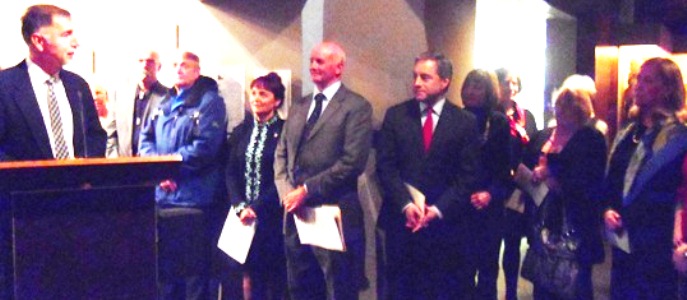
Before the unveiling, Parnell, House and Senate leaders, artist Dean Larson, and Catherine Stevens spoke about Stevens’ ardent love for the state and his 40 years representing Alaska in the U.S. Senate. Stevens was first elected to political office representing Anchorage in the Alaska State House from 1965 through 1968.

“The Stevens’ family wants to thank you for bringing him home to the state,” Catherine Stevens said.

Artist Dean larson addresses the crowd. Catherine Stevens is at far right. Photo by Steven Perrins.
The artist is the son of the late Rep. Ron Larson of Palmer and was an intern in Steven’s U.S. Senate office. Larson said he used multiple photos of Stevens to create the protrait, which is set in the U.S. Senate Appropriations Committee Room. Stevens served many years as a member of the appropriations committee. Catherine Stevens said it was his favorite room in the U.S. Capitol.

Larson also studied under Alaska artist Fred Machetanz (Mah-kah-tan), who painted the portrait of Alaska’s first U.S. senator, Ernest Gruening. The Gruening portrait hangs on the second floor of the state capitol.

Stevens’ portrait to be unveiled today

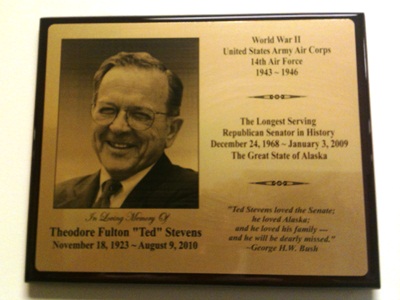
Stevens' portrait will hang on the second floor of the State Capitol, near this plaque.

A portrait of the late Sen. Ted Stevens to hang in the Alaska State Capitol will be unveiled today (Friday).

Juneau Rep. Cathy Munoz says the idea came from Juneau resident and long-time legislative staffer John Manly. Munoz helped put all the pieces together, including funding approval by the Legislative Council, working with Stevens’ family to select an image for the portrait, and selecting an artist.

She says it took only eight months from idea to portrait, which has been painted by Alaskan artist Dean Larson, son of the late Rep. Ron Larson of Palmer.

Unlike other state expenditures, art work does not have to go through the competitive bid process, but can be selected by those commissioning the work, according to Munoz. she says Larson’s name kept coming up.

“In fact he was, at one time, on the staff of Sen. Stevens and had a very high regard for the senator,” Munoz says. “So it was a wonderful choice.”

She says all of the pieces came together when the Stevens’ family and Legislative Council chair, Sen. Linda Menard, suggested Larson. “It was like all of the indicators were pointing to him as the artist.”

Larson was raised in Alaska and was a student of famous Alaska artist Fred Machetanz.

Larson and Stevens’ wife Catherine will speak during the unveiling this evening, scheduled from 5 to 6 p.m. at the Alaska State Museum.

The portrait will eventually hang on the second floor of the state capitol, between the House and Senate chambers. A small plaque commemorating Stevens now hangs near the eventual location of his portrait.

Stevens served Alaska in the U. S. Senate for 40 years, and was in the Alaska House of Representatives from 1965 through 1968.

He died in a plane crash in Southwest Alaska in 2010.

ACMP initiative verification marches on

More than 60 percent of signatures collected by the group behind a citizen’s initiative to revive the Alaska Coastal Management Program have been verified by an initial computer review. Casey Kelly has more.

The Alaska Sea Party submitted more than 33 thousand signatures to the state Division of Elections two weeks ago in hopes of qualifying the measure for this year’s statewide ballot. Division Director Gail Fenumiai says computer scanners verified more than 20 thousand of those as being from qualified registered voters, leaving more than 12 thousand to be verified manually.

“It’s not uncommon to have a high number of unqualified after the initial computer qualification phase,” Fenumiai says. “And what we do with those then is that we go back through and we do a manual search for that person in our voter registration system to see if they really are a true qualified voter in the State of Alaska.”

Fenumiai says a signature may not meet the computer qualification for any number of reasons.

“Say they signed the book as Jim Smith and they’re really James Smith in the voter registration system. The VR system would not match that, because it wasn’t an exact name match,” she says. “It could be somebody signed and put their driver’s license down as an identifier, but we don’t have their driver’s license in our VR system. So we’re able to get that information through other means and provide a match and say yes this person is a qualified voter.”

Fenumiai says manual qualification of signatures for the coastal management initiative started last Friday. She estimates it will take another three to four weeks to complete the process.

The news that many of the signatures did not pass the initial computer scan led to lots of unnecessary angst amongst lawmakers Tuesday. Senate President Gary Stevens said at a press conference that initiative backers “may not … have the numbers.”

But House Minority Leader Beth Kerttula, who’s been involved with the Alaska Sea Party’s efforts, says the group sees no reason to panic.

“We are confident that in those names we’ll see yet again many more qualified voters. It’s as simple as that,” says Kerttula.

Lawmakers can bypass the citizen’s initiative by approving substantially similar legislation this session. The House and Senate Judiciary Committees are scheduled to hold a joint hearing on the issue next Monday, February 6th.

Until it closed last year, the Alaska Coastal Management Program allowed the state to put conditions on certain development in federal land and waters. It interacted with and received most of its funding through the federal Coastal Zone Management Act.

The program folded after legislators and the Parnell Administration failed to reach an agreement to reauthorize it.

Senate education bill is on the move

The Senate Education Committee Monday approved a three-year increase to the Basic Student Allocation, or BSA. That’s the amount of money to cover the cost of educating each student enrolled, and it’s the basis for calculating extra costs such as the difference in operating expenses in various communities.

Gov. Sean Parnell’s budget for next year proposes the same level of funding at $5,680 per student. Senate Bill 171 increases the BSA for each of the next three years — by $125 dollars per student in July of this year; $130 in 2013, and by $135 a student in 2014.

Kenai School Board member Sunny Hilz praised the committee’s decision to provide more than one year of funding. She said forward funding will allow schools to plan ahead.

“What it does in our school district, it changes the morale of the entire place. It lets us focus on what we know will work,” she said. “A program doesn’t work for one year and then start over again. We have to be able to plan ahead.”

SB 171 is priority legislation for the Senate. It’s next hearing will be in Senate Finance. But when it gets to the House, the outcome is unpredictable, said House Speaker Mike Chenault during Monday’s press availability. He said education needs more state money, but he’s concerned about making changes to the formula used to fund public schools.

“Sometimes it’s a lot harder to change it once we’ve put it in (law) so I think we’ve got to be careful,” he said. “Could we come up with something that’s a year or two or three years certainty for education? We’ve done it in the past, and we can certainly do it in the future. But I think we have to have those conversations as we look at the budget continuing to grow.”

Site notifications
Update notification options
Subscribe to notifications