State Government

Bills would increase school funding

As school districts across the state brace for budget cuts and layoffs, the Senate Education Committee this morning (Monday) will take up a bill to increase the Base Student Allocation – that’s the amount paid to districts for each student enrolled.

The Senate Majority coalition of Republicans and Democrats considers increased school operating funds a session priority, while Gov. Sean Parnell’s budget proposes flat funding at $5,680 per student. Senate Bill 171 would add $390 in three increments over the next three fiscal years: $125 per student this July, $130 in 2013, and $135 per student in 2014.

The Senate Education Committee held the first hearing on SB 171 on Friday. The Alaska Council of School Administrators said districts actually need a $320 increase in the BSA just to keep pace with current programs, and even then many districts will have to lay off staff.

But Senate President Gary Stevens said the Senate has to be realistic. He said a higher amount would not get past the House and Gov. Parnell.

“I don’t want to hear how this is not enough because I don’t think that takes us forward. I want to hear how this helps and how we can get the support of the other body and the administration to do what this bill says,” Stevens said.

Juneau Harborview Elementary School fourth grader Sierra Wood told the committee she was in a class of 27 students.

“In my classroom I see kids who need lots of help. If my school had more money we could have more classrooms so students could have more time with teachers. The best way to learn is to spend more time with the teacher because then you can feel more confident,” she said.

In the House, a bill just introduced would inflation-proof education funding. HB 143 would require the administration to increase the Base Student Allocation by at least the annual rise in the Anchorage Consumer Price Index. Anchorage Democrat Rep. Pete Peterson’s bill would provide an additional $187.52 for each student.

“And that’s just the minimum that is needed just to keep up with last year’s inflation,” Peterson said.

According to the Senate Education Committee, Alaska ranks 22nd among states in the amount it spends on education.

Senate Education Committee Co-chairman Kevin Meyer hopes SB 171 bill can be through the legislative process by mid-March, when districts must wrap up their budgets. School districts annually complete their spending plans long before they know the amount of state funding, which makes up about 60 percent of local district revenue. This morning’s hearing on SB 171 begins at 8 o’clock in room 105 of the state capitol (Beltz Room).

Meanwhile, the Juneau School Board holds another public hearing Tuesday on next year’s proposed budget. The district is facing a $5.8 million shortfall and could cut 69 positions, with at least 7 percent from the certified teaching staff and 10 percent from support staff.

The board also wants written testimony, which can be emailed to budgetinput@jsd.k12.ak.us.

Tuesday’s school board hearing starts at 6:00 p.m. in the Juneau-Douglas High School library.

Businessman, statehood bell ringer Derr passes away

Longtime Juneau businessman and Chamber of Commerce luminary Romer Derr passed away yesterday (Thursday) at the age of 75. He’s being remembered not just for his efforts to improve Juneau’s economy, but for his participation in the Capital City’s first ever statehood celebration. Casey Kelly has more.

Romer Derr. Photo courtesy Juneau Chamber of Commerce

Romer Derr was 23-years-old when Alaska became a state. President of the Junior Chamber of Commerce at the time, he helped organize a community celebration, where he ended up ringing the statehood bell, even though it wasn’t his job.

“I put together the celebration thing, and I had two girls – one to hold the Alaska flag, one to hold the new US flag. And I had another girl to ring the bell. They got busy at her work and she couldn’t come,” Derr explained in a 2009 KTOO interview. “So they kept saying, ‘Get it done!’ So I kept sending an emissary down there and finally they said, ‘You gotta do it!’ So I did it. So it was strictly an accident that I did it.”

50 years later, Derr rang the bell again at a ceremony marking Alaska’s golden anniversary.

Derr was on the Juneau Chamber of Commerce Board of Directors when Cathie Roemmich was hired as Executive Director. She says the bell story was typical Romer.

“Just get out of the way, this needs to be done,” she says.

Roemmich calls Derr both a colleague and a friend, and says the Chamber wouldn’t be what it is today without him.

“I think his father was one of the founders of our chamber, which is the second oldest in the State of Alaska,” Roemmich says. “There was even a time when the chamber struggled here in Juneau and Romer actually paid the staff out of his own pocket. That’s how important the chamber of commerce and the organization was to Romer.”

Derr owned Harri Plumbing and Heating in Juneau for many years.

Former chamber president Chuck Collins served with him on the chamber board and says it’s impossible to think of Juneau without him.

“I don’t think the Juneau business community would be the Juneau business community that it is without Romer and his dealings here,” says Collins. “You know, Romer was one of those guys, he didn’t mind telling you how he felt, whether you made him happy or not so happy.”

Derr apparently died of a heart attack. He’s survived by his wife Laraine, two daughters, two grandson, and five great grandchildren. He’s preceded in death by a son, and his first wife, Carole. Services will be held Tuesday at Chapel by the Lake.

Education settlement helps rural schools

A long-running lawsuit over rural education has been settled and will provide $18-million for Alaska’s poorest-performing schools.

Filed in 2004, Moore vs. State of Alaska claimed the state failed to meet its constitutional obligation to provide quality education and adequate funding.

The state lost the original case in Superior Court. The settlement, announced Thursday, sets up a method for the Department of Education and local school districts to work together to focus resources on the state’s 40 lowest-performing schools. Education Commissioner Mike Hanley said negotiations have been based on the idea that neither the state nor the plaintiffs should be seen as winners or losers.

“The Moore settlement stated that it will need an $18-million one-time appropriation,” Hanley said. “The design has been that it will provide funding for several years and would lay a foundation that we could look to and a model that we could look to in the future for successful pedagogical strategies that would make a difference for our kids.”

The group Citizens for Educational Advancement of Alaska’s Children took the lead on the case by coordinating the schools, plaintiffs and attorneys. Executive Director Charles Wohlforth signed the settlement documents in the Attorney General’s office Thursday. He said the group continued to push the state for a settlement that would work to erase what he called a “waste of human potential” when children are not given a chance.

“So, have we solved all the problems with rural education in some of our schools in Alaska? Well, I think the answer would be no. Eighteen-million is clearly not going to be enough to solve this broad span of problems,” Wohlforth said. “But I think what we’ll do – and the commissioner alluded to it – we’re going to demonstrate some programs, we’re going to work on them collaboratively, and we’re going to see that they work. We’re going to prove that this is the right way to go – and there’s new hope for kids in rural schools across Alaska.”

The settlement specifically sets up a committee appointed by the citizens group and the Education Department to determine how resources should be shared to meet the court’s decision.

Senate oil tax bill expected soon

Courtesy Gavel Alaska
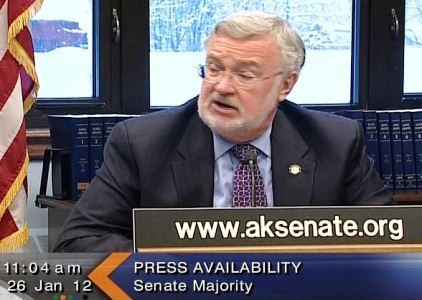
State Senate President Gary Stevens says nothing is more important this legislative session than coming to agreement on oil tax legislation.

The Senate’s bi-partisan coalition is writing its own bill to counter Gov. Sean Parnell’s proposal to reduce Alaska’s oil revenue by giving producers major tax breaks. Stevens says the Senate Resources Committee version will be drafted in about a week and a half.

Fairbanks Democrat Joe Paskvan – co-chair of the committee – says the legislation will treat Alaska as an “owner state.”

“You know we are different than most other jurisdictions in the United States and we need to act like a sophisticated owner with a world class resource,” Paskvan told reporters Thursday.

While details are scarce, the bill will include a progressive surcharge and tax credits.

Senators say they’ve been discussing their approach with the Parnell administration and the promise of more oil industry jobs for Alaskans may help bridge the gap between the two sides.

Parnell’s House Bill 110 passed the House last session, but the Senate refused to move it, asking for more and better information on the need to reduce oil taxes.

A report commissioned by the Senate Labor and Commerce Committee, chaired by Sen. Dennis Egan, D-Juneau, indicates the administration exaggerated when it claimed oil industry jobs were being shipped out of Alaska to other oil-rich states.

According to the McDowell Group report, average annual employment on Alaska’s North Slope reached a 20-year high in 2010.

Bill makes texting illegal

Thirty-five states have banned texting while driving – and Alaska thought it had, too.

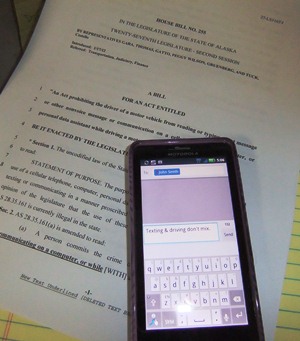
But some judges say the law passed in 2008 is not clear, so legislation is on the move that specifically prohibits drivers from reading or typing a text, email or other message while their vehicle is in motion.

A Fairbanks judge has advised magistrates to refuse texting cases and a Kenai judge has thrown out a case against a driver for texting.

That case is on appeal. Anchorage Democrat Les Gara told the House Transportation Committee Thursday that lawmakers should not wait for a court ruling before fixing the statute.

“I think you only really need one fact and that is, according to the National Conference on State Legislatures, drivers who text while they drive are 20 times more likely to have an accident than people who don’t text,” Gara said.

Calling it “the new drunk driving,” he says texting while driving has been taken up by the national organization Mothers Against Drunk Driving.

House Bill 255 moved out of the transportation committee Thursday, heading for judiciary.

The legislation states that texting is illegal while the vehicle is underway. Gara said reading or sending a text while parked should not be a crime.

Site notifications
Update notification options
Subscribe to notifications