State Government

State looks to fill coastal management void

The Parnell Administration is looking to fill the void left by the closure of the Alaska Coastal Management Program in June.

The program helped coordinate the local, state, and federal permitting process for development projects in coastal areas of the state. Last session, the administration and House Republicans fought proposed changes designed to make it more accountable to local communities, and the legislature failed to reauthorize the program.

State Division of Oil and Gas Director Bill Barron told the House Resources Committee this week (Tuesday) that the Department of Natural Resources has established a special task force to help developers navigate permitting issues. He says the administration has no plans to re-establish the old Coastal Management system. Instead, the task force is looking at modifying the Office of Project Management and Permitting – or O-Pump.

“What we’re trying to structure, recognizing that OPMP has worked very well, is there a way we could have – for lack of a better term – O-PUMP lite,” said Barron. “Something that a smaller company can use to help coordinate that. Is that a twist on ACMP? Maybe. It depends on how you slice the words.”

Bethel Democrat Bob Herron – who attempted to negotiate reauthorization of Coastal Management last session – asked Barron about the practical side of the administration’s work.

“Is O-PUMP lite going to be recognized by your federal counterparts?” asked Herron.

“That’s yet to be seen,” Barron said. “I believe part of that is how we structure it and present it. But we’ll find out.”

A citizens’ initiative co-sponsored by Juneau Mayor Bruce Botelho that would re-establish an Alaska Coastal Management Program is currently under review by Lieutenant Governor Mead Treadwell’s office. Botelho says the program gave local communities input into projects proposed in their backyards, but it also helped developers.

“One of the great features of coastal zone management is the opportunity for basically one-stop permitting – the idea that all agencies would work together in terms of a streamlined permitting process and coordination, which now is lacking,” said Botelho. “And of course the second element which I think is of particular importance is that the federal government would be required to submit its plans for review.”

The proposed initiative was submitted to the Lt. Governor’s office October 7th. Treadwell will rule by December 6th on whether sponsors can begin gathering nearly 26-thousand signatures to put it on next November’s ballot.

The Department of Natural Resources will be back before lawmakers during the upcoming session.
Judge says State must honor child support orders from Tribe

Southeast tribal officials are welcoming a decision by a state judge that’s based on their inherent right of self-governance. The latest opinion specifies that their jurisdiction includes the issuance of child support orders that the State of Alaska has, so far, refused to honor.

“I was just delighted,” said attorney Holly Handler who argued the case for the Central Council of Tlingit and Haida Indian Tribes of Alaska. CCTHITA is the sovereign tribal government for over 27,000 Tlingit and Haida Indians worldwide.

“The Tribe has been waiting for sometime to get a decision in this case,” said Handler.

Tribal court orders specifying the garnishment of income tax refunds, unemployment benefits, and Permanent Fund Dividends were ignored by the State of Alaska. Tribal courts had issued the orders for either child support, or for reimbursement of benefits paid out by the Temporary Assistance to Needy Families program, the tribe’s version of the Alaska Temporary Assistance Program.

CCTHITA filed the suit in January 2010. Oral arguments were held last April. Superior Court Judge Philip Pallenberg of Juneau issued the 16-page opinion on Tuesday, October 25 which referred to the recent State v. Native Village of Tanana opinion and the pivotal John v. Baker opinion issued by the Alaska Supreme Court in 1999. Justices ruled then that tribes had the sovereign authority to adjudicate custody of tribal children in their own courts, but they did not specifically touch on the issue of child support. Judge Pallenberg, however, writes that child custody and support are naturally intertwined. In State courts, for example, both issues are considered at the same time. Pallenberg considers monetary support as an integral part of any custody determination and a paramount duty that any parent has to their children.

“It’s not charting any strange and bizarre territory,” said Handler. “It’s really a direct application of John v. Baker to child support cases.”

David Voluck, chief judge for the Sitka Tribe of Alaska and family law magistrate for the CCTHITA, calls it a strong and solid opinion that’s based on centuries of precedent, principles, and legal reasoning of federal Indian law.

“Every other facet of family law that impacts a child — it is agreed — can fall under the inherent sovereighty of a tribal court,” said Voluck. “So it really makes no sense to argue that the financial support (or) the child support, that’s different.”

Voluck says he hears as many as thirty cases a month. He says he can recall at least ten cases that he’s heard where a poor working relationship between the tribe and the State has affected support for the family.

Attorneys who defended the State did not respond to inquiries seeking comment. But — among their claims outlined in briefing documents — the Central Council has no jurisdiction under Alaska’s version of the Uniform Interstate Family Support Act, the law that allows recognition of support orders from different states.

Judge Pallenberg’s opinion notes an amendment by the Legislature two years ago that stemmed from federal welfare reform legislation; the Uniform Interstate Family Support Act included a ‘tribe’ as part of the definition of a ‘state.’

Jessie Archibald, a staff attorney for the Tribal Child Support Unit, says the tribe’s child support order should be processed just as any state child support case is processed. The Tribal Child Support Unit has handled about 500 cases since its inception four years ago.

“Initially, there was just a small number of cases,” said Archibald. “As we’ve grown, there are more and more cases.”

State of Alaska Child Support Division Director John Mallonee says they are still reviewing the opinion. He declined to immediately comment on it or any potential impacts on his division’s operations. He referred further questions to the State Department of Revenue’s Commissioner’s office.

Additional related claims still must be decided in the case before a final judgment is issued. Since state attorneys did not respond for comment, it’s unknown whether they plan to eventually appeal.

Details on administration decision to hold off on new state office building

Downtown Douglas will keep a state office building and a new office complex will NOT be built in Juneau any time soon.

As KTOO has reported, the Douglas Island building has become the Parnell Administration’s top priority as it addresses the needs of state office space in the capital city. Here are more details of that decision:

The administration was expected to soon announce the location of a new 140-thousand square foot office building to house about 500 employees from the departments of Labor, Public Safety, Fish and Game and Corrections.

Instead, Administration Commissioner Becky Hultberg says an analysis led to a different plan:

“I don’t think we’re saying we’re not going to build a new building, we’re just saying that our first priority is renovating the Douglas Island Office Building and then we’re going to do some additional work and planning to understand the need for office space in Juneau,” Hultberg says.

Juneau city leaders, state legislators as well as Palin, then Parnell administration officials, have been discussing the new facility for about three years.

A new capital city office complex was proposed in 2009 at the old downtown subport, owned by the Mental Health Trust Authority. Legislation allowing the Authority to develop office space and lease it to the state did not survive that session, but $2-million in planning and design funds were given to the project last year.

Hultberg says the work led to a different conclusion.

“It enabled us to have a better understanding of the condition of the existing buildings we have,” she says. “Prior to this there were some assumptions made, some very limited work done, but really the appropriation enabled us to do the detailed work that has led us to this conclusion.”

Hultberg says an engineer’s study shows the old Douglas building is structurally sound and can be renovated. She estimates it could cost $15-million to $20-million.

But the question remains of what to do with the old Public Safety Building on Whittier Street. It’s been considered a temporary home for the department since the 1970s.

Hultberg says the Public Safety Building is not worth rehabilitating and employees will have to be moved at some point.

“Whether that’s in a lease or a state-owned building has yet to be determined. And we don’t have a decision yet on the ultimate disposition of that building,” she says.

The lease for the so-called Plywood Palace, which houses the Department of Labor, expires next year. The poorly constructed building has long been a pain to the administration. Recent work was done to get rid of mold and other bacteria that some state employees said made them sick.

Hultberg says the administration is negotiating with the building’s absentee owner.

“But really we need to go through a process of looking at the space that we have in state office buildings, ensuring that we’re maximizing the use that space, looking at what space might be freed up in the SLAM project goes forward, and then assessing what additional space needs we have in Juneau and that would include a decision on what do about the Department of Labor,” she says.

SLAM is the proposed State Libraries, Archives and Museum complex, which will not be built for several years. Hultberg says nearly two floors of the State Office Building may be available once the library is moved.

Juneau State Representatives Cathy Munoz and Beth Kerttula carried the legislation is 2009 for a new office complex.

Both say they’re disappointed the Parnell administration has changed course and they will continue working with the administration on a new office building in the capital city.

While Munoz says she appreciates the need for fiscal responsibility and is pleased the administration still plans to invest in Juneau, she believes the Plywood Palace has to be replaced.

“And we just need to keep moving forward to make ensure our long term goal of replacing, or being able to construct a new facility to accommodate the Department of Labor employees is met,” she says.

Kerttula says it’s good the state will retain an office building in downtown Douglas.  She admits frustration at the state’s decisions years years ago to construct sub-standard facilities. Kerttula says it is clear Juneau will need a new state office building.

“You could have told them at the time when they moved people into the Plywood Palace and the DEC building, too, from my perspective, that eventually those buildings were not going to withstand even the weather,” she says.

Administration Commissioner Hultberg says the administration has no plans to move employees from the four departments out of Juneau.

Administration nixes new state office building

A new state office building will NOT be built in Juneau any time soon.

The Parnell Administration has changed course. Instead of building a new 140-thousand square foot office building, Administration Commissioner Becky Hultberg says the Douglas Island Office Building will be renovated.

The administration was expected to announce the location of the proposed facility that would house about 500 employees from the departments of Labor, Public Safety, and some Fish and Game and Corrections employees.

But Hultberg says an analysis made possible by a $2-million legislative appropriation has led to a different conclusion.

“It enabled us to have a better understanding of the condition of the existing buildings we have,” Hultberg says. “Prior to this there were some assumptions made, some very limited work done, but really the appropriation enabled us to do the detailed work that has led us to this conclusion.”

Hultberg says an engineer’s study shows the old Douglas building is structurally sound and can be renovated for $15 to 20-million.

It does not resolve the question of the old Public Safety building, which has been considered a temporary home for the department since the 1970s. The lease for the so-called Plywood Palace, which houses the Department of Labor, expires next year. The poorly constructed building has long been a pain to the administration. Hultberg says the administration is negotiating with the building’s owner.

She says the administration will have to move public safety employees, but it’s not clear where.

Once the new Libraries, Archives and Museum complex is built – several years from now — space will be available in the State Office Building, Hultberg says.

A new capital city office complex was first proposed in 2009 at the old subport, owned by the Mental Health Trust Authority. Legislation allowing the Authority to develop office space and lease it to the state did not survive that session, but planning and design funds were granted last year.

Juneau State Representatives Cathy Munoz and Beth Kerttula carried the legislation on the first proposal.

Both say they’re disappointed, but say it’s good that a state facility will remain in downtown Douglas.

Munoz says it’s important the administration is still planning to invest in Juneau.

“Going back two or three years when we were working on the Mental Health Trust project that was a great opportunity. It’s unfortunate it didn’t get through the process then, but obviously there are new considerations today that we weren’t looking at two or three years ago,” Munoz says.

Kerttula says Juneau legislators are committed to working with the administration on a new office building.

This story will be updated with more details.

Thousands of PFDs sent out in error

About 5,500 Permanent Fund Dividends are being recalled.

The PFDs were sent out in error. Approximately 3,600 were deposited directly into bank accounts and 1,900 were sent out as paper checks.

PFD Division Director Deborah Bitney says employees didn’t match correct records in a new software program and dividends were paid to applicants instead of creditors.

The software is called “eGarns” and it’s being used for the first time this year.

“This affects only debts that are basically court ordered, like restitution, judgments for debts that are unpaid, things like that,” Bitney says.

It does not affect garnishments for child support, she says.

The division has requested that direct deposits be reversed and also has issued stop payment orders on the checks. Bitney says the error was discovered late Monday afternoon. While the total amount of the error isn’t available, it’s expected to be nearly $7 million.

Bitney says it’s important to get the word out about the error.

“You know, 99 percent of the dividends that went out are just fine,” she says. “This affects a very small subset of the population. We really are trying to help those people and we would like them to contact us as quickly as possible once they find out they are involved in this.”

Bitney says safeguards have been programmed into “eGarns” to prevent similar errors.

Nearly every Alaskan received $1,174 in this year’s PFD.

Fast ferry builders, AMHS trade shots in dispute over engine problems

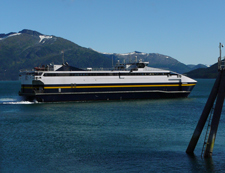
FVF Chenega in Prince William Sound. Photo by Ed Schoenfeld/CoastAlaska

The Alaska Marine Highway System says the engines being used in their two fast ferries are defective and builders of the ships knew it when they delivered the ships only six years ago. But the ferries’ builders say it’s not their fault, and they shouldn’t be obligated to replace the engines when the warranty doesn’t cover it.

Judge Philip Pallenberg enters the courtroom lugging a stack of files and documents easily a foot high. He’s about to get handed a few more accordian folders that will extend that by several more inches.

“I think the state fired the opening salvo in this naval battle,” said Pallenberg. “So, I think the state should go first.”

October 7th’s skirmish in Juneau Superior Court was over the engines installed in the state’s fast ferries Fairweather and Chenega, relatively new ships with diesel-powered jet drives that push the catamarans at a nice 32-knot clip. That’s about twice the speed of the ferry system’s standard mono hulls.

State attorney Dana Burke is leading the attack for the ferry system. But he runs out of time during oral arguments to carefully cite excerpts of contract documents and internal memos. Burke says manufacturers of the fast ferries knew the engines were defective, almost as soon as they were installed. He said they breached warranties that called for repairs and – if necessary – replacement of the engines. For both ships, all eight engines have been valued at $20 million.

“And we cannot wait,” said Burke. He said both the Fairweather and Chenega are in danger of being decertified from passenger service in the very near future.

Burke wants the ship and engine builders’ liability extended to the engines’ defects, especially when they admitted to using the wrong kind of coolant (that accelerated corrosion in the engines).

Burke said that MTU instructed the state to stop using Power Cool 3000 because it might degrade a layer of molybdenum in the crank case cylinder bores.

David McMahon representing Robert Derecktor Incorporated said the state was not entitled to any more rights after expiration of a standard year-and-a-half warranty.

“These two vessels have been operated on an uninterrupted basis since they went into operation,” said Burke.

But Derecktor Shipyard is only one of the parties in the state’s lawsuit. The state’s real target is MTU Friedrichshafen and MTU Detroit Diesel, the German company that built the engines and the American company that did the subsequent repairs.

Jon Dawson, who has already been prepared for a response, said they already have a potential repair of an interstitial ring that they’ve been trying to install.

“Scare mongering and hyperbole aside, the principle issue in this case involves only one component of these engines: the engine block,” said Dawson.

Dawson said there are clear factual issues at what caused the faster-than-expected deteroriation; instead of the coolant – perhaps the Alaska environment, improper maintanence by ferry crews, even excessive vibration caused by a misaligned installation by the shipyard.

“You can’t wave a wand and resolve this wear issue when you don’t know what’s causing it,” said Dawson.

Dawson also says the engine warranty was assigned to Derecktor – the general contractor, not the final buyer of the vessels, or in this case, the state ferry system. And it did not include replacement of the entire engine, beyond the engine block.

But the plantiffs always have the last word in any courtroom argument.

“Something’s wrong with these engines. They’re lemons,” said Burke. “These were defective beyond delivery and someone is responsible.”

October 7th’s hour-and-twenty minute oral arguments focused not on any factual disputes, but primarily arcane and esoteric interpretations of liability and warranty law. It will be sometime before Judge Philip Pallenberg issues an opinion.

Site notifications
Update notification options
Subscribe to notifications