Archives for March 21, 2014

Sub-Hunting Planes Use High-Tech Gear To Search For Flight 370

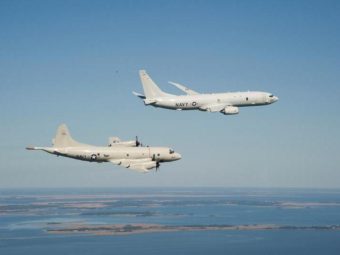
A P-8A Poseidon (top) and a P-3 Orion are shown flying off the coast of Maryland. U.S. Navy

Two of the most advanced maritime surveillance aircraft are being pressed into service to search for possible wreckage from Malaysia Airlines Flight 370 in the middle of the Indian Ocean.

Australia’s U.S.-made P-3 Orions and U.S. Navy P-8A Poseidons bring high-tech sub-hunting gear to bear in the search for debris. They are combing a remote stretch about 1,500 miles from Perth, Australia, where satellite images taken March 16 showed floating objects.

As sophisticated as the search planes are, the task is daunting.

Weather and the sheer distance from bases near Perth to the target zone are complicating efforts to answer the question of what — if anything — is out there. Because of ocean currents, the search area has also expanded since the satellite snapshot was taken. And it’s possible that whatever was seen by satellite is now thousands of feet deep at the bottom of a vast ocean.

How Far Can They Fly?

Both the P-3 and the P-8 have the range — but only just — to get to the general search area, spend a few hours looking and then return. The P-3 can fly out about 1,500 miles and spend three hours searching before having to turn back, while the P-8, a modified Boeing 737, has an operational range of roughly 1,400 miles with four hours on site.

The P-8’s AN/APY-10 radar — designed to locate enemy surface contacts such as submarine periscopes — and the Australian P-3’s somewhat less sophisticated radar set would very likely be the first to pick up on any floating refuse, says Sam LaGrone, editor at U.S. Naval Institute News and a former maritime reporter for Jane’s Defence Weekly.

“It’s not like looking out the window,” he says.

How Would They Spot Wreckage?

Once a radar contact is made, typically from a fairly high altitude, the plane can dip down to get a closer look, switching on an EO/IR (electro-optical/infrared) ball housed under the aircraft. These are similar to the pods you might see hanging under a police helicopter, LaGrone says.

“Pretty much all military radar are built to filter out ocean spray, rain, clouds and all other manner of potential interference via different frequencies and different methods,” he says.

The EO/IR unit, though, blends high-tech-camera images with infrared input into a “very detailed conventional video image” similar to what military reconnaissance and strike drones use. Darkness limits the effectiveness of the cameras, and the chilled debris — now nearly as cold as the surrounding ocean — also means limited infrared input.

“Maybe [the wreckage is] down on the bottom; maybe it’s floated away,” he says. “If it’s on the surface, the radar would be able to detect it relatively easily.”

Cmdr. Mark Turner, the chief of the policy division for the U.S. Coast Guard’s Office of Search and Rescue, says the bigger the waves, the more “sea surface clutter” will appear on radarscopes and that the search is going on in the so-called Roaring 40s, referring to latitudes where the oceans are notoriously rough.

What Are They Likely To Find?

Turner says planes usually sink. In the case of Air France Flight 447, which crashed off the Brazilian coast in 2009, a tail section was located, but most of the flotsam was “seat cushions and service trays,” he says.

Turner says the Coast Guard uses computer models to determine how far debris and survivors might drift with the winds and currents.

“The longer it’s been out there, the greater the uncertainty” about where to look, he says. It’s been 12 days since the plane disappeared on March 8.

What If The Debris Has Sunk?

LaGrone says both aircraft are capable of dropping sonobuoys, which are designed to detect submarines, but they might not be of much use for an object sitting on the bottom of the ocean. You can see a video of a P-3 dropping a sonobuoy here.

“If it’s underwater, you might be able to detect that with sonar, but it really depends on the circumstances,” he says.

“If you determined there was something there — either on the surface or on the bottom — that’s when surface ships would arrive with more sophisticated sonar and underwater equipment to take a closer look,” LaGrone says.

In a nine-hour search of the area on Thursday, a U.S. P-8 came back empty-handed after finding only a freighter and some dolphins, ABCNews says.

According to ABC:

“The plane worked back and forth through its search area in a lawn mowing pattern. … The Poseidon had enough fuel to scan for three hours and cover 4,100 square miles before having to begin the three hour trip back to its base north of Perth, Australia. The crew was disappointed that it hadn’t found anything.”

The Telegraph says a merchant ship was also diverted to the area, but apparently found nothing either.

The Australian Maritime Safety Authority says a C-130 Hercules has been dispatched to the area “to drop marker buoys to assist with the search and indicate water movements,” the newspaper says, adding that “commercial satellites have been redirected to capture further images from the area.”

Copyright 2014 NPR. To see more, visit http://www.npr.org/.image
Read original article – Published March 20, 2014 1:43 PM
Sub-Hunting Planes Use High-Tech Gear To Search For Flight 370

Reds Pitcher Expected To Recover After Line Drive To Face

Cincinnati Reds pitcher Aroldis Chapman last month. Now, he's recovering from being hit in the face by a batted ball last night. Gregory Bull/AP
Cincinnati Reds pitcher Aroldis Chapman last month. Now, he’s recovering from being hit in the face by a batted ball last night. Gregory Bull/AP

All-Star relief pitcher Aroldis Chapman of the Cincinnati Reds is expected to make a full recovery and pitch again despite the injuries he suffered Wednesday night when he was hit square in the face by batted ball.

He’s due to have surgery today to repair fractures above his left eye and nose, the Cincinnati Enquirer reports. The Enquirer adds that:

“Chapman will have a plate inserted into his head, but should ‘absolutely’ be able to pitch again this season, Reds medical director Dr. Tim Kremchek said on Thursday morning. ‘He has a very mild concussion, no other brain injury, his eye’s fine,’ Kremchek said. ‘He’s a very lucky guy.’

“Kremchek said the plate will be permanent, and Chapman could be out of the hospital by Saturday.”

According to SI.com:

“Recovery is expected to take roughly two months, but Kremchek cautioned that Chapman would likely not be able to begin pitching immediately after that six-to-eight week timetable.”

There’s video of what happened here, but we should caution those who are squeamish about such things that they may find it tough to watch. Chapman was pitching in the sixth inning of an exhibition game against the Kansas City Royals at Surprise Stadium in Surprise, Ariz., when Royals catcher Salvador Perez hit the ball straight back toward the pitcher’s mound. It was flying so fast that Chapman had no chance to get out of the way.

The game was stopped, with Kansas City leading 6-3, after he was struck.

Chapman, 26, is from Cuba. This is his fifth season in the big leagues. He was an All-Star in both 2012 and 2013.

What happened to him Wednesday will remind older fans of Herb Score, an up-and-coming pitcher with the Cleveland Indians who was hit in the face by a batted ball in 1957. As the Baseball Hall of Fame writes, Score’s playing career never recovered:

“He didn’t pitch again until 1958, then injured his arm. He insisted that his eye was fine, but it didn’t matter. His arm never came back to form, and he retired in 1962, just shy of his 29th birthday. Roughly two-thirds of his career wins and strikeouts occurred before his injury — that is, before he turned 24. Multiply his early innings pitched by eight to compare his statistics to the average Hall of Fame pitcher’s. Even without estimating improved numbers during his prime, he would top 300 wins and 4,200 strikeouts.

“Score, however, made the best of his situation and went on to enjoy a long tenure as an Indians broadcaster. But for fans of the game, it is easy to wonder how great he would have been.”

SI.com reports, though, that “despite the injury, Reds manager Bryan Price and catcher Brayan Pena, who was behind the plate when Chapman was injured, said that Chapman was in good spirits the morning after.”

Copyright 2014 NPR. To see more, visit http://www.npr.org/.image
Read original article – Published March 20, 2014 2:23 PM
Reds Pitcher Expected To Recover After Line Drive To Face

Westboro Baptist Church Founder Fred Phelps Sr. Dies

July 2007: The Rev. Fred Phelps Sr. prepares to protest outside the Kansas Statehouse in Topeka, Kan. Orlin Wagner/AP

The Rev. Fred Phelps Sr., whose tiny Westboro Baptist Church has protested outside the funerals of fallen soldiers and celebrities to spread its views about homosexuality and abortion, has died, according to news reports. He was 84.
A son, Timothy Phelps, tells WIBW-TV in Topeka, Kan., that his father died just before midnight Wednesday. A daughter, Shirley Phelps-Roper, tells The Topeka Capital-Journal that her father died at Midland Care Hospice in Topeka. The Associated Press says it too has confirmed the news. The cause of death hasn’t been reported yet.

As NPR’s Nathan Rott reports:

“Phelps made a name for himself by protesting military and high-profile funerals. He’d wave hateful signs with members of his Westboro Baptist Church and proclaim that the U.S. was being punished for its tolerance of homosexuality.

” ‘God’s wrath is upon this nation,’ Phelps said at one such protest. ‘And he’s pouring out his wrath by killing those soldiers and maiming those soldiers in Iraq. And its only gonna get worse.’

“An ordained minister, Phelps formed the Westboro Baptist Church in 1955. He also practiced law as a civil rights attorney but was disbarred from the Kansas state court in 1979 and later lost his license to practice in federal courts.

“Phelps is survived by many family members, who make up most of his church’s congregation.”

The Washington Post notes that:

“Rev. Phelps was an ordained Baptist minister, a disbarred Kansas lawyer and, according to a BBC documentary, the patriarch of the ‘most hated family in America.’

“The Southern Poverty Law Center, a prominent civil rights group, described his Westboro congregation as a ‘family-based cult’ and ‘arguably the most obnoxious and rabid hate group in America.’

“The expression of Rev. Phelps’s bigotry managed to offend the conscience of the Ku Klux Klan, which staged protests to counter Westboro’s demonstrations at military funerals.”

The Southern Poverty Law Center’s page about Phelps is here.

While the church’s protests outrage many Americans, the Supreme Court ruled in 2011 that the First Amendment gives the protesters the right to do what they do. Chief Justice John Roberts, writing for the majority in the 8-1 decision, said that because the protesters’ signs address the state of the nation, the content “relates to broad issues of interest to society at large, rather than matters of ‘purely private concern’ ” and deserves protection.

In his dissent, Justice Samuel Alito wrote that the protest at the center of the case — staged at the 2006 funeral of Marine Lance Cpl. Matthew Snyder, who died while serving in Iraq — was “a malevolent verbal attack on Matthew and his family at a time of acute emotional vulnerability” and deserved no First Amendment protection.Word that Phelps was in hospice care came over the weekend. There was also word over the weekend that the church had excommunicated Phelps, though the reason wasn’t clear in the reports. One son told the AP that there had been “some kind of falling out.” WIBW-TV says it was three of Phelps’ children who cut the church’s ties with its founder.

Copyright 2014 NPR. To see more, visit http://www.npr.org/.image
Read original article – Published March 20, 201412:20 PM
Westboro Baptist Church Founder Fred Phelps Sr. Dies

Split Decisions: Ukraine Signs Up With EU, Russia Wraps Up Crimea

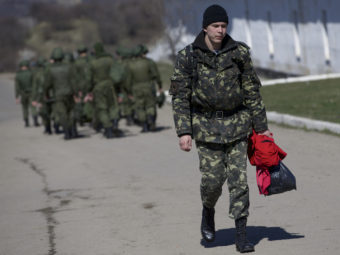
As Russian soldiers walked one way in the distance, a departing Ukrainian soldier carried some of his belongings Friday at a military base in Perevalne, Crimea. Ivan Sekretarev/AP

There will be few days that better symbolize the crisis in Ukraine.

On Friday:

As Ukrainian Prime Minister Arseniy Yatsenyuk was signing an agreement on closer relations with the European Union
Russian President Vladimir Putin was signing the laws his country has put in place to take Crimea from Ukraine and make it part of the Russian Federation.

Ukraine’s pact with the EU, as CNN notes, has “symbolic force because it was the decision of ousted Ukrainian President Viktor Yanukovych in November to ditch it in favor of closer ties with Russia that triggered the protests that spiraled into the current crisis.”

The BBC says that “the EU Association Agreement is designed to give Ukraine’s interim leadership under PM Arseniy Yatsenyuk economic and political support. EU President Herman Van Rompuy said in a statement that the accord ‘recognises the aspirations of the people of Ukraine to live in a country governed by values, by democracy and the rule of law.’ ”

But, as CNN adds, “Russia’s moves to annex Crimea, following a contested weekend referendum in the Black Sea peninsula, have turned a confrontation with Europe and the United States into the biggest crisis in East-West relations since the Cold War.” The U.S. and EU nations say the annexation violates both international and Ukrainian law.

Also Wednesday

— The U.S. ambassador to Poland said the U.S. is planning military exercises in Poland that could involve that nation, the Czech Republic, Hungary, Slovakia, Romania, Bulgaria and the Baltics. (Reuters) In Washington, officials said the discussions concern the expansion of already scheduled exercises.

Meanwhile, NPR’s Ari Shapiro reports from London that the EU has added 12 names to its list of Russian and Ukrainian officials who it says were involved in interfering in Ukraine’s affairs. Those officials are now subject to “visa restrictions and asset freezes,” Ari says. Twenty one officials were put on the EU’s list earlier this week.

On Thursday, President Obama announced that the U.S. had increased the number of Russians and Ukrainians on its sanctions list to 31. The Russian government responded by barring nine Americans — including six members of Congress — from traveling to Russia. Putin has spoken about taking more steps.

Ukraine has said it will withdraw its troops and sailors from Crimea. Russian forces, along with local “self-defense” units, have taken control of many bases there and other strategic locations. On Friday, the BBC reports, families of Ukrainian military personnel in Crimea were seen departing from bases.

Also Friday, U.N. Secretary-General Ban Ki-moon arrived in Kiev. Ban, who is trying to find a diplomatic solution to the crisis, was in Moscow on Thursday. “I have emphasized that all parties (should) refrain from any hasty or provocative actions that could further exacerbate the already very tense and very volatile situation,” he said after meeting with Putin.

Background

As the crisis in Ukraine has developed over recent weeks, we’ve tracked developments. Here’s a recap:

Crimea has been the focus of attention as the ripple effects of the protests that led to last month’s ouster of Yanukovych have spread.

Summing up the history and importance of Crimea to Russia and Ukraine isn’t possible in just a few sentences, of course. The Parallels blog, though, has published several posts that contain considerable context:

Crimea: 3 Things To Know About Ukraine’s Latest Hot Spot

Crimea: A Gift To Ukraine Becomes A Political Flash Point

Why Ukraine Is Such A Big Deal For Russia

Shortly after Yanukovych was deposed and fled Ukraine, Russia moved to take control of Crimea by sending thousands of troops there to secure strategic locations. Along with “local defense forces,” those soldiers surrounded Ukrainian military facilities.

This week, after Crimeans voted to join the Russian Federation, Russian President Vladimir Putin signed a treaty to annex the region. The U.S. and European Union have objected, calling that action a violation of international law. Putin says he is supporting Crimeans’ right to “self-determination.”

We’ve recapped what set off months of protest in Kiev and ultimately led to Yanukovych’s dismissal by his nation’s parliament last month this way:

“The protests were sparked in part by the president’s rejection of a pending trade treaty with the European Union and his embrace of more aid from Russia. Protesters were also drawn into the streets to demonstrate against government corruption.”

It was after Yanukovych left Kiev and headed for the Russian border that troops moved to take control of strategic locations in Crimea.

Copyright 2014 NPR. To see more, visit http://www.npr.org/.image
Read original article – Published March 21, 2014 8:20 AM
Split Decisions: Ukraine Signs Up With EU, Russia Wraps Up Crimea

Seiners land 4K tons in herring season opener

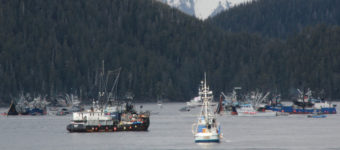
Seiners in Starrigavan Bay during the first opening of Sitka’s 2014 sac roe herring fishery. (Photo by Rachel Waldholz/KCAW)

The Sitka herring fishery had its first opening yesterday afternoon.
The Alaska Department of Fish & Game declared the Sitka Sound sac roe herring fishery open at 1:45 p.m. The fishing area covered much of Starrigavan and Katlian bays, north of Sitka.

The Alaska Department of Fish & Game released this map, showing the boundaries of Thurday’s herring season opener. Fishing was restricted to Starrigavan and Katlian bays, north of Sitka. (Map courtesy ADF&G)

The opening lasted two hours and thirty-five minutes, closing at 4:20 p.m. The Department estimated that the fleet caught at least 4,000 tons of herring, and announced that there will be no fishing Friday (3-21-14), to allow processors to work through the catch.

If sold at last year’s price, today’s catch would be worth about $2.4-million to fishermen at the docks. This year’s price, however, remains unclear.

The total harvest level for this year is over 16,000 tons. Speaking with KCAW earlier this week, Fish & Game biologist Dave Gordon estimated that it would take about four separate openings to reach the limit.

Officials gave the fleet two hours’ notice of the opening at 11:45 a.m. (Thu 3-20-14), after samples of fish tested in the morning found well over 10-percent mature roe, or eggs, in the herring.  10-percent mature roe is the Department’s threshold for a fishery. The most recent two samples came back with 12.5-percent and 13.1-percent mature roe, which is high even for the high-quality Sitka fishery.

The opening kicked off with a voice countdown from Gordon, on board the state’s research vessel, the Kestrel:

Ten, nine, eight, seven, six, five, four, three, two, one, OPEN! The Sitka Sound sac roe fishery is now open. The Sitka Sound sac roe fishery is now open. This is the Department of Fish & Game standing by, Channel 10.

Sitkans lined Halibut Point Road near the ferry terminal to watch the fishery. From left: George Eliason, Dillon Bets, Alainah Nelson, Misty Smith, Sandee Holst. (Photo by Rachel Waldholz/KCAW)

There are forty-eight permit-holders in the lucrative seine fishery. On Thursday afternoon, most of those boats were concentrated in Starrigavan Bay, within sight of Sitka’s road system. People lined Halibut Point Road near Sitka’s ferry terminal, watching through binoculars and cameras as the fishery unfolded in front of them and spotter planes circled overhead.

Among the spectators were two women who identified themselves as Karen and Leanne.

Leanne: You’ve got your pilots flying, and you’ve got spotters actually looking down talking to boats, so you’ve got several people in the planes. And they just have to be very, very careful. They get special permission to work in this kind of airspace.  Normally you’re not supposed to fly that close to each other.”

Karen: It’s very exciting of  course when they do the count down and you see all the boats jockeying for position. And seeing what they catch — it’s actually amazing to see how many herring are in a net.

The Department of Fish & Game plans aerial and vessel surveys throughout the day on Friday (3-21-14), and will be issuing informational updates over the radio at 11 a.m. and 4 p.m. Those can be heard on VHF marine radio, on Channel 10.

Emily Forman contributed to this report.

Group seeks to prevent suicide through paddle-making

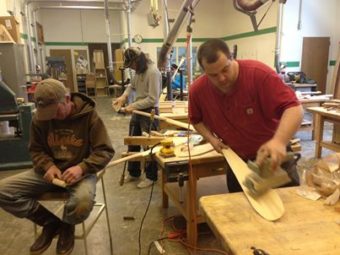
Paddle makers at the One People Canoe Society workshop. (Photo by Shady Grove Oliver/KSTK)

Alaskan communities can be very tight-knit. And suicide rates in Alaskan communities are some of the highest in the country. Last weekend, the One People Canoe Society held a two-day paddle-making workshop in Wrangell.

As part of the workshop, the participants attended a behavioral health course on suicide prevention. Its goal is to bring communities together to both learn a traditional art and talk about a contemporary problem.

Around 15 people are hard at work in the high school shop class, sawing, sanding and shaping paddles. What started off as rough yellow cedar boards are slowly turning into streamlined paddles.

The One People Canoe Society puts on workshops throughout southeast Alaska.

Brian and Michael Chilton make their way around the Panhandle teaching communities the art of paddle-making.

Michael says he decided to learn more about the craft after one particular trip.

“It was really inspiring when we started traveling down to Washington. They have a canoe journey that they do down there. Once we saw how much people are actually involved and know about their own culture down there, we said, why don’t we do that in Juneau?” says Chilton.

His uncle, Brian Chilton, has been carving paddles since the early 1990s and painting them for even longer. And now, he passes that knowledge on.

“We travel all over, different places, different towns, different villages- Angoon, Kake, Wrangell, POW, Ketchikan. I think we’re going to do a total of a dozen paddle workshops. This is to help them, the local canoe groups, make their own paddles. They’re actually going to use them to paddle to Juneau; it’s called the paddle to Celebration.”

But these paddle workshops are a forum for more than just woodcraft.

They are sponsored in part by a behavioral health grant from the Southeast Alaska Regional Health Consortium, or SEARHC. The grant funds presenters that attend the workshops and give condensed courses on suicide awareness and prevention.

Alicia Chilton is a board member for the canoe society. She says the partnership began a few years ago.

“SEARHC, Suicide: One is too many, had a canoe and so we started working together in preparation for the paddle to Celebration in 2012. Over the years, our relationships have just grown and we think it’s important with the high suicide rates that we have here, especially in Alaska and in our southeast communities,” says Chilton.

Several hundred people welcomed seven canoe teams Wednesday who paddled to Juneau for Celebration 2012. About 90 people made the trip and came from Angoon, Hoonah, Hydaburg, Juneau, Kake, Sitka, and Wrangell. They ranged in age from 10 to 70.
Several hundred people welcomed seven canoe teams Wednesday who paddled to Juneau for Celebration 2012. About 90 people made the trip and came from Angoon, Hoonah, Hydaburg, Juneau, Kake, Sitka, and Wrangell. They ranged in age from 10 to 70. (Photo by Heather Bryant/KTOO) Celebration Paddlers

Participants in the paddle workshop spend an hour each day away from the bandsaws and sanders in a quiet classroom.

Carla Mahoskey does youth suicide prevention training for SEARHC.

“Part of our grant’s mission is to try and decrease the stigma associated with seeking mental health help,” says Mahoskey.

She shows slides with possible warning signs that a person is having suicidal thoughts. She asks the room questions like, “What would you say if a friend told you they were thinking about suicide?”

At the end of the day, there’s a quiz. She hopes her students feel more confident about finding resources in the future.

“I hope that if they see a person in need, that they’re able to go and help them and refer them to someone to get professional help if that’s needed,” says Mahoskey.

Participants leave the class with keychains and business cards, which they put in their pockets before going back to making paddles.

This melding of tradition and prevention is a natural one. They both deal with fulfillment and communication.

“You know, with the paddle workshops or the canoe journeys, it provides a level of enthusiasm that comes with learning about their native culture and wanting to get involved. Also, there’s the awareness part. Unfortunately, people have friends that have attempted suicide or that have committed suicide and it’s a big impact on the community,” says Chilton.

And, bringing community together is the reason Michael Chilton travels around, helping people carve cedar boards into beautiful paddles that they’ll use to perhaps make the journey of a lifetime.

“It’s actually really important to me because it keeps the culture alive. It keeps the passion alive. Not just in myself, though. I get to help people keep passion as far as their culture goes, all over Southeast Alaska,” says Chilton.

He says it’s about transformation, for paddles and people.

Site notifications
Update notification options
Subscribe to notifications