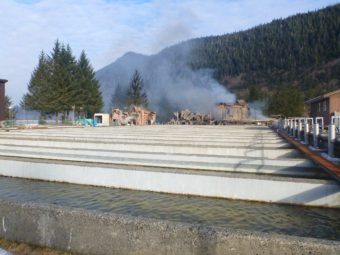
Petersburg residents have started a letter writing campaign to urge the state to reconstruct the Crystal Lake hatchery facilities destroyed by fire earlier this month.
Crystal Lake is a king and coho salmon facility about 18 miles south of Petersburg. Salmon fry from the hatchery are released near Petersburg and in remote sites closer to Wrangell and Ketchikan. Crystal Lake’s incubation room burnt down March 4th.
The hatchery buildings are owned by the state of Alaska and they’re operated by the Southern Southeast Regional Aquaculture Association. Sally Dwyer and husband Al, former mayor of Petersburg, hope to gather over a thousand letters from area residents to send to Fish and Game Commissioner Cora Campbell, who grew up here.
Collection boxes have been placed at the library, Wild Celery, Coastal Cold Storage, Petersburg Pilot, visitor information center and Lees Clothing. Dwyer says they’ll be collecting all the letters next Friday, March 28th to send to the capital city in a fish box.
To hear more about the campaign listen to the audio at KFSK.
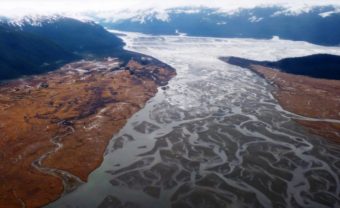
The Stikine River empties into the ocean near Wrangell. Mines and energy projects proposed for upstream sites in Canada are worrying some fishermen and tribal leaders. (Ed Schoenfeld/CoastAlaska News)
Southeast Alaska tribal leaders meet March 25th and 26th to discuss Canadian mines that could impact regional fisheries.
The Summit on Headwater Transboundary Development was called by the Organized Village of Kasaan, where Richard Peterson is tribal president.
“When you talk about the Stikine and the Unuk and some of these other rivers, and the impact on the Chinook and the ooligan (eulachon) and the other fish that go up these rivers, we want to make sure they have adequate plans in place that can promise minimal impact,” Peterson says.
The Stikine is east of Wrangell and Petersburg, while the Unuk is northeast of Ketchikan. The Taku, east of Juneau, is another transboundary river with a mine in its watershed.
Chris Zimmer of the group Rivers Without Borders Transboundary Watershed Alliance says the main focus is the KSM Project. It’s a proposed gold and copper mine across the border in British Columbia, roughly 80 miles east of Wrangell.
“Basically, you have what could be considered a time bomb up there of a massive acid-mine drainage factory that’s going to continue to leach acid-mine drainage pollution for hundreds of years. So the question is, can that be contained? Can these tailings dams last forever? Can we trust the mines to do the job right?”
Randy Wanamaker says we can.
“Modern mining is different from older mining, when people didn’t worry about the environmental consequences of things,” Wanamaker says.
Wanamaker is a former Juneau Assembly member who ran a business training tribal members for mining jobs. He’s also a director of Goldbelt, the capital city’s urban Native corporation, and he’s working with the Palmer mine prospect upriver from Haines.
“Canada has a good permitting process and environmental review process. It’s different from ours, but it’s no less stringent. They will take into consideration whatever it is we point out to them that would be an issue for us because the same fish that we’re protecting also migrate up into Canada,” he says.
Some tribal leaders are already working with developers of rare-earth, gold and silver mines on Prince of Wales Island.
Kasaan’s Peterson wants a similar relationship with Canadian companies.
“Whether we come out pro or con depends a lot on the engagement of the mines. We’ve had really successful open dialog with Heatherdale and Niblack and Ucore. They’ve been really great about being forthcoming and I actually really have a lot of praise for those groups.”
A representative of British Columbia’s KSM prospect will be at the Prince of Wales Island meeting. So will representatives of B.C. tribal groups, called First Nations.
The summit will take place at the Tribal House in Craig, the largest city on Prince of Wales Island.
Transboundary mine critics are also traveling to Washington, D.C., around the same time to lobby for federal involvement.
A group from Southeast will call for the State Department to increase Alaska’s voice in mine permitting and development.
“The scope here is massive. It’s across the entire transboundary (area). So you have tribes, fishermen and businesses almost from Yakutat to Haines and all the way down past Ketchikan concerned here,” Zimmer says.
Groups involved include the Alaska Trollers Association, Trout Unlimited, the Petersburg Vessel Owners Association, the Southeast Alaska Conservation Council, the Tlingit Haida Central Council and several tourism businesses.
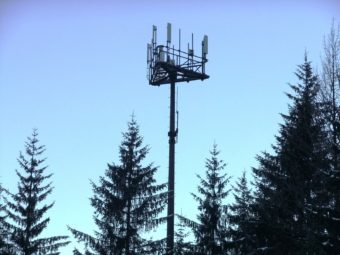
Wireless communication tower in the Mendenhall Valley. (Photo by Rosemarie Alexander/KTOO)
Only 12 Juneau residents showed up for the first neighborhood meeting Thursday night on the CBJ wireless tower master plan. Many of them have been intimately involved in the issue for years.
The city and borough’s Community Development Department has two months to finish the policies that will guide cell tower regulations. That’s when a moratorium on tower permits will expire.
After lots of citizen angst over towers in certain neighborhoods, city officials have said they want to hear from the public.
The process includes a survey that asks for the most to least-preferred tower design, including type of tower, co-location, camouflage and screening, lights, and other ways to harmonize towers within neighborhoods.
Take for example, co-location. City planner Eric Feldt says the city master plan and ordinance will encourage companies to locate their antennas on existing towers.
“So you could have AT&T, Verizon and ACS, instead of a tower for AT&T, a tower for Verizon and a tower for ACS in one location,” Feldt says.
Collocation does have some drawbacks, says Planning Manager Travis Goddard. It requires a certain distance between the antennas so towers are taller.
“Say a 140-foot tower could have an antenna array at 140 feet, 130 feet, 120 feet, 110 feet. So it depends on the type of antenna and the type of structure,” Goddard explains. “If it is the roof of a building, say the federal building, you could have two antennas right next to each other and they won’t change the height of the building.”
The tallest wireless tower in Juneau is 300 feet on North Douglas Highway.
Goddard says the surveys and comments from last night’s meeting will be synthesized and sent to the Planning Commission and Assembly, which will hold several work sessions and public hearings on the master plan and ordinance.
The Spuhn Island cell tower has a constant flashing red light at night and a white strobe during the day. (Photo courtesy Jon Lyman)
North Douglas resident Doug Mertz has been battling the 150-foot Spuhn Island cell tower for more than a year.
Like many residents who see the flashing lights every few seconds, 24-hours a day, Mertz feels they haven’t been heard. So he’s glad for the survey process, which he calls awkward, but necessary.
“Democracy is messy. The only thing I could ask for in the whole process that would be better is a more open attitude by the city manager’s office. So far, every time we’ve interacted with them on cell tower issues, we’ve gotten animosity and negativism,” he said.
But Mertz says CBJ Community Development is working hard to reconcile citizens’ various concerns on cell towers.
Patricia Wherry says she’s affected by any tower that goes up in Juneau, no matter where it’s located. She was disappointed so few people came to the meeting. She says she likes the process city planners are using for citizen input.
“I like that they’re trying to explain to us the specifics. They’re asking us for a gradated opinion. They’re here to answer questions. They’re doing a good job of that; they’re trying,” Wherry says.
CBJ community planners will hold another neighborhood meeting on March 27th at the University of Alaska Southeast. Later today (Friday), Goddard says, the survey will be on the city website.
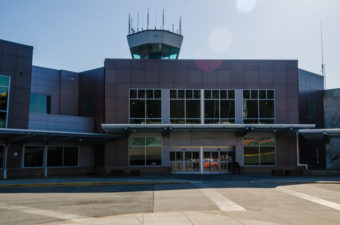
Juneau International Airport is getting a second X-ray machine for luggage to ease a backlog during peak travel times. (Photo by Heather Bryant/KTOO)
Juneau International Airport is getting a second X-ray machine to handle the piles of luggage that build up during the morning air traffic rush hour.
The Transportation Security Administration approved the new scanner after hearing from the Juneau Assembly, airport officials, Alaska Airlines and the state’s Congressional delegation.
Airport Manager Patty deLaBruere says in the past year Alaska Airlines and TSA employees have had trouble moving luggage through the scanner, even when it’s a normal amount.
“What was happening, especially if anyone had come in during those morning bank of flights, in the summer you’d see several hundred bags stacked out in the lobby and it was kind of a mess,” deLaBruere says.
Five early morning flights depart the Juneau airport every day during the summer months, with one leaving roughly every half hour between 7 and 8:30 a.m.
DeLaBruere says the baggage problem has caused delays and was still an issue over the winter, when there are fewer departures. With Delta Air Lines offering flights to and from Juneau this summer, she says it was only going to get worse.
In addition to a second X-ray machine, deLaBruere says TSA agreed to increase staffing at the airport.
“We’ve seen a decrease in the staffing over the last year,” she says. “We don’t have the numbers yet for the staffing, but we did get approval for the scanner and the staffing to go with it.”
TSA officials could not be reached for comment.
DeLaBruere’s not sure when the new scanner will arrive in Juneau. She says the machine will be located in the lobby, near the Alaska Airlines check-in counter.
Close
Update notification options
Subscribe to notifications
Subscribe
Get notifications about news related to the topics you care about. You can unsubscribe anytime.