Listen:
The National Science Foundation plans to yank a long-standing ocean observation station from the sea floor far off the coast of Alaska next year.
It’s one station in an entire ocean monitoring system slated to be dismantled as part of the Trump Administration’s rollback on federal science programs that help researchers study the changing climate.
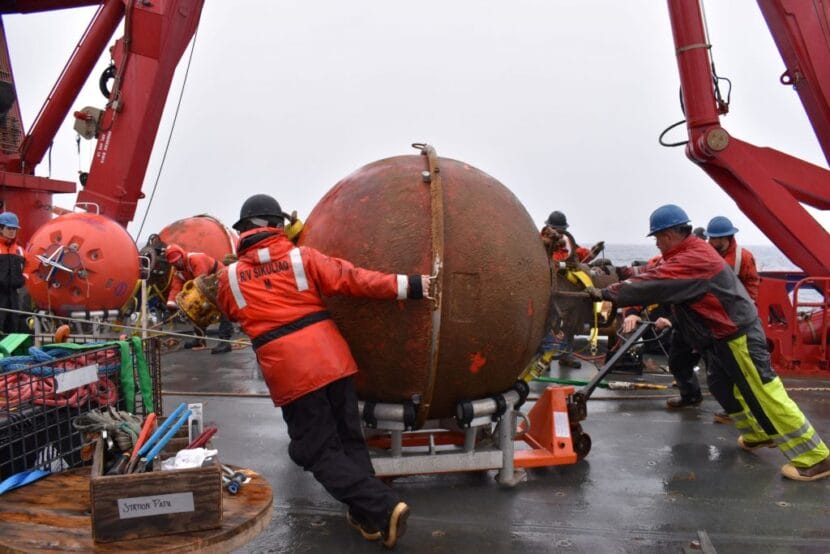
Ocean Station Papa is located more than 2.5 miles beneath the water’s surface in the Gulf of Alaska. It’s made up of three large, round moorings arranged in a triangle and equipped with sensors that collect ocean biogeochemical data.
Russ Hopcroft, chair of the oceanography department at the University of Alaska Fairbanks, said its removal could make it harder to study ocean warming events like a combined marine heatwave and El Niño that could ramp up in the Pacific this summer.
“It’s an unfortunate time to have something being pulled out of the water with all these predictions we’re hearing about this super El Niño coming, and this is, you know, one of the important sentinel sensors in that system,” Hopcroft said.
He said it’s a unique station. It began during the Cold War and has one of the longest-running data sets in the North Pacific. Papa is anchored to the ocean’s bottom in the middle of a rotating current system called the Alaska Gyre, which is a major driver of regional weather. The gyre also influences fisheries and ocean acidification, since it forces deep, nutrient and carbon-rich offshore waters to the surface in a process called upwelling.
“The advantage of having a mooring like that out there is you get all that high-resolution data, not just at the surface, but through the whole water column,” Hopcroft said.
Scientists have used data from Papa to help understand the effects of marine heatwaves like “the blob” from 2014 to 2016 that decimated some fish populations and killed sea birds and marine mammals across the Pacific.
Seth Danielson is an oceanography professor at the University of Alaska Fairbanks who studied the heatwave. He said he couldn’t have done that without measurements of deep ocean temperatures.
“We wouldn’t have been able to know how much heat actually was in the ocean during the time of the blob,” he said.
The University of Alaska operates other ocean floor stations closer to shore, but Danielson said none are as far out at sea as Papa. In addition to tracking ocean temperature, he said Papa tracks salinity, pressure, water chemistry and nutrient concentrations.
He said that’s important for fisheries managers who look at long-term ocean conditions when planning catch limits for fisheries in the Gulf of Alaska.
“Ocean Station Papa is just one of those key sites that has consistent data that stretches over many decades,” Danielson said.
Mike England, a spokesperson for the National Science Foundation, said in an email to KTOO that the federal government isn’t cancelling the Ocean Observatories Initiative, but scaling back the program is part of the foundation’s wider strategy of a “nimbler approach to prioritize support for evolving scientific priorities.”
It’s unclear how the initiative will operate once the foundation pulls all of its stations out of the ocean over the next couple of years.
A NOAA ocean climate station located on the water’s surface at the same site as Papa won’t be affected by the removal, according to NOAA Spokesperson Theo Stein.
Image from work supported by the National Science Foundation Ocean Observatories Initiative, a major facility fully funded by the NSF.